Magma
· updated · 8 min
Part of the series KGLW Lyric Prompts · 9 posts
Magma, fire bagwan
The all, the one and the none
Lifts rock, makes stuff
The sleeping hawk, the ticking clock
Hair of child, skin of bone
Gift of flesh exchanged for a burn
I'm a drill, I drown the earth
Tectonic romance, infinite rebirthMagma, essence oozing
Molten rock, moving fluorescence
Melting all within its presence
Forever creeping luminescence
Destroying to invent
Magma god ever present
I live in debt, I bathe in glow
Subterranean web, infest my soul
Flying arcs come bearing gifts
Praise the return of G.I. Joe
Brewing beneath, the magma shifts
Heavenly bird, luscious cargoDigging deep
Burying gifts for the molten god that sits
Beneath our feet, great abyss
Offerings burn in the pit
We console
Reminisce for the molten god that sits
He'll accept those that commit
If we dance in the shitMagma
Subterranean tsar
The scimitar and the neutron star
Makes from ether, basalt weaver
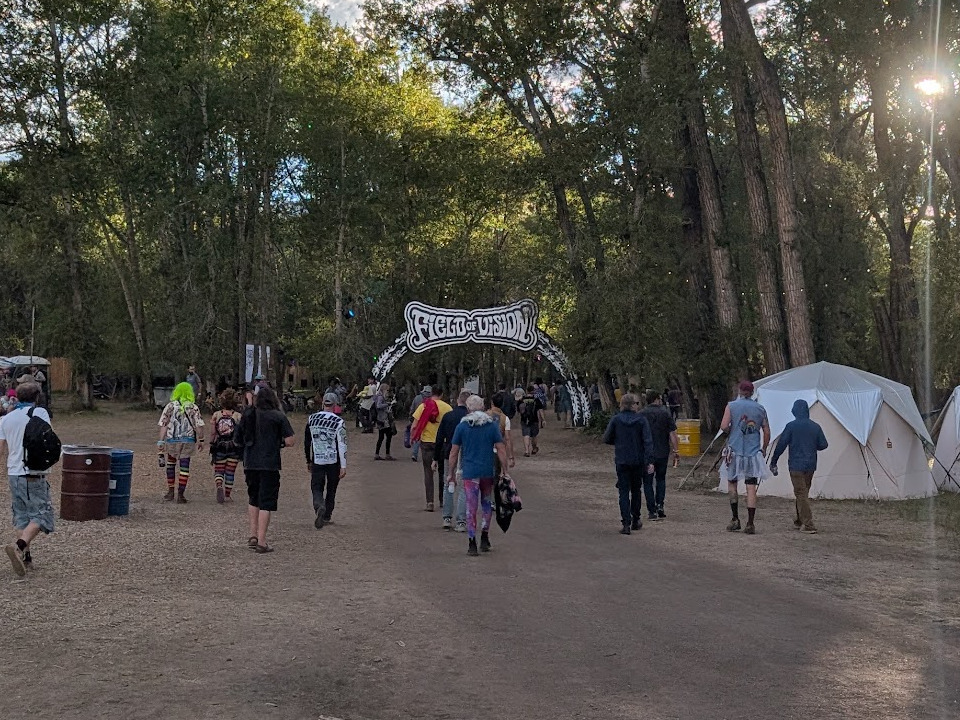
Obsidian cleaver, make believerKing Gizzard & the Lizard Wizard -- Magma (live at Field of Vision II '26)
New to King Gizzard?
If you've arrived here with no idea what a King Gizzard & the Lizard Wizard is, welcome. My simple three step program gets you up to speed in as little as a week or two, assuming you don't need much sleep:
- Watch the brief documentary: A Brief History of King Gizzard & the Lizard Wizard, by Bootleg Gila. Only 4.5 hours.
- Listen to all 29 albums, every studio album, in any order you like.
- Listen to the bootlegs: hundreds of hours of live shows on the band's bootleg Bandcamp.
Longer quote for this one. I think it's currently my favorite tune. Musically it's a song that can go full guitar, slide almost completely over to the Eurorack or become a hybrid, mutant variation featuring both. The first day FOV II version was a standout, pairing with its usual friend Smoke & Mirrors. They're a one two punch, and they were at that show. It's got a nice funky start to it building to waves of rhythm and power, making us believers in KGLW's song craft and performance, if no other conversions take place.
Lyrically it's playing with a lot of KGLW ideas. The fear and power of what lies below. The old gods. Destroying to invent.
I've touched on these as I've started to populate this site with some of my interests. The Solar Religion page and shelf carry some of it. Let's go a bit deeper. The song calls it he and tsar, but the magma god is no human figure. This is not an Abrahamic figure made in our image, who asks for certain kinds of attention in exchange for things that come after. The exchange here is more visceral and immediate. We need to dance in the shit. It's unclear exactly what's on offer, but it seems like power, rebirth, destroying to invent.
I don't mean to draw dividing lines or diminish this faith or that. I am of the Ram Dass school that there are many ways up the mountain, but the top looks the same. I do note the long history of the modern Abrahamic religions trying to remove any traces of the older nature based spirituality that preceded them though. That erasure is well documented, and it was thorough. Buddhism is slightly older, an offshoot of even older spiritual traditions in India, and it hybridized with region specific nature religions like Bön. It's seen today as a rational, wellness aligned spirituality. I see it as closer to that older nature based spirituality. I think Buddhism is fundamentally a worship of consciousness itself and its mystery. It gives you direct experience of a universal consciousness that is maybe what other spiritualities are pointing at with a monotheistic god.
But, I don't think we'll get anywhere with this kind of dry lyrical analysis. The oldest spiritual traditions tend towards ecstatic elements and the use of sacred plants as a means to establish a deeper connection to the mysteries woven into our natural world. Folktale and myth try to make sense of it in highly anthropomorphic ways. We relate to and understand things through our human lens as social animals, seeing ourselves as central to the world story. But these stories are oral and written traditions that likely served different purposes than worship: they reused familiar characters and old gods to help humans relate and be civic. Worship forms for these old gods were probably much different and closer to what we now call magic.
We now know that our planet has been made and remade over and over again. It is itself a living process even if you don't subscribe to a broader meaning posited in the Gaia hypothesis. The crust of the earth is changing shape and form continuously, much as some of the Aboriginal stories tell of Earth's landscapes formed by great gods and their actions across our earth. Massive tectonic plates shift, obeying the larger forces of magma flow, itself tuned to the eonic rhythm of sun and moon. This magma god beneath our feet is ever present. The earth is even alive in many senses. But our attention has shifted: these matters rise to our awareness only when a volcano, earthquake or other natural disaster disrupts our modern taming of all that is nature.
Deep Dive: Magma and the solar system
Earth's engine is its own. Heat left over from formation and heat from radioactive decay, roughly half each, keep the mantle churning, and sinking slabs do much of the pulling on the plates. The rest of the solar system doesn't run that engine. It helps set the timing, and at least once it may have rebuilt the machine.
Hours: the moon and sun. Both raise tides in solid rock as well as in the sea. At Axial Seamount, an undersea volcano off Oregon, earthquakes bunched up near low tide before its 2015 eruption, when the lighter load of water unclamped the faults. Only a weak signal remained afterward. Tides don't make the magma. They may help pick the moment.
Tens of thousands of years: sun, moon and planets. The sun and moon pull on Earth's equatorial bulge and swing its axis around about every 26,000 years. Jupiter and Venus stretch and relax the orbit, with one cycle lasting 405,000 years. Together these change how sunlight falls on Earth, and that paces the ice ages. When ice locks up water, sea level drops, the pressure on the mantle eases, and more melt forms at mid-ocean ridges. The seafloor seems to record it: abyssal hills carry the 23,000, 41,000 and 100,000 year rhythms. On land the load is the ice itself, and Iceland's volcanic output rose as its ice melted. This is active research, not settled science.
Always on: Io. Jupiter's moon Io is the extreme case. Its orbit is locked in a resonance with Europa and Ganymede: four laps for Io, two for Europa, one for Ganymede. That keeps the orbit stretched, so Jupiter's tides keep flexing Io and heating it. It's the most volcanic body in the solar system, and it has been active for billions of years. There, orbits and gravity really are the engine.
One time: lost planets and asteroids. The moon likely formed when a planet called Theia hit the young Earth. It's named for the Titan who bore the moon goddess, and Theia is the opening song on KGLW's The Silver Cord, the same album as Gilgamesh. The song is about this very impact:
Theia, a force of destiny
Fate intertwined with that of earth
A ticking clock of new reality
A spiritual rebirth
And when Theia it did impact
The silver cord did snap as well
Leaving the soul to sail on
A journey beyond which we dwellKing Gizzard & the Lizard Wizard -- Theia
A 2023 modeling study proposes that two huge dense masses at the base of the mantle, under Africa and the Pacific, are buried pieces of Theia. If so, they're still in the machine. The asteroid that hit at Chicxulub may have shaken magma loose too. One study reads a pulse of mid-ocean ridge volcanism in the seafloor within a million years of the impact, but the link to India's Deccan eruptions is disputed. I didn't find anything solid tying comets to magma. Whether they helped seed life is another question.
I think we will come to know some of the old gods again. We are maybe collectively summoning them to save us from ourselves. I visited LA several times this past winter and got a strong sense of how fragile the city is: the physical structures, the ownership, and the mental model. I don't mean this to sound dark or apocalyptic, just humble. We have forgotten that most of what we think we own is on loan. We imagine that we have built something lasting on top of nature, but have neglected what is below.
Magma god ever present
I live in debt, I bathe in glow