Idea
The Gaia Hypothesis
Does life keep Earth fit for life? Lovelock and Margulis said yes, critics said it can't evolve, and the argument is still going.


Overview
The Gaia hypothesis says that living things and their surroundings work together as one system that keeps Earth habitable. Air, oceans, rocks and life are linked by feedback loops, and those loops have held conditions such as temperature and the chemistry of the air within the range life can tolerate for billions of years. The chemist and inventor James Lovelock and the biologist Lynn Margulis set it out in a 1974 paper whose title gives the claim in a phrase: "atmospheric homeostasis by and for the biosphere."1 Homeostasis means keeping something steady, the way a body holds its temperature near 37°C.
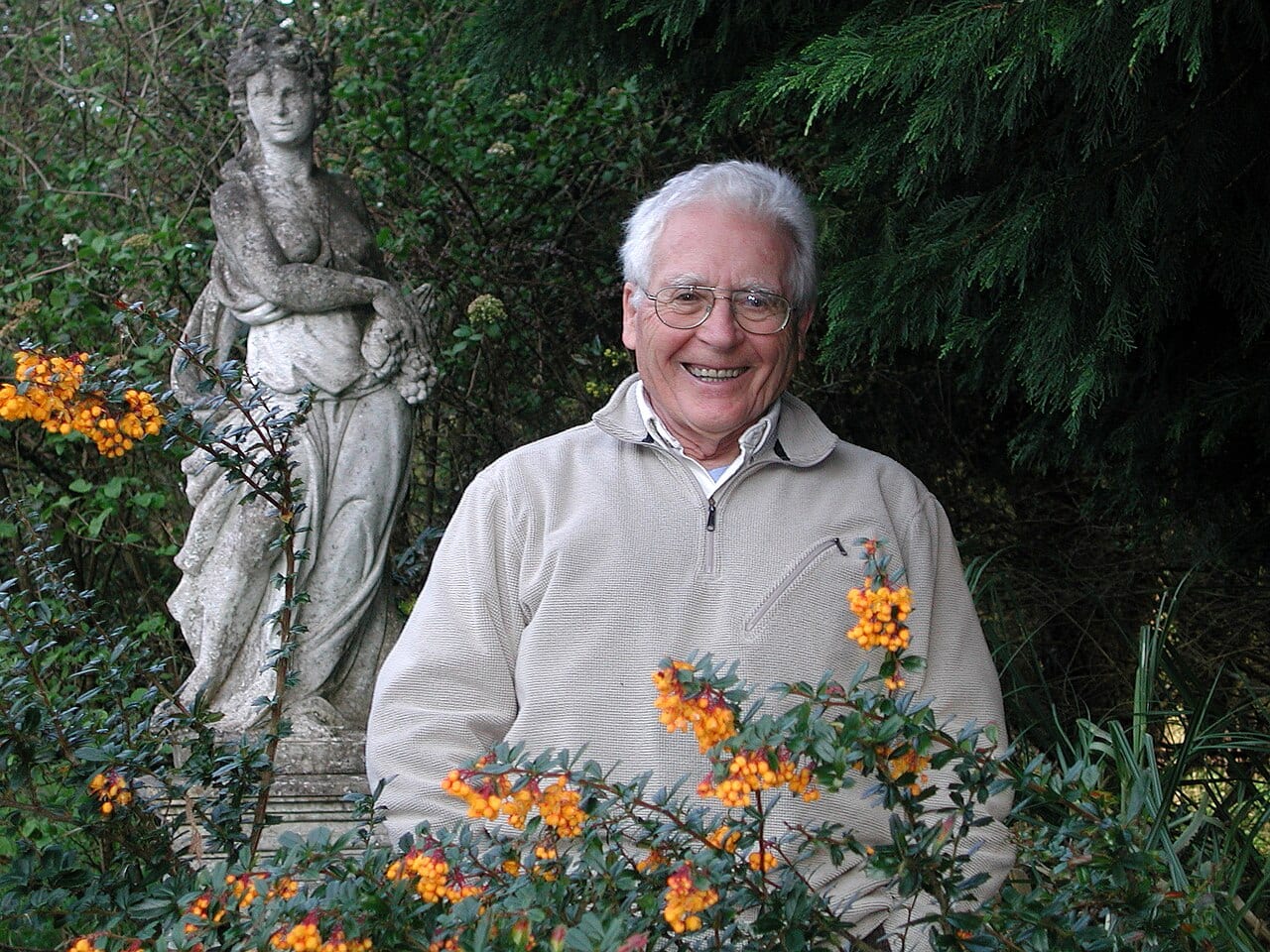
James Lovelock in 2005. Photo: Bruno Comby, CC BY-SA 1.0, via Wikimedia Commons.
The puzzle behind it is simple to state. The paper notes that the Sun has grown brighter since life began, by at least 30 percent on their figures, and the chemistry of the early Earth changed a great deal too. Yet the rock record shows liquid water the whole time. Either the planet happened to stay on a safe path by "blind chance," they wrote, or life "acquired control of the planetary environment" early on and has kept it ever since.1
The name was the novelist William Golding's idea. He and Lovelock were neighbors, and in the late 1960s he suggested naming the idea after Gaia, the Greek goddess of the Earth.23 The name helped the idea spread far beyond science. It also made many scientists suspicious, because it sounded like a claim that the Earth is alive or has goals.
That gap between a careful version and a grand one runs through the whole story. In 1989 the hydrologist James Kirchner sorted the claims into a range. At the weak end, life has a large effect on the environment and the two evolve together, which almost every Earth scientist accepts. At the strong end, the biosphere acts like one giant organism, or life adjusts the planet to suit itself, which Kirchner called unfalsifiable: no observation could prove it wrong. In the middle sits "Homeostatic Gaia," the claim that life's feedbacks mostly stabilize the planet. That middle claim is testable, and it is where most of the real argument has happened.4
In context
Lovelock came to Gaia from the search for life on Mars. In the 1960s he worked on NASA's Moon and Mars programs at the Jet Propulsion Laboratory.5 His 1965 paper in Nature argued that a good life-detection experiment needs a physical definition of life and an account of a planet's whole environment, including its atmosphere.6 The logic was that life uses the air as a source of raw materials and a dump for waste, so a living planet's atmosphere should be far from chemical balance. The 1974 paper makes the point with Earth. Oxygen and methane react with each other, so their steady coexistence in our air breaks the rules of equilibrium chemistry by "no less than 30 orders of magnitude." Mars and Venus, by contrast, have air close to equilibrium.1
Margulis brought biology, especially microbes. She is best known for showing that mitochondria and chloroplasts, the energy-making parts of complex cells, began as bacteria that came to live inside other cells. Her first paper on that idea was rejected many times before a journal printed it in 1967.7 She and Lovelock began working together in 1972 and wrote to each other for decades. Their surviving letters number 287 items from 1970 to 2007.8 Her view of Gaia was more modest than his popular writing. In her 1998 book Symbiotic Planet she wrote that "Gaia is not an organism" and described it as an emergent property of organisms, the planet and the Sun interacting.9 The book's publisher sums up her view as "symbiosis as seen from space."10
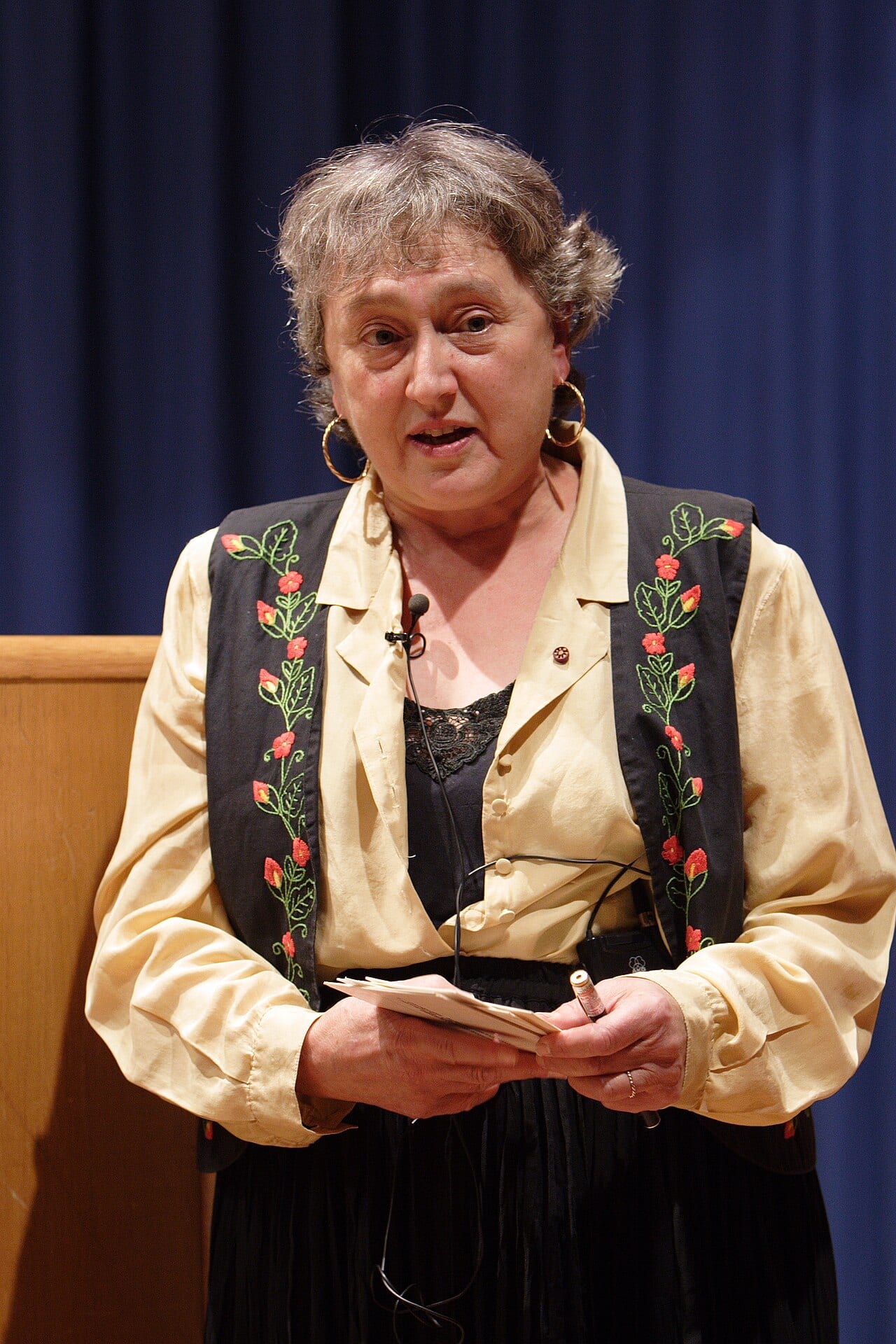
Lynn Margulis lecturing in A Coruña, Spain, in 2005. Photo: Javier Pedreira, CC BY 2.0, via Wikimedia Commons.
Gaia sits among several other answers to the same question: why has Earth stayed habitable?
- Coevolution. Life and the environment shape each other, with no built-in tendency to stability. This is the view Kirchner and the oceanographer Toby Tyrrell defend.411
- Luck. Earth may have been fortunate. A 2020 study by Tyrrell simulated 100,000 random planets, and fewer than one in ten stayed habitable for three billion years even once.12
- The Medea hypothesis. The paleontologist Peter Ward argued in 2009 that life tends to harm its own conditions, and that most mass extinctions were caused by life itself.13
- Earth system science. The field that grew partly out of the Gaia debate. In 2001 four large international research programs declared that "the Earth System behaves as a single, self-regulating system comprised of physical, chemical, biological and human components."14
That last line shows how far the moderate idea has traveled. The word Gaia is absent, but the picture of a coupled, self-regulating Earth is now ordinary science.
- 1965 Life detection Lovelock proposes reading a planet's air for signs of life.
- 1974 The Gaia paper Lovelock and Margulis publish the hypothesis in *Tellus*.
- 1983 Daisyworld Watson and Lovelock model a planet that regulates itself without foresight.
- 1988 First Chapman conference Scientists meet in San Diego to test the idea; Kirchner sorts it into versions.
- 2001 Amsterdam Declaration Earth system science calls Earth "a single, self-regulating system."
- 2013 On Gaia Toby Tyrrell's book-length test finds the evidence weak.
- 2018 Gaia 2.0 Lenton and Latour ask whether humans can add awareness to Earth's self-regulation.
The original books, and later ones that build on them, are in the Library.
Research
The claim
The 1974 paper makes three moves. First, it points to the strange chemistry of Earth's air, a mixture that "tends towards a combustible mixture," while the air of Mars and Venus looks more like the products of combustion. Second, it points to stability: liquid water and near-neutral oceans for over three billion years, while the Sun brightened. Third, it offers an explanation: "the total ensemble of living organisms which constitute the biosphere can act as a single entity to regulate chemical composition, surface pH and possibly also climate."1
The second point is now known as the faint young Sun problem. Astronomers agree that the early Sun was dimmer, by about 30 percent, and that early Earth was still not frozen. Most proposed solutions involve more greenhouse gas or a darker surface, and the problem is not fully solved.15 Gaia offers one answer, and it is not the only one.
The paper's wording also gave critics their target. It says the atmosphere "appears to be a contrivance specifically constituted for a set of purposes," and calls the biosphere "an active adaptive control system."1 Words like purposes and control suggest planning. Teleology, the idea that things happen for a goal, has no place in Darwinian biology, so these phrases drew fire for decades.
The biologists' objection came fast, and Daisyworld was the reply.
Daisyworld and the Darwinian objection
The core objection is about evolution. Natural selection favors genes that help their carriers leave more offspring. A microbe that pays a cost to cool the planet helps every other microbe too, including rivals that pay nothing. So why would planet-wide regulation evolve? Doolittle summarized the view of most Darwinians in a 2025 paper: Gaia has "too many parents" and does not reproduce, so it cannot undergo natural selection in the usual sense.16
Lovelock and the scientist Andrew Watson answered in 1983 with a thought experiment in equations, Daisyworld. It is an imaginary planet with no clouds and two kinds of daisy. Dark daisies absorb more sunlight and warm their surroundings. Light daisies reflect it and cool them. Both grow best at the same temperature. As the model's sun brightens, dark daisies thrive at first and warm the planet, then light daisies take over and cool it. The authors were explicit: "we are not trying to model the Earth," only a fictional world that shows one property.17
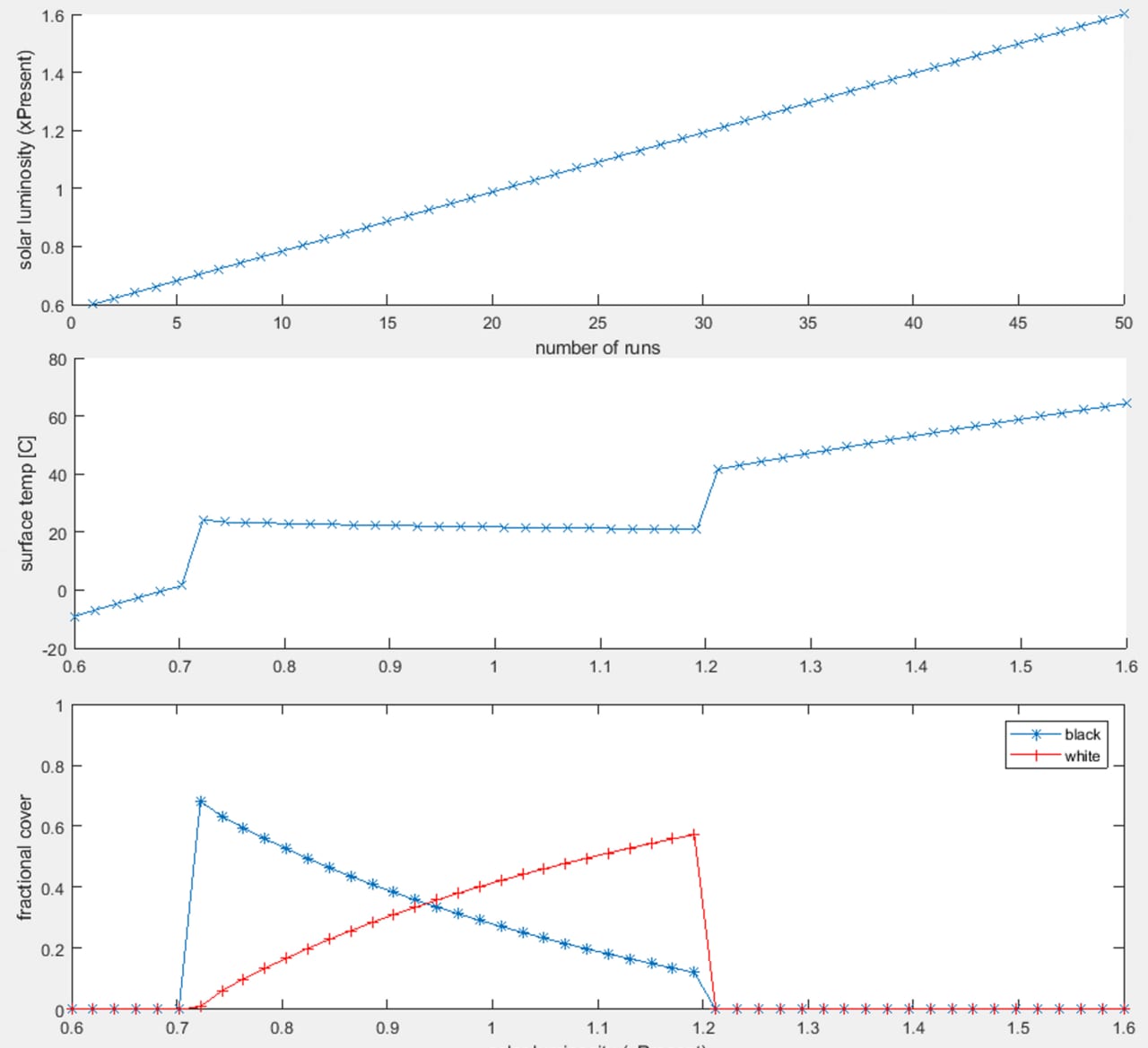
A Daisyworld-style model run. Top: the sun's brightness rises steadily. Middle: the planet's surface temperature. Bottom: how much ground the black and white daisies cover. Chart: TDMBethel, CC BY-SA 4.0, via Wikimedia Commons.
- Temperature holds near 22°C while daisies grow
- Black daisies dominate under a faint sun
- White daisies take over as the sun brightens
The result was that temperature stays nearly flat across a wide range of solar brightness, then collapses when the daisies can no longer cope. Watson and Lovelock traced this to the peaked shape of the growth curve, and said it did not depend on the details of how the daisies change temperature.17 Each daisy simply grows where it grows best. No daisy plans anything, which was the point.
Critics were not fully persuaded. Kirchner argued that Daisyworld works because it assumes that any trait that improves the environment also helps the organism that carries it. In the real world, selection favors whatever gives its carriers an advantage, whether it improves the environment or degrades it. So Gaian feedbacks can evolve, and so can anti-Gaian ones.4
Deep Dive: How Daisyworld works, step by step
Daisyworld has one variable that matters to life: temperature. The daisies grow fastest at about 22.5°C and do not grow at all below 5°C or above 40°C. This is the peaked growth curve.17
Start with a dim sun. The bare ground is too cold for anything. As the sun brightens a little, patches of ground reach 5°C and daisies start to grow. Dark daisies absorb more sunlight than bare ground, so the ground around them is warmer than average, and they grow better than light daisies. As they spread, they darken the whole planet, which absorbs more sunlight and warms further. This is a positive feedback, a loop that pushes in the same direction, and it lifts the planet into the daisies' comfortable range quickly.
As the sun keeps brightening, the planet risks getting too hot. Now the light daisies have the edge, because they keep their patches cooler. They spread, the planet reflects more sunlight, and the temperature stays near the daisies' preferred value. This is a negative feedback, a loop that pushes back against a change. Watson and Lovelock found that over part of the range, the planet's temperature even fell slightly as the sun grew brighter.17
Eventually the sun is too bright even for a planet covered in light daisies. The daisies die back, the planet darkens, and the temperature jumps up. Life's control fails suddenly, not gradually.
The paper also tested a version where clouds formed over dark daisies and made them cool the planet instead. The feedbacks reversed, the less suited species lost out, and the model was still more stable with daisies than without them.17 That robustness is what made Daisyworld persuasive to some readers.
The objections are about what is left out. There is no daisy that gains a private advantage by doing nothing for the planet, sometimes called a "cheater." Kirchner's point is that the model builds in the link between helping yourself and helping the planet.4 Later researchers stopped asking whether planet-scale selection exists and asked whether stability could arise some other way. That is where the 2018 idea of sequential selection comes in, under The 2010s and 2020s below.18
The evidence tested
The best-known test came from the ocean. In 1987 Robert Charlson, Lovelock, Meinrat Andreae and Stephen Warren proposed that plankton help control the climate. Many marine algae release dimethyl sulfide, DMS, a gas that turns into tiny sulfate particles in the air. Those particles seed clouds, and more clouds reflect more sunlight. If warmer seas meant more DMS, the loop would cool the planet. The idea became known as the CLAW hypothesis, after the authors' initials.19
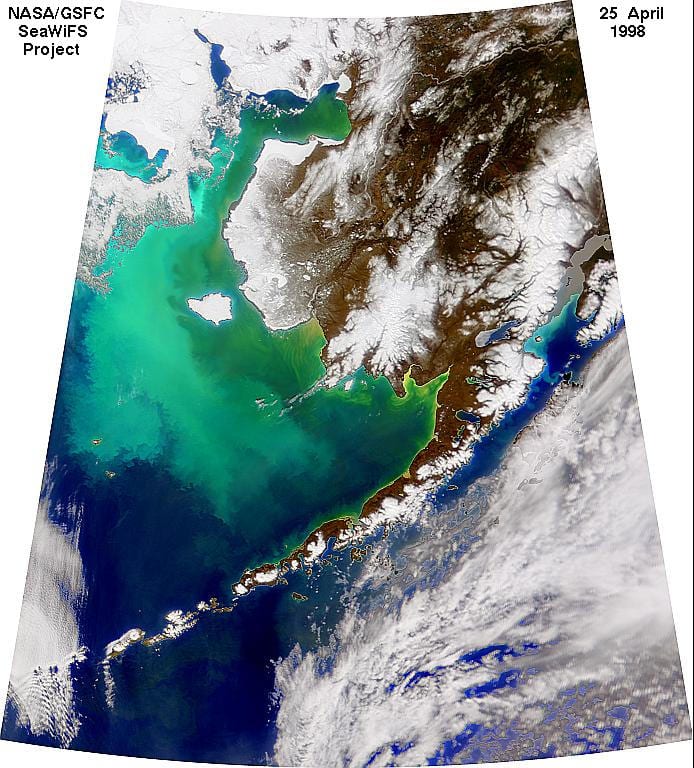
A bloom of coccolithophores, plankton that produce DMS, turns the Bering Sea milky blue, 25 April 1998. Image: SeaWiFS Project, NASA Goddard Space Flight Center and ORBIMAGE, public domain, via Wikimedia Commons.
It inspired two decades of work, and it did not hold up. Ice cores from Antarctica showed that during cold glacial periods there was more of the sulfur compounds linked to DMS, not less. If plankton were a thermostat, Kirchner wrote, it was "hooked up backwards."4 In 2011 Patricia Quinn and Timothy Bates of NOAA reviewed the observations and concluded that biological control of cloud seeds through DMS probably does not exist. They called for the CLAW hypothesis to be retired.20 Kirchner's own verdict was that Gaia can motivate important research "even if, as in this case, the hypothesis itself turns out to be incorrect."4
Kirchner went further in 2003. He listed tests where Gaia predicts one thing and the data show another.21
- Carbon uptake. Since pre-industrial times carbon dioxide in the air has risen by about 35 percent, but uptake of carbon into living things has sped up by only about 2 percent.
- Biology no better than chemistry. Land plants, which are alive, absorb extra carbon dioxide about as weakly as the oceans do through mostly non-living chemistry.
- Amplifying feedbacks. Carbon dioxide, methane and DMS, all made by life, make the planet warmer when it is warm and colder when it is cold in the Vostok ice core.
- Deep time. Peaks in temperature line up with peaks in carbon dioxide back to the Permian, about 300 million years. If life runs a thermostat, it has been wired backwards that whole time.
- Two principles in tension. Organisms that improve their surroundings for themselves create positive feedback, which destabilizes. So the claim that life stabilizes the environment and the claim that life improves it for itself pull against each other.
Kirchner was not dismissive. He wrote that he agreed with Gaia's central theme that no view of Earth can be right without life's pervasive influence, and that coupled systems can regulate themselves. His challenge was to the generalization. Earth's climate, he suggested, may have stayed fairly stable "in spite of biologically mediated feedbacks rather than because of them."21
Toby Tyrrell's 2013 book On Gaia is the longest test. He examined the hypothesis's main claims, accepted the weak coevolutionary forms, and rejected the stronger ones. His conclusion: "I believe Gaia is a dead end. Its study has, however, generated many new and thought provoking questions."11 His 2020 simulation added a twist. Among thousands of random planets with random climate shocks, staying habitable was rare, and most that managed it did so in fewer than ten of every hundred runs. "Earth stayed suitable for life for so long due, at least in part, to luck," he said.12
Peter Ward turned Gaia upside down.
The 2010s and 2020s
The newer work accepts the Darwinian objection and looks for another route to stability. In 2018 Tim Lenton and colleagues proposed "sequential selection." When life destabilizes its environment, that state tends to be short-lived and leads to further change. When a stable arrangement turns up, it tends to persist. Over billions of years, Earth would collect stabilizing feedbacks the way a sieve collects stones, with no planning and no planet-level reproduction. They add a second process, "selection by survival alone": systems that last longer have more time to pick up further features that help them last.18 Lenton said that "evolution via natural selection cannot explain how the whole planet came to have stabilizing properties," and that these simpler mechanisms working together can.18
Doolittle, the early critic, has moved toward the idea. In his 2024 book Darwinizing Gaia and a 2025 summary, he argues that if selection theory counts differential persistence (some things simply lasting longer than others) and not only differential reproduction, Gaia makes Darwinian sense. His version is called "It's the song not the singer": the recycling processes, like a song, persist and are selected, even while the species performing them, the singers, change.1622
Lenton and the sociologist Bruno Latour pushed the idea somewhere new. Their 2018 essay in Science, "Gaia 2.0," starts from the standard modern position: Gaia "has operated without foresight or planning on the part of organisms." Humans change that, because we can see the global effects of what we do. Choosing deliberately to live within Earth's limits would be, in their words, "a fundamental new state of Gaia." They admit that "at first sight" the potential for a successful Gaia 2.0 "does not seem promising," and they judge that Gaia's control of climate is "probably fairly crude" compared with its recycling of nutrients.23
Deep Dive: Darwinizing Gaia: the three routes
The modern debate turns on one question: what would it take for natural selection to build a planet-scale regulator? Three answers are now on the table.
The first is sequential selection. Lenton and colleagues start from the point that natural selection does explain regulation at small scales. Microbes recycling nutrients in a patch of soil, or an ecosystem holding its own conditions steady, are well within ordinary evolution, because the organisms that do the work live with the results. At the global scale that link breaks. A gas released in one ocean affects the climate everywhere, decades later. So the authors stop looking for selection on Gaia and look for a filter. Unstable states destroy themselves and give way to new ones. Stable states last. Run the process long enough and what remains is stable, simply because that is what lasts.18 Tyrrell's 2020 simulation fits alongside this, as a reminder that the filter does not guarantee success. Many planets in his model failed.12
The second is persistence as a kind of fitness. Classic selection theory needs things that reproduce, vary and pass on their traits. Doolittle points out that Gaia does not reproduce, so it fails that recipe. His proposal is to widen the recipe so that differential persistence counts as well as differential reproduction. Once that change is made, he argues, Gaia and smaller multispecies communities become possible units of selection.16
The third is to change what is selected. In "It's the song not the singer," the units are the processes themselves: nitrogen fixation, photosynthesis, the recycling of a nutrient. The species carrying out a process can come and go. Lenton and Latour make a related point: in Earth's microbial networks, functional roles have been kept even when the species filling them were replaced.2316
None of these routes is settled, and each is a reframing more than a discovery. They do not overturn Kirchner's or Tyrrell's evidence that many real feedbacks amplify change. What they do is answer the old objection that Gaia was impossible in principle. The empirical question, how much of Earth's stability is down to life and how much to geology and luck, is still open.
Gaia beyond science
Lovelock's own later books moved toward alarm. In The Revenge of Gaia (2006) he suggested that civilization might collapse, and spoke of the last breeding pairs of humans surviving in the Arctic. A review on RealClimate, a site run by climate scientists, said no one had proposed "a specific, quantitative scenario" for such a collapse.24 In 2012 Lovelock told msnbc.com he had been "alarmist" and had extrapolated too far. "The problem is we don't know what the climate is doing," he said, while adding: "I'm not a denier."25 He died on his 103rd birthday, 26 July 2022, at his home in south-west England.5
The name had already escaped into philosophy and culture. Latour's lecture series Facing Gaia, published in French in 2015 and in English in 2017, uses Gaia as a secular figure for a world where people can no longer treat nature as a passive backdrop.26
It even turned up in Australian heavy metal.
Where it stands
Three versions need to be kept apart. The weak version, that life strongly shapes the planet and the two evolve together, is standard science and the basis of Earth system science.414 The strong version, that Earth is an organism or that life adjusts the planet for its own benefit, has few defenders, and the idea that the biosphere acts with purpose was dropped long ago, even by Gaia's supporters.423
The middle version is the real question. Do life's feedbacks, on balance, make Earth more stable? The specific tests have mostly gone against it: the plankton thermostat failed, and many biological feedbacks amplify warming.2120 On the other side, Earth has stayed habitable for an extraordinarily long time, and newer theories explain how stabilizing feedbacks might pile up without anyone planning them.18 Lovelock's own collaborators now describe climate control as crude.23
A fair reading is that Gaia was wrong in many details and useful as a guide to research. It made scientists study the whole Earth as one system, which is now how the planet is studied.1421 Whether life deserves credit for Earth's long run of good conditions, or just shared in a lucky streak, is still open.
Footnotes
-
J. E. Lovelock and L. Margulis, "Atmospheric homeostasis by and for the biosphere: the Gaia hypothesis," Tellus 26(1-2), 1974, 2-10, doi 10.3402/tellusa.v26i1-2.9731 (abstract and opening sections read on Lovelock's website). jameslovelock.org ↩ ↩2 ↩3 ↩4 ↩5
-
"Lovelock, James," The Encyclopedia of Science Fiction, entry updated 12 September 2022 (Golding's suggestion "in the late 1960s"; book dates). sf-encyclopedia.com ↩
-
Wikipedia, "Gaia hypothesis" (secondary source for Golding as neighbor, the 1981 Doolittle and 1982 Dawkins critiques, the 1988 and 2000 Chapman conferences; the critiques themselves not read). en.wikipedia.org ↩ ↩2
-
James W. Kirchner, "The Gaia Hypothesis: Fact, Theory, and Wishful Thinking," Climatic Change 52, 2002, 391-408 (author's reprint; read in full). seismo.berkeley.edu ↩ ↩2 ↩3 ↩4 ↩5 ↩6 ↩7 ↩8
-
The Associated Press, "James Lovelock, creator of Gaia ecology theory, dies at 103," 27 July 2022. ktiv.com ↩ ↩2
-
J. E. Lovelock, "A Physical Basis for Life Detection Experiments," Nature 207, 1965, 568-570, doi 10.1038/207568a0 (abstract only). link.springer.com ↩
-
Wikipedia, "Lynn Margulis" (secondary source for the endosymbiosis work and the 1967 paper's many rejections; not read in full). en.wikipedia.org ↩
-
Bruce Clarke and Sébastien Dutreuil, "The Scientific Collaboration that Brought Gaia to the World," Fifteen Eighty Four (Cambridge University Press blog), 1 September 2022, on their edited volume Writing Gaia: The Scientific Correspondence of James Lovelock and Lynn Margulis. cambridgeblog.org ↩
-
Lynn Margulis, Symbiotic Planet: A New Look at Evolution, Basic Books, 1998, p. 119, as quoted in "Margulis, Autopoiesis, Gaia," Electronic Book Review (the book itself not read). electronicbookreview.com ↩
-
Hachette Book Group, publisher's description of Lynn Margulis, Symbiotic Planet. hachettebookgroup.com ↩
-
Toby Tyrrell, On Gaia: A Critical Investigation of the Relationship between Life and Earth, Princeton University Press, 2013; conclusions and the "dead end" quote via Wikipedia's article on the book (the book not read). en.wikipedia.org ↩ ↩2
-
University of Southampton, "Chance played a major role in keeping Earth fit for life," 14 December 2020, on T. Tyrrell, Communications Earth & Environment, 2020 (press release; the paper not read). southampton.ac.uk ↩ ↩2 ↩3
-
Peter Ward, The Medea Hypothesis: Is Life on Earth Ultimately Self-Destructive?, Princeton University Press, 2009; summarized from Wikipedia, "Medea hypothesis," and publisher and review descriptions (the book not read). en.wikipedia.org ↩ ↩2
-
IGBP, IHDP, WCRP and DIVERSITAS, "Amsterdam Declaration on Global Change," Global Change Open Science Conference, Amsterdam, July 2001 (wording confirmed through a search of the scanned text). monoskop.org ↩ ↩2 ↩3
-
Colin Goldblatt and Kevin J. Zahnle, "Faint young Sun paradox remains," arXiv 1105.5425, 2011 (summary only). arxiv.org ↩
-
W. Ford Doolittle, "Darwinizing Gaia: conceptual approaches," Philosophical Transactions of the Royal Society B 380(1931), 2025, 20240089, doi 10.1098/rstb.2024.0089 (abstract and first sections read). pmc.ncbi.nlm.nih.gov ↩ ↩2 ↩3 ↩4 ↩5
-
Andrew J. Watson and James E. Lovelock, "Biological homeostasis of the global environment: the parable of Daisyworld," Tellus 35B, 1983, 284-289 (read in a scanned copy). jameslovelock.org ↩ ↩2 ↩3 ↩4 ↩5
-
Timothy M. Lenton et al., "Selection for Gaia across multiple scales," Trends in Ecology & Evolution, 2 July 2018, doi 10.1016/j.tree.2018.05.006 (abstract only); and University of Exeter, "Scientists propose solution to 'Gaia puzzle'," 2018 (Lenton quotes). news-archive.exeter.ac.uk ↩ ↩2 ↩3 ↩4 ↩5
-
R. J. Charlson, J. E. Lovelock, M. O. Andreae and S. G. Warren, "Oceanic phytoplankton, atmospheric sulphur, cloud albedo and climate," Nature 326, 1987, 655-661, doi 10.1038/326655a0 (abstract only). jameslovelock.org ↩
-
P. K. Quinn and T. S. Bates, "The case against climate regulation via oceanic phytoplankton sulphur emissions," Nature 480, 2011, 51-56, doi 10.1038/nature10580 (abstract and NOAA summary only). pmel.noaa.gov ↩ ↩2
-
James W. Kirchner, "The Gaia Hypothesis: Conjectures and Refutations," Climatic Change 58, 2003, 21-45 (abstract and first sections read). courses.seas.harvard.edu ↩ ↩2 ↩3 ↩4
-
W. Ford Doolittle, Darwinizing Gaia: Natural Selection and Multispecies Community Evolution, MIT Press, 2024 (publisher's description only). mitpressbookstore.mit.edu ↩
-
Timothy M. Lenton and Bruno Latour, "Gaia 2.0," Science 361(6407), 14 September 2018, 1066-1068, doi 10.1126/science.aau0427 (read in full). gsd.harvard.edu ↩ ↩2 ↩3 ↩4
-
"James Lovelock's gloomy vision," RealClimate, 13 February 2006 (review of The Revenge of Gaia). realclimate.org ↩
-
Ian Johnston, "'Gaia' scientist James Lovelock: I was 'alarmist' about climate change," msnbc.com, 23 April 2012 (quotes via search summaries of the article). nbcnews.com ↩
-
Kathrin Bartha, review of Bruno Latour, Facing Gaia: Eight Lectures on the New Climatic Regime (Polity, 2017), Australian Book Review, December 2017 (search summary; the book not read). australianbookreview.com.au ↩
-
Wikipedia, "Omnium Gatherum (album)" (release date, track 4, single release, genre). en.wikipedia.org ↩
-
King Gizzard & the Lizard Wizard, "Gaia," lyrics on the band's Bandcamp page. kinggizzard.bandcamp.com ↩
-
Simon Workman, "King Gizzard & The Lizard Wizard: Omnium Gatherum [Album Review]," The Fire Note, 22 April 2022. thefirenote.com ↩