Idea
The Stoned Ape Hypothesis
Did magic mushrooms help build the human mind? A famous, mostly unproven idea, and the careful versions scientists now discuss.


Overview
The stoned ape hypothesis says that psilocybin mushrooms helped push our ancestors toward language, imagination and religion. It comes from the writer and ethnobotanist Terence McKenna, who laid it out in his 1992 book Food of the Gods. In McKenna's telling, early humans in Africa followed cattle herds, ate Psilocybe cubensis mushrooms that grew in the dung, and were changed by them. He gave the date as about 100,000 years ago and called the mushroom an "evolutionary catalyst."1
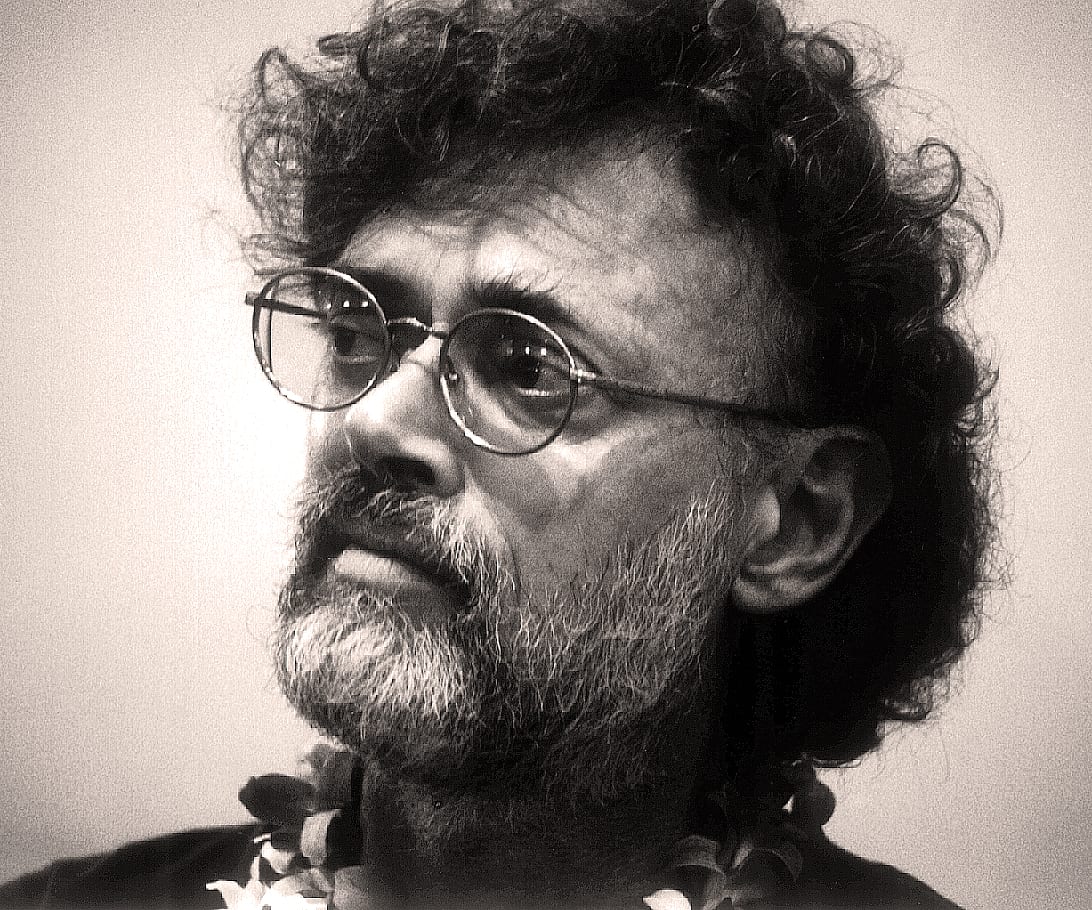
Terence McKenna at the AllChemical Arts Conference, Kona, Hawaii, 1999. Photo: Jon Hanna, CC BY-SA 3.0, via Wikimedia Commons.
The idea has three steps, one for each dose. A small dose, McKenna argued, sharpened vision, which helped with hunting. A bigger dose raised arousal and energy, which helped reproduction. A large dose dissolved the ego, stirred up visions and may have switched on language-related parts of the brain.1 Each step is a claim about biology, so each one can be checked, and most of them are hard to check.
Mainstream scientists have mostly ignored the hypothesis or called it too speculative, and there is no direct evidence that early humans ate psilocybin mushrooms.12 But it has not gone away. Since 2017 a few researchers have returned to a smaller question: could psychedelic substances have been one factor, among many, in how human societies bonded and thought?34 This page tries to keep the big claim and the small one apart.
In context
Human brains got big. The Smithsonian's Human Origins program reports an average chimpanzee brain of 384 grams against 1,352 grams for modern humans, with the fastest growth between about 800,000 and 200,000 years ago.5 Nobody doubts the growth. The argument is about the cause, and there are several leading explanations, none of which involve drugs.
- Cooking. Richard Wrangham proposed that cooked food is easier to digest and gives more energy, which could have paid for an expensive brain. He suggested this began before 1.8 million years ago, though others say controlled fire is at most 500,000 years old.6
- Expensive tissue. Leslie Aiello and Peter Wheeler argued in 1995 that brains are costly, about 22 times more energy per unit than muscle, and that a better diet let guts shrink to compensate.7
- Social brain. Robin Dunbar's work links brain size to the demands of living in large, complex groups.8
- Unstable environments. The Smithsonian also notes that big brains may have helped in a world of swinging climates and unfamiliar habitats.5
The stoned ape idea sits beside these as an outsider. It is not about energy or group size. It is about altered states, and it is the only one that makes a claim you cannot test with a fossil.
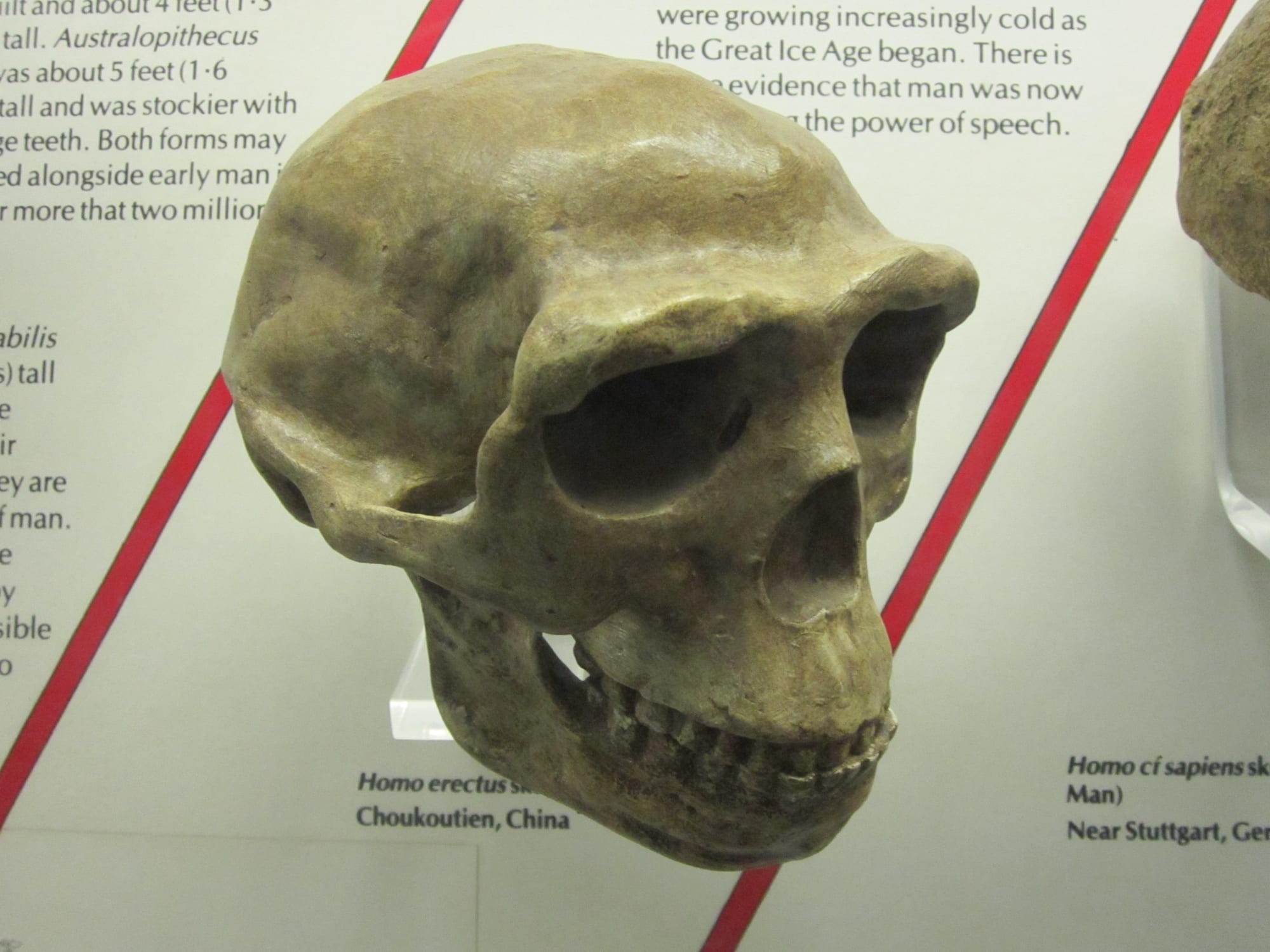
A cast of a Homo erectus skull from Zhoukoudian, China, at World Museum Liverpool. Photo: Rept0n1x, CC BY-SA 3.0, via Wikimedia Commons.
- 1970 Fischer's experiments A study of how psilocybin changes the sense of nearby space.
- 1992 Food of the Gods Terence McKenna sets out the hypothesis in book form.
- 2017 Stamets revives it Paul Stamets calls for bringing it back, at a conference.
- 2021 A careful revival Rodríguez Arce and Winkelman: psychedelics as one factor in human sociality.
- 2026 A new relative A southern African Psilocybe shifts ideas about where P. cubensis came from.
The original argument, and the books around it, are in the Library.
Research
The claim in three stages
McKenna's story starts with a changing Africa. As the climate dried, he said, forests shrank and our ancestors moved into open country, where they followed grazing animals. Psilocybe cubensis grows from the dung of large grazers, so the apes ran into it.1 The effect then depends on how much they ate.
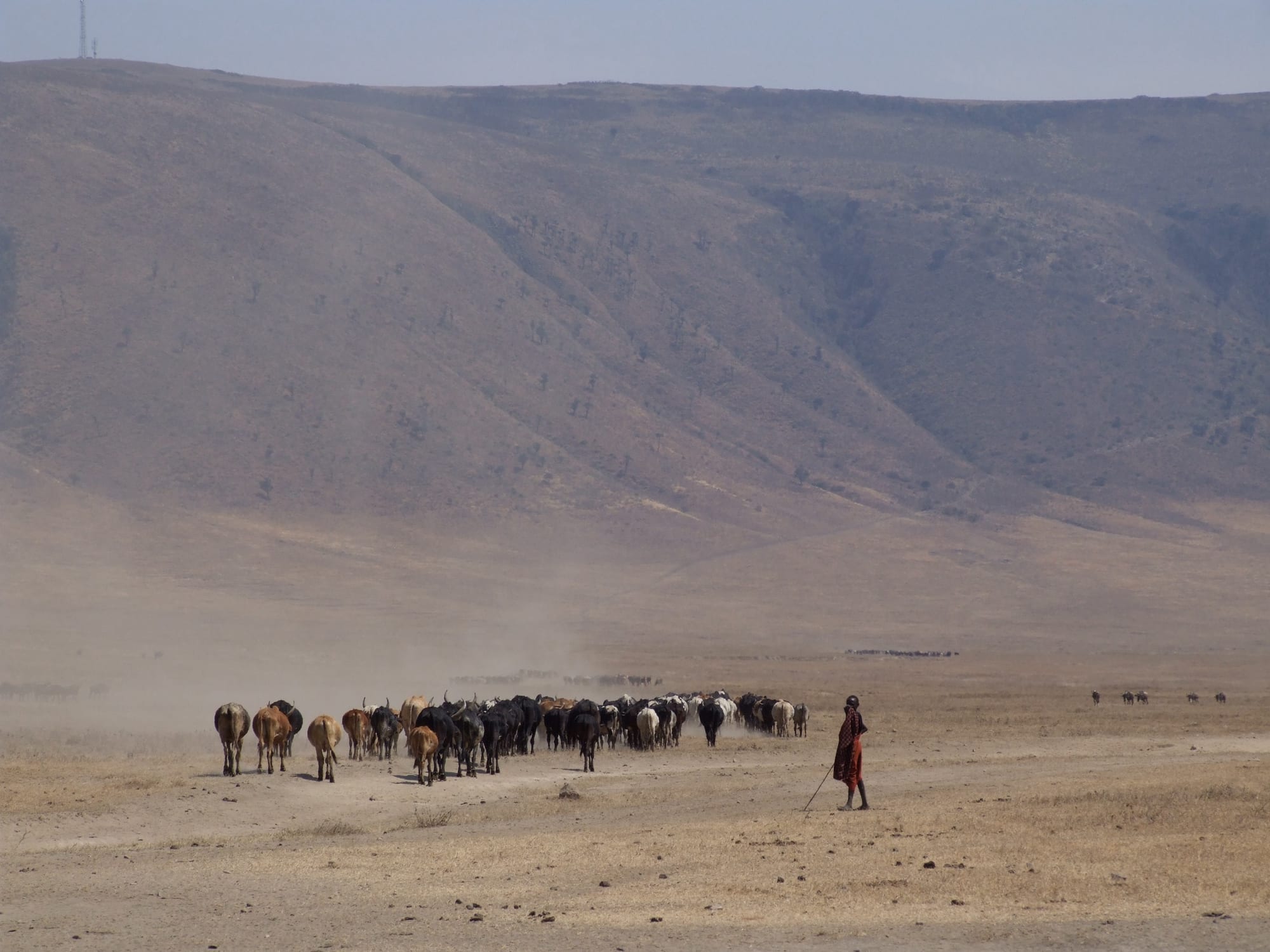
Cattle crossing dry grassland in Ngorongoro Crater, Tanzania: the kind of open country McKenna imagined. Photo: Nicor, CC BY-SA 3.0, via Wikimedia Commons.
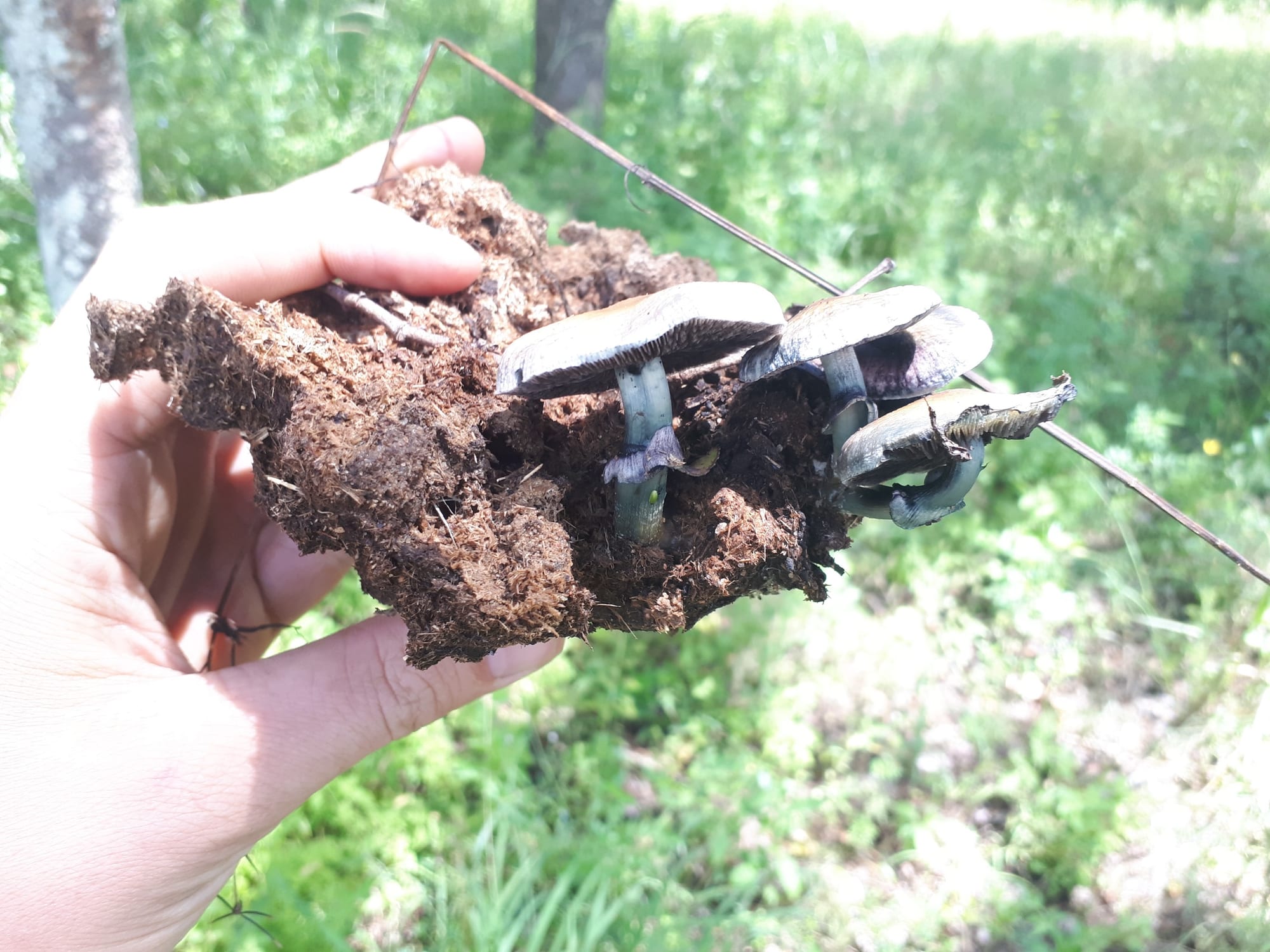
Psilocybe cubensis growing from cow dung at Imire, Zimbabwe. Photo: Robert van der Horst, CC BY-SA 4.0, via Wikimedia Commons.
- The mushrooms
- A piece of cow dung, their growing medium
At low doses, he said, the mushroom improved visual acuity, including edge detection, which would help in hunting and so in feeding and having children. At higher doses it raised sexual energy and attention. At the highest doses it produced social bonding, group rituals, visions and a loosened sense of self, which he linked to the origin of language and religion.19 For McKenna this was a single story with drugs at its center. In a 1993 interview he said he wrote the book to reframe origins so that drugs were part of the picture.10
The first stage depends on a scientist named Roland Fischer.
The evidence cited
The visual-acuity claim rests on Fischer. The 1970 paper, by Fischer, Hill, Thatcher and Scheib, measured how psilocybin contracts the perception of nearby visual space, using changes in apparent surface tilt and handwriting size at the drug's peak.11 That is a study of distortion. A critic who read it says it found the drug changes how things look, not how clearly they are defined, and that it did not test acuity or edge detection at low doses.9 That critique is a blog post, so the point should be checked against the paper, but the paper's own abstract does not describe an acuity test.11
What McKenna had beyond that was circumstantial. Psilocybin mushrooms exist, some grow on dung, early humans lived near grazing animals, and psychedelics reshape experience. These are all true and none of it connects to the claim that they changed the course of evolution.
The more modern neuroscience is real but answers a different question. A 2012 PNAS study of 15 volunteers found that psilocybin lowered blood flow and activity in hub regions of the brain, and that the drop in the medial prefrontal cortex tracked how strong the experience was.12 That is how the drug works in a living brain today. It does not say what happened 100,000 years ago.
Deep Dive: Neuroplasticity and epigenetics: testing the new mechanism
The updated case for the hypothesis, made by Terence's brother Dennis McKenna (see his deep dive under The 2020s revival), rests on two links. First, psychedelics change the structure of the brain. Second, those changes could be passed down through epigenetics, a set of chemical tags that switch genes on or off without changing the DNA itself.13 Each link can be checked against published research, and they come out very differently.
The first link has real support in animals. In a 2018 study, several psychedelics, including psilocin, the form psilocybin takes in the body, made rat neurons in a dish grow more branches and connections. A single dose of DMT did the same in the prefrontal cortex of live rats.14 A 2021 study in mice went further. One dose of psilocybin raised the size and number of dendritic spines, the small buds where nerve cells receive signals, by about 10 percent. The change appeared within 24 hours and was still there a month later.15 Both teams were studying possible treatments for depression and stress, and neither study tested anything about evolution.1415
The human imaging evidence is thinner. The McKenna Academy describes a brain under psilocybin as "exponentially denser than baseline."16 One widely cited 2014 analysis scanned 15 volunteers after an injection of psilocybin and found that their brain activity formed many new short-lived patterns compared with placebo.17 That describes a brain during the drug's effect, not a lasting change. An earlier study of the same kind found that psilocybin lowered activity in key hub regions.12
The second link is much weaker. Epigenetic tags do respond to diet, stress and toxins. But in mammals, most of these tags are wiped clean when eggs and sperm form and again in the early embryo. A major 2014 review in Cell concluded that "proof that transgenerational inheritance has an epigenetic basis is generally lacking in mammals." It added that inheritance over multiple generations "seems unlikely given the robust reprogramming found in the mammalian germ line."18 For the hypothesis, that matters. A change in one hominin's brain after a mushroom meal would need to reach its great-grandchildren, and the review finds little sign that mammals can do this.
There is another route that does not need epigenetics. Rodríguez Arce and Winkelman argue through gene-culture co-evolution: shared rituals and social habits built around psychedelics could persist as culture, and that culture could then favor certain genes over many generations.4 In this case it is still a proposal without direct evidence.
The fungal side of the story has moved too. A 2018 genetics study found that the genes for making psilocybin jumped between unrelated mushroom groups, a rare process called horizontal gene transfer. The authors suggest the compound helped fungi living in dung and rotting wood, perhaps by changing the behavior of insects that eat them.19 If so, insects were probably the compound's first targets, and its effects on mammals came later.
What would settle more of the question is direct evidence from ancient people. Rodríguez Arce and Winkelman name the kind that is missing: traces of psilocybin mushrooms in fossilized dental plaque.4 Until that kind of evidence turns up, the brain studies show what psilocybin does to brains today, and the inheritance step remains the weakest part of the updated argument.
The criticism
The objections are plain and mostly the same across the literature.
- No direct evidence. Archaeologist Elisa Guerra-Doce told Inverse that the hypothesis is too simplistic and lacks direct evidence, such as early Homo sapiens eating hallucinogenic mushrooms. She also said McKenna got basic facts wrong, including the dating of the Tassili-n-Ajjer paintings.20
- Timeline. The big brain expansion started long before the date McKenna gave, and the earliest signs of religion and art are much more recent.59
- One cause for a many-sided change. Paleontologist Martin Lockley said the idea implies a single cause for consciousness, which most scientists doubt.20
- Misread source. The Fischer claim, above.
- The dung story is shaky. For decades the standard view was that cattle carried P. cubensis into the Americas. A 2026 paper in Proceedings B describes a related species, P. ochraceocentrata, on cattle dung in southern Africa. The two species share an ancestor about 1.5 million years ago. The authors say African fungi are poorly sampled and their scenarios are theories, not settled conclusions.21 This does not rescue or kill the hypothesis. It shows the fungus's history is still being worked out.
- Psychedelics do not guarantee harmony. Some critics point to societies that use psychedelics ceremonially and are still violent, which cuts against the idea that the drugs make groups more peaceful.22
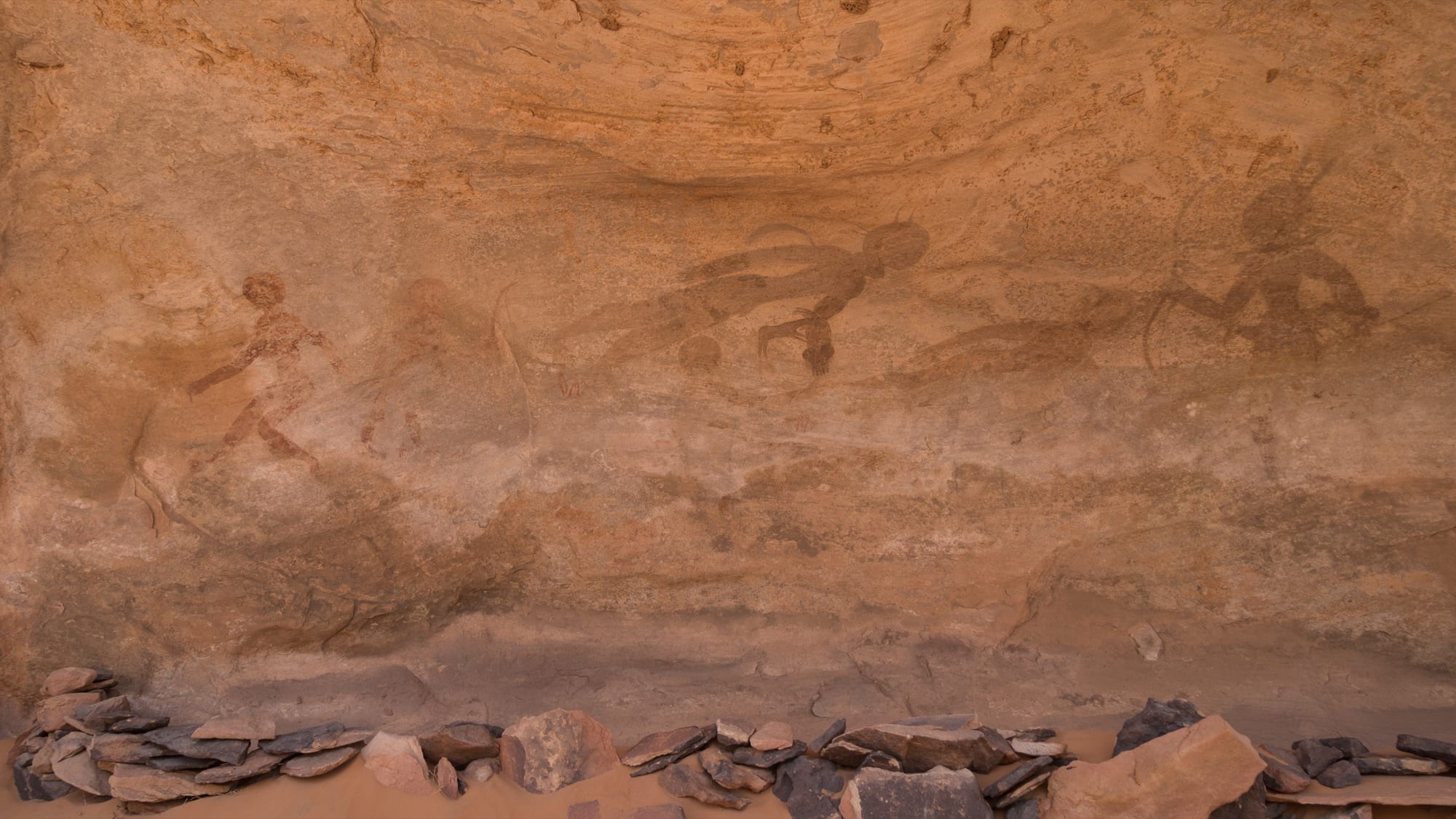
Painted figures at Tin Tazarift, Tassili n'Ajjer, Algeria. Tassili's rock art is often cited for the hypothesis; these figures are not the well-known "mushroom" figure. Photo: IssamBarhoumi, CC BY-SA 4.0, via Wikimedia Commons.
The 2020s revival
The best-known recent step is a paper in Frontiers in Psychology by Manvir Rodríguez Arce and Michael Winkelman, published in September 2021 as a hypothesis article. They argue that early hominins likely ate fungi, noting that 22 primate species are known to do so and that forest-floor foods mattered from the Pliocene on. They suggest psychedelic effects on sociality, imagination and suggestibility may have helped group life.4
The paper is careful where McKenna was bold. It calls a simple version of McKenna's account "most certainly false," says psychedelics are "definitely not" the "missing link," and frames them as an "enabling factor" in a multifactor, co-evolutionary process. It also admits there is no "incontrovertible direct evidence" of psychedelic mushroom use by ancient humans.4 That is a different and much more modest hypothesis than the 1992 book.
Outside the journals, Paul Stamets carried the idea to a larger audience. At the Psychedelic Science conference in April 2017 he said he wanted to "bring back the concept of the Stoned Ape Hypothesis," said "Dennis and Terence were right on," and also admitted it might be unprovable.20 His claim that the brain "doubled" suddenly about 200,000 years ago is not how the Smithsonian describes a long, uneven expansion.520
Deep Dive: Dennis McKenna's version
Dennis McKenna is Terence's younger brother and the scientist of the pair. His doctorate came from the botany department of the University of British Columbia in 1984, with a thesis on monoamine oxidase inhibitors in Amazonian hallucinogenic plants.23 Monoamine oxidase (MAO) is a gut enzyme that normally destroys DMT before it can act. His 1984 paper in the Journal of Ethnopharmacology showed that ayahuasca samples from Peru strongly block that enzyme, which helps explain why the brew works when swallowed.24 He was later a key investigator on the Hoasca Project, a 1993 study of long-term ayahuasca drinkers in a Brazilian church.2526 Since 2019 he has been building the McKenna Academy of Natural Philosophy, a school for the study of plant medicines and consciousness.26
He says the idea began as conversations between the two brothers. In an email to HowStuffWorks he said he once planned a book to be called "Hallucinogens and Evolution" but never wrote it. He added: "While Terence's approach is different from what I would have written, there are complementarities. Terence's ideas were certainly fertilized by those conversations."27 The abstract for a 2022 talk he gave at the University of Exeter repeats that the theory emerged from those conversations.26
The roots go back to La Chorrera, Colombia, in 1971, where the brothers ate mushrooms repeatedly and Dennis spent weeks in a disturbed state.13 In his 2012 memoir, The Brotherhood of the Screaming Abyss, Dennis wrote that he "was lost in hyperspace for much of the time, or overwhelmed by psychosis, again depending on interpretation."28 In 2021 he told Tim Ferriss the episode was closest to "a shamanic initiation," and he warned that mushrooms "can lead you into these delusional spaces."13 The writer Tao Lin, reviewing the memoir, describes a division of labor that followed. Dennis wrote the technical parts of their 1976 mushroom-growing guide, and Terence wrote the passages in which "the mushroom" speaks.2829 That is Lin's reading, but it fits a pattern of a chemist and a storyteller working on one set of ideas.
Dennis's own version uses a longer clock. Terence put the change at about 100,000 years ago.1 Dennis told HowStuffWorks: "We know the brain tripled in size about 2 million years ago, and probably the ecosystems which put hominids, cattle and mushrooms together were around that old."27 The Smithsonian describes a slower story, with the fastest brain growth between about 800,000 and 200,000 years ago.5 In the memoir, Dennis also proposed a loop in which practicing language changed the brain, writing that "there must have been a feedback between the acquisition and practice of language that resulted in a relatively rapid change in primate brain structures over a few hundred thousand years."28
He is also clear that mushrooms were one cause among several. "Obviously there were multiple factors involved," he told HowStuffWorks. "It's simplistic just to postulate that people ate mushrooms, so they were better equipped."27 The same article reports that neither brother used the name "stoned ape," and that Dennis thinks the name misrepresents the idea.27 His 2022 Exeter abstract says the label came from critics.26 He now uses it himself: in 2021 he spoke of a planned symposium "on the Stoned Ape Theory," and his academy sells a course under that name.1316 An Esalen recording of a 1992 talk by Terence also carries the title.30
On whether the idea is likely, he has grown more confident. Since about 2021 he has argued that the hypothesis looks stronger than it did in 1992. He wrote a new foreword for a reprint of Food of the Gods and told Ferriss that two newer findings matter: psychedelics "foster neuroplasticity," and "epigenetics provides a mechanism for inheritance." He said: "These things can never be proven," and in the same answer said the new findings move the idea "from plausible to maybe more than likely."13 He told HowStuffWorks that "the idea has more support than ever."27 In a 2021 podcast he was more hedged, saying psychedelics may connect to our earliest ancestors "if you put credence of the stoned ape hypothesis."31 He can go further than Terence's book, too. In the memoir he floated the idea that psilocybin and DMT "may in fact be alien artifacts seeded into the biosphere."28
Others have used his name in their own arguments. Paul Stamets told a 2017 conference that "Dennis and Terence were right on."20 Jahan Khamsehzadeh's 2022 book The Psilocybin Connection draws on Dennis's essay "Of Apes and Men" in the 2019 book Fantastic Fungi, which also printed a reply by Andrew Weil: "I don't buy the 'stoned ape' hypothesis and never have."29 The careful 2021 paper by Rodríguez Arce and Winkelman cites Terence's book and does not discuss Dennis's work.4 Winkelman now teaches a course at the McKenna Academy, so the two camps are in contact.16
In short, Dennis frames the idea in the terms of his field: plant chemistry, a long time span and co-evolution between fungi and people. On the question of single cause, he is more careful than Terence. On whether it is likely, he has grown more confident than the studies can support. The two mechanisms he leans on are tested in the deep dive "Neuroplasticity and epigenetics," under The evidence cited.13
Stamets's talk landed in the middle of a wave of psychedelic research.
Modern trials ask a narrower question than McKenna did.
Where it stands
A fair summary has three layers. The strong version, in which mushrooms drove the evolution of human language and religion, has no direct evidence and conflicts with the timeline of brain growth. The visual-acuity step looks like a misreading of Fischer. The weak version, that psychedelic experiences were sometimes part of early human social life and ritual, is plausible but unproven, and the authors who argue it say so.4
It is worth separating what is open from what is closed. What is open: whether our ancestors ate psychoactive fungi, and whether such use shaped culture. What is closed, at least for now: the claim that psilocybin explains the leap from Homo erectus to Homo sapiens. The idea earns its place as a prompt for questions about mind, food and ritual, and not as a finding. Anything you read that treats it as settled, in either direction, has gone past the evidence.
Footnotes
-
Wikipedia, "Stoned ape theory" (summary of McKenna's claim, three dose stages, and criticism; secondary source). The original is Terence McKenna, Food of the Gods, Bantam, 1992. en.wikipedia.org ↩ ↩2 ↩3 ↩4 ↩5 ↩6
-
Sarah Sloat, "In 'Stoned Ape' Theory, Consciousness Has Roots in Psilocybin," Inverse, 14 July 2017. inverse.com ↩
-
Sloat, Inverse, 2017, as above (Stamets; critics). ↩
-
Manvir Rodríguez Arce and Michael Winkelman, "Psychedelics, Sociality, and Human Evolution," Frontiers in Psychology 12, 2021, doi 10.3389/fpsyg.2021.729425. pmc.ncbi.nlm.nih.gov ↩ ↩2 ↩3 ↩4 ↩5 ↩6 ↩7
-
Smithsonian National Museum of Natural History, Human Origins Program, "Brains." humanorigins.si.edu ↩ ↩2 ↩3 ↩4 ↩5
-
Alexandra Rosati, "Food for Thought: Was Cooking a Pivotal Step in Human Evolution?" Scientific American, 26 February 2018. scientificamerican.com ↩
-
L. C. Aiello and P. Wheeler, "The Expensive-Tissue Hypothesis," Current Anthropology, 1995; summarized in "Brains and guts in human evolution: The Expensive Tissue Hypothesis," Brazilian Journal of Genetics. scielo.br ↩
-
R. I. M. Dunbar, "The social brain hypothesis," Evolutionary Anthropology 6, 1998, 178-190 (citation confirmed; abstract not read). neuroscience.ox.ac.uk ↩
-
Sam Woolfe, "A Critique of Terence McKenna's 'Stoned Ape Theory,'" 2013 (blog; secondary source for the Fischer critique and the timeline objection). samwoolfe.com ↩ ↩2 ↩3 ↩4
-
Terence McKenna interview, 1993, Erowid (summarized from a search result; not read in full). erowid.org ↩
-
R. Fischer, R. Hill, K. Thatcher and J. Scheib, "Psilocybin-Induced Contraction of Nearby Visual Space," Agents and Actions 1, 1970, 190-197 (Erowid reference entry; abstract details only). erowid.org ↩ ↩2 ↩3
-
R. L. Carhart-Harris et al., "Neural correlates of the psychedelic state as determined by fMRI studies with psilocybin," PNAS 109(6), 2012, 2138-2143. pmc.ncbi.nlm.nih.gov ↩ ↩2 ↩3
-
"Dennis McKenna: The Depths of Ayahuasca" (episode 523), The Tim Ferriss Show, transcript, 25 July 2021. tim.blog ↩ ↩2 ↩3 ↩4 ↩5 ↩6
-
C. Ly et al., "Psychedelics Promote Structural and Functional Neural Plasticity," Cell Reports 23(11), 2018, 3170-3182. pmc.ncbi.nlm.nih.gov ↩ ↩2
-
L.-X. Shao et al., "Psilocybin induces rapid and persistent growth of dendritic spines in frontal cortex in vivo," Neuron 109(16), 2021, 2535-2544 (abstract only). pmc.ncbi.nlm.nih.gov ↩ ↩2
-
McKenna Academy, "The Stoned Ape Theory: What the Evidence Actually Shows," 14 May 2026 (bylined Dennis McKenna, PhD; a promotional guide to the academy's Stoned Ape Hypothesis course, so a sympathetic source). mckenna.academy ↩ ↩2 ↩3
-
G. Petri et al., "Homological scaffolds of brain functional networks," Journal of the Royal Society Interface 11(101), 2014, 20140873 (abstract only). pmc.ncbi.nlm.nih.gov ↩
-
Edith Heard and Robert A. Martienssen, "Transgenerational epigenetic inheritance: myths and mechanisms," Cell 157(1), 2014, 95-109. pmc.ncbi.nlm.nih.gov ↩
-
H. T. Reynolds et al., "Horizontal gene cluster transfer increased hallucinogenic mushroom diversity," Evolution Letters 2(2), 2018, 88-101 (abstract only). pmc.ncbi.nlm.nih.gov ↩
-
Sloat, Inverse, 2017, as above (Stamets quotes; Guerra-Doce and Lockley). ↩ ↩2 ↩3 ↩4 ↩5 ↩6
-
Andrew Paul, "New psychedelic fungus rewrites origins of magic mushrooms," Popular Science, 10 March 2026, reporting a Proceedings of the Royal Society B paper (doi 10.1098/rspb.2025.2270; original paper not read). popsci.com ↩
-
Wikipedia, "Stoned ape theory," as above (secondary source for the criticism about psychedelic-using societies). ↩
-
Dennis Jon McKenna, "Monoamine Oxidase Inhibitors in Amazonian Hallucinogenic Plants: Ethnobotanical, Phytochemical, and Pharmacological Investigations," PhD thesis, Department of Botany, University of British Columbia, February 1984 (title page read). bibliography.maps.org ↩
-
D. J. McKenna, G. H. N. Towers and F. Abbott, "Monoamine oxidase inhibitors in South American hallucinogenic plants: tryptamine and beta-carboline constituents of ayahuasca," Journal of Ethnopharmacology 10(2), 1984, 195-223 (abstract only). pubmed.ncbi.nlm.nih.gov ↩
-
C. S. Grob, D. J. McKenna, J. C. Callaway et al., "Human psychopharmacology of hoasca, a plant hallucinogen used in ritual context in Brazil," Journal of Nervous and Mental Disease 184(2), 1996, 86-94 (abstract only). pubmed.ncbi.nlm.nih.gov ↩
-
Philosophy and Psychedelics Exeter Research Group, "Dennis McKenna: Psilocybin and the Origin of Consciousness, A re-examination of the 'Stoned Ape' Hypothesis," University of Exeter, talk of 21 October 2022 (abstract and speaker bio; the recording is slides only and was not watched). sites.exeter.ac.uk ↩ ↩2 ↩3 ↩4
-
Robert Lamb and Austin Henderson, "Stoned Ape Theory: Magic Mushrooms and Human Evolution," HowStuffWorks, 2023 (includes emailed quotes from Dennis McKenna; read in a January 2025 Wayback Machine copy). science.howstuffworks.com ↩ ↩2 ↩3 ↩4 ↩5
-
Tao Lin, "Dennis and Terence McKenna: Parts of an Intellectual Dyad," Vice, 2 September 2014 (quotes passages from Dennis McKenna, The Brotherhood of the Screaming Abyss, North Star Press, 2012; the memoir itself not read). vice.com ↩ ↩2 ↩3 ↩4
-
Jahan Khamsehzadeh, The Psilocybin Connection, North Atlantic Books, 2022, chapters 1 and 5 and bibliography (cites Dennis McKenna, "Of Apes and Men," and quotes Andrew Weil, "Counterpoint: The Stoned Ape Theory, Not," both in Paul Stamets, ed., Fantastic Fungi, Earth Aware, 2019; Fantastic Fungi itself not read). northatlanticbooks.com ↩ ↩2
-
Esalen, "Terence McKenna: The Stoned Ape Hypothesis (8/22/92)" (title only; who chose it is unknown). esalen.org ↩
-
Jamie Wheal, "Understanding Non-Ordinary Experiences, Psychedelics and Our Reality: An Interview With Dennis McKenna," Qualia Life, 8 September 2021 (podcast transcript). qualialife.com ↩
-
Mitchell B. Liester, "The Stoned Ape Theory Revisited," Psychology Today, 2024. psychologytoday.com ↩