Place · Şanlıurfa, Turkey
Göbekli Tepe
A hilltop near Şanlıurfa where hunter-gatherers raised carved stone pillars 11,500 years ago, and the story of what they built keeps changing.

Overview
Göbekli Tepe is a mound on the highest point of the Germuş hills, about 15 kilometers northeast of the city of Şanlıurfa in southeastern Turkey.1 The name means "belly hill."2 The whole mound is made by people. It is about 300 meters across and up to 15 meters high, and it is built from the debris of buildings put up and rebuilt over roughly 1,500 years.13
The people who built it lived in the Pre-Pottery Neolithic, the stretch of the early Neolithic in the Near East before anyone made pottery. They were hunter-gatherers on the edge of the change to farming.41 Their buildings are round to oval rooms, which archaeologists call enclosures or "special buildings," ringed by stone walls and benches. Set into the walls are T-shaped limestone pillars, and two larger pillars stand in the middle, the tallest about 5.5 meters high and weighing around 8 tonnes. Many pillars are carved with animals, and some have arms, hands, belts and loincloths, so they are read as stylised human figures.3
The site became famous through its first excavator, Klaus Schmidt, who called it the world's first temple and argued that the urge to build it came before farming.2 Since his death in 2014, the team led by Lee Clare has revised that picture. They now describe Göbekli Tepe as a settlement with a strong ritual side, where people lived, ground cereals and stored rainwater.15 Both versions are still in circulation, which is part of what makes the place worth a careful look.
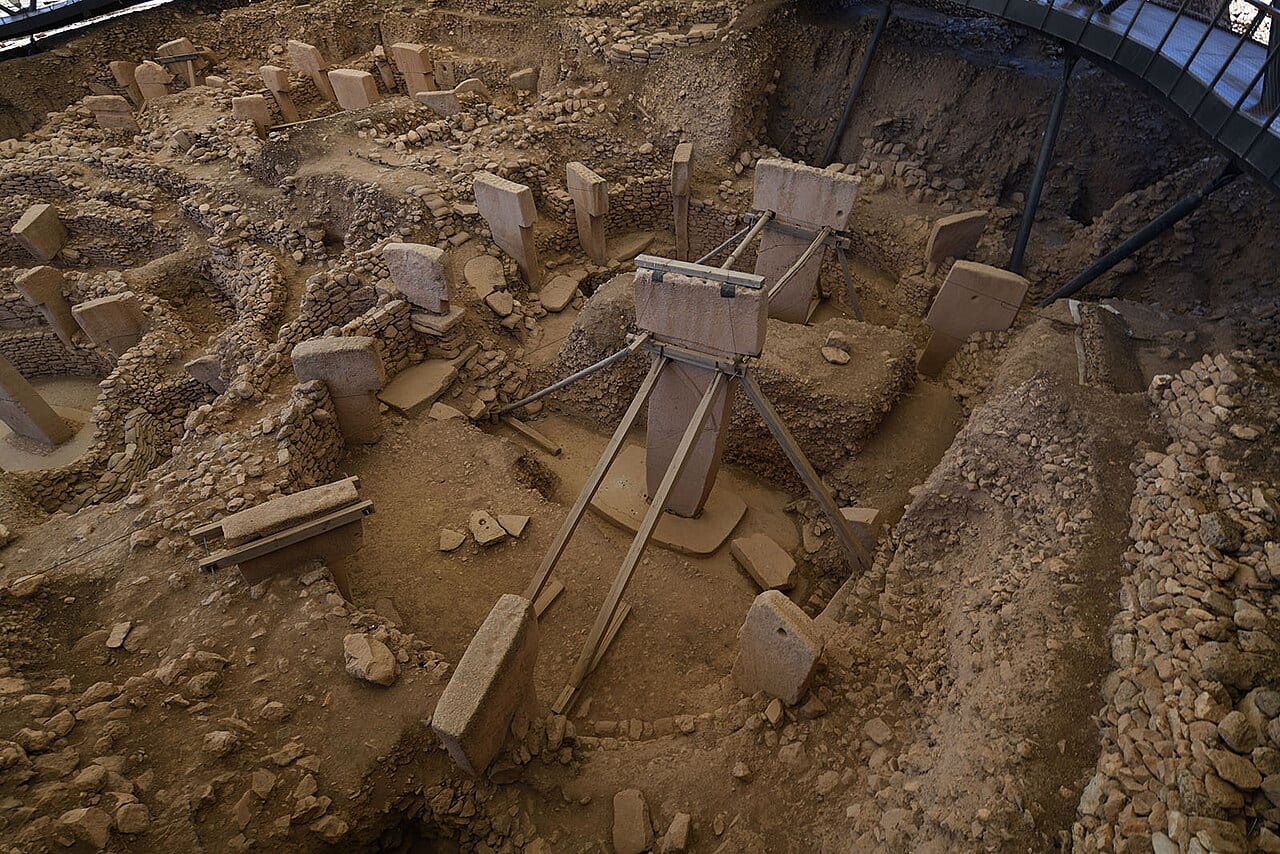
Enclosure D, the best preserved of the big round buildings, seen from the visitor walkway in September 2019. Photo: Dosseman, CC BY-SA 4.0, via Wikimedia Commons.
- One of the two central pillars, braced with steel struts
- The second central pillar, behind it
- The low pedestal cut from bedrock that holds the front central pillar
- Smaller T-pillars set into the stone wall of the ring
- The rubble-stone wall that encloses the room
- The modern protective roof and walkway
- ~9500 BCE First big enclosures The oldest round-oval buildings with T-pillars go up in the Pre-Pottery Neolithic A.
- ~8000 BCE The end Building, repair and rebuilding stop, and the mound is left as it stands today.
- 1963 Survey An Istanbul and Chicago survey notes the flint on the surface but misses the pillars.
- 1995 Digging begins Klaus Schmidt, who spotted pillar tops in 1994, starts excavating with the Şanlıurfa Museum.
- 2018 World Heritage UNESCO inscribes the site.
- 2024 A wider world Reports from Karahan Tepe and Sayburç show Göbekli Tepe was one of many related sites.
Older times are squeezed together so the whole span fits.
In context
The Neolithic, or New Stone Age, is when people in parts of the world began to farm, herd animals and live in permanent villages. In the Near East it began in an arc of hills and plains called the Fertile Crescent. Göbekli Tepe sits on its northern edge.2 Archaeologists split the region's early Neolithic into the Pre-Pottery Neolithic A (about 9600 to 8800 BCE) and B (about 8800 to 8000 BCE). Göbekli Tepe spans both.1
Genetic work has traced the domestication of einkorn, one of the oldest cultivated wheats, to the area around Karacadağ, a mountain not far from the site.67 That is one reason the site drew so much attention. Here were monumental buildings, made by people who did not yet farm, a short walk from where farming may have started. Ian Hodder, who excavated the later town of Çatalhöyük, said in 2008: "This shows sociocultural changes come first, agriculture comes later."2
Göbekli Tepe is no longer alone. T-pillars were found first at Nevalı Çori, a village site to the north now under a dam reservoir.13 Since 2021 Göbekli Tepe and its neighbor Karahan Tepe have been part of a regional research program called Taş Tepeler, "Stone Hills," which covers several more early sites around Şanlıurfa.1
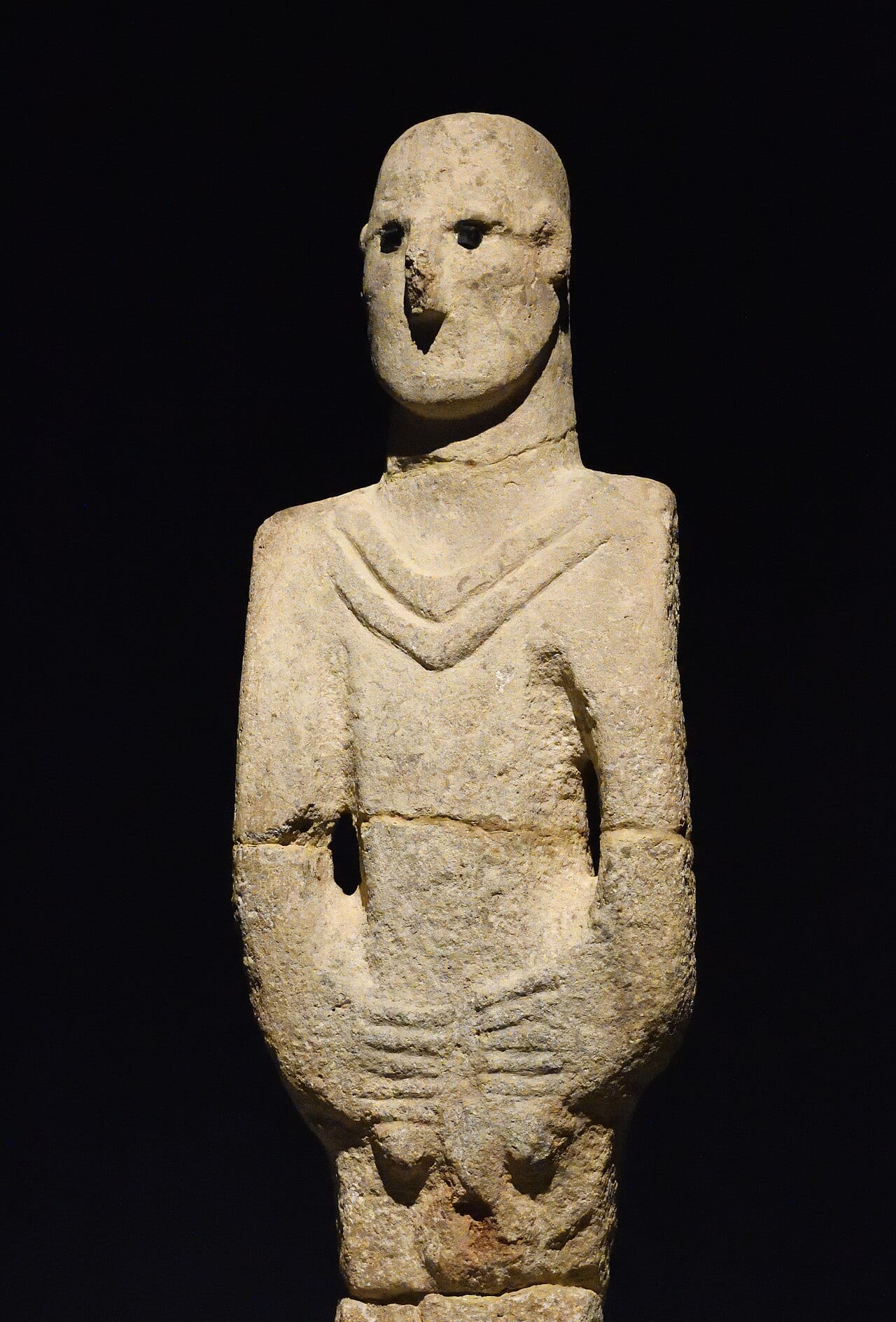
Urfa Man in the Şanlıurfa Archaeology Museum, September 2019. Photo: Dosseman, CC BY-SA 4.0, via Wikimedia Commons.
- Eyes set with black obsidian
- A V-shaped collar, perhaps a necklace or garment
- Hands held together in front of the body, like the arms on the T-pillars
Urfa Man, a life-sized standing figure found in Şanlıurfa in 1993, gives the T-pillars a face. He is about 1.9 meters tall, with obsidian set into his eyes, and is dated to around 9000 BCE.8 The excavators call him "the oldest known life-sized sculpture of a man" and note that heads from similar statues have turned up at Göbekli Tepe.9 The pillars, in comparison, are deliberately faceless and larger than life.9
Several books in the Library cover the site and the world around it.
Research
Discovery
The site was first recorded in 1963 by a joint survey of Istanbul University and the University of Chicago, led by Halet Çambel and Robert Braidwood. The surveyors noticed the flint tools and flakes on the surface but not the buildings.1 They saw broken slabs of limestone and took the mound for an abandoned medieval cemetery.2 Peter Benedict, who wrote up the survey, is reported to have mistaken the pillar tops for grave markers.10 Attention moved to Çayönü, a site found on the same survey.11
In October 1994 Klaus Schmidt of the German Archaeological Institute (DAI), who had worked at Nevalı Çori, went to look, together with Murat Akman and Michael Morsch.3 He recognized the big limestone blocks as the heads of T-pillars.1 The excavation team has stressed that local people already knew the place mattered. Families from the village of Örencik had reported finds from plowing to the Şanlıurfa Museum, and a local farmer guided Schmidt to the mound.11
Digging began in 1995 under the Şanlıurfa Museum, with Harald Hauptmann of the DAI as acting director and Schmidt coordinating the fieldwork. Schmidt became director in 2006 and led the work until he died in 2014. The Şanlıurfa Museum then took over, with Lee Clare of the DAI as field director. Necmi Karul of Istanbul University became head of excavations in 2019 or 2020 (the team's own pages give both years), with Clare still coordinating the DAI research.111
The enclosures and their animals
Four big round buildings, A to D, have been partly dug in the main excavation area. More have since been found: E on the western plateau, where only the carved sockets for its pillars survive, and F, G, H and I elsewhere on the mound.13 Geophysical surveys, which map buried walls from the surface, show more than ten further large buildings that have not been dug.3 The floors of C and D were cut and smoothed from the bedrock itself, and the central pillars stand in sockets carved into it.1
Enclosure D is the largest and best preserved. Its two central pillars are about 5.5 meters tall and weigh some 8 tonnes. Eleven more pillars stand in its ring at the current state of excavation. The central pair have arms that bend around to hands over the belly, belts, and loincloths shaped like animal skins. A few small bones from a fox's tail were found in front of one of them, which may mean a real pelt once hung there.3
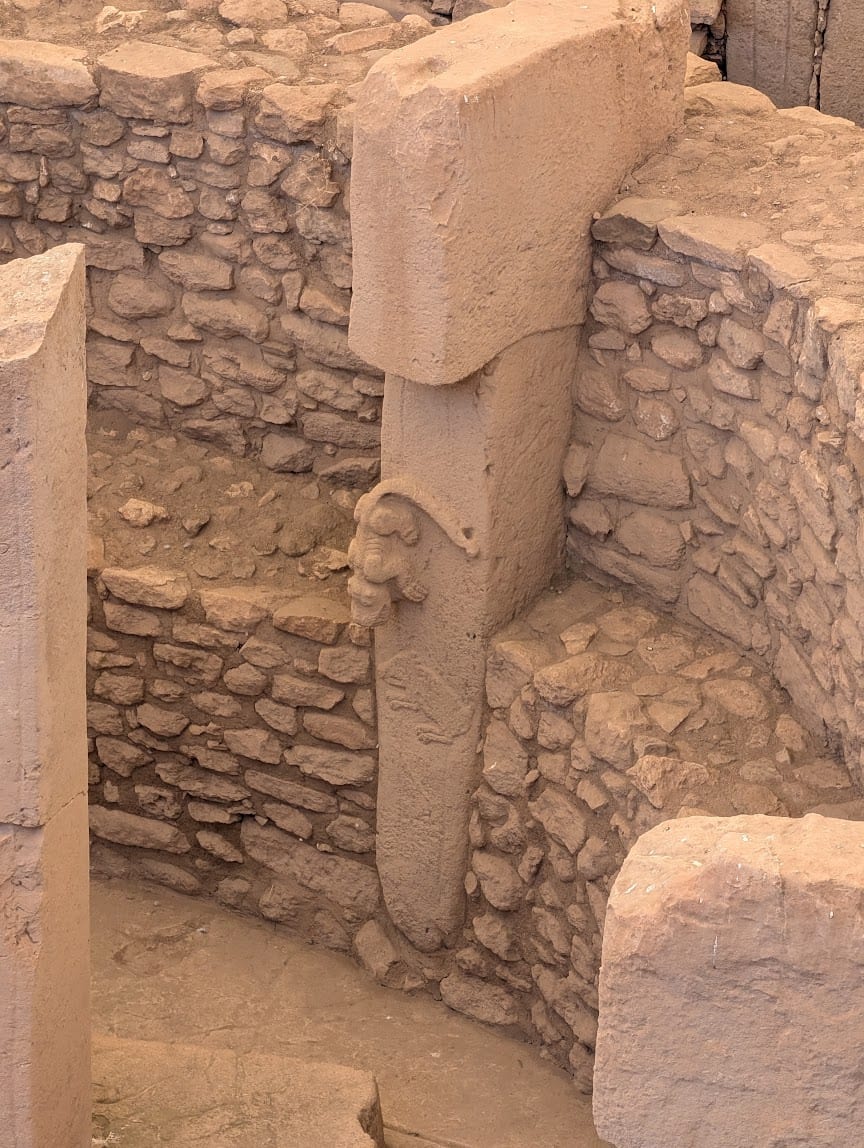
Pillar 27 in Enclosure C, the boar enclosure. A predator in high relief climbs the shaft above a boar carved in low relief. Photo: Kerimove, CC0, via Wikimedia Commons.
- The predator, carved almost free of the stone
- The faint outline of a boar below it
- The T-shaped head of the pillar
- The stone wall of the enclosure
The carvings are mostly wild animals: foxes, boars, snakes, birds, aurochs (wild cattle), gazelle, wild donkeys, spiders, scorpions. Schmidt called the site "a Stone Age zoo."12 There are no imaginary hybrids or monsters; every animal shown lived near the site.1 Each building seems to favor one species. In Enclosure A it is snakes, in B foxes, in C boars, and in D birds. The excavators suggest this may mark different groups who built and used different buildings.12 Almost all the imagery is male. Wherever an animal's sex is shown, it is male, and the only clearly female image is a graffito on a slab in a later building.3
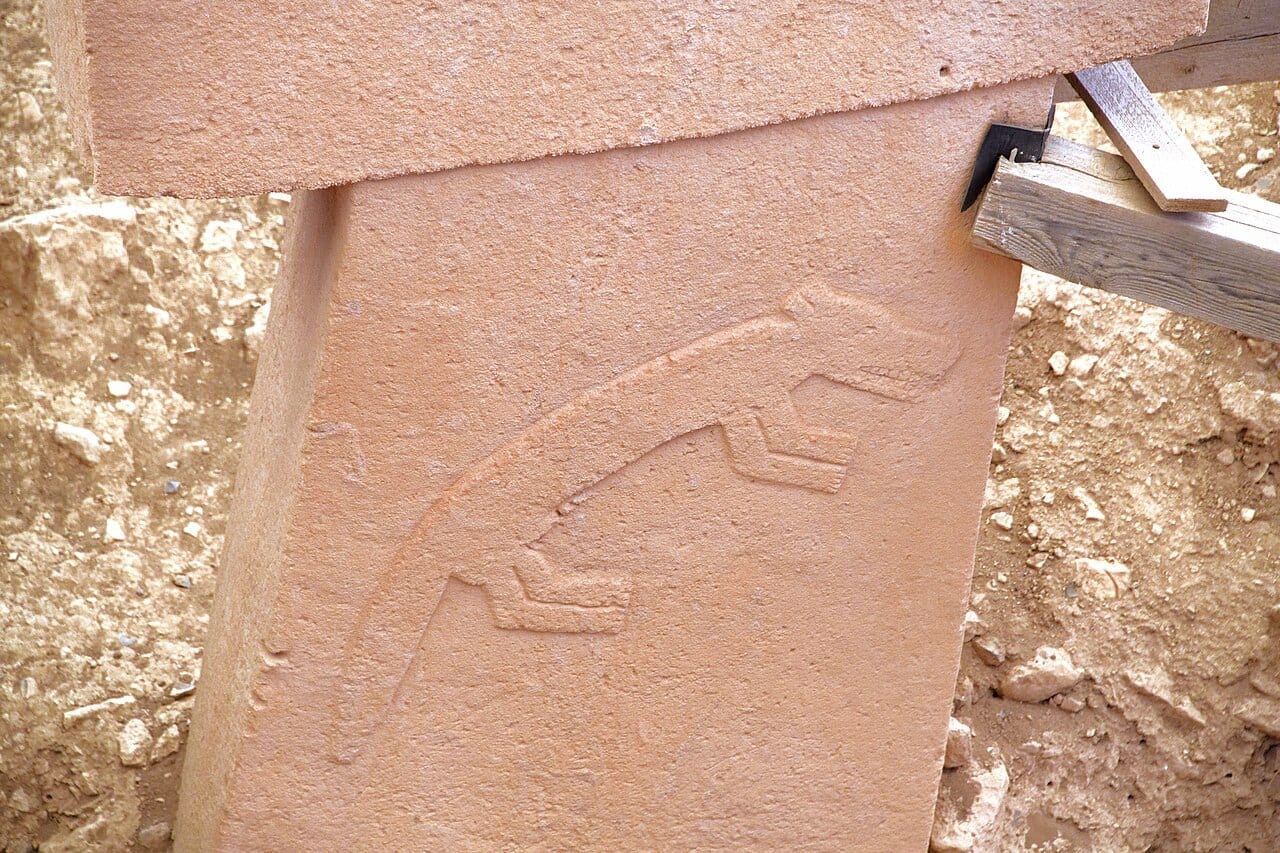
A leaping fox on a pillar in Enclosure B, where foxes are the main motif. September 2019. Photo: Dosseman, CC BY-SA 4.0, via Wikimedia Commons.
- The fox's head, with bared teeth
- Front legs, stretched out mid-leap
- Hind legs
- The T-shaped head of the pillar
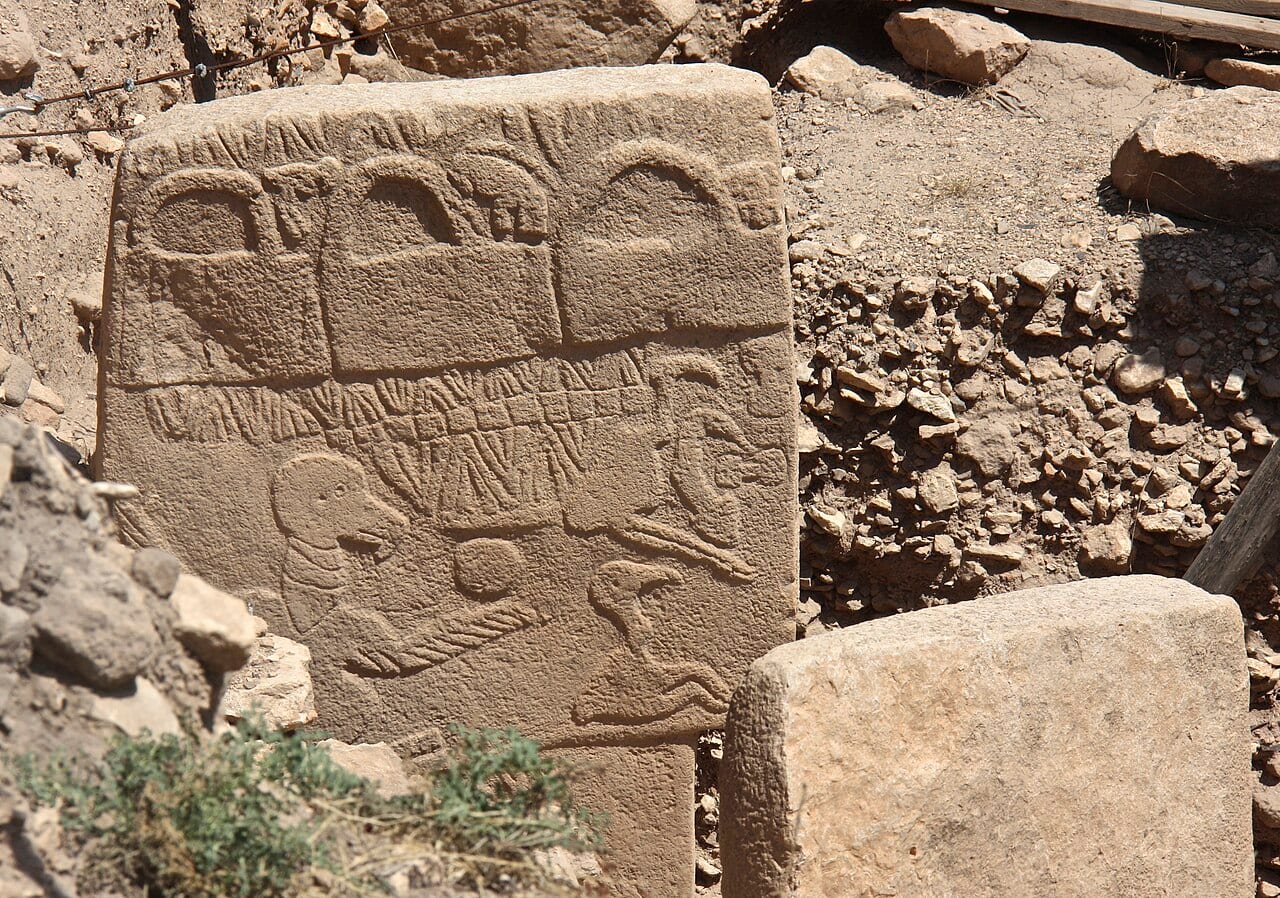
The upper part of Pillar 43, the "Vulture Stone," in Enclosure D, 2013. The scorpion and the headless man are lower on the shaft and out of view here. Photo: Sue Fleckney, CC BY-SA 2.0, via Wikimedia Commons.
- Three box shapes with arched tops, each with an animal; perhaps buildings, seen from the side
- A band of V-shaped marks
- The vulture's head
- The disc above the vulture's wing: a sun, an egg, or a severed head
- A second bird, perhaps a young vulture or an ibis
Pillar 43, the "Vulture Stone," is the most argued-over carving at the site.
The DAI team reads Pillar 43 as a narrative scene. The vulture lifts one wing toward the disc. If the bird beside it is a young one, the wing may be a gesture of protection and the disc an egg. It could also be the sun or the moon. Near the base of the scene is the headless man. Images of severed heads and headless bodies with carrion birds are known from other sites of the period, and the excavators link them to rituals for the dead, so the disc might be the man's head. The three box shapes at the top may show buildings with roofs, each with its group's animal, but the team says a final decision on their meaning "is not possible at the moment."13
Human remains point the same way. About 700 fragments of human bone have come from the fill, though no burials of whole bodies have been found inside the buildings. In 2017 Julia Gresky, Juliane Haelm and Lee Clare reported three skull fragments with deep grooves cut along the top, and one with a drilled hole and traces of red ochre. They suggest the skulls were decorated and hung for display, a kind of "skull cult" not seen elsewhere in that form.14 Birds that eat carrion, crows and vultures, are common among the bird bones, which the team reads as a possible sign of excarnation, leaving the dead out for birds to strip.1
"First the temple, then the city"
Schmidt's reading, set out through the 2000s, was clear. The buildings were sanctuaries. Nobody lived on the hill. Bands of hunter-gatherers came together from a wide area to quarry, carve and raise the pillars, and feasted while they did it. Once a ring was finished it was deliberately buried and another was built. The effort of feeding all those workers, he argued, pushed people to cultivate wild cereals, so religion came first and farming followed.25 His team found no hearths, houses or rubbish pits and none of the clay figurines common at village sites of the same age.2 He called the site "a cathedral on a hill."2
The first serious challenge came from outside. In 2011 Ted Banning argued in Current Anthropology that archaeologists impose a modern divide between sacred and everyday space. He proposed that Göbekli Tepe's buildings might be houses rich in symbolism, and that the flint-knapping and food preparation at the site suggested a resident population.15 The DAI team pushed back. In 2017 Jens Notroff wrote that the buildings matched the "special purpose" buildings that other villages of the period had one or two of, while at Göbekli Tepe they were the rule. He concluded that Banning's houses were "not the most convincing interpretation of the available evidence so far."9
Deeper digging after 2014 changed the team's own view. Excavating down to bedrock, they found middens, fireplaces, hearths and stone tools, which Clare described as "all smelling very domestic."5 The site's own FAQ now lists fire installations, food remains, structures read as rainwater cisterns, burials and the sheer number of buildings, and concludes: "Nowadays Göbekli Tepe is interpreted as settlement site with a pronounced ritual component."1 UNESCO's description also notes "non-monumental structures which appear to stem from domestic buildings."4 Clare's 2020 summary says the work "is leading to a revision of former interpretations" that "still fuel the popular media image" of the world's first temples.16
Water was one of the arguments against a settlement. The nearest springs are about 5 kilometers away.9 But the hill has rock-cut channels feeding pits in the bedrock that could hold about 150 cubic meters of rainwater, enough for people to stay for long periods, if perhaps not through the dry summer.910 Clare's comment on the channel: "They were harvesting water."5
The team also asks whether the buildings had roofs. There is no clear evidence yet, but the FAQ calls it "perfectly conceivable – and technically feasible."1 A roof matters for the meaning of the place. A covered room is a different space from a ring open to the sky, and it is harder to use as an observatory.17
On the word "temple," the team is careful. Their FAQ says it is "perhaps not the best chosen term," because it suggests a house for gods, and offers "oldest so far excavated special buildings with a ritual component" instead. It adds that "temple" is "perhaps not entirely wrong" as a measure of the site's importance.1
Deep Dive: How firm is each picture?
Firm: the mound is entirely artificial. Its big round-oval buildings with carved T-pillars date to the Pre-Pottery Neolithic, from about 9500 BCE, and the site ends around 8000 BCE.116 The builders did not yet have domesticated animals, and the pillars were quarried and carved on the hill.43
Now accepted by the excavators: people lived on the site. There are hearths, middens, thousands of grinding tools, rainwater cisterns and smaller ordinary buildings alongside the big ones. Rectangular buildings of the Pre-Pottery Neolithic B are described as domestic. The team still regards the big round buildings as ritual spaces, and says homes of the same age as the oldest monuments have not yet been clearly identified.118
Schmidt's original interpretation, now largely set aside: that no one lived there, that the buildings were temples and nothing else, and that they were deliberately buried after use.251
Open: whether the buildings were roofed, how long each was in use, what exactly happened inside, and whether any of the cereals were cultivated. Clare has proposed that the site expresses a hunter-gatherer way of life holding on as farming spread nearby, a "last stand" rather than a beginning. That is an argument, and critics point out that 12,000-year-old symbols are hard to read.5
Feasting and beer
The case for feasting rests on food remains and tools. Gazelle bones show hunting concentrated between midsummer and autumn. Laura Dietrich and colleagues studied more than 7,000 grinding stones, pestles and stone vessels and found heavy processing of cereals. They found no large storage buildings, so they argue food was made for immediate use, in seasonal "work feasts" that drew labor for building.18 Dietrich's 2021 monograph, now in the Library, sets out the full study.
The question of what was cereal and what was wild is still open. Charred plant remains are poorly preserved and earlier finds were wild einkorn and wild barley. Phytoliths, microscopic silica bodies that plants leave in soil, show cereals in every layer. A few of them may point to domesticated barley, a result the authors say needs more sampling.18
Beer is the most quoted claim and the weakest. Six large limestone vessels, holding up to 160 liters, were found in place in Pre-Pottery Neolithic B rooms, some with gray-black residue. A first round of tests came back partly positive for calcium oxalate, a compound that forms when grain is soaked, mashed and fermented. Oliver Dietrich called the results "only preliminary."6 The test used was not sensitive enough to give results that could be repeated, and the 2019 study still calls the evidence for brewing "tentative."186 A beer-like drink at Göbekli Tepe is possible. It is not shown.
Dating and the backfilling question
Dates come from typical stone tools, such as el-Khiam and Byblos arrowheads, and from radiocarbon on organic material in the fill and in wall plaster.13 The oldest buildings are dated to the middle of the tenth millennium BCE, and the site ends around 8000 BCE. Published ranges differ a little: UNESCO gives 9600 to 8200 BCE, the excavators' own pages give 9500 or 9250 to 8000 or 7750 BCE.43 Dates from plaster can come out too old, because the plant matter in it may already have been old when it was mixed, the "old wood effect."19
Schmidt's model was simple. Layer III was the old monumental phase, Layer II the later small rectangular buildings, and Layer I the plowed topsoil. The team now says the site "can no longer be explained by a simple tripartite sequence."3
Deep Dive: Was Göbekli Tepe buried on purpose?
For Schmidt, the most striking fact was that the enclosures were full of rubble, bone and broken tools, packed in around the pillars. He read this as a deliberate burial: once a ring was finished, its builders covered it and built another.2 That idea fed every later story about the site, including the claim that its builders were hiding it.
The excavators now describe the fill as "much more complex than initially thought." Some sediment was dumped by people during new building work. Some came from slope slides, earth sliding off the hill after heavy rain or earthquakes. Several filling events took place, clearly separated in time.1 Moritz Kinzel, the team's building archaeologist, noted that the walls closest to the hill are the most damaged and "show clear signs of slope slide or pressure." Kinzel and Clare think the buildings were knocked down and then repaired or rebuilt again and again.5 A slide at the end of the early Pre-Pottery Neolithic B appears to have buried Enclosure D, and the builders put up terrace walls to hold back the slope.1910 Clare also argues that many of the bones once read as feast debris slipped in from older layers.5
The team does not know how long each building was used before it filled up, or why the rebuilding finally stopped around 8000 BCE. Their guess is that society changed and the old buildings lost their purpose.1
The wider network: Taş Tepeler
The same iconography, from snakes and foxes to H-shaped signs and human figures, appears on stone bowls, shaft straighteners (grooved stones for straightening arrow shafts) and plaques at many sites of the same age in the region.117 By 2024 archaeologists had identified more than 20 Pre-Pottery Neolithic sites around Şanlıurfa that share T-pillars and carved benches.20
Karahan Tepe, about 46 kilometers east of Göbekli Tepe, was found by Bahattin Çelik in 1997 and has been dug since 2019 by Necmi Karul's team.2021 Its Structure AB, cut into the bedrock, holds ten stone pillars about six feet tall, widely described as phallic, and a carved human head that juts from the wall. Karul reads the head as "a symbol of male power." He is cautious about labels: "It's difficult to call these structures temples until we know what took place inside them."20 In 2023 the team found a seated stone man about 2.3 meters tall, holding his penis in both hands. The same season, a life-size boar carrying traces of red, white and black paint was found on a carved stone bench at Göbekli Tepe.22
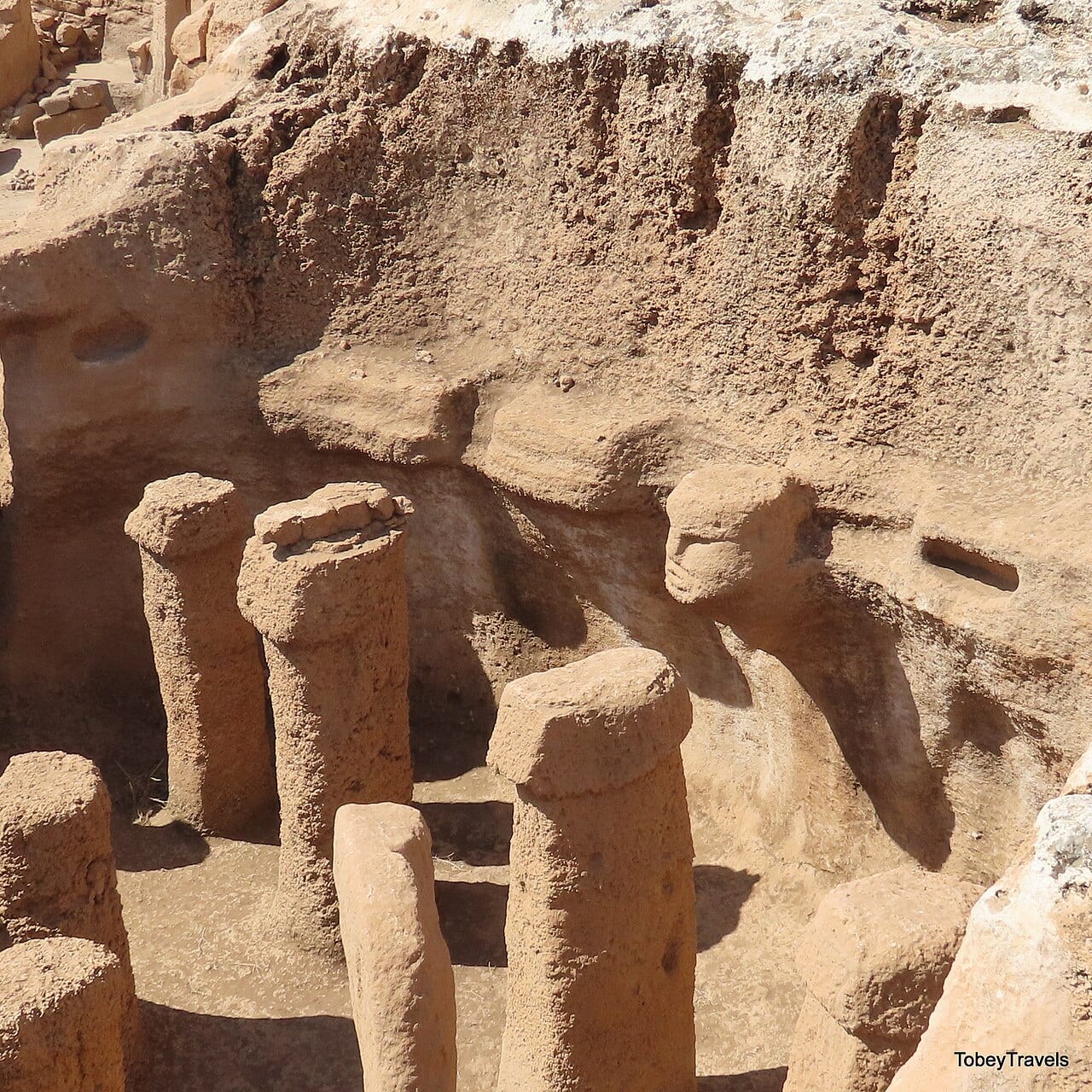
Structure AB at Karahan Tepe, cut into the bedrock, 2025. Photo: tobeytravels, CC BY-SA 4.0, via Wikimedia Commons.
- The carved human head projecting from the wall
- Stone pillars standing in the floor of the room
- The bedrock, carved back to form the room's walls
Sayburç lies about 25 miles from Göbekli Tepe, under a modern village. In 2021 Eylem Özdoğan's team found a relief 3.7 meters long on a bench in a round building. It shows five figures: a seated man holding his penis between two leopards, and a second man facing a bull.2023 The Archaeology magazine report of March 2024 called it "the most detailed depiction of a Neolithic 'story' found to date in the Near East."20 By 2026 nearly 70 structures had been uncovered at Sayburç across 2,700 square meters, including houses as well as communal buildings, and Turkey plans to make it an open-air museum.24
The emerging picture is a region of villages and gathering places sharing a world of images, with Göbekli Tepe as one of its largest and longest-lived sites. Karahan Tepe and Sayburç also show people living right next to their carved buildings, which fits the revised view of Göbekli Tepe.2024
The excavators also map the hunting landscape around these sites.
The Vulture Stone and the comet
In 2017 the chemical engineer Martin Sweatman and Dimitrios Tsikritsis published a reading of Pillar 43 as a sky map. They took the animals for constellations and the disc for the sun, and dated the scene to 10,950 BCE, give or take 250 years. They tied it to a comet strike at the start of the Younger Dryas, a sudden cold spell at the end of the last Ice Age.2517
The excavators replied in the same journal. Their main points:17
- None of the buildings is fully excavated, many pillars have been moved and reused, and the rooms may have been roofed, which would limit their use for watching the sky.
- Sweatman's date is 700 to 1,000 years older than the oldest radiocarbon date for Enclosure D. The site's dates mark "rather the end than the beginning of the Younger Dryas."
- There is no reason to think hunters in the tenth millennium BCE saw the same constellations later named by Egyptian, Arabian and Greek astronomers.
- More than 60 pillars are known, and similar images appear on objects across the region. Picking one pillar and leaving out its context is "extremely problematic."
- The headless man has an emphasized erect penis, which sits oddly with a symbol of death and extinction.
Sweatman answered that "any interpretation inconsistent with [theirs] is very likely to be incorrect." The team replied that they doubt "human creativity really can be treated as a statistical case solely."17 Their FAQ says that so far no link between astronomy and the orientation of the pillars or buildings has been found.1
In 2024 Sweatman went further, arguing in the journal Time and Mind that the V-shaped marks on Pillar 43 count days in a 365-day calendar, 12 lunar months plus 11 extra days, and that the pillar records a comet strike in 10,850 BCE.26 The press coverage quoted no archaeologist who accepts it.26
The comet idea it rests on has also lost ground. The Younger Dryas impact hypothesis claims a comet or its fragments struck Earth around 12,900 years ago. A 2023 review in Earth-Science Reviews by Vance Holliday and colleagues, titled "Comprehensive refutation of the Younger Dryas Impact Hypothesis," found flawed methods, irreproducible results and no crater of the right age, and its authors stood by it in a 2024 reply to Sweatman and others.27 On current evidence, the comet readings of Pillar 43 are fringe.
Ancient Apocalypse
Göbekli Tepe is the centerpiece of the writer Graham Hancock's argument that an advanced Ice Age civilization was wiped out by a cataclysm and passed its knowledge to hunter-gatherers. His Netflix series Ancient Apocalypse began airing on 11 November 2022.2829 On the show he says the site "very strongly speaks of a lost civilization," and he uses the comet reading of Pillar 43.30
The archaeologist Flint Dibble noted that Göbekli Tepe is "the only site Hancock visits that actually dates to near the end of the ice age."31 Carl Feagans, reviewing the episode, pointed out that the site's age is known because archaeologists dated it, that it was built over about 1,500 years, around 60 generations, leaving plenty of time to learn, and that a teaching civilization "would have left a trace both archaeologically and genetically."30 The Society for American Archaeology wrote to Netflix on 30 November 2022 saying the series "publicly disparages archaeologists and devalues the archaeological profession on the basis of false claims and disinformation," that there is "no archaeological evidence to support the existence of an 'advanced, global Ice Age civilization'," and that the theory "has a long-standing association with racist, white supremacist ideologies." It asked Netflix to reclassify the series and add disclaimers.28 In April 2024 Dibble debated Hancock on the Joe Rogan Experience.32
A related claim is that archaeologists are dragging their feet or hiding what remains buried. The YouTuber Jimmy Corsetti made that accusation on Rogan's podcast in November 2024. Clare's answer, in 2025: "You can't just bulldoze a site to get everything out. That's the wrong approach." He also said: "Some of these guys go to the site for half an hour and think they can explain the whole site."29 The team's FAQ says it digs only as much as needed to answer open questions, because excavation destroys context.1 The same FAQ ends with the question "Is it true that aliens built the Göbekli Tepe special buildings?" The whole answer is: "No."1
World Heritage and visiting
UNESCO inscribed Göbekli Tepe in 2018, calling it "one of the first manifestations of human-made monumental architecture."4 Turkey had protected the mound and the limestone plateau around it as a first-degree archaeological site since 2005.4 The site is open to visitors and signposted from Şanlıurfa. The excavated area is covered by permanent shelters and viewed from walkways, and the fenced dig itself is off limits.1
Footnotes
-
Göbekli Tepe Research Project (DAI), "FAQ," Tepe Telegrams (read from an archived copy; discovery, special buildings A to H, dating, size, settlement reinterpretation, filling, roofs, astronomy, "temple," aliens). dainst.blog ↩ ↩2 ↩3 ↩4 ↩5 ↩6 ↩7 ↩8 ↩9 ↩10 ↩11 ↩12 ↩13 ↩14 ↩15 ↩16 ↩17 ↩18 ↩19 ↩20 ↩21 ↩22 ↩23 ↩24 ↩25 ↩26 ↩27 ↩28
-
Andrew Curry, "Gobekli Tepe: The World's First Temple?," Smithsonian Magazine, November 2008 (read from an archived copy; Schmidt's view, the 1960s dismissal, Hodder quote). smithsonianmag.com ↩ ↩2 ↩3 ↩4 ↩5 ↩6 ↩7 ↩8 ↩9 ↩10
-
Göbekli Tepe Research Project (DAI), "The Site," Tepe Telegrams (read from an archived copy; size, 1994 rediscovery with Akman and Morsch, phasing, Enclosure D pillars, male imagery). dainst.blog ↩ ↩2 ↩3 ↩4 ↩5 ↩6 ↩7 ↩8 ↩9 ↩10 ↩11 ↩12
-
UNESCO World Heritage Centre, "Göbekli Tepe," World Heritage List no. 1572, inscribed 2018 (read from an archived copy; dates 9,600 to 8,200 BCE, domestic structures, criteria, legal protection). whc.unesco.org ↩ ↩2 ↩3 ↩4 ↩5 ↩6
-
Andrew Curry, "Last Stand of the Hunter-Gatherers?," Archaeology, May/June 2021 (summary of the article; Clare and Kinzel quoted). archaeology.org ↩ ↩2 ↩3 ↩4 ↩5 ↩6 ↩7 ↩8
-
Oliver Dietrich, "Out for a beer at the dawn of agriculture," Tepe Telegrams, 24 April 2016 (read from an archived copy), summarizing O. Dietrich, M. Heun, J. Notroff, K. Schmidt and M. Zarnkow, "The role of cult and feasting in the emergence of Neolithic communities," Antiquity 86(333), 2012, 674-695 (not read). dainst.blog ↩ ↩2 ↩3
-
M. Heun et al., "Site of Einkorn wheat domestication identified by DNA fingerprinting," Science 278, 1997, 1312-1314 (not read; cited through the Tepe Telegrams beer post in footnote 13). science.org ↩
-
Wikipedia, "Urfa Man" (secondary source; 1993 find, height, obsidian eyes, date, citing Schmidt 2006). en.wikipedia.org ↩
-
Jens Notroff, "A Sanctuary … or so fair a House?," Tepe Telegrams, 24 January 2017 (read from an archived copy; springs, cisterns of 153 cubic meters after Herrmann and Schmidt 2012, Urfa Man, reply to Banning). dainst.blog ↩ ↩2 ↩3 ↩4 ↩5
-
Wikipedia, "Göbekli Tepe" (secondary source; Benedict and the grave markers, cistern capacity of at least 150 cubic meters citing Clare 2020, terrace walls). en.wikipedia.org ↩ ↩2 ↩3
-
Göbekli Tepe Research Staff, "Over twenty-five years of research at Göbekli Tepe!," Tepe Telegrams, 16 January 2023 (read from an archived copy; Örencik villagers, directors, team list). dainst.blog ↩ ↩2 ↩3
-
Tepe Telegrams, "Emblematic signs? On the iconography of animals at Göbekli Tepe," 16 August 2016 (read via an archived copy of the blog's data feed; dominant animal per enclosure, "a Stone Age zoo"). dainst.blog ↩ ↩2
-
Oliver Dietrich, "Of animals and a headless man. Göbekli Tepe, Pillar 43," Tepe Telegrams, 14 October 2016, updated 2017 (read from an archived copy). dainst.blog ↩ ↩2
-
Julia Gresky, Juliane Haelm and Lee Clare, "Modified human crania from Göbekli Tepe provide evidence for a new form of Neolithic skull cult," Science Advances 3(6), e1700564, 28 June 2017 (abstract and press summaries). pmc.ncbi.nlm.nih.gov ↩
-
E. B. Banning, "So Fair a House: Göbekli Tepe and the Identification of Temples in the Pre-Pottery Neolithic of the Near East," Current Anthropology 52(5), 2011, 619-660 (not read; argument from search summaries and the DAI reply). journals.uchicago.edu ↩
-
Lee Clare, "Göbekli Tepe, Turkey. A brief summary of research at a new World Heritage Site (2015–2019)," e-Forschungsberichte des DAI 2020(2), 81-88 (abstract only; the full PDF could not be loaded). publications.dainst.org ↩ ↩2
-
Jens Notroff, "More than a vulture: A response to Sweatman and Tsikritsis," Tepe Telegrams, 3 July 2017 (read from an archived copy), summarizing J. Notroff, O. Dietrich, L. Clare, L. Dietrich, J. Schlindwein, M. Kinzel, C. Lelek-Tvetmarken and D. Sönmez, Mediterranean Archaeology and Archaeometry 17(2), 2017, 57-63. dainst.blog ↩ ↩2 ↩3 ↩4 ↩5
-
Laura Dietrich, Julia Meister, Oliver Dietrich, Jens Notroff, Janika Kiep, Julia Heeb, André Beuger and Brigitta Schütt, "Cereal processing at Early Neolithic Göbekli Tepe, southeastern Turkey," PLOS ONE 14(5), e0215214, 2019 (first part of the full text read). pmc.ncbi.nlm.nih.gov ↩ ↩2 ↩3 ↩4
-
Moritz Kinzel and Lee Clare, "Monumental – compared to what? A perspective from Göbekli Tepe," in Monumentalizing Life in the Neolithic, Oxbow, 2020, 29-48 (not read; cited through Wikipedia for the slope slide and the old wood effect). jstor.org ↩ ↩2
-
Tolga İldun, "Discovering a New Neolithic World," Archaeology, March/April 2024 (summary of the article; Karahan Tepe, Sayburç, Karul quoted, trapping areas). archaeology.org ↩ ↩2 ↩3 ↩4 ↩5 ↩6 ↩7
-
Wikipedia, "Karahan Tepe" (secondary source; distance, 1997 discovery by Bahattin Çelik). en.wikipedia.org ↩
-
Archaeology Magazine (archaeologymag.com), "Statues found in Göbekli Tepe and Karahan Tepe," 3 October 2023 (Ministry of Culture and Tourism announcement). archaeologymag.com ↩
-
Eylem Özdoğan, "The Sayburç reliefs: a narrative scene from the Neolithic," Antiquity 96(390), 2022, 1599-1605 (not read; details through Wikipedia, "Sayburç"). en.wikipedia.org ↩
-
Hürriyet Daily News, "Karahantepe, Sayburç reveal major turning point in human history," 21 August 2026. hurriyetdailynews.com ↩ ↩2
-
Martin B. Sweatman and Dimitrios Tsikritsis, "Decoding Göbekli Tepe with archaeoastronomy: what does the fox say?," Mediterranean Archaeology and Archaeometry 17(1), 2017 (not read; claim and date as summarized in the reply). research.ed.ac.uk ↩
-
NPR via KUNC, "The world's oldest solar calendar may have been unearthed in Turkey," 11 August 2024, on M. B. Sweatman, Time and Mind, 2024, doi 10.1080/1751696X.2024.2373876 (paper not read). kunc.org ↩ ↩2
-
Vance T. Holliday et al., "Comprehensive refutation of the Younger Dryas Impact Hypothesis (YDIH)," Earth-Science Reviews 247, 104502, 2023, and the authors' "Rebuttal of Sweatman, Powell and West's rejection of Holliday et al.," Earth-Science Reviews 258, 2024 (abstracts only). pure.royalholloway.ac.uk ↩
-
Society for American Archaeology, open letter to Netflix and ITN on Ancient Apocalypse, 30 November 2022 (read in full from an archived copy). documents.saa.org ↩ ↩2
-
Rebecca Rosman, "An ancient archaeological site meets conspiracy theories and Joe Rogan," NPR, 9 August 2025, via KPBS (Clare quoted; Corsetti on Rogan, November 2024). kpbs.org ↩ ↩2
-
Carl Feagans, "Fitting the Sky to the Ground. A Review of Ancient Apocalypse 5 and 6," A Hot Cup of Joe, 5 December 2022 (Hancock quoted). ahotcupofjoe.net ↩ ↩2
-
Flint Dibble, "With Netflix's Ancient Apocalypse, Graham Hancock has declared war on archaeologists," The Conversation, republished by Raw Story, 21 November 2022. rawstory.com ↩
-
University of Alberta Anthropology, "Flint Dibble and Graham Hancock on Joe Rogan: Key Takeaways," 18 April 2024 (teaser only; the body did not load). ualberta.ca ↩