Place · Avella, Pennsylvania, USA
Meadowcroft Rockshelter
A sandstone overhang in Pennsylvania where people may have camped 16,000 years ago, and an argument that has run for fifty years.
Visited July 2026

Overview
Meadowcroft Rockshelter is a shallow cave under a sandstone cliff, above Cross Creek in Washington County, about 27 miles west-southwest of Pittsburgh.1 People used it, on and off, for a very long time. The site's own excavators say the layers record at least 16,000 years of intermittent use, and possibly 19,000.2 If the oldest dates hold up, Meadowcroft is one of the earliest signs of people in the Americas, and it sits in a part of the continent that was close to the edge of the Ice Age glaciers.
The word "if" matters. Meadowcroft has been argued over since the 1970s. The excavator, James Adovasio, has called it "a late-Pleistocene Holiday Inn": high and dry, well ventilated, with fresh water just below.3 Critics have asked whether the charcoal used for the oldest radiocarbon dates was contaminated by old carbon, and whether the plants and animals fit the claimed age.4 Both sides are serious archaeologists, and the argument is a good way to learn how archaeology works.
It is also a place you can visit. The site is run by the Heinz History Center, and tours of the rockshelter are part of a larger outdoor museum with reconstructed villages from later centuries.5 Digging began in 1973, the site went onto the National Register of Historic Places in 1978, and it became a National Historic Landmark in 2005.1
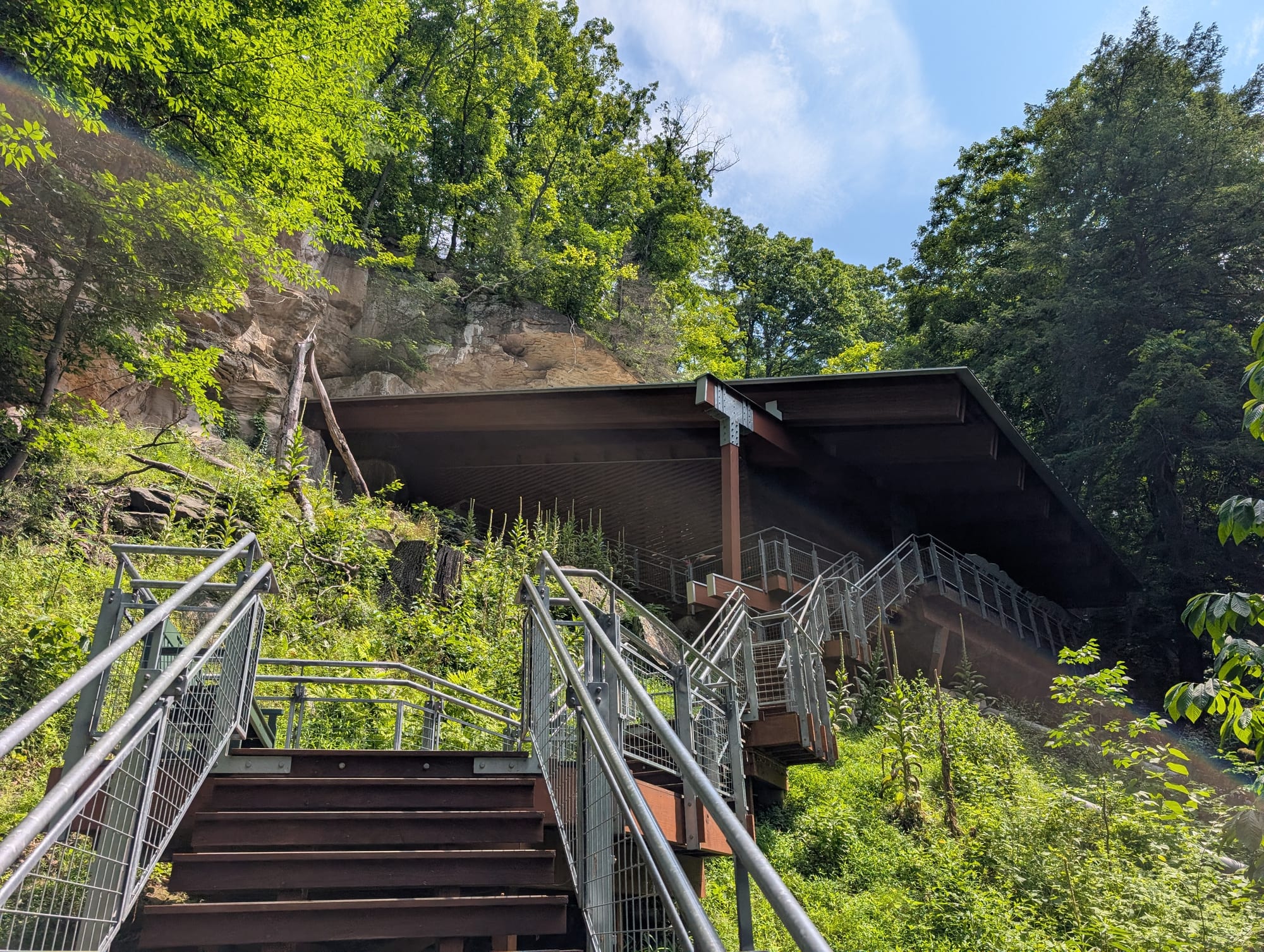
The climb up to the rockshelter, July 2026. The shelter sits high on the hillside, under the cliff.
- The sandstone cliff; the shelter is under its overhang
- The enclosure built over the rockshelter to protect the dig
- Stairs up from the visitor path
- ~16,000 years ago Oldest firepits The lowest hearths in Stratum IIa; the 1978 report allowed up to 19,000 years.
- ~13,000 years ago Clovis era Clovis points appear across North America.
- 1973 Digging begins James Adovasio's University of Pittsburgh team starts work, after a 1955 find in a groundhog burrow.
- 2005 National Historic Landmark Listed on the National Register in 1978, then made a landmark.
- 2026 Visited A summer tour of the rockshelter.
Older times are squeezed together so the whole span fits.
In context
For most of the twentieth century the standard story was called Clovis-first. Clovis people, known from fluted stone spear points, were thought to be the first Americans, crossing from Siberia and moving south once an ice-free corridor opened. Their sites were dated to roughly 13,000 years ago in calendar years.6 Any older claim had to clear a high bar.
That bar has been lowered by a slow pile of evidence. Stemmed points beneath Clovis layers at the Friedkin site in Texas have been dated to roughly 13,500 to 15,500 years ago.7 Footprints at White Sands, New Mexico, have been dated to between about 21,000 and 23,000 years ago, a result that was challenged and then tested again with independent methods.8 Meadowcroft was one of the first sites to push on the door. Adovasio later put it this way: "Meadowcroft set the evidentiary bar! Monte Verde broke it!"9
The other piece of context is that the Meadowcroft people did not look like Clovis people. Their stone toolkit is small, with thin blades and a simple unfluted point. They may have been generalist foragers, not big-game hunters.9
Monte Verde, in Chile, was the site that finally shifted the argument.
Two books in the Library tell this story at length.
Research
The dating debate
The oldest material at Meadowcroft comes from Stratum IIa, where excavators found shallow, basin-shaped firepits on the lowest living floors.12 More than 50 radiocarbon dates were taken, mostly from hearth charcoal, and they run in order from bottom to top.3 A 1990 chronology by Adovasio, Donahue and Stuckenrath added accelerator mass spectrometry dates from Oxford. The team argued the data still make Meadowcroft "the best-dated evidence" for people south of the glacial front.13
The critique came in 1980, in the same issue of American Antiquity as the site's own defense. C. Vance Haynes asked whether the charcoal was contaminated,14 and Jim Mead argued that the plants and animals did not match the claimed age.15 The reply, "Yes, Virginia, It Really Is That Old," came from Adovasio and colleagues, who said the dates fit the fauna, flora and local geology, and called attachment to Clovis-first outdated.16
The contamination worry is specific. The watershed contains coal, which is old enough to have no radiocarbon left. If tiny particles of coal, or dissolved carbon from it, got into a charcoal sample, the date would come out too old. Tankersley and Munson raised this again in 1992, noting that the site's investigators concluded contamination had not affected the dates but arguing that questions remained, and they suggested specific tests.17 The critics' focus is on the eleven oldest samples.12
Adovasio's answers have three parts. The dates are in stratigraphic order. The samples come from fire features with clear human activity around them. And a study of the sediments found no groundwater movement that could have carried dissolved carbon into the deposits.12 Critics also point out that the oldest layers have very little to show for the claimed age: only eleven identifiable animal bones and under 12 grams of plant remains came from the middle and lower parts of Stratum IIa.18 Adovasio says the animals and plants that do appear are species known from the late Ice Age in eastern North America.12
Deep Dive: Where opinion stands
When the first dates came out in the 1970s, most specialists still held to Clovis-first. The 1980 exchange in American Antiquity set out the case against it. C. Vance Haynes asked whether the hearth charcoal had been contaminated with old carbon.14 Jim Mead argued that the plants and animals were "discordant with other local Wisconsinan-age fossils," meaning other late Ice Age finds from the region.15 Kenneth Tankersley and colleagues pressed the coal question in 1987 and again in 1992.1917
The excavators answered with tests. Their 1990 chronology reported more than 50 dates in consistent order, added accelerator dates from Oxford, and concluded that people were in southwestern Pennsylvania by 14,000 to 14,500 years ago.13 One test split a sample from Stratum I, below the human layers, into its solid charcoal and the part that dissolves in alkali. Oxford dated the two parts to 31,400 ± 1,200 and 30,900 ± 1,100 years, close to an earlier Smithsonian date of 30,710 ± 1,140. If groundwater had carried dissolved old carbon into the charcoal, the excavators argued, the parts should have differed. They also reported that no lab had found coal particles in the Ice Age samples under the microscope.19 In 1999 Paul Goldberg and Trina Arpin examined thin slices of the sediments and found "no evidence of groundwater contamination of the early levels." David Meltzer wrote in 2002 that this objection had been "effectively rebutted."19
Adovasio has summed up the remaining criticisms as three: possible contamination of the eleven oldest samples, the absence of Ice Age animals, and plant remains that look out of place.20
- Contamination: some reviewers point out that the humates in Meadowcroft charcoal samples, the dissolved soil organic matter removed in the lab's alkali wash, are older than the charcoal itself.1
- Sparse fauna and flora: lower Stratum IIa produced only 11 bone fragments, all from animals found in temperate climates today, such as white-tailed deer, chipmunk, flying squirrel and passenger pigeon. The plant remains are walnut and oak charcoal and walnut shell.19
- What was dated: the three oldest dates, 19,100 to 21,070 radiocarbon years, came from material "of uncertain, but possible cultural origins." The 19,600 date is on a piece of bark that may have been cut for a basket, or may have burned in a forest fire.19 The artifacts are dated through the hearths around them, and the age of the Miller point, about 14,000 years, "remains to be confirmed."21
The wider field then moved. In 1997 a panel of specialists, Haynes among them, visited Monte Verde in Chile and agreed its main layer was "both archaeological and 12,500 years old," in radiocarbon years.22 Later work added Page-Ladson in Florida, about 14,550 years old; human coprolites (preserved feces) with Native American DNA at Paisley Caves in Oregon, about 14,150 years old; and the Friedkin site in Texas, about 15,500 to 13,500 years old. Michael Waters, reviewing the field in Science in 2019, called the evidence for people in the Americas by about 15,000 years ago "secure."23 The White Sands footprints later pushed the possible range back to 21,000 to 23,000 years.8
Opinion on Meadowcroft itself stayed split. In a 2011 poll of researchers, published in 2012, Monte Verde was the most accepted pre-Clovis site at 67 percent and Paisley Caves came second at 43 percent.24 The Associated Press reported the Meadowcroft result as about 38 percent agreeing with the dates, 38 percent unsure and 20 percent disagreeing.25 Recent reviews still hedge. Waters (2019) lists Meadowcroft under "compelling but equivocal evidence." He says about 700 Stratum IIa artifacts "may date between ~15 and ~14 ka ago," but that the site "remains equivocal because of concerns about the early radiocarbon ages."23 A 2018 letter in Science by Ben Potter and 13 colleagues, Haynes among them, said there is "no consensus on the validity of purported pre–16,000-year-old sites."26 Other researchers are more accepting. A 2018 population study used Meadowcroft, Paisley Caves and Page-Ladson as "the few most widely accepted pre-Clovis sites."27 A 2024 Popular Archaeology feature describes the controversy as having "evolved to one of broad acceptance."20
The site's own page calls it the oldest site of human habitation in North America.5 Adovasio has argued that even a cautious reading puts people there at the same time as Clovis, with a different technology.3 The fair short version is that people were probably at Meadowcroft before Clovis, and the older the date, the more room there is for doubt.
How it was dug
Meadowcroft is known for fine-grained excavation. Students were trained to tell strata apart by texture, meaning how compact, crumbly, dense or porous the sediment felt under a trowel. Thin occupation surfaces were exposed with a single-edged razor blade. Each artifact and each bone was plotted in three dimensions, first by hand and later with total stations, and sediment from each stratum was run through an adapted blood-cell counter to measure grain size.12 That level of care was meant to answer the critics in advance. About a third of the site has not been excavated.12
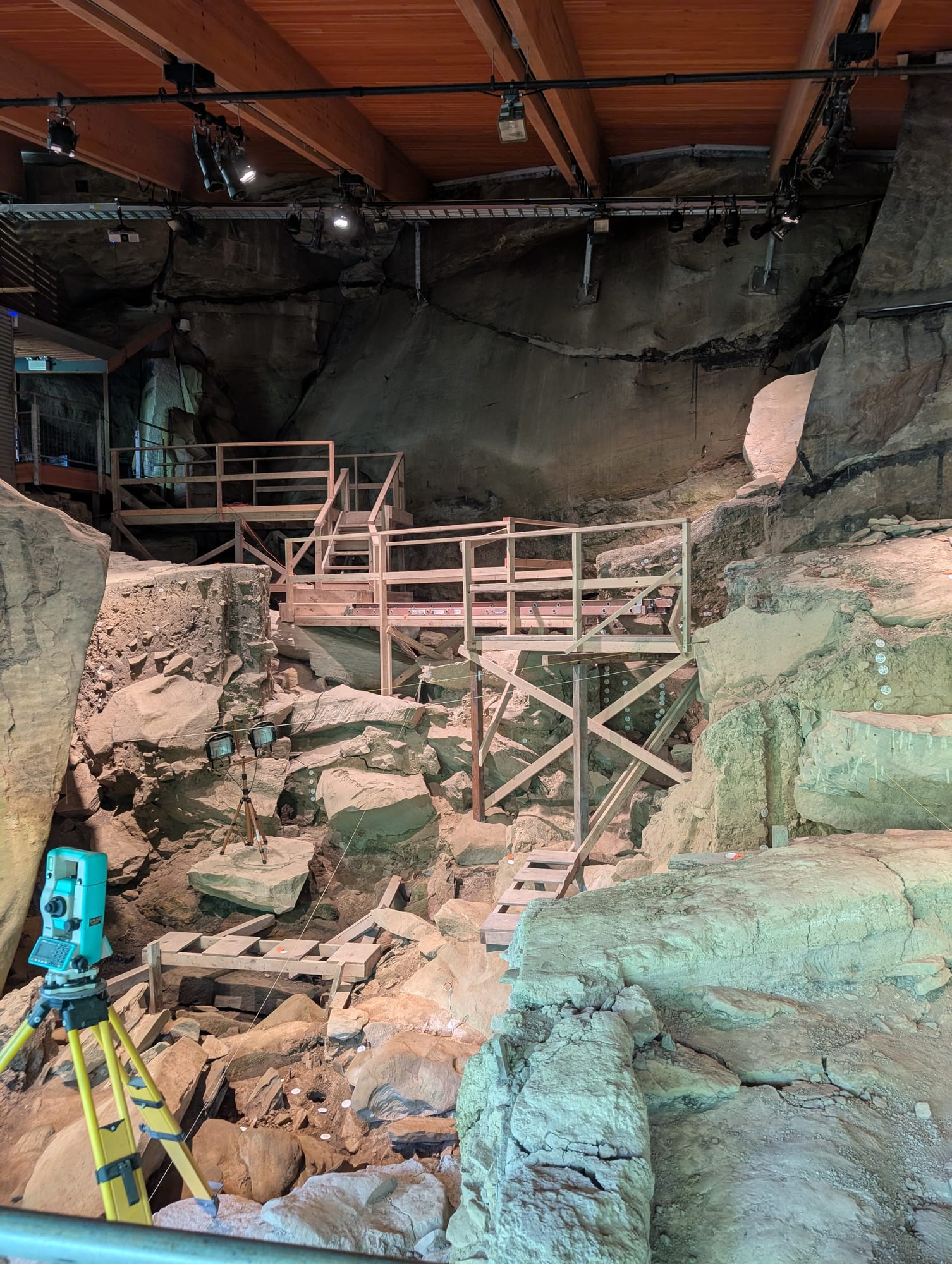
Inside the enclosure, July 2026. The excavation is left open, with its survey gear still in place.
- A total station, the survey instrument used to plot each find in three dimensions
- Wooden walkways built above the deposits
- The rock wall of the shelter
- Small markers pinned into the excavated wall
The shelter's story is also written in rock. Roof spalling and block collapse changed the floor space several times. One collapse about 13,000 to 14,000 years ago trapped older material beneath it.3
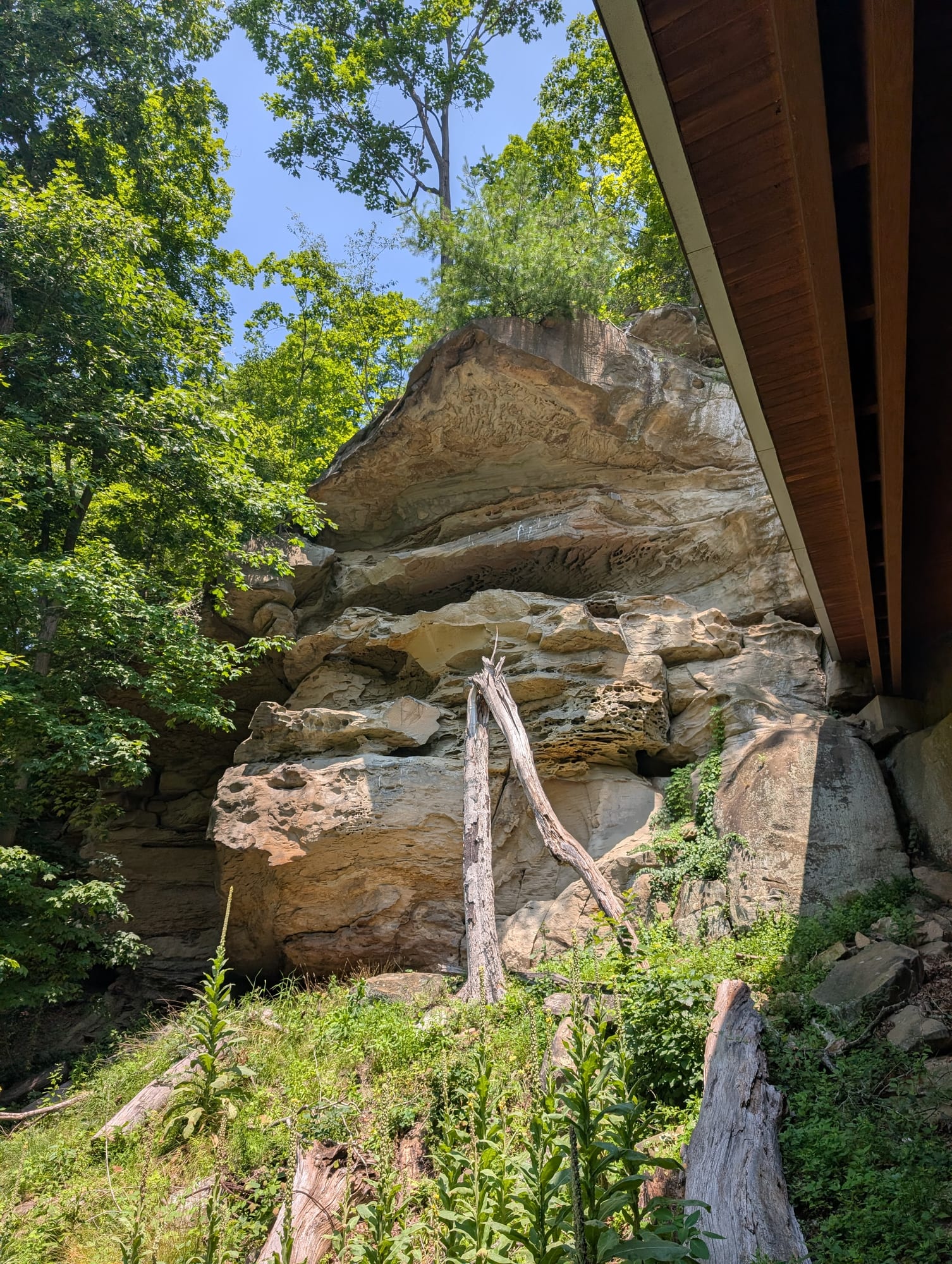
The cliff just outside the enclosure, July 2026. The same sandstone forms the shelter's roof.
- The sandstone cap
- An overhang, where the softer rock beneath has worn back
- Blocks that have fallen from the face
- The edge of the enclosure's roof
What was found
The Stratum IIa toolkit is called the Miller complex. It includes small prismatic blades struck from small prepared cores, thin bifaces, and an unfluted lanceolate point found on the uppermost floor of lower Stratum IIa in 1976. That point is the Miller Lanceolate, named for Albert Miller.1218 Raw materials include local Cross Creek chert plus chert from Ohio, New York and West Virginia, which Adovasio reads as evidence of trade or long-distance movement.12
Across all layers, the site has produced 115,166 identifiable bones and fragments from more than 140 species, which makes it one of the richest animal collections of its kind.18 The oldest levels are far thinner than that total suggests. Adovasio reads the earliest users as seasonal visitors, mainly in fall, who ate a broad mix of foods.12
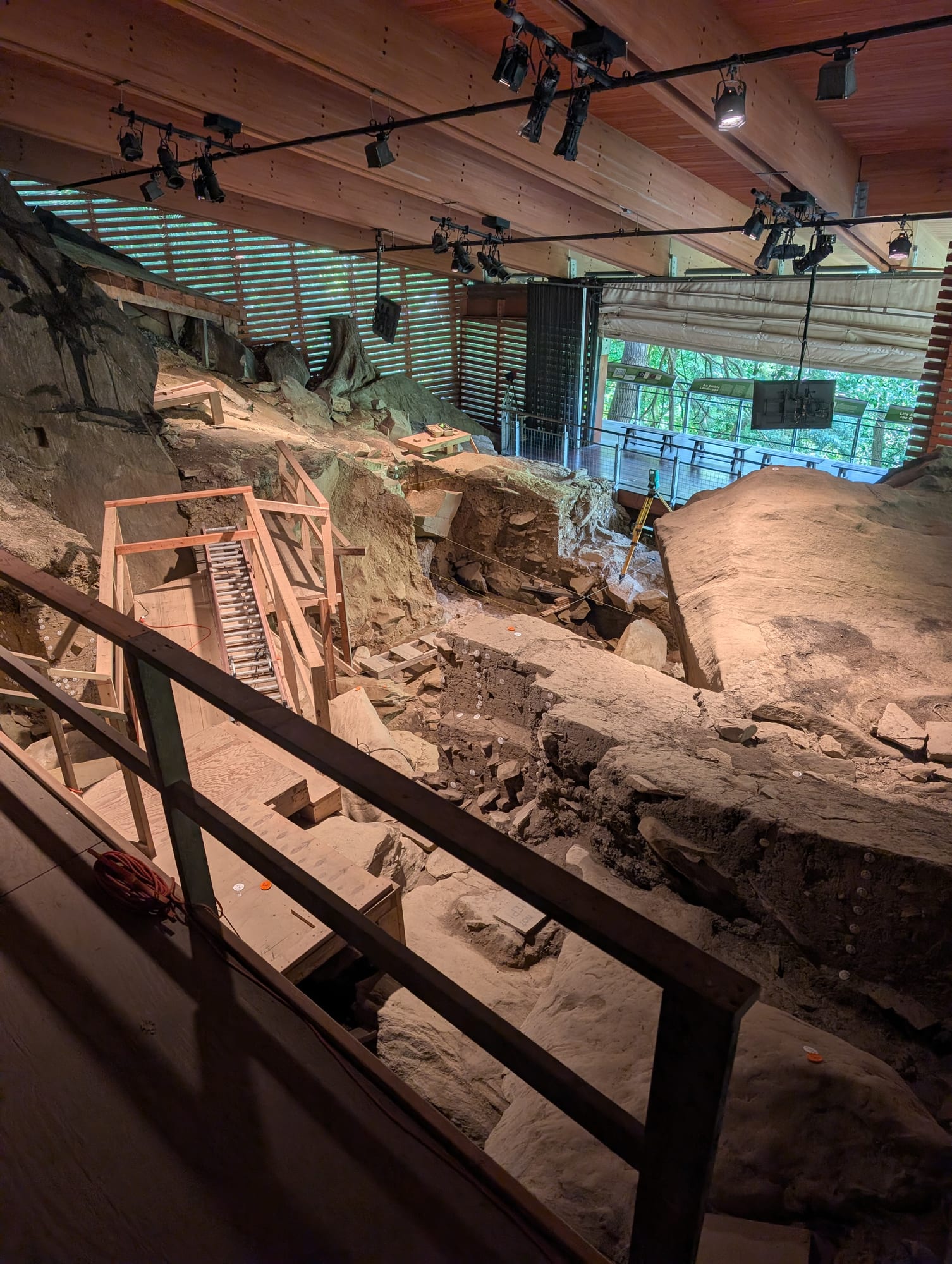
Looking down into the excavation, July 2026.
- Dark bands in the cut wall: layers of sediment that built up over time
- A large sandstone block; roof falls like this changed the floor several times
- A survey instrument on its tripod
- Stairs down into the excavation
What it means now
Meadowcroft is no longer the lone outlier it once was. Sites in Texas, Chile and New Mexico now back the idea that people were in the Americas well before Clovis, even if each has its own disputes.7810 That shifts the question from "was anyone here before Clovis?" to "how early, by what route, and which sites can we trust?" For Meadowcroft, the open questions are the deepest dates and how much to read into a small set of early artifacts. Its main legacy may be the quality of the excavation, which gave everyone a record to argue with.
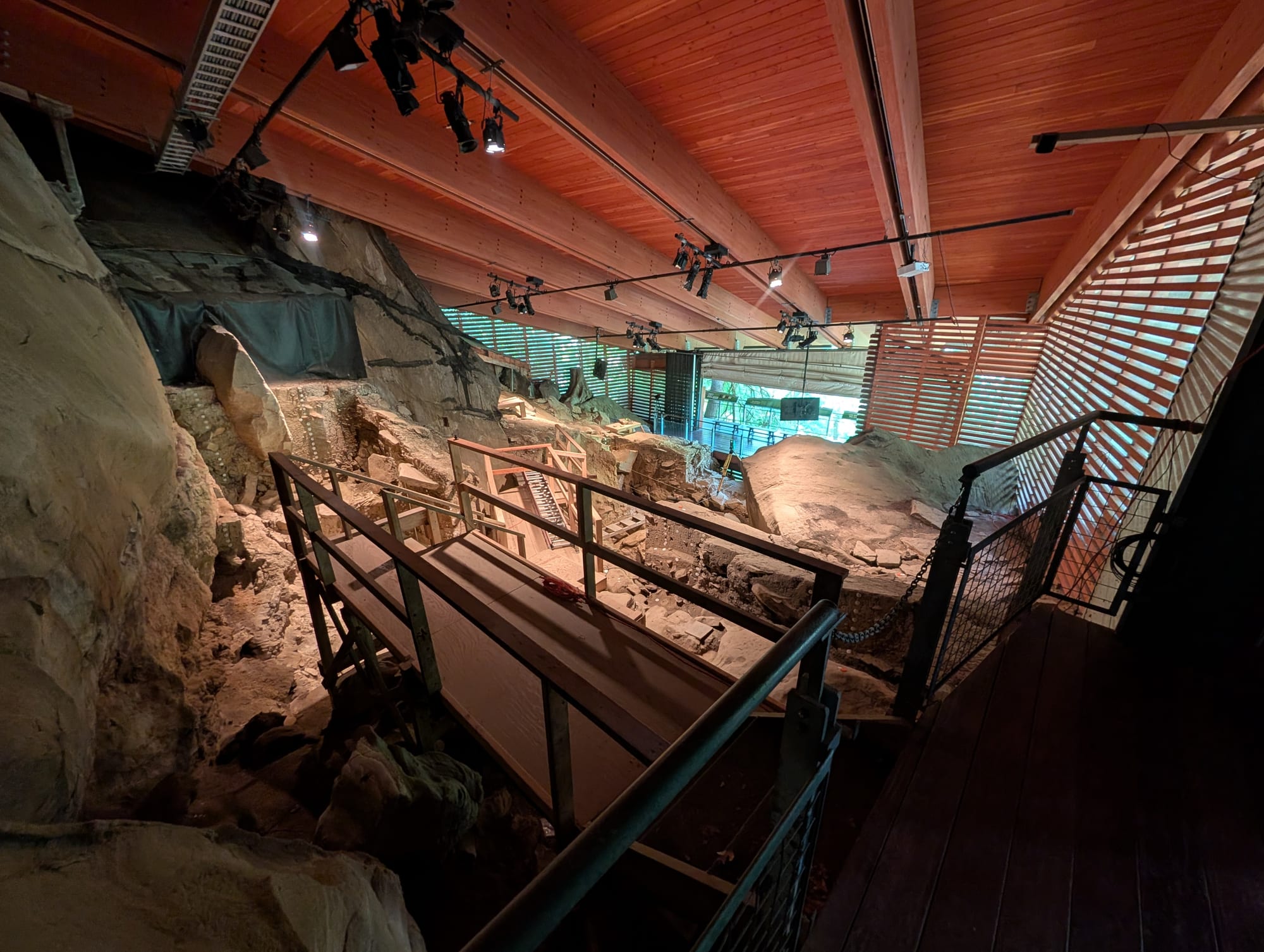
The rockshelter today, under its protective roof, July 2026.
- The excavated floor of the shelter
- The rock wall of the overhang
- The visitor walkway
- The modern roof
Radiocarbon dating works by counting what is left of an unstable carbon atom.
Deep Dive: Calibration: BP versus calendar years
A radiocarbon lab measures how much carbon-14 is left in a sample compared with a modern standard. It turns that into an age using two fixed assumptions: that the air always held as much carbon-14 as it did in 1950, and that carbon-14 has a half-life of 5,568 years.2930 The result is the conventional radiocarbon age, written BP (before present) or RCYBP (radiocarbon years before present), where "present" is AD 1950.29 The true half-life is about 5,730 years. Labs keep the older figure so that dates stay comparable, and calibration corrects for the difference.31
The bigger problem is that the air's carbon-14 has changed over time.29 In the late Ice Age it was much higher. Between 16,000 and 20,000 calendar years ago the air held roughly 30 to 45 percent more carbon-14 than in 1950.32 So samples from then look too young. A date of 16,000 radiocarbon years, for example, calibrates to about 19,300 calendar years ago.33 Calibrated dates are written cal BP, meaning calendar years before 1950.29
A calibration curve records what radiocarbon age material of known calendar age gives. The current curve for the Northern Hemisphere is IntCal20, published in 2020, which runs back 55,000 years. Tree rings, counted year by year, carry it back to about 13,900 years ago. Older than that, it combines floating tree-ring sequences, lake and ocean sediments, speleothems (cave formations such as stalagmites) and corals. The lake record from Lake Suigetsu in Japan uses varves, thin yearly layers that can be counted. Each archive is corrected for its own offset from the air.32 A calibrated date is a spread of probability across calendar years: the range where the true age falls with a stated probability, usually 95 percent. Because the curve wiggles, one measurement can give several separate ranges.29
A reservoir effect happens when carbon reaches a sample by way of the ocean, which holds older carbon than the air. Trees take carbon straight from the air, so this matters less for wood charcoal.31 Contamination is the Meadowcroft issue. Coal is millions of years old and has no carbon-14 left, so any coal carbon in a sample makes it read too old. By the standard age equation, 1 percent of such "dead" carbon adds about 80 radiocarbon years. Making a 12,500-year sample read 16,000 would take about 35 percent.33 That matches the excavators' statement that "nearly 35 percent of the sample would have to be coal."19 Labs try to remove such material with chemical pretreatment before dating.31
Conventional dating counts the radiation from atoms as they decay, which takes weeks and a large sample. Accelerator mass spectrometry (AMS) counts the carbon-14 atoms directly, so samples can be about a thousand times smaller and cleaned more selectively. Small samples have their own risks: they move more easily within a deposit, and contaminants are harder to control.34 The Stratum IIa dates carry Smithsonian lab numbers (SI-). When Oxford ran AMS tests in 1990 no Stratum IIa sample was left, so the test used Stratum I.19
The key Meadowcroft dates, as raw radiocarbon ages, with 95 percent calibrated ranges worked out for this page:1933
- Lower Stratum IIa hearths: five dates from 16,175 ± 975 (SI-2354) down to 13,240 ± 1,010 (SI-2065). These calibrate to about 22,100 to 17,300 cal BP, centered near 19,600, and about 18,300 to 13,200 cal BP, centered near 15,800.
- Lowest Stratum IIa, possibly cultural: 19,600 ± 2,400 (SI-2060) spreads across about 28,700 to 18,100 cal BP. The other two, 21,070 ± 475 and 19,100 ± 810, come out near 26,300 to 24,200 and 25,000 to 21,100 cal BP.
- Middle Stratum IIa, above a roof fall: 12,800 ± 870 (SI-2489) gives about 17,600 to 13,100 cal BP. This date belongs to the layer above the oldest floors.
Published conversions are rarer. Popular Archaeology gives 16,000 radiocarbon years as about 19,000 calendar years.20 Waters's estimate of about 15,000 to 14,000 calendar years for the Stratum IIa artifacts is far more cautious than the raw hearth dates.23 For comparison, Clovis at about 10,900 to 11,300 radiocarbon years9 calibrates to about 12,800 to 13,200 cal BP.33 At these ages the curve's own uncertainty is under 50 radiocarbon years. Most of the width in the Meadowcroft ranges comes from the large errors on the 1970s measurements.33
Footnotes
-
Wikipedia, "Meadowcroft Rockshelter" (secondary source; location, 27 miles from Pittsburgh, 1955 find). en.wikipedia.org ↩ ↩2 ↩3
-
J. M. Adovasio, J. D. Gunn, J. Donahue and R. Stuckenrath, "Meadowcroft Rockshelter, 1977: An Overview," American Antiquity 43(4), 1978 (abstract: 11 stratigraphic units spanning at least 16,000 and possibly 19,000 years). cambridge.org ↩
-
Archaeology magazine, "Meadowcroft Rockshelter," Peopling the Americas series, September/October 2014 (Adovasio quoted). archaeology.org ↩ ↩2 ↩3 ↩4
-
K. B. Tankersley and C. A. Munson, "Comments on the Meadowcroft Rockshelter Radiocarbon Chronology and the Recognition of Coal Contaminants," American Antiquity 57(2), 1992 (abstract). cambridge.org ↩
-
Heinz History Center, "Meadowcroft Rockshelter and Historic Village." heinzhistorycenter.org ↩ ↩2
-
Michael R. Waters et al., "Pre-Clovis projectile points at the Debra L. Friedkin site, Texas," Science Advances 4(10), 2018 (Clovis-complex points by about 13 thousand years ago; body text 12.7 to 13 thousand years). pmc.ncbi.nlm.nih.gov ↩
-
Waters et al., 2018, as above (stemmed points about 13.5 to 15.5 thousand years old, dated by optically stimulated luminescence). pmc.ncbi.nlm.nih.gov ↩ ↩2
-
USGS publication record for the 2023 Science study testing the White Sands seed ages with independent methods; the original 2021 claim was by M. R. Bennett et al., Science, 2021. usgs.gov ↩ ↩2 ↩3
-
Interview with James M. Adovasio, "Meadowcroft," Popular Archaeology, 5 September 2015. popular-archaeology.com ↩ ↩2 ↩3
-
Vanderbilt University News, "New clues emerge about the earliest known Americans," 18 November 2015; and Dillehay et al., "New Archaeological Evidence for an Early Human Presence at Monte Verde, Chile," PLOS ONE 10(11), 2015. news.vanderbilt.edu ↩ ↩2
-
Associated Press via WCAX, "New study challenges a site that's key to how humans got to the Americas," 19 March 2026 (Latorre and Surovell in Science; responses from Dillehay and Waters). wcax.com ↩
-
Popular Archaeology, 2015, as above (excavation methods, strata, Miller complex, raw materials, objections and replies). ↩ ↩2 ↩3 ↩4 ↩5 ↩6 ↩7 ↩8 ↩9
-
J. M. Adovasio, J. Donahue and R. Stuckenrath, "The Meadowcroft Rockshelter Radiocarbon Chronology 1975-1990," American Antiquity 55(2), 1990 (abstract). cambridge.org ↩ ↩2
-
C. V. Haynes, "Paleoindian Charcoal from Meadowcroft Rockshelter: Is Contamination a Problem?" American Antiquity 45(3), 1980, 582-587 (title and citation only; full text not read). cambridge.org ↩ ↩2
-
J. I. Mead, comment on the Meadowcroft "Overview," American Antiquity 45(3), 1980, 579-582 (summary of its argument from a secondary search result; full text not read). cambridge.org ↩ ↩2
-
J. M. Adovasio et al., "Yes Virginia, It Really Is That Old: A Reply to Haynes and Mead," American Antiquity 45(3), 1980, 588-595 (abstract). cambridge.org ↩
-
Tankersley and Munson, 1992, as above. cambridge.org ↩ ↩2
-
"Progress Report on the Meadowcroft Rockshelter: A 16,000 Year Chronicle" (bone and plant counts for Stratum IIa; Miller Lanceolate found 1976), via search summary; original not opened. academia.edu ↩ ↩2 ↩3
-
Mark McConaughy (Pennsylvania Historical and Museum Commission), "Meadowcroft Rockshelter," National Historic Landmark nomination, National Park Service, dated 15 April 2004 (read in full; Stratum IIa dates and lab numbers, faunal and floral lists, the 1990 Oxford split-sample test, coal-particle checks; quotes from Adovasio et al. 1990, Goldberg and Arpin 1999 and Meltzer 2002 are taken from this document, not from the originals). npgallery.nps.gov ↩ ↩2 ↩3 ↩4 ↩5 ↩6 ↩7 ↩8
-
Dan McLerran, "Return to Meadowcroft," Popular Archaeology, 7 February 2024 (includes Adovasio's own summary of the three criticisms). popular-archaeology.com ↩ ↩2 ↩3
-
Waters et al., 2018, as above (the Miller point "may be dated to ~14 ka ago, but this age remains to be confirmed"). pmc.ncbi.nlm.nih.gov ↩
-
D. J. Meltzer, D. K. Grayson, G. Ardila, A. W. Barker, D. F. Dincauze, C. V. Haynes, F. Mena, L. Núñez and D. J. Stanford, "On the Pleistocene Antiquity of Monte Verde, Southern Chile," American Antiquity 62(4), 1997, 659-663 (abstract). cambridge.org ↩
-
Michael R. Waters, "Late Pleistocene exploration and settlement of the Americas by modern humans," Science 365, eaat5447, 2019 (review; read in full from an archived copy of the author's center's PDF; Page-Ladson, Paisley Caves, Friedkin ages; Meadowcroft as "compelling but equivocal"). science.org ↩ ↩2 ↩3
-
Amber Wheat, "Survey of Professional Opinions Regarding the Peopling of the Americas," The SAA Archaeological Record 12(2), March 2012 (online text read; the Meadowcroft percentages appear only in a figure that was not visible). onlinedigeditions.com ↩
-
Associated Press, "Ancient Pa. dwelling still divides archaeologists," via the Durango Herald, 10 August 2013 (reports the survey's Meadowcroft figures). durangoherald.com ↩
-
B. A. Potter, A. B. Beaudoin, C. V. Haynes, V. T. Holliday and others, "Arrival routes of first Americans uncertain," letter, Science 359(6381), 16 March 2018, 1224-1225 (read in full; a reply to T. J. Braje et al., "Finding the first Americans," Science 358, 2017). stephanschiffels.de ↩
-
Jack M. Broughton and Elic M. Weitzel, "Population reconstructions for humans and megafauna suggest mixed causes for North American Pleistocene extinctions," Nature Communications 9, 5441, 2018. pmc.ncbi.nlm.nih.gov ↩
-
Wikipedia, "Radiocarbon calibration" and "Before Present" (half-life 5,730 years, BP fixed at AD 1950, cal BP; secondary source, to be replaced with the Oxford Radiocarbon Unit pages if wanted). en.wikipedia.org ↩
-
Oxford Radiocarbon Accelerator Unit, "Radiocarbon Calibration" (BP and cal BP conventions, 5,568-year half-life, curves, probability ranges). c14.arch.ox.ac.uk ↩ ↩2 ↩3 ↩4 ↩5
-
Minze Stuiver and Henry A. Polach, "Discussion: Reporting of 14C Data," Radiocarbon 19(3), 1977, 355-363 (the conventional age equation, t = −8033 ln of the measured ratio, with AD 1950 as the reference year). cambridge.org ↩
-
Oxford Radiocarbon Accelerator Unit, "Radiocarbon Dating" (half-life, contamination, reservoir effects, pretreatment). c14.arch.ox.ac.uk ↩ ↩2 ↩3
-
Paula J. Reimer et al., "The IntCal20 Northern Hemisphere Radiocarbon Age Calibration Curve (0-55 cal kBP)," Radiocarbon 62(4), 2020, 725-757 (abstract and sections on Lake Suigetsu and speleothems; the air's carbon-14 levels are read from the published curve data, Δ14C of about 321 to 429 per mil between 16,000 and 20,000 cal BP). cambridge.org ↩ ↩2
-
Calculated for this page, not a published figure. Each date was calibrated against the IntCal20 curve file from intcal.org using the standard probability method: the curve interpolated to 5-year steps, the lab error combined with the curve error, and 95.4 percent highest-probability ranges and medians, rounded to the nearest hundred years. The dead-carbon figures use the conventional age equation: added age = 8,033 × ln(1 ÷ (1 − fraction of dead carbon)). Worth checking in OxCal or CALIB before quoting. intcal.org ↩ ↩2 ↩3 ↩4 ↩5
-
Oxford Radiocarbon Accelerator Unit, 14C WebInfo, "Accelerator mass spectrometry (AMS) measurement" (AMS versus beta counting). c14.arch.ox.ac.uk ↩