Idea
Solar Religion
Many ancient peoples worshiped the sun. Victorian scholars went further and saw the sun behind almost every myth. What holds up, and what does not.

Overview
Solar religion is the worship of the sun as a god, or as the visible body of one. It is one of the best documented religious patterns in the ancient world. Egyptian kings called themselves "Son of Re," the sun god.1 Inca rulers claimed descent from the sun god Inti.2 Japan's imperial house traces its line to the sun goddess Amaterasu.3 Rome had an official cult of Sol, the Unconquered Sun, with its own temple and priests.4
The same phrase also names a much bigger claim. In the nineteenth century the Oxford scholar Max Müller argued that the names of the old gods began as words for the sun and the dawn, so that many myths were the sun's daily round retold as stories about people.5 Writers since then have pushed the idea further and read Christianity itself as a disguised sun myth.6
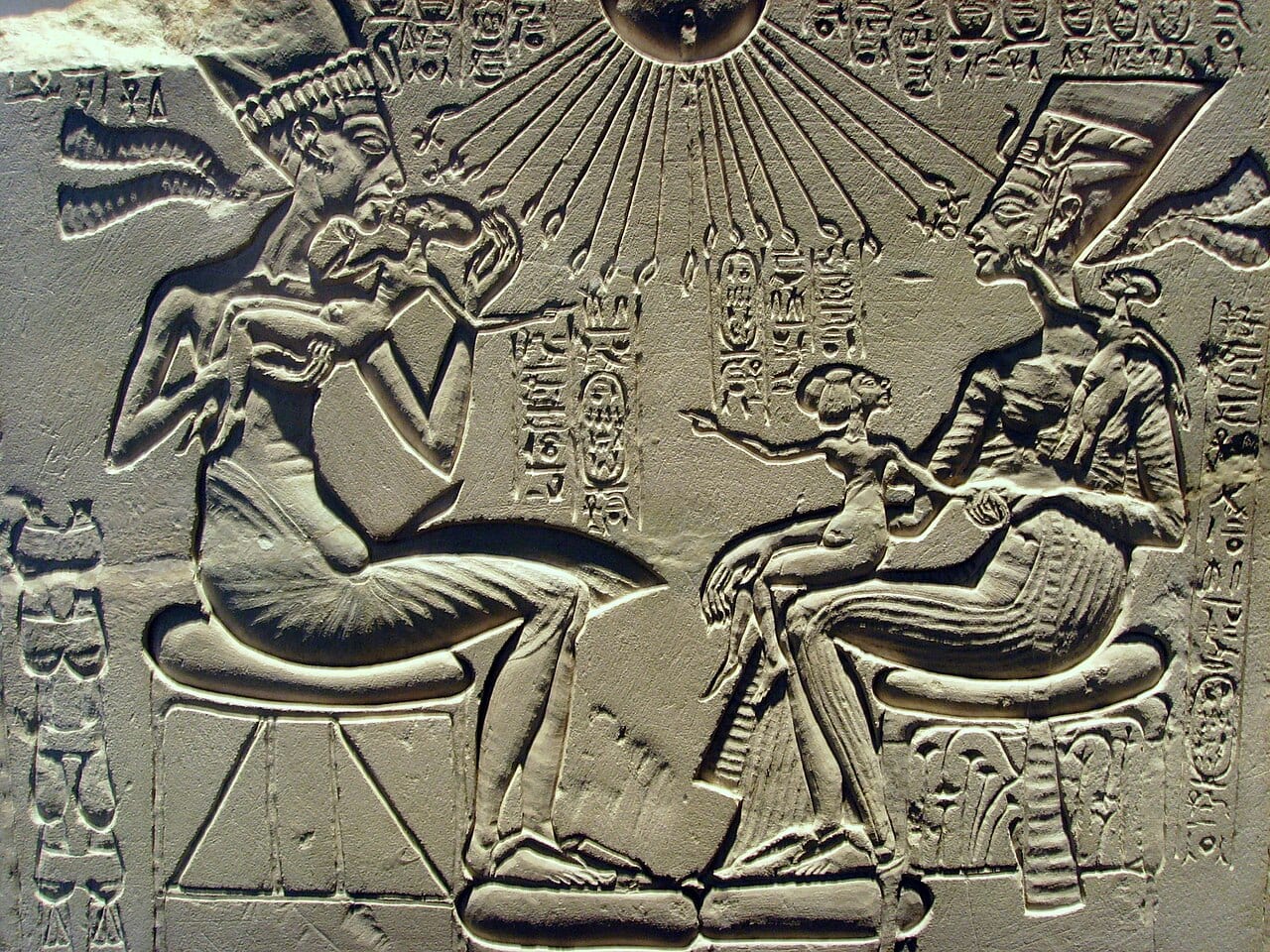
A house altar from the reign of Akhenaten, about 1340 BCE: the king, Queen Nefertiti and three daughters under the Aten, the sun disc, whose rays end in small hands. Photo: Gerbil, CC BY-SA 3.0, via Wikimedia Commons.
- The Aten, the sun disc
- Rays ending in small hands, reaching toward the royal family
It helps to separate a strong version from a weak one. The weak version says that the sun was a major god in many cultures, that rulers borrowed its authority, and that religions sometimes borrowed sun imagery from one another. That version is well supported by texts, temples and buildings aimed at sunrise. The strong version says that most myths, or a particular religion, are at bottom coded stories about the sun. Scholars largely gave that version up by 1900, and it returned in popular form in the twenty-first century.56
In context
The solar theory was one of several Victorian attempts to explain where religion came from. Müller's school worked from language: compare words across Sanskrit, Greek and Latin, and the original meaning of a god's name should appear. Its rivals worked from anthropology. Edward Tylor's Primitive Culture (1871) and the folklorist Andrew Lang compared customs and stories from living peoples around the world, and their approach won out.57
Today the evidence for sun worship comes from two places. One is texts and images, such as Egyptian hymns, Roman coins and Japanese chronicles. The other is archaeoastronomy, the study of how ancient buildings line up with the sky. A tomb whose passage fills with light at the winter solstice, the shortest day of the year, shows that its builders cared about the sun's yearly turning point, even when no text tells us why.8
- 3200 BCE Newgrange An Irish passage tomb is built to catch the midwinter sunrise.
- 1345 BCE The Aten Akhenaten makes the sun disc the focus of Egyptian worship.
- 1856 Comparative Mythology Max Müller reads Greek myths as stories of sun and dawn.
- 1897 Modern Mythology Andrew Lang publishes his answer to Müller.
- 2007 Zeitgeist An online film revives the claim that Jesus is a sun myth.
Older times are squeezed together so the whole span fits.
The Library has a shelf of books on sun worship.
Research
Egypt: Re and the Aten
Egypt gives the longest record of a sun cult. Re, the sun god, was shown as a falcon, or a man with a falcon's head, crowned with the sun disc. His main temple stood at Iunu, which the Greeks called Heliopolis, "sun city." From the Fourth Dynasty, in the mid-third millennium BCE, kings took the title "Son of Re," and Fifth Dynasty kings built open-air sun temples with an altar and a benben, a pointed stone that was an early form of the obelisk.1
Egyptians pictured the sun's day as a journey. At sunset Re was called Atum and went down into the underworld, traveled for twelve hours through the night, met Osiris at midnight and was reborn at dawn as Khepri, the scarab.1 Re also merged with other gods. Joined with Amun of Thebes, he became Amun-Re, "king of the gods," the chief god of the Middle and New Kingdoms.1 This habit of fusing gods is called syncretism: two gods are treated as aspects of one.
Then came Akhenaten. As Amenhotep IV he began in the fourth year of his reign to build a new capital at Amarna, named Akhetaten, "the horizon of the Aten." Sixteen boundary stelae, large carved stone slabs cut into the cliffs, dedicated the site to the Aten, the sun disc.9 Art of the period shows the disc with rays that end in hands, some holding the ankh, the sign of life, to the king and his family.10 The Great Hymn to the Aten, found in the tomb of the courtier Ay, praises the god in lines such as "O sole god, like whom there is no other!"11
The reform did not outlive him. Akhenaten died in the seventeenth year of his reign, the city was abandoned soon after, and images of him and Nefertiti were defaced.9 The young king Tutankhaten, who came to the throne soon after, changed his name to Tutankhamun, honoring Amun again, and the court left Amarna.12
Deep Dive: Was Akhenaten the first monotheist?
The early twentieth-century Egyptologist James Henry Breasted saw Akhenaten as the first monotheist, someone who believed in only one god. He also thought the biblical Psalm 104, which has close parallels to the Great Hymn, was inspired by it.11 Both ideas have been argued over since.
Some scholars call the Aten religion monotheism. Others call it henotheism, the worship of one god without denying that other gods exist.11 James Hoffmeier's 2015 study, in the Library, leans toward the first view. His reviewer in the Bryn Mawr Classical Review, Peter Nadig, notes that the religion "in its final stage can be likened to monotheism," and that Akhenaten closed other cults and had the names and images of gods, especially Amun, destroyed.13 Hoffmeier also suggests that the king may have had what he took to be a revelation, though the review treats this as a tentative reading of the texts.13
On Psalm 104, opinion has cooled. Miriam Lichtheim thought the likeness reflects the general resemblance between Egyptian hymns and biblical psalms.11 Hoffmeier finds "no direct connection," while allowing that Egyptian influence cannot be ruled out.13
The deeper point for this page is that Akhenaten did not invent sun worship. Hoffmeier's first chapter, as Nadig summarizes it, shows how strongly solar the Old Kingdom already was, with its pyramids, sun temples and obelisks, and how solar forms of the gods grew under the kings just before Akhenaten.13 The Aten was the end of a long line, pushed to an extreme.
Sun gods elsewhere
The Andes. Inca rulers saw themselves as descendants of Inti, the sun god. The Coricancha, his temple in Cusco, was lined with 700 panels of beaten gold, and held a gold statue of the sun as a seated boy, called Punchao, "day." Inti's great festival, Inti Raymi, fell at the June solstice, which is midwinter in the southern hemisphere. Solar eclipses were read as signs of his anger.2 The source here is a general encyclopedia, and the Spanish chroniclers it rests on wrote after the conquest.
Japan. In the Kojiki, Japan's oldest chronicle, the sun goddess Amaterasu is born when the creator god Izanagi washes his left eye, and she becomes the highest of the kami, the Shinto gods, ruling the Plain of High Heaven.3 She sends her grandson Ninigi down to rule the land, and his descendants found the imperial house.14 The Inner Shrine at Ise holds her sacred mirror and has been rebuilt every twenty years since the custom was set in the late seventh century.14
India. The Rigveda, the oldest Hindu scripture, has two sun gods. Savitr is the sun before it rises, and Surya the sun from sunrise to sunset. A verse to Savitr (Rigveda 3.62.10) became the Gayatri mantra, still recited daily. Surya rides a chariot drawn by seven horses.15 At Konark, on India's east coast, the thirteenth-century king Narasimhadeva I built Surya a temple in the shape of that chariot, carved with twenty-four stone wheels about three meters across. It became a UNESCO World Heritage Site in 1984.16
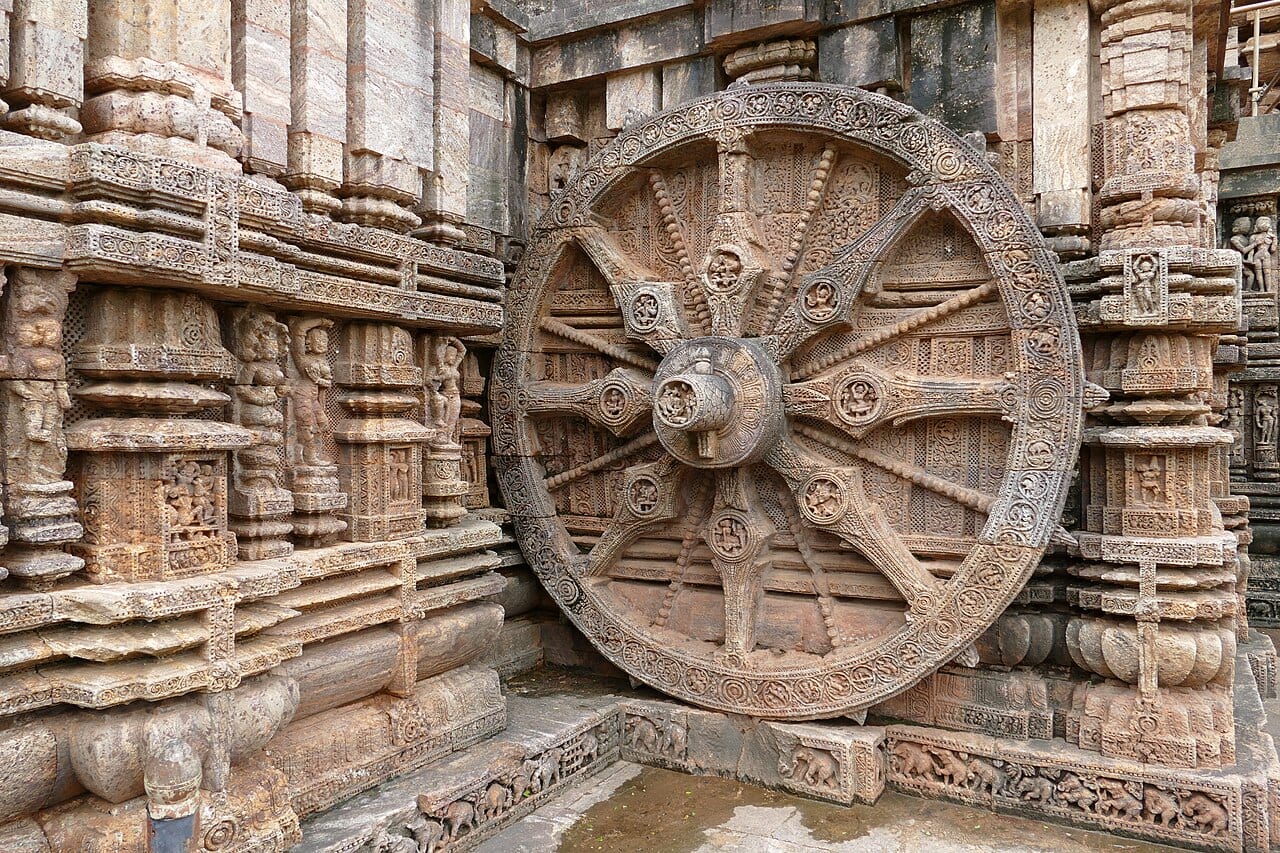
One of the twenty-four carved stone wheels of the Sun Temple at Konark, Odisha, built around 1250 as Surya's chariot. Photo: Ankur Panchbudhe, CC BY 2.0, via Wikimedia Commons.
Greece and northern Europe. The Greek sun god Helios drove a chariot across the sky each day. The island of Rhodes was sacred to him, and around 280 BCE the Rhodians set up the Colossus, a bronze statue of Helios about 32 meters tall, which fell in an earthquake some fifty years later.17 The idea of the sun traveling in a vehicle is much older in the north. The Trundholm sun chariot, a bronze horse pulling a disc found in a Danish bog in 1902, is about 3,400 years old. Only one side of the disc is gilded, which is usually read as the sun's day side, with the dark side as night.18
Rome's Unconquered Sun
Rome had worshiped Sol for centuries. The classicist Steven Hijmans argues that the Roman sun god goes back to the early Republic, against an older view that the Unconquered Sun was a late import from Syria.419 Under the emperor Elagabalus, who reigned from 218 to 222, the god of the Syrian city of Emesa was briefly set above Rome's traditional gods, and that episode colored later accounts of the cult.4
In 274 the emperor Aurelian made Sol a chief god of the empire. He built Sol a new temple, created a college of senatorial priests for him, and founded games held every four years.4 The first Christian emperor, Constantine, kept Sol on his coins until about 325, with the legend Soli Invicto Comiti, "to the Unconquered Sun, companion [of the emperor]." In 321 he made Sunday, "the venerable day of the Sun," a day of rest.4
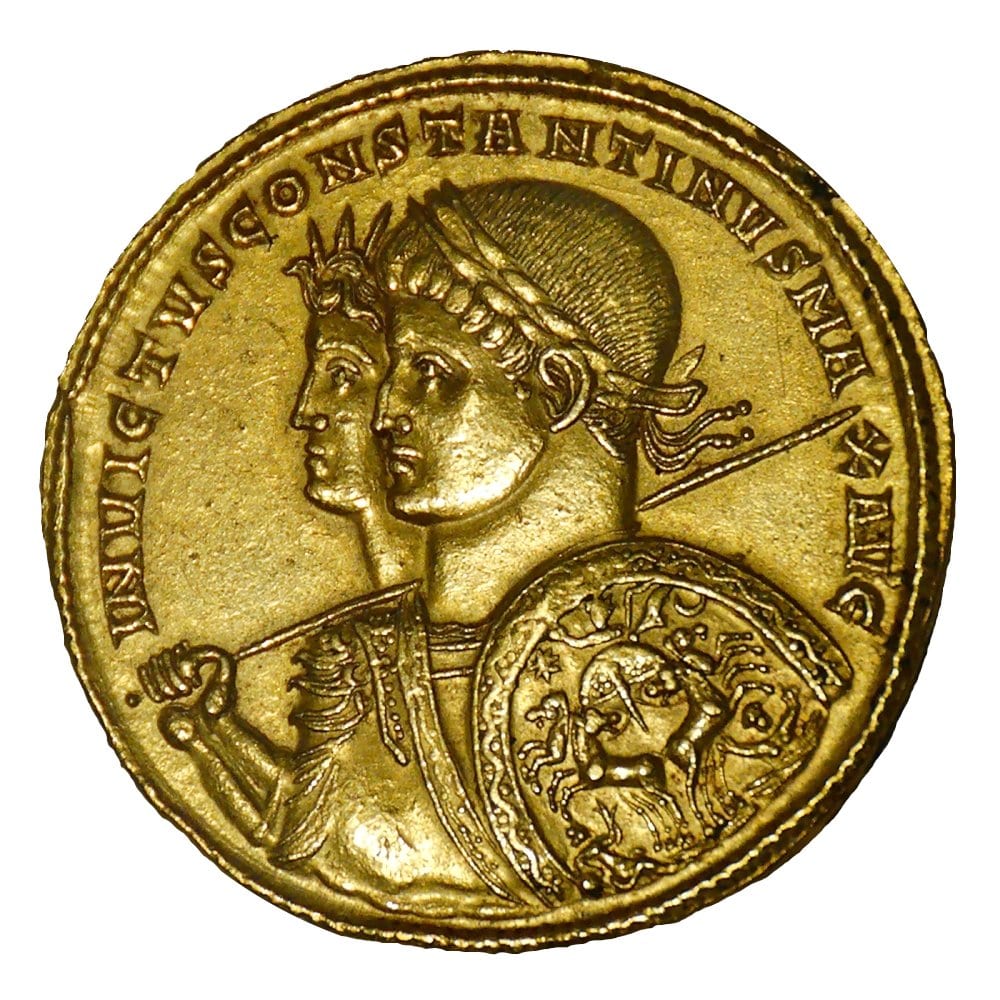
A gold medallion struck for Constantine in 313. Sol, with his crown of rays, appears behind the emperor, whose shield shows the sun's four-horse chariot. Cabinet des Médailles, Paris. Photo: Marie-Lan Nguyen, public domain, via Wikimedia Commons.
- Sol's radiate crown
- The sun's chariot on the shield
The mystery cult of Mithras grew up beside the public cult. It appeared in the Roman Empire in the first century CE, worshiping a Romanised form of the old Indo-Iranian god Mithra. Its members met in small cave-like shrines for twenty or thirty people and rose through seven grades of initiation. The Belgian scholar Franz Cumont's theory that the cult came straight from Persia was largely rejected at the first international congress on Mithraic studies in 1971.20 Sol appears often in Mithraic art, and Mithras was sometimes equated with the Unconquered Sun, though how the private cult related to the public one is unclear.419
Deep Dive: December 25 and the Unconquered Sun
A familiar claim says that Christians chose December 25 for Christmas to take over a pagan festival of the sun's birthday. The evidence is thinner than the claim suggests.
The case for borrowing rests on a Roman calendar of 354, which lists the "birthday of the Unconquered" on December 25. Some modern accounts add that Aurelian dedicated his temple on that day in 274.4 Hijmans, the leading specialist on Sol, has argued that there is "no evidence before the mid 4th c. AD for a solar festival on December 25th." Aurelian's games for Sol, as Hijmans counts them, fell on October 19 to 22. The December entry in the calendar of 354 is irregular in form and may have been added later, and Christian evidence for celebrating Christmas on that date goes back to the 330s.21 His 2003 article on the question appeared in the journal Mouseion; the summary here comes through a 2019 blog exchange in which he is quoted.21
There is a second theory. Some early Christians held that Jesus was conceived and died on the same date, March 25, and nine months later gives December 25. The historian of early Christianity Andrew McGowan notes that the first explicit suggestion that Christians picked the date to match a pagan feast is a twelfth-century marginal note, and that writers such as Ambrose treated the timing near the solstice as a sign from God.22 A 2012 review of the research by C. P. E. Nothaft suggests that both theories have something to offer, with more weight than before on early Christian date-reckoning.23
Christian writers did use sun imagery for Christ, and Constantine's Sunday law sits right where solar and Christian practice met.422 What is unproven is the specific story of a pagan sun festival on December 25 that Christmas was designed to replace.
The solar theory of myth
Friedrich Max Müller (1823–1900) was a German-born scholar at Oxford who edited the Rigveda.24 In his 1856 essay "Comparative Mythology" he argued that the earliest speakers of the Indo-European languages described nature in lively, personal language, and that later generations forgot what the words meant and took them for gods. Athena, he said, matched a Vedic word Ahanâ, the dawn, and Zeus matched Dyaus, the bright sky, so the story of Athena born from Zeus's head began as "the sky gives birth to the dawn." Apollo chasing Daphne was the sun chasing the dawn.5 In lectures of 1861 he called mythology "a disease of language."5
The theory was hugely popular through the 1860s and stayed dominant until the early 1870s.5 It attracted a "solar school" of followers who found the sun in hero after hero. Then the critics arrived: R. F. Littledale's parody in 1870, Tylor's Primitive Culture in 1871, and Andrew Lang's essay "Mythology and Fairy Tales" in 1873.5
Lang's objection was simple. Stories that Müller explained through Greek and Sanskrit words also turn up among peoples who speak unrelated languages. "The truth is, that while languages differ, men (and above all early men) have the same kind of thoughts," he wrote in Modern Mythology (1897), and of Müller's favorite example: "Were the myths, say the myths of Daphne, really solar? That is precisely what we hesitate to accept."7 Lang is usually credited with ending the philological school.25 The folklorist Richard Dorson's 1955 essay "The Eclipse of Solar Mythology" became the standard account of its fall, and a 2019 reassessment by Yang Yang argues that Müller's own cautions have since been forgotten.5
The best-known attack was a joke.
Is Jesus the sun?
The modern form of the strong claim is sometimes called astrotheology. It holds that Jesus is a personification of the sun, the twelve apostles are the zodiac, and the Gospel story is a calendar myth. Its best-known recent vehicle is Zeitgeist, a 2007 online film whose first part argues that Christianity derives from astrological myths and that Jesus never existed. That part drew on the writer Acharya S (D. M. Murdock), who co-wrote the film's sourcebook.6
Historians have been blunt. The ancient historian Chris Forbes of Macquarie University said it is "extraordinary how many claims it makes which are simply not true." Writing in Skeptic, Tim Callahan found the film's history "liberally — and sloppily — mixed with material that is only partially true," with much that is "plainly and simply bogus."6 Bart Ehrman, an agnostic New Testament scholar, wrote Did Jesus Exist? (2012) to explain why scholars in the field agree that Jesus was a real person.28
The method is also the problem. Claims of this kind usually rest on lists of parallels between Jesus and gods such as Horus, Mithras or Krishna. The historian of religion Jonathan Z. Smith argued that the broad category of "dying and rising gods," on which such lists depend, was "a fantasy, the product of uncritical comparison rather than a close consideration of evidence." His rule was that similarity does not prove descent.29 The December 25 claims run into the problems described in the deep dive above.21 Seen this way, astrotheology repeats the solar school's method, and Littledale's parody already answered it.
Buildings aimed at the sun
Where texts are missing, buildings can show that people tracked the sun closely. These are the strongest evidence that the sun mattered to ritual.
Newgrange, Ireland. The passage tomb at Newgrange is about 5,000 years old. Above its entrance is a "roof-box," a stone slot. On the morning of 21 December 1967 the archaeologist Michael O'Kelly stood inside and watched a beam of sunlight run up the passage into the chamber. The light lasted about 17 minutes.30 Today the light enters about four minutes after sunrise; because the Earth's tilt has shifted slightly over five thousand years, it would once have entered at sunrise itself. Many passage tombs face the sun, but few have a roof-box.31
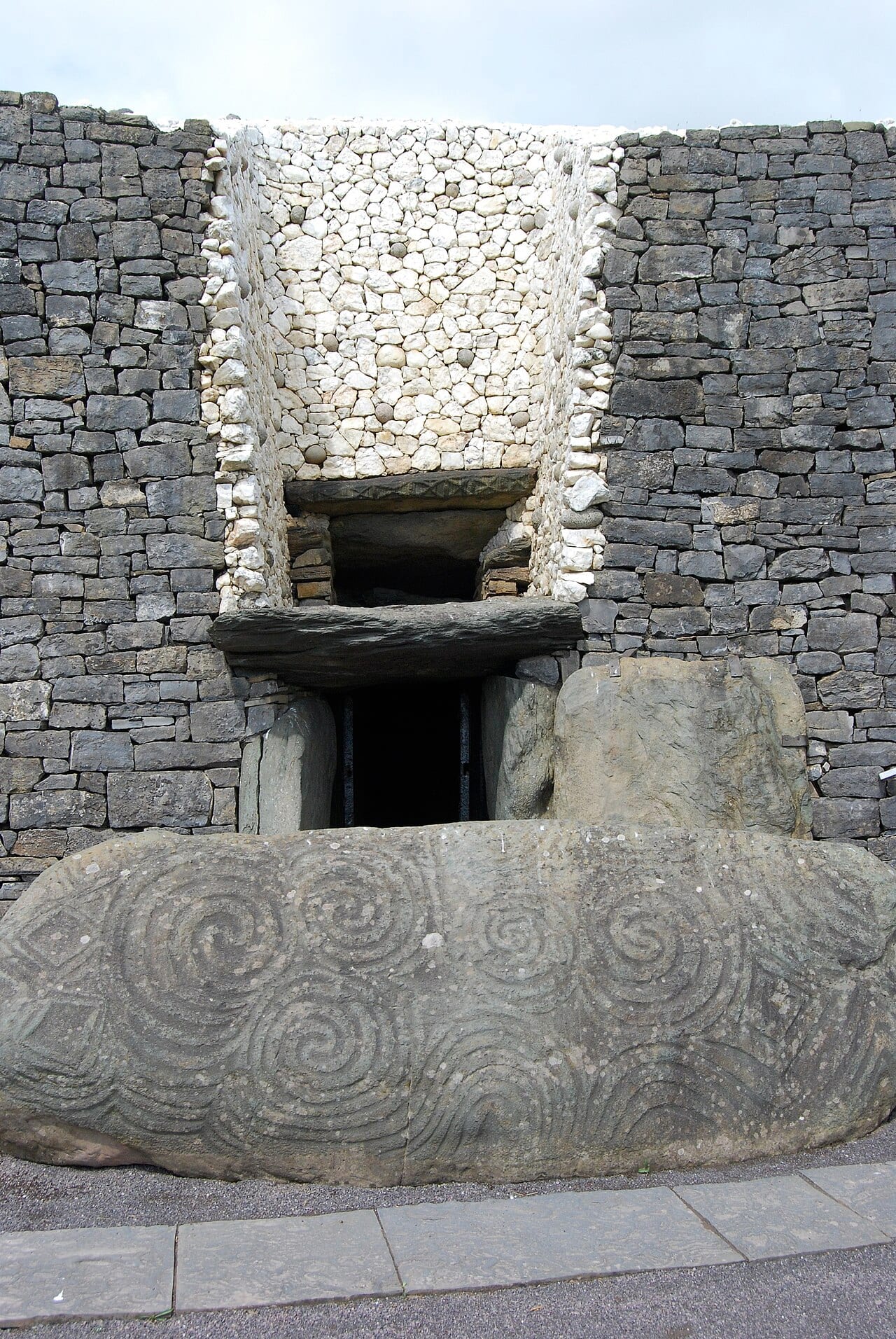
The entrance to Newgrange, with the roof-box above the doorway and the carved entrance stone in front. Photo: jemartin03, CC BY 2.0, via Wikimedia Commons.
- The roof-box, which admits the midwinter sunrise
- The passage entrance
- Carved spirals on the entrance stone
Stonehenge, England. The great sarsen stones, put up around 2500 BCE, frame the midsummer sunrise and the midwinter sunset. English Heritage suggests that midwinter may have mattered more: walking up the ceremonial Avenue, people faced the setting midwinter sun. At nearby Durrington Walls most pigs were slaughtered in midwinter, and animal bones show that people brought livestock from far away for feasts.8 Alignments can also be overdone. In 1965 the astronomer Gerald Hawkins called Stonehenge a "Neolithic computer," and the archaeologist Richard Atkinson answered in 1966 with "Moonshine on Stonehenge," arguing that many of the claimed sightlines were chance.32
Abu Simbel, Egypt. Ramesses II, who reigned from 1279 to 1213 BCE, cut a great temple into a cliff in Nubia.33 Twice a year, around 22 February and 22 October, the rising sun reaches the back of its sanctuary and lights the statues there, while Ptah, a god linked to the underworld, stays in shadow. When the temple was moved 65 meters uphill in the 1960s to escape the waters of the Aswan High Dam, engineers kept its original orientation so the effect would survive.34
Chankillo, Peru. On a ridge in coastal Peru stand thirteen towers built in the fourth century BCE. Seen from two observation points, one to the east and one to the west, they form an artificial "toothed horizon" whose span matches almost exactly the sun's rising and setting positions through the year. In their 2007 paper in Science, Ivan Ghezzi and Clive Ruggles called them evidence "of early solar horizon observations and of sophisticated Sun cults," nearly two thousand years before the Inca.35 It was named a UNESCO World Heritage Site in 2021.36
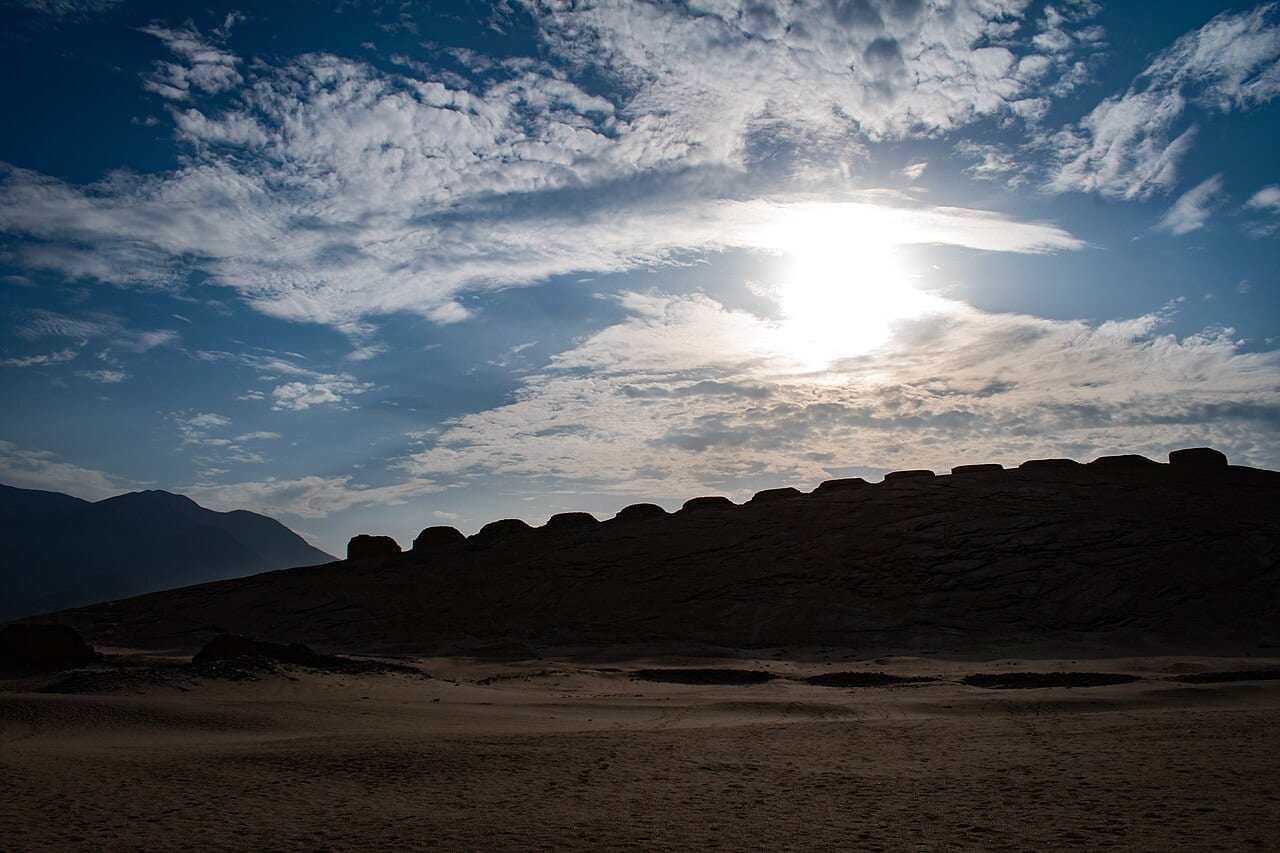
The Thirteen Towers of Chankillo, Casma, Peru, silhouetted along their ridge. Seen from the observation points, the sun rises or sets behind a different gap as the year turns. Photo: Corrispo, CC BY-SA 4.0, via Wikimedia Commons.
Where it stands
The weak version of solar religion is not in doubt. Egypt, the Inca, Japan, India, Greece and Rome all had sun gods with temples, priests and festivals, and kings in several of them claimed descent from the sun.123 Buildings from Newgrange to Chankillo show people watching the sun's turning points with care, thousands of years before writing reached them.3035 Religions also borrowed sun imagery from one another, as Constantine's coins show.4
The strong version has not held up. Müller's solar mythology produced real insight into how word meanings shift, but its readings of individual myths could not be checked, and it collapsed under evidence from outside the Indo-European languages.57 Its modern descendant, the claim that Jesus is a sun myth, uses the same loose method and has no support among historians.628 A fair reading keeps both halves: the sun was among the most widely worshiped beings in the ancient world, and that fact does not turn every myth into a story about the sun.
Footnotes
-
"Re," World Eras (Gale), and Leonard H. Lesko, "Re," Encyclopedia of Religion, both on Encyclopedia.com. encyclopedia.com ↩ ↩2 ↩3 ↩4 ↩5
-
Mark Cartwright, "Inti," World History Encyclopedia, 7 March 2014 (a general reference work). worldhistory.org ↩ ↩2 ↩3
-
"Amaterasu Ōmikami," Encyclopedia of Shinto, Kokugakuin University (opening section read through a search summary). d-museum.kokugakuin.ac.jp ↩ ↩2 ↩3
-
Wikipedia, "Sol Invictus" (secondary source; draws on S. E. Hijmans, Sol: The Sun in the Art and Religions of Rome, PhD thesis, Groningen, 2009; G. Halsberghe, The Cult of Sol Invictus, 1972; M. Clauss, 2001; S. Berrens, 2004). en.wikipedia.org ↩ ↩2 ↩3 ↩4 ↩5 ↩6 ↩7 ↩8 ↩9
-
Yang Yang, "Quest for the Origin of Primitive Myths: Revisiting Max Müller's Comparative Mythology," Antae 6(1), 2019, 5–20 (read in full; cites R. M. Dorson, "The Eclipse of Solar Mythology," Journal of American Folklore 68, 1955, 393–416). um.edu.mt ↩ ↩2 ↩3 ↩4 ↩5 ↩6 ↩7 ↩8 ↩9 ↩10
-
Wikipedia, "Zeitgeist (film series)" (secondary source for the film's claims, its debt to Acharya S, and the quotes from Chris Forbes, Centre for Public Christianity interview, and Tim Callahan, "The Greatest Story Ever Garbled," Skeptic, 2009; the originals not read). en.wikipedia.org ↩ ↩2 ↩3 ↩4 ↩5
-
Andrew Lang, Modern Mythology, Longmans, Green, 1897, Project Gutenberg text (first part read). gutenberg.org ↩ ↩2 ↩3
-
English Heritage, "Celestial Stonehenge." english-heritage.org.uk ↩ ↩2
-
Amanda Dunsmore, "Sun queen," NGV Magazine 37, National Gallery of Victoria, 25 October 2022. ngv.vic.gov.au ↩ ↩2
-
"Offering to the Aten, c. 1345 BCE," Center for Online Judaic Studies (a relief in the Egyptian Museum, Cairo). cojs.org ↩
-
Wikipedia, "Great Hymn to the Aten" (secondary source; quotes Miriam Lichtheim's translation in Ancient Egyptian Literature, vol. 2, and summarizes Breasted, Lichtheim and Mark S. Smith). en.wikipedia.org ↩ ↩2 ↩3 ↩4
-
Wikipedia, "Amarna" (secondary source, for Tutankhaten's change of name and the court's move from Amarna). en.wikipedia.org ↩
-
Peter C. Nadig, review of James K. Hoffmeier, Akhenaten and the Origins of Monotheism (Oxford, 2015), Bryn Mawr Classical Review 2015.11.28. bmcr.brynmawr.edu ↩ ↩2 ↩3 ↩4
-
"Ise no Jingū" and "Amaterasu Ōmikami," Basic Terms of Shinto, Kokugakuin University (the second through a search summary). d-museum.kokugakuin.ac.jp ↩ ↩2
-
Wikipedia, "Savitr" and "Surya" (secondary sources, through search summaries). en.wikipedia.org ↩
-
Wikipedia, "Konark Sun Temple," and the UNESCO World Heritage nomination file for the site (both through search summaries; the UNESCO pages blocked direct reading). whc.unesco.org ↩
-
"Colossus of Rhodes," National Geographic History, and Structurae (through search summaries; dates for building and collapse vary between sources). nationalgeographic.com ↩
-
Google Arts & Culture, "The Trundholm Sun Chariot" (story with objects from the National Museum of Denmark). artsandculture.google.com ↩
-
Lorena Pérez Yarza, review of Steven E. Hijmans, Sol: Image and Meaning of the Sun in Roman Art and Religion (Brill, 2024), Bryn Mawr Classical Review 2025.02.24. bmcr.brynmawr.edu ↩ ↩2
-
Gillis Kersting, "The mystery of Mithras," World Archaeology 115, 28 September 2022 (exhibition review). the-past.com ↩
-
Roger Pearse, "Was there no festival of Sol on 25 December before 324 AD?," blog, 24 December 2019, updated with comments from Steven Hijmans quoted with permission (a blog; Hijmans's article, "Sol Invictus, the Winter Solstice, and the Origins of Christmas," Mouseion 3(3), 2003, 377–398, not read). roger-pearse.com ↩ ↩2 ↩3
-
Andrew McGowan, "How December 25 Became Christmas," Bible Review, December 2002, republished in Bible History Daily, Biblical Archaeology Society. biblicalarchaeology.org ↩ ↩2
-
C. P. E. Nothaft, "The Origins of the Christmas Date: Some Recent Trends in Historical Research," Church History 81(4), 2012, 903–911 (abstract only). cambridge.org ↩
-
Wikipedia, "Max Müller" (secondary source, for his dates and the Rigveda edition). en.wikipedia.org ↩
-
Benjamin C. Ray, "Lang, Andrew," Encyclopedia of Religion, 1987, on Encyclopedia.com. encyclopedia.com ↩
-
"Max Müller as a solar myth," Languagehat, quoting R. F. Littledale, "The Oxford Solar Myth: A Contribution to Comparative Mythology," reprinted in R. Y. Tyrrell and E. Sullivan, eds., Echoes from Kottabos, London, 1906, 279–290 (a blog quoting the text; the original not read). languagehat.com ↩ ↩2
-
J.-B. Pérès, Comme quoi Napoléon n'a jamais existé, 1827, Project Gutenberg (1909 edition, opening read through a search summary), with Wikipedia, "Jean-Baptiste Pérès," for the link to Dupuis. gutenberg.org ↩ ↩2
-
Wikipedia, "Did Jesus Exist? (Ehrman book)" (secondary source; the book itself, HarperOne, 2012, not read). en.wikipedia.org ↩ ↩2
-
David Frankfurter, review of Tryggve N. D. Mettinger, The Riddle of Resurrection (2001), Bryn Mawr Classical Review 2002.09.07 (quotes J. Z. Smith, "Dying and Rising Gods," Encyclopedia of Religion, 1987; Smith's article not read). bmcr.brynmawr.edu ↩
-
"The Fabulous Prehistoric Light Show," Newgrange.com (a site run by a local guide; quotes O'Kelly's account). newgrange.com ↩ ↩2
-
National Museum of Ireland, "The Winter solstice at Newgrange" (through a search summary; the page blocked direct reading). museum.ie ↩
-
R. J. C. Atkinson, "Moonshine on Stonehenge," Antiquity 40, 1966 (abstract page only), with Wikipedia, "Archaeoastronomy and Stonehenge," for Hawkins's claims. cambridge.org ↩
-
NASA Sun-Earth Day 2005, "Abu Simbel" (archived page). science.gsfc.nasa.gov ↩
-
"Abu Simbel's sun festival," Daily News Egypt, 26 February 2014. dailynewsegypt.com ↩
-
Ivan Ghezzi and Clive Ruggles, "Chankillo: A 2300-Year-Old Solar Observatory in Coastal Peru," Science 315, 2007, 1239–1243 (abstract only, through the PUCP repository record). cris.pucp.edu.pe ↩ ↩2
-
World Monuments Fund, "Chankillo Archaeoastronomical Complex Named UNESCO World Heritage," 2021 (through a search summary: inscribed 27 July 2021, site 1624). wmf.org ↩