Sapience
· updated · 9 min
Part of the series KGLW Lyric Prompts · 9 posts
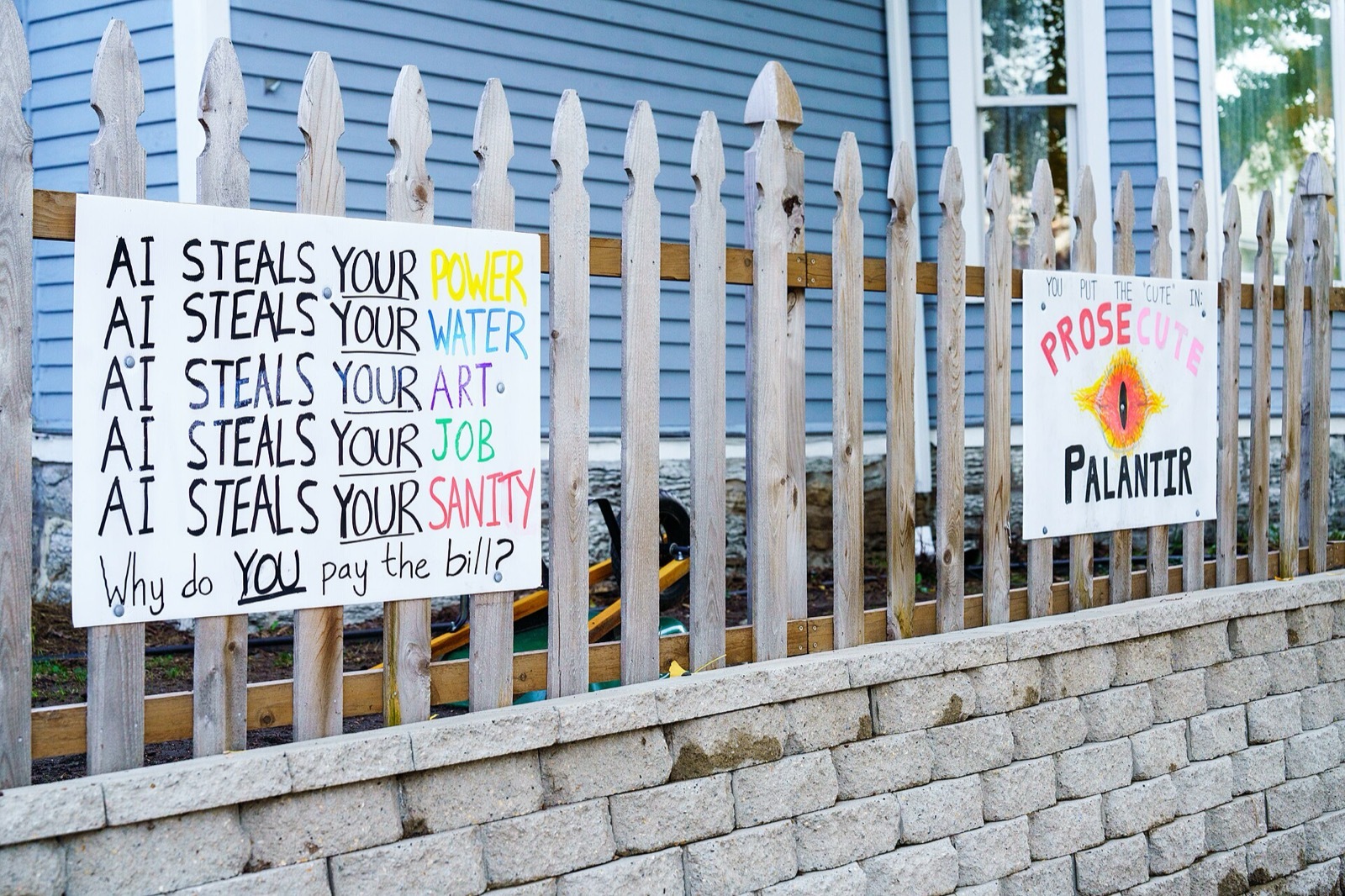
Palantir
Palantir
PalantirKing Gizzard & the Lizard Wizard -- Sapience (live at Field of Vision II '26)
New to King Gizzard?
If you've arrived here with no idea what a King Gizzard & the Lizard Wizard is, welcome. My simple three step program gets you up to speed in as little as a week or two, assuming you don't need much sleep:
- Watch the brief documentary: A Brief History of King Gizzard & the Lizard Wizard, by Bootleg Gila. Only 4.5 hours.
- Listen to all 29 albums, every studio album, in any order you like.
- Listen to the bootlegs: hundreds of hours of live shows on the band's bootleg Bandcamp.
Again quoting the whole song ;) Sapience-- ability to think, judge or reflect deeply, a level beyond sentience. It's human level judgment which you can get from the root, even though we all know that owls, at the very least, are much wiser than us.
AI weapon design is not something I am going to pretend to know much about. Nobody knows much about it unless they're working on these systems or living in Ukraine. I am grateful not to be in either of those categories, though I have a lot of affinity for the Ukrainian people and their plight. I encourage you to look at the valuable work of Timothy Snyder.
It is not hard to see where this is going though. Human targeting and kill decisioning have been reduced to seconds in many cases. We are approaching nominal human oversight of these autonomous systems. I suspect existing systems already have modes that need no human decisioning at all. We are investing trillions of dollars into technology meant to replace both our minds and our bodies in an end game capitalism that removes the need for the traditional worker altogether. What happens when workers no longer control the means of production? This mind-body replacement is of course being proven out where new technology has been tested for most of the last century and likely much longer-- the military.
Deep Dive: AI goes to war: Palantir, Helsing and the Spotify walkout
The palantír. In Tolkien, the palantíri are seeing-stones that let you watch far-off places, and that let Sauron watch, and bend, whoever looks into them. Peter Thiel's data company took the name in 2003. Its software fuses data from many sources so analysts can find patterns, and people.
Palantir now
- Maven: Palantir has been the main industry partner on Project Maven, the Pentagon's AI targeting program, since 2019. Maven turns drone video, satellite images and signals into suggested targets. The Pentagon credits it with targeting support for US airstrikes in 2024, and in March 2026 moved it toward a permanent "program of record." Military.com · Project Maven
- Money: The Army's Maven contract went from $480 million (2024) to a ceiling of about $1.3 billion. In August 2026, a draft memo from the Deputy Secretary of Defense would buy up to $244 million more from Palantir with no competitive bidding. The Register
- When it goes wrong: A Bloomberg investigation named over-reliance on Maven as one of several failures behind a US strike, and more than 120 House Democrats asked the Defense Secretary what role it played. Gizmodo
- At home: ICE pays Palantir $30 million for ImmigrationOS, which ranks who to deport first. A related tool, ELITE, builds dossiers with "confidence scores" for addresses that ICE uses to plan raids. American Immigration Council · Surveillance Watch
Helsing, Spotify and the walkout
- The investment: In June 2025, Daniel Ek's investment firm Prima Materia led a €600 million round in Helsing, a German defense-AI company. Ek chairs Helsing. Helsing makes the HX-2 strike drone (a loitering munition: it circles, then dives onto a target), underwater surveillance drones and AI software for weapons. EBU Spotlight
- King Gizzard leaves (July 2025): The band pulled its whole catalog from Spotify and put it up as name-your-price on Bandcamp. They followed Deerhoof and Xiu Xiu; Godspeed You! Black Emperor, Massive Attack and a wave of Melbourne indie bands came after. The Fader · Music Business Worldwide
- Since then: Ek stepped down as Spotify CEO on January 1, 2026 and stayed on as executive chairman; Spotify says that was unrelated. Helsing raised $1.8 billion at an $18 billion valuation in July 2026, so the money kept coming. Germany approved a €269 million HX-2 order in February 2026, and Helsing says it ships hundreds of HX-2s a month to Ukraine. Bloomberg has also reported scrutiny over pricing and glitchy software, which Helsing disputes. CNBC
- Not everyone stayed out: Sylvan Esso returned to Spotify in September 2026, calling the boycott "unsustainable" for a working band, not a change of mind. Music Ally
- A myth to skip: Posts claiming Helsing's weapons are used by Israel in Gaza have no evidence behind them. Helsing says its tech is deployed only in Europe for Ukraine's defense against Russia. The real issue is AI weapons and who profits from them, which is enough on its own. EBU Spotlight
The big AI labs pick sides (2026)
- Anthropic says no: The Pentagon wanted its AI available for "any lawful use." Anthropic, the company behind Claude, refused two uses: fully autonomous weapons and mass surveillance of Americans. In late February 2026 the President ordered agencies to stop using Anthropic, and in March the Pentagon labeled it a "supply chain risk," a tag normally used for foreign adversaries. Anything that works for the Pentagon now has to certify it doesn't use Claude. NPR
- The courts split: A California federal judge ruled the label illegal in August. In September the D.C. Circuit upheld it, saying the model's built-in limits could make it unreliable for military use; the dissent said the law doesn't cover a contractor openly enforcing its own rules. TechCrunch · CNBC
- Everyone else says yes: xAI (Grok) signed for classified use in February, and OpenAI stepped in to replace Claude on classified networks. Google signed in April for "any lawful government purpose," with no right to veto how it's used, over a letter of protest from more than 600 of its employees. In 2018, Google employees had forced the company to drop Maven. Axios · Washington Examiner
What the machines can already do
What's publicly known, from the most proven to the newest:
- Defensive autopilot (decades old): Ship guns like Phalanx and missile shields like Iron Dome and Patriot have automatic modes that spot and fire at incoming rockets and missiles faster than a person could react. Nobody calls these new, and they're aimed at objects, not people.
- Finding targets fast: Maven's computer vision scans drone video and satellite images and marks vehicles, buildings and weapons. One targeting officer said it took him from about 30 targeting decisions an hour to 80. The Army set a goal of 1,000 an hour from a small team; the head of Central Command says they've reached it, but nobody independent has checked. Maven has reportedly been used against targets in Iran. Defense News · Sandboxx
- Lists of people: Israel's Lavender system scored Gaza residents on how likely they were to be militants and at one stage flagged about 37,000 people. A companion system, Gospel, suggested buildings. Officers told +972 Magazine they sometimes spent about 20 seconds checking each name. A human signs off, but the machine does the judging. +972 Magazine
- Last-mile autonomy (Ukraine): Jamming cuts the radio link between a drone and its pilot, so both sides now build drones that lock onto a target and fly the final stretch on their own. A person still picks the target. CSIS says this lifts hit rates from roughly 10–20% to 70–80%, and Ukraine's Defense Ministry says AI-guided strikes rose tenfold in 2026, across more than 70 AI systems. They're still a small share of the millions of drones in use. Swarms, where many drones coordinate with each other, are still small experiments. CSIS · Al Jazeera
- AI pilots: In 2023–24 an AI flew a modified F-16 in real dogfights against a human pilot, with the Air Force Secretary riding along on one flight. In June 2026 the Air Force ordered its first production drone wingmen from Anduril and General Atomics: over 150 jets by 2029, about 1,000 planned in the long run, flown by AI software and directed by a human in a nearby fighter. Defense News
- Chatbots on secret networks: The 2026 lab deals put large language models inside classified systems to summarize intelligence, draft plans and sort data. What they actually do there isn't public.
The line not crossed, as far as anyone can show: no confirmed weapon picks a person and kills them with no human say at all. The closest claim, a 2020 UN report that a Turkish-made Kargu-2 drone in Libya may have attacked on its own, is still disputed. The real shift is quieter. Humans stay in the loop, but the loop gets so fast, seconds per target and a thousand decisions an hour, that the human check gets thin.
Killer robots and the treaty that isn't
- The UN has talked about lethal autonomous weapons, machines that choose and attack targets without a person deciding, since 2014. The UN Secretary-General and the Red Cross set the end of 2026 as the deadline for a binding treaty. UN News
- The expert group finished in September 2026 with a draft text that 76 countries, a majority, say is ready for real negotiations. The US and Russia lead the opposition, arguing existing laws of war are enough. Human Rights Watch
- Next week: The review conference in Geneva, November 16–20, 2026, decides whether treaty talks start at all. Human Rights Watch
We have no idea what is happening inside the latent space of current 1 trillion plus parameter models, but it is almost certainly a learned abstract model distilled from all human intellectual heritage. What's largely missing is the ability to take in realtime data and use reinforcement learning to shape a flexible world model in the same or similar latent space. The world model problem is rapidly being worked on, but most of that work still happens in separate models trained on video and simulation, not inside the language model's own latent space. Hardware and software that can reason about this world at a superhuman level are just a few steps away. The models will invent their own sensors and explore the physical world much more rapidly and comprehensively than we have managed in the last several million years.
We are using AI to target and kill people though. We also use it to design drugs and solve math problems, but mostly to kill people. The real problem here is a pathological need to protect ourselves that escalates to extinction level capacity for destruction in the process. We are so afraid of being killed or subjugated that we willingly create the means to do it on a more and more massive scale.
I think AI is a logical progression of capability. I don't think the same is true of our human intellectual heritage, which we have trained it with, or of this pathological need for protection.
Maybe we get to the Great Chain of Being soon.
Photo: AI Steals and Prosecute Palantir Protest Signs by Chad Davis, CC BY 4.0, via Wikimedia Commons; resized.
