Idea
Panspermia
Did life on Earth start somewhere else? The old idea that life drifts between worlds, and what meteorites and asteroid samples actually show.

Overview
Panspermia is the idea that life, or the seeds of life, can travel between worlds. The name comes from Greek words meaning "all" and "seed."1 In its boldest form it says that life on Earth did not begin here. Living cells arrived from somewhere else, inside a rock, on a comet, or even on purpose, sent by someone.
There are several versions, and they differ a great deal in how much they claim.
- Lithopanspermia ("rock" panspermia): microbes ride inside rocks blasted off one planet by an impact and land on another.1
- Radiopanspermia: tiny spores are pushed between stars by the pressure of starlight. This was Svante Arrhenius's version, from 1903.12
- Directed panspermia: an advanced civilization seeded Earth deliberately. Francis Crick and Leslie Orgel put this forward in 1973.3
- Pseudo-panspermia, sometimes called soft panspermia: only the chemical ingredients of life, such as amino acids and sugars, formed in space and were delivered by meteorites. Life itself then began on Earth.1
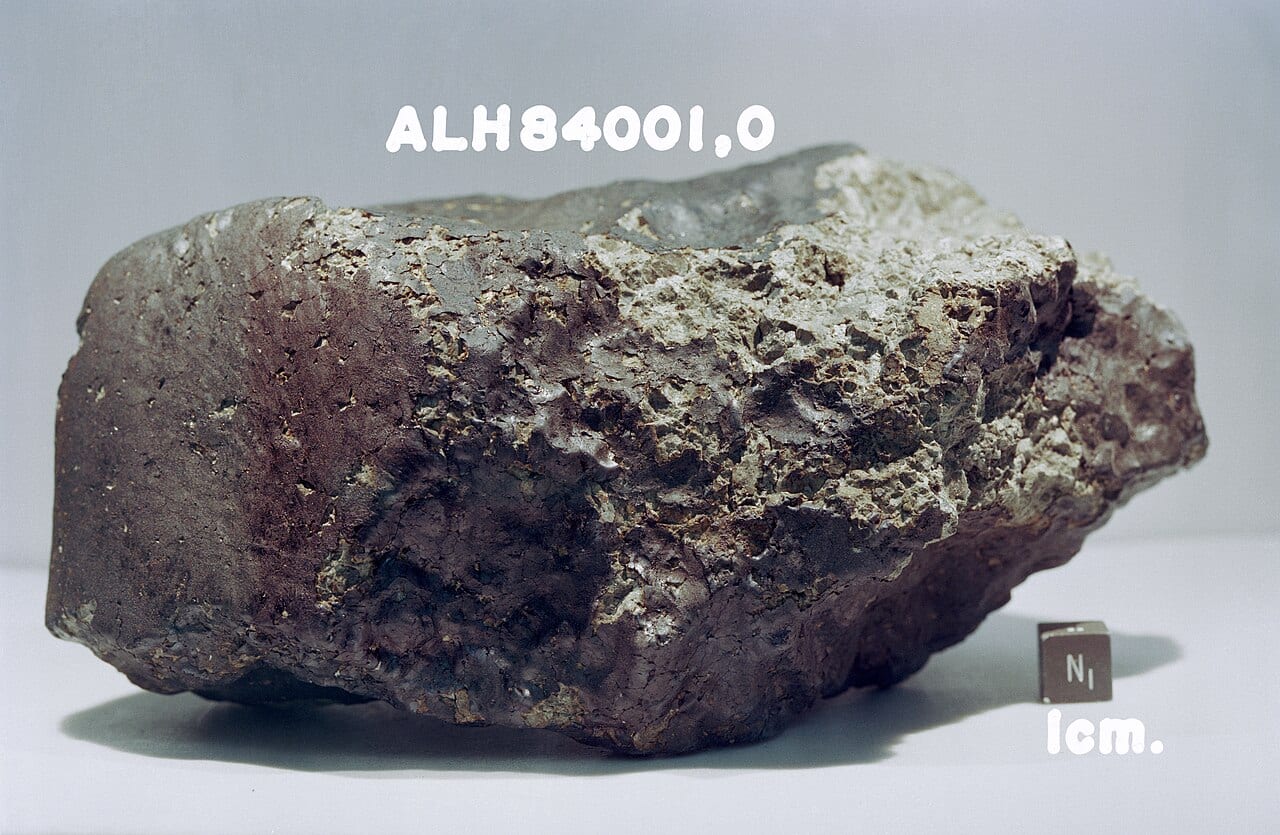
ALH84001, a meteorite from Mars found in Antarctica in 1984. In 1996 a NASA team said it might hold traces of ancient Martian life. Photo: NASA/JSC, public domain, via Wikimedia Commons.
The strong versions, in which living things crossed space and started life here, have no direct evidence, and mainstream scientists treat them as fringe.1 The weak version, delivery of ingredients, is now well supported: space rocks carry amino acids, the bases used in DNA and RNA, and the sugar ribose.45 This page tries to keep those two apart, because news stories about "the building blocks of life" from space often blur them.
In context
Nobody knows how life began. Most researchers assume it began on Earth, through abiogenesis (life arising from non-living chemistry).1 Panspermia is one of a few ways of framing that question.
- Home-grown life. Life began on Earth from local chemistry. This is the default assumption, and a 2026 modeling paper calls Earth's own origin "the default inference."6
- Home-grown life, imported ingredients. Life began on Earth, but meteorites and comets helped by delivering ready-made organic molecules. The Bennu and Ryugu samples support this part.47
- Life from a neighbor. Life began on early Mars and came to Earth in a rock, or the other way round. Rocks do travel between the two planets: more than 270 meteorites from Mars have been identified.8 Whether anything alive survived the trip is unknown.
- Life from far away. Life came from another star system, by drifting spores or by design. These ideas face the longest journeys and have the least support.16
Each version answers a different question. Only the first two say anything about how chemistry became biology. The others move the start of life to somewhere else.
- 450 BCE Anaxagoras The Greek philosopher writes of the "seeds of all things" in the cosmos (date approximate).
- 1871 Kelvin's meteorites Lord Kelvin suggests life could have reached Earth on a meteorite.
- 1903 Arrhenius Spores pushed between stars by the pressure of light.
- 1973 Directed panspermia Crick and Orgel propose that Earth was seeded on purpose.
- 1996 ALH84001 A NASA team reports possible signs of life in a Martian meteorite.
- 2025 Bennu Asteroid samples hold amino acids, all five nucleobases and ribose.
- 2026 Comets doubted Simulations suggest comets struck Earth too fast to deliver hydrogen cyanide intact.
Older times are squeezed together so the whole span fits.
The information side of life's origin has its own book in the Library.
Research
Four versions of the claim
The oldest version is philosophical. Anaxagoras, who lived in Athens around 500 to 428 BCE, wrote of "the seeds of all things" in the original mixture of the world, and of living things made up from it.9 Classicists agree he thought the cosmos was full of life and that life on Earth began from seeds that fell from elsewhere.1 What he meant by "seeds" is unclear. The Stanford Encyclopedia of Philosophy notes that he "nowhere explains" the term, and readings range from tiny particles to biological seeds.9 So he is an ancestor of the idea more than an early version of it.
The scientific version came in the late 1800s. In 1871 Lord Kelvin told the British Association that life might have reached Earth on a meteorite.1 Svante Arrhenius, the Swedish chemist, took a different route. In a little-known 1903 paper and then in his 1908 book Worlds in the Making, he argued that bacterial spores could be pushed through space by the pressure of starlight.2 He did not share Kelvin's hope for meteorites: a falling stone "becomes incandescent all over its surface," he wrote, so seeds on it would be killed.10
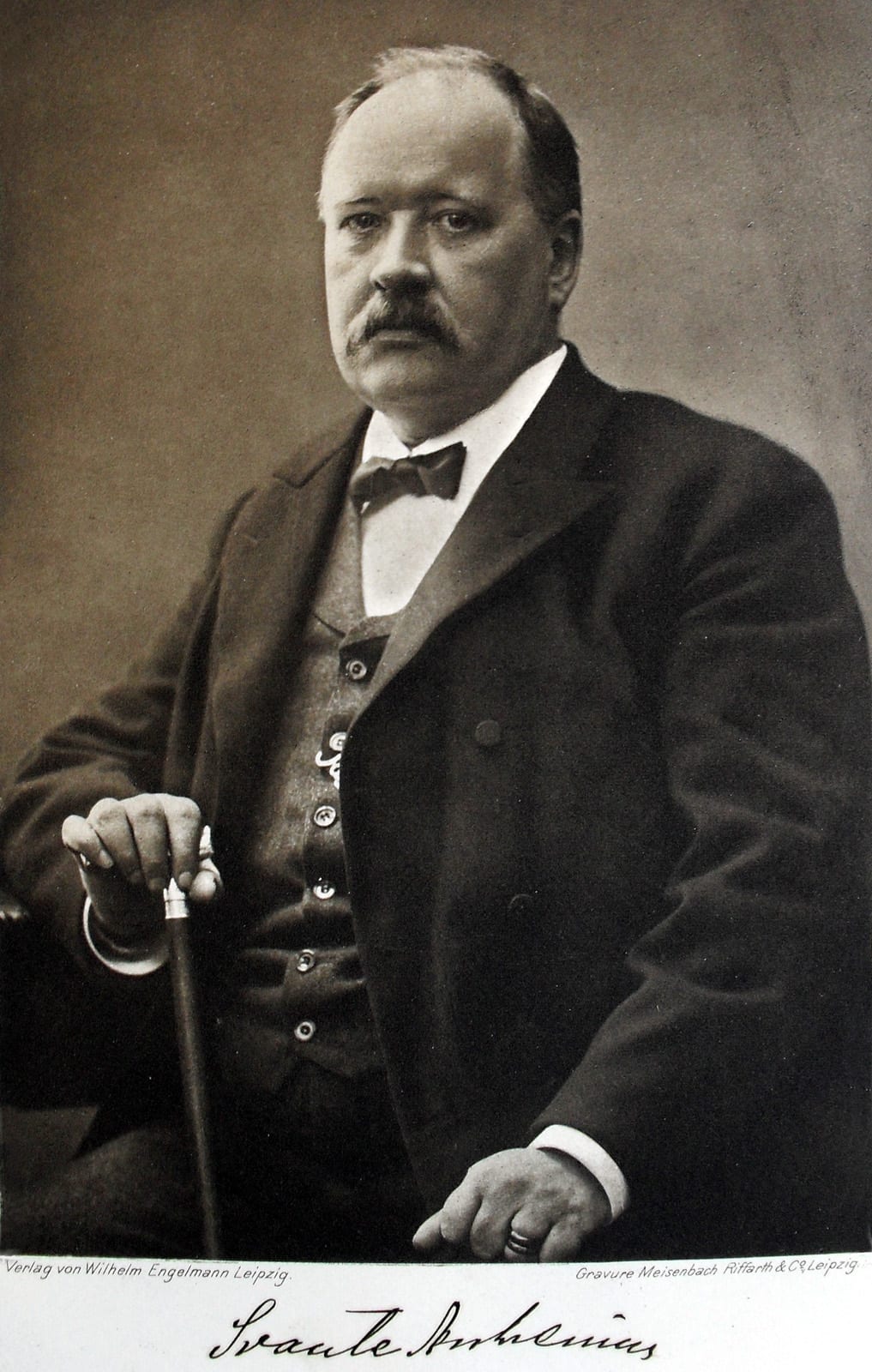
Svante Arrhenius, from a 1909 portrait. He gave panspermia its first physical mechanism. Photogravure by Meisenbach Riffarth & Co., public domain, via Wikimedia Commons.
Arrhenius did the sums. Particles about 0.00016 millimeters across would be pushed hardest by sunlight. Such a spore, he calculated, would cross the orbit of Mars in twenty days, reach Neptune's orbit in fourteen months, and arrive at the nearest star, Alpha Centauri, in nine thousand years. The cold of space, he argued, would act as "a most effective preservative."10 He was not trying to explain how life began. He thought life, like matter and energy, had always existed and had no origin in time.2
The third version is the strangest. In 1973 Francis Crick, co-discoverer of the structure of DNA, and the chemist Leslie Orgel published "Directed Panspermia" in the journal Icarus.3 They had first raised it at a 1971 conference on contacting extraterrestrial intelligence, organized by Carl Sagan in Soviet Armenia.11 Their idea was that an older civilization might have sent microorganisms to Earth on purpose, in an unmanned spacecraft.12 They concluded that this was possible, but that the evidence was too thin to say how likely it was.311
Deep Dive: Crick and Orgel's "two weak facts"
Crick and Orgel were open about how little they had. "We do not have any strong arguments of this kind," they wrote, "but there are two weak facts that could be relevant."11
The first was the genetic code. Every known living thing uses the same code to turn DNA into proteins. If life had started many times, you might expect several codes. One code fits a single origin, and they suggested it also fits a single delivery.11
The second was molybdenum, a metal that some key enzymes need. Molybdenum is rare in Earth's crust, which seemed odd for something so important to life. Perhaps, they suggested, life began somewhere richer in it.11 This point was challenged soon after: molybdenum is more plentiful in seawater than in rock, which removes much of the puzzle.11
Crick turned the paper into a book, Life Itself: Its Origin and Nature, in 1981. Its working title was "Directed Panspermia." In it he added a third argument, that life appeared on Earth surprisingly soon after the planet cooled.12 Reviewers were polite and doubtful. Kirkus noted that Crick "admits that there is precious little evidence" for the theory, while adding that the same was true of the rival idea of a primordial soup.12
The two authors went different ways. Crick kept defending the idea as viable. Orgel, according to the historian Christian Orlic, later dropped it.11 Wikipedia's summary also reports that Orgel was less serious about the claim from the start.1 Crick and Orgel did suggest a test: a deliberate sender might leave a "signature" in the genome. Mutation and natural selection could erase such a message over billions of years, so the test is weak.1
The fourth version is the longest-running and the most controversial. From the 1970s, the astronomer Fred Hoyle and his former student Chandra Wickramasinghe argued that life is cosmic: that bacteria and viruses exist in interstellar dust and comets, and still rain down on Earth. In 1974 they proposed that some interstellar dust matched the light spectrum of freeze-dried bacteria.13 They set out the case in books including Lifecloud (1978), Diseases from Space (1979) and Evolution from Space (1981).13 The reception of their work is covered under The criticism, below.
Can anything survive the trip?
For lithopanspermia to work, a microbe has to survive three things: being blasted off a planet, years or millions of years in space, and the fall through another planet's atmosphere. Experiments since 2000 have tested each step.
Getting off the planet. Rocks do leave planets. About 277 Martian meteorites were known by 2020, identified partly because gas trapped in them matches the Martian atmosphere measured by the Viking landers.8 The rocks are not always cooked on the way. In 2000 a Caltech team measured the magnetism inside ALH84001 and found that its interior had not been heated above 40°C since before it left Mars. Only the outer few millimeters were heated on entry into Earth's atmosphere. Since 40°C would not sterilize most bacteria, the authors said this supported the idea that meteorites could carry life between planets.14
Getting between planets. A 2000 modeling study in Icarus, using two hardy bacteria as test cases, concluded that if microbes ever lived on Mars, their arrival alive on Earth was "not only possible but also highly probable." Transfer the other way, Earth to Mars, was possible but much rarer.15
Surviving space. Some organisms are surprisingly tough.
- In 2007 dried tardigrades, tiny eight-legged animals also called water bears, rode outside the FOTON-M3 spacecraft for ten days. Most survived vacuum and cosmic radiation. When also exposed to raw ultraviolet light from the Sun, most died, but a few survived and later reproduced.16
- On ESA's EXPOSE-E platform outside the International Space Station, spores of a UV-resistant strain of the bacterium Bacillus subtilis spent 559 days in space. Unfiltered solar UV was the main killer. Shielded from sunlight, about 8% survived.17
- Japan's Tanpopo experiment left dried pellets of the radiation-resistant bacterium Deinococcus outside the space station. Pellets 0.5 mm thick were still alive after three years, because the dead cells on the outside shielded the living ones inside. The authors estimated that clumps 1 mm across could last two to eight years, and named the idea "massapanspermia," from the Latin for mass.18
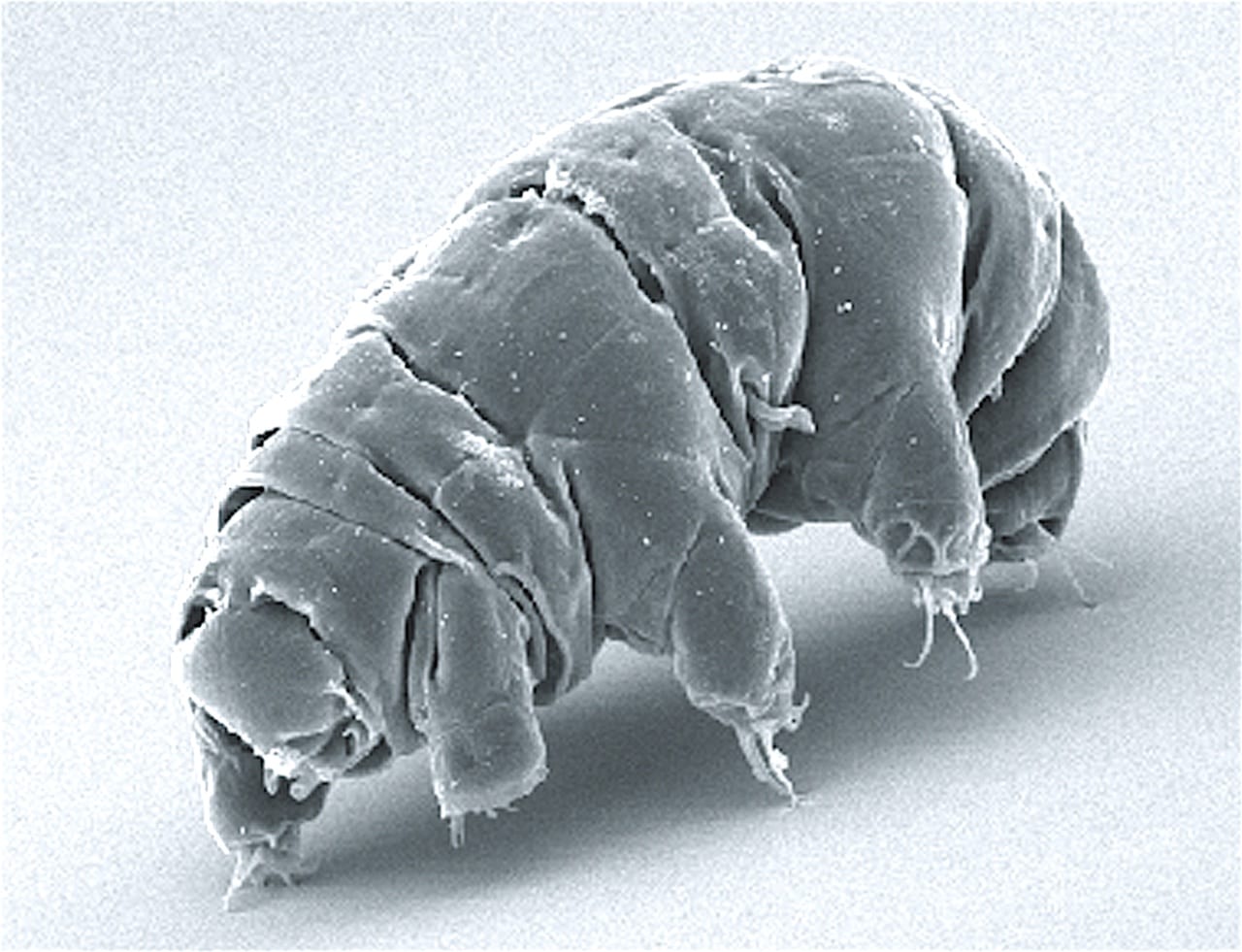
Milnesium tardigradum, one of the two tardigrade species flown on FOTON-M3, under a scanning electron microscope. Image: Schokraie et al., PLoS ONE, 2012, CC BY 2.5, via Wikimedia Commons.
Landing. Arrival is the hard part. In a 2021 test, frozen tardigrades fired from a gun survived impacts up to 0.9 km per second, but not faster.19 That is far slower than most natural impacts. The authors found that rock from Earth hitting the Moon at the average speed would kill them, though about 40% of such rocks land slowly enough for survival.19
Put together, these results show that the trip between Mars and Earth is survivable in principle for some microbes, if they are shielded. None of them shows that any microbe has made the trip. Over the far longer journeys between stars, the numbers collapse. A 2026 modeling paper, a preprint not yet peer reviewed, concluded that natural panspermia is credible only within one solar system, with early Mars as the best donor, and that transfer from other stars "is not competitive."6
Interstellar objects show that material does cross between stars.
ALH84001: the rock at the center
On 7 August 1996 a NASA-led team announced in Science that a meteorite from Mars might hold traces of ancient life.21 The rock, ALH84001, was found in the Allan Hills of Antarctica on 27 December 1984. It formed on Mars about 4.1 billion years ago, was knocked off the planet by an impact about 17 million years ago, and fell to Earth about 13,000 years ago.22
The team, led by David McKay, reported four kinds of evidence: organic molecules called polycyclic aromatic hydrocarbons (PAHs), carbonate globules like those that bacteria help form on Earth, tiny magnetite crystals similar to ones made by some bacteria, and tube-like shapes that looked like fossil microbes. They said inorganic origins were possible, but that life could explain many of the features.21 President Bill Clinton made a televised statement,22 saying that "rock 84001 speaks to us across all those billions of years and millions of miles," and that the finding still needed to be checked by other scientists.23
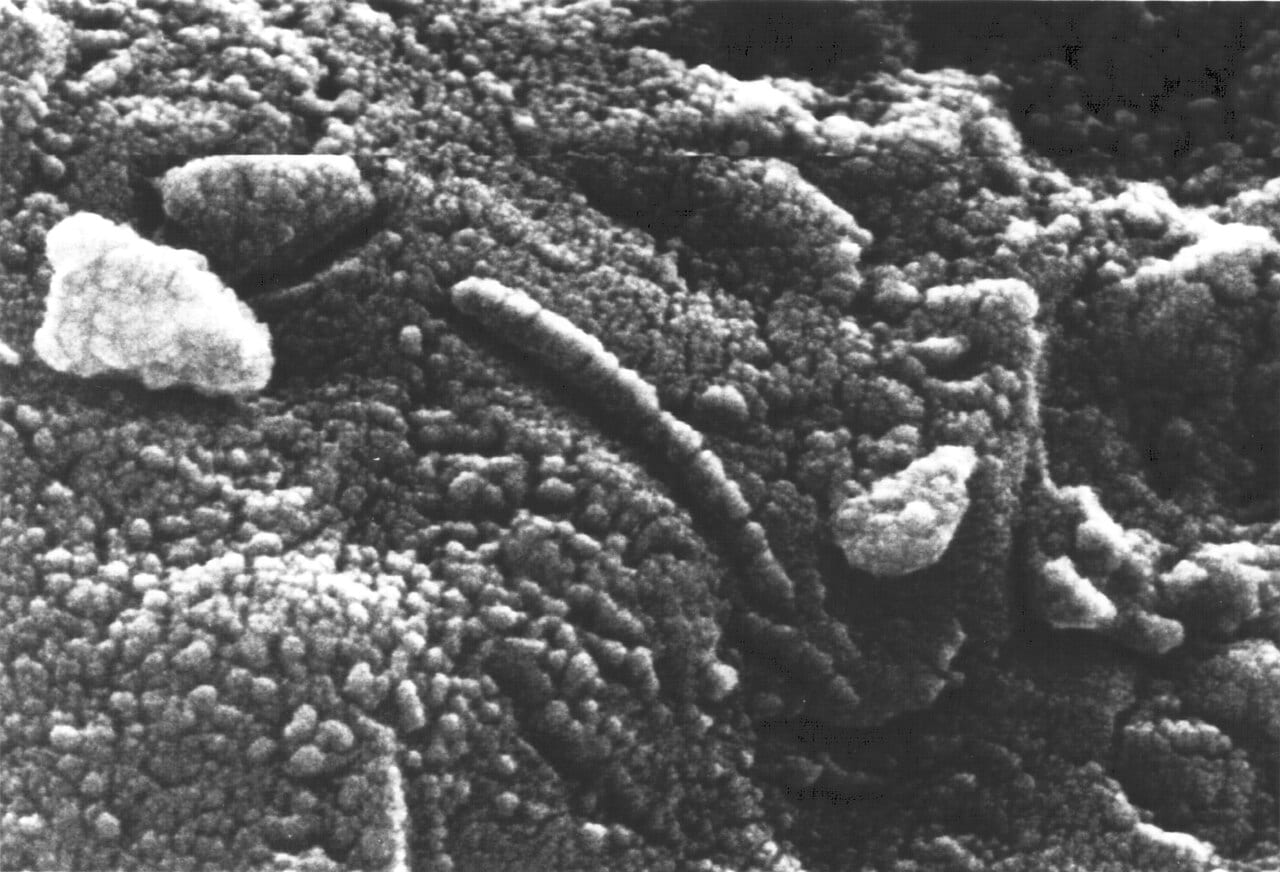
An electron microscope image of a chain-like structure inside ALH84001, released by NASA in 1996 as a possible microfossil. Similar shapes measure about 20 to 100 nanometres, smaller than any known cell. Image: NASA, public domain, via Wikimedia Commons.
- The tube-like shape read as a possible fossil microbe
The checking did not go well for the life claim. Each piece of evidence turned out to have a non-living explanation.
- Size. The proposed fossils are about 20 to 100 nanometres long, smaller than any cell known at the time. Critics argued they were too small to hold what a cell needs to live.22
- Organics. PAHs also turn up in asteroids, comets and other meteorites, where no life is involved. Amino acids found in the rock probably came from Antarctic contamination.22
- Magnetite. In 2001, researchers made similar carbonate globules with magnetite crystals through a purely inorganic process that simulated conditions on Mars.22
A small group, including members of the original team, kept arguing for life, especially from the magnetite.22 Most of the scientific community rejected the claim.22 In January 2022 a team led by Andrew Steele of the Carnegie Institution reported in Science that the rock's organic material formed through chemistry between water and rock on early Mars, with no life involved. The hydrogen in the organics matched Martian water, so the molecules are Martian, and they formed without biology. Steele put it this way: "Mars can undertake the chemistry that eventually led to life."24
The episode still mattered. It is remembered as a turning point for astrobiology, the science of life beyond Earth, and it showed how hard it is to read signs of life in a rock.22 It also supported one part of panspermia: a piece of Mars did reach Earth without being heated through.14
Ingredients from space
The best evidence for any version of panspermia is about ingredients.
The Murchison meteorite. A carbon-rich meteorite fell near Murchison, Australia, in 1969. In 1970 a team reported amino acids in it. Because the amino acids came in equal left- and right-handed forms, unlike the left-handed amino acids in living things, the team concluded they were made without life.25 Forty years later, a 2010 study using very high-resolution mass spectrometry found about 14,000 distinct compounds in it, including 70 amino acids, and estimated the true number could run into millions.25 In 2022 a Japanese team reported cytosine and thymine in Murchison and two other meteorites, completing the set of five nucleobases, the "letters" used in DNA and RNA.26
Meteorites that land on Earth can be contaminated, so the strongest results come from samples collected in space.
Ryugu. Japan's Hayabusa2 mission collected grains from the asteroid Ryugu and returned them in sealed capsules. In 2023 a team led by Yasuhiro Oba reported uracil, one of the bases in RNA, in about 10 milligrams of that material. Because the samples never touched Earth's surface, the team could rule out contamination from Earth's life.7
Bennu. NASA's OSIRIS-REx mission brought samples of the asteroid Bennu to Earth in 2023. On 29 January 2025 two papers reported 14 of the 20 amino acids that life uses to build proteins, all five nucleobases, very high amounts of ammonia, and salts left by evaporating brines.427 The amino acids came in equal left- and right-handed forms, so the question of why life uses only one hand is still open.4 In December 2025 a team led by Yoshihiro Furukawa reported the sugars ribose and glucose. Ribose is the sugar in RNA, and with it, Furukawa said, "all of the components to form the molecule RNA are present in Bennu."5
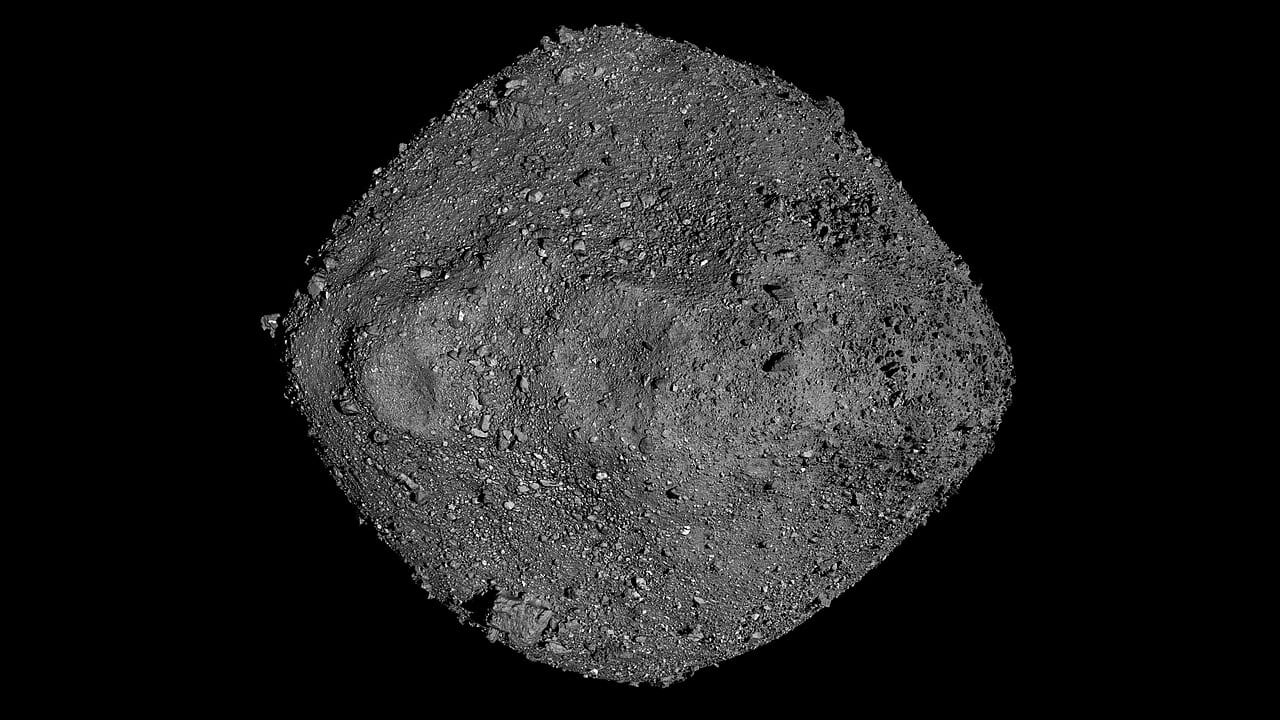
Asteroid Bennu in a mosaic from NASA's OSIRIS-REx spacecraft. Samples returned from it in 2023 hold amino acids, nucleobases and the sugar ribose. Image: NASA/Goddard/University of Arizona, public domain, via Wikimedia Commons.
The details make Bennu look less like a frozen leftover and more like a chemistry set. Daniel Glavin's team counted 33 amino acids in all: the 14 that life uses, plus 19 that are rare or unknown in biology.28 Bennu is a "rubble pile," rebuilt from pieces of a larger parent asteroid more than 100 km across that formed in the cold outer solar system about 4.5 billion years ago. Ammonia-rich ice melted inside that parent body, and the liquid gave organic molecules somewhere to form.28 As the water seeped out and evaporated, it left a concentrated brine, like the salt crust of a dry lakebed, with sodium phosphates, carbonates, sulfates, chlorides and fluorides. One mineral, trona (soda ash), had never been seen in an asteroid or meteorite before.28 Tim McCoy of the Smithsonian, co-lead of the minerals paper, called it "that next step on a pathway to life," while adding that no one knows how far along that pathway it could go.28 Glavin described asteroids like Bennu as "giant chemical factories in space."28
That also raises the obvious puzzle: if nearly all the ingredients were there, why did life not start inside Bennu's parent body? Glavin's guess is time. The salty liquid may simply have dried up before the chemistry could get further.28
NASA was careful about what this means. The findings "do not show evidence for life itself," its release said. They suggest instead that the conditions for life's emergence were widespread in the early solar system.4 That is pseudo-panspermia: space as a chemistry lab that stocked the young Earth, with life still starting here.
Comets, the wrong delivery van?
Since at least 1961, a popular version of the weak idea has given comets the starring role: icy "dirty snowballs" full of organic molecules, raining onto the young Earth.29 A study published in Scientific Reports in October 2026 argues that they were poor couriers.29
The team, led by Richard Anslow, who did the work as a doctoral student at Cambridge's Institute of Astronomy, followed one molecule: hydrogen cyanide (HCN). It has been detected in dozens of comets, including Halley's and Hale-Bopp, and with water it can lead to amino acids.29 They ran the early bombardment of Earth, more than 100,000 comets larger than 100 meters, through 100,000 simulations. Comets hit Earth so fast that the heat and pressure of impact broke the HCN down. In 54% of runs no comet delivered it intact. Most of the rest had one such impact, and a tiny minority up to three.29 "On average, our simulations found that there were no successful impacts," Anslow said.29
Even a lucky impact would not be enough. It would have to land somewhere that already had liquid water and the other ingredients, such as phosphorus and sulfur compounds, which comets do not usually carry. An impact into the ocean would dilute the HCN almost at once.29
Two twists keep the story open.
- Asteroids are back in favor. They hit Earth more slowly and more often than comets, and the Bennu and Ryugu samples show what they carried.294 Bennu even holds sodium phosphates, the kind of phosphorus compound comets lack.28 The "imported ingredients" idea survives; the vehicle changes.
- Mars may have done better. Mars is smaller and farther from the Sun, so comets struck it more slowly, and more of their HCN would have survived.29 That gives a new reason to think early Mars may have been the better chemistry lab, which feeds straight into the "life from a neighbor" version above.
Not everyone treats comets as ruled out. Queenie Chan of Royal Holloway, who was not involved, pointed out that HCN may react inside a comet before it ever reaches Earth, forming tougher compounds, such as amino acids, that survive impact better. Nicolle Zellner of Albion College said the authors "have definitely put some good parameters around the likelihood," but was also reluctant to drop comets entirely.29
The criticism
It moves the problem. The most common objection is that panspermia does not explain how life began. It "merely places it on another celestial body."1 If life came from Mars, it still had to start on Mars. Arrhenius avoided this by assuming life had always existed, which few scientists would accept now.2 The objection does not touch the weak version, which is about ingredients, and it is less damaging than it looks for a Mars origin: if early Mars had better conditions than early Earth, the question would change rather than vanish. But no one has shown that it did.
It is hard to test. Critics say the strong versions cannot be tested by experiment, which keeps them on the fringe.1 The survival experiments show what is possible, not what happened.
The fringe claims. Hoyle and Wickramasinghe's later work did the most damage to the idea's reputation, and it is worth being fair about who they were before being clear about the claims.
Deep Dive: Hoyle and Wickramasinghe: a serious astronomer and a fringe idea
Fred Hoyle was one of the most important astronomers of the 20th century. With Margaret and Geoffrey Burbidge and William Fowler he worked out, in a classic 1957 paper, how stars make the chemical elements. Many colleagues felt he should have shared Fowler's 1983 Nobel Prize.30 He also held unpopular views, rejecting the Big Bang long after most astronomers accepted it.30
Chandra Wickramasinghe, born in Sri Lanka in 1939, was his student and then his collaborator for over 40 years.13 Their 1974 suggestion that interstellar dust looked like freeze-dried bacteria was mostly ignored. Polycyclic aromatic hydrocarbons, which form without life, explain the same light signature.13
Hoyle also made a famous probability argument. In Evolution from Space (1981), he and Wickramasinghe put the chance of life's roughly 2,000 enzymes forming at random at one in 10 to the power 40,000.31 He compared it to the chance that "a tornado sweeping through a junkyard might assemble a Boeing 747."31 Biologists reply that nothing in evolution is assembled at random in one step. As John Maynard Smith put it, "no biologist imagines that complex structures arise in a single step."31
Then came disease. In a 1977 New Scientist article and in later work, the pair proposed that comets shed viruses and bacteria that "drift down onto the surface," and that sudden epidemics, including the 1918 flu, came from space. In 1979 they used sickness records from British boarding schools to argue that influenza fell from the sky rather than spreading from person to person. Biologists called the ideas "highly improbable" from the start.32
Wickramasinghe carried the idea on alone after Hoyle's death in 2001. In 2003 he suggested in a Lancet letter that the SARS virus came from space; the journal published three replies saying the idea was not based on evidence.3213 In 2020 he and colleagues proposed that SARS-CoV-2, the virus behind COVID-19, arrived on a meteor seen over China in October 2019.32 The virus is closely related to the earlier SARS virus, and coronaviruses could not survive the radiation of space.32 The claim was widely criticized for lacking evidence.13
A 2018 paper with 33 authors, led by E. J. Steele, with Wickramasinghe among them, went further and suggested that octopus or squid eggs might have arrived frozen in icy comets.33 The journal's editor defended publishing it as a debate. The virologist Karin Mölling said the claims "cannot be taken seriously."1333 Wickramasinghe also claimed fossil algae in fragments from a 2012 fireball in Sri Lanka. Experts said the rock was a fulgurite, glass formed by lightning, and the algae were from Earth.13
In fairness, Hoyle's early questions about organic matter in space were not foolish. Space is full of organic molecules, and comets and asteroids do carry them, as Bennu shows.4 The step from organic dust to living bacteria, and from comets to flu outbreaks, is where the evidence ran out.
The chemistry points the other way. The amino acids in Murchison and Bennu come in equal mirror-image forms, the signature of chemistry without life. Life on Earth uses only left-handed amino acids.254 So far, everything found in space rocks looks like what chemistry makes on its own, and nothing looks like what life leaves behind.
Dennis McKenna once gave panspermia a psychedelic twist.
Where it stands
A fair summary has three layers.
The weak version is now mainstream science. Space rocks carry amino acids, all five nucleobases, ribose and thousands of other organic compounds, and they formed without life.2545 Meteorites and comets almost certainly delivered some of this material to the young Earth. Whether it mattered for life's start is open. A 2026 simulation suggests comets hit too fast to deliver much intact, which shifts the weight toward slower asteroids, and toward early Mars as a place where comet chemistry survived better.29
The middle version, life swapped between Mars and Earth, is possible but unproven. Rocks move between the two planets, the inside of a Martian meteorite stayed cool, and shielded microbes can survive years in space.14818 What is missing is any sign that life ever existed on Mars, let alone that it traveled. ALH84001, the best candidate, did not hold up.2224
The strong versions, life drifting between stars or sent on purpose, and diseases falling from comets, have no evidence, and the disease claims have been rejected.13213 Their authors included some of the best scientists of the 20th century, and Crick and Orgel were candid that they had only "two weak facts."11 The idea stays useful as a question, mostly the question of whether life is rare or common. Future tests may come from rock returned from Mars and from material sampled in the plumes of icy moons such as Enceladus and Europa.19
Footnotes
-
Wikipedia, "Panspermia" (secondary source; used for the overview of versions, Anaxagoras, Kelvin 1871, Orgel's reported doubts, the "signature" test, the main objections and interstellar transfer). en.wikipedia.org ↩ ↩2 ↩3 ↩4 ↩5 ↩6 ↩7 ↩8 ↩9 ↩10 ↩11 ↩12 ↩13 ↩14 ↩15 ↩16
-
Helge Kragh, "The rise and fall of cosmical physics: notes for a history, ca. 1850-1920," arXiv 1304.3890, 2013 (section on Arrhenius read; the 1903 paper itself not read). arxiv.org ↩ ↩2 ↩3 ↩4
-
F. H. C. Crick and L. E. Orgel, "Directed panspermia," Icarus 19(3), July 1973, 341-346 (citation confirmed through Crossref; the paper itself not read; its conclusion is summarized from secondary sources). doi.org ↩ ↩2 ↩3
-
NASA, "NASA's Asteroid Bennu Sample Reveals Mix of Life's Ingredients," news release, 29 January 2025. nasa.gov ↩ ↩2 ↩3 ↩4 ↩5 ↩6 ↩7 ↩8 ↩9
-
NASA, "Sugars, 'Gum,' Stardust Found in NASA's Asteroid Bennu Samples," 2 December 2025, on Y. Furukawa et al., "Bio-essential sugars in samples from asteroid Bennu," Nature Geoscience, 2025 (the paper itself not read). nasa.gov ↩ ↩2 ↩3
-
Slava G. Turyshev, "Natural Lithopanspermia to Earth: Transport, Shielding, and Survival Limits for Solar-System and Extrasolar Donor Classes," arXiv 2604.03916, April 2026 (preprint in physics.gen-ph, not peer reviewed; abstract only). arxiv.org ↩ ↩2 ↩3
-
Allison Gasparini, "A crucial building block of life exists on the asteroid Ryugu," Science News, 21 March 2023, on Y. Oba et al., Nature Communications, 2023. sciencenews.org ↩ ↩2
-
Wikipedia, "Martian meteorite" (277 known as of 15 September 2020; identification by trapped gases; ejection ages). en.wikipedia.org ↩ ↩2 ↩3
-
John Sisko and Patricia Curd, "Anaxagoras," Stanford Encyclopedia of Philosophy, first published 2007, revised August 2026 (sections on seeds and fragments B4a and B4b). plato.stanford.edu ↩ ↩2
-
Svante Arrhenius, Worlds in the Making: The Evolution of the Universe, translated by H. Borns, Harper & Brothers, 1908, chapter VIII, "The Spreading of Life Through the Universe" (read in the Project Gutenberg edition). gutenberg.org ↩ ↩2
-
Christian Orlic, "The Origins of Directed Panspermia," Scientific American guest blog, 9 January 2013 (the "two weak facts" quote, the 1971 Byurakan conference, the molybdenum rebuttal and Orgel's later view). scientificamerican.com ↩ ↩2 ↩3 ↩4 ↩5 ↩6 ↩7 ↩8
-
Kirkus Reviews, review of Francis Crick, Life Itself: Its Origin and Nature, Simon & Schuster, 1981 (read through a search summary; the book itself not read; the working title and third argument also from search summaries). kirkusreviews.com ↩ ↩2 ↩3
-
Wikipedia, "Chandra Wickramasinghe" (secondary source for the 1974 dust claim, the books, the Lancet replies, the Polonnaruwa fragments, the 2020 COVID claim and Mölling's comment). en.wikipedia.org ↩ ↩2 ↩3 ↩4 ↩5 ↩6 ↩7 ↩8 ↩9
-
B. P. Weiss et al., "A Low Temperature Transfer of ALH84001 from Mars to Earth," Science 290(5492), 2000, 791-795, as described in Caltech's news release, October 2000 (read through a search summary). caltech.edu ↩ ↩2 ↩3
-
C. Mileikowsky et al., "Natural transfer of viable microbes in space," Icarus 145, 2000, 391-427 (abstract only, through Europe PMC). doi.org ↩
-
Ed Yong, "Tardigrades become first animals to survive vacuum of space," National Geographic (Not Exactly Rocket Science), 8 September 2008, on K. I. Jönsson et al., Current Biology, 2008 (the paper itself not read; no exact survival figures given). nationalgeographic.com ↩
-
M. Wassmann et al., "Survival of spores of the UV-resistant Bacillus subtilis strain MW01 after exposure to low-Earth orbit and simulated martian conditions: data from the space experiment ADAPT on EXPOSE-E," Astrobiology 12(5), 2012, 498-507 (abstract only, through search results). doi.org ↩
-
Y. Kawaguchi et al., "DNA Damage and Survival Time Course of Deinococcal Cell Pellets During 3 Years of Exposure to Outer Space," Frontiers in Microbiology 11, 2020, 2050 (abstract, introduction and discussion read). pmc.ncbi.nlm.nih.gov ↩ ↩2
-
Alejandra Traspas and Mark J. Burchell, "Tardigrade Survival Limits in High-Speed Impacts: Implications for Panspermia and Collection of Samples from Plumes Emitted by Ice Worlds," Astrobiology 21(7), 2021, 845-852 (abstract only). pmc.ncbi.nlm.nih.gov ↩ ↩2 ↩3
-
NASA Science, "Comet 3I/ATLAS" (discovery date and its status as the third known interstellar object). science.nasa.gov ↩
-
D. S. McKay et al., "Search for Past Life on Mars: Possible Relic Biogenic Activity in Martian Meteorite ALH84001," Science 273(5277), 1996, 924-930 (abstract only, through citation records). doi.org ↩ ↩2
-
Wikipedia, "Allan Hills 84001" (secondary source for the discovery, dates, structure sizes, contamination, the 2001 magnetite experiment and the scientific reception). en.wikipedia.org ↩ ↩2 ↩3 ↩4 ↩5 ↩6 ↩7 ↩8 ↩9
-
Bill Clinton, remarks on the possible discovery of life on Mars, 7 August 1996, American Presidency Project (quote confirmed through search results that cite the transcript; the transcript page itself not opened). presidency.ucsb.edu ↩
-
Derek Smith, "A New Explanation for Organics on a Mars Rock That Fell to Earth," Eos, 26 January 2022, on A. Steele et al., Science, January 2022 (the paper itself not read). eos.org ↩ ↩2
-
Wikipedia, "Murchison meteorite" (secondary source for the 1969 fall, K. Kvenvolden et al., Nature 228, 1970, 923-926, and the racemic amino acids), with P. Schmitt-Kopplin et al., "High molecular diversity of extraterrestrial organic matter in Murchison meteorite revealed 40 years after its fall," PNAS 107(7), 2010, 2763-2768 (both papers known through summaries only). en.wikipedia.org ↩ ↩2 ↩3 ↩4
-
Coverage of Y. Oba et al., "Identifying the wide diversity of extraterrestrial purine and pyrimidine nucleobases in carbonaceous meteorites," Nature Communications 13, 2022 (read through search summaries of press coverage; the paper itself not read). space.com ↩
-
D. P. Glavin et al., "Abundant ammonia and nitrogen-rich soluble organic matter in samples from asteroid (101955) Bennu," Nature Astronomy, January 2025 (abstract only, through search results). doi.org ↩
-
CNN, "Historic asteroid samples collected by OSIRIS-REx contain ingredients crucial for life," 29 January 2025, on D. P. Glavin et al., Nature Astronomy, and T. J. McCoy et al., Nature, both January 2025 (the papers themselves not read). cnn.com ↩ ↩2 ↩3 ↩4 ↩5 ↩6 ↩7
-
CNN, "New study challenges theory that comets seeded life on Earth," 31 October 2026, on R. Anslow et al., Scientific Reports, October 2026 (the paper itself not read; figures and quotes from the article). cnn.com ↩ ↩2 ↩3 ↩4 ↩5 ↩6 ↩7 ↩8 ↩9 ↩10
-
"Fred Hoyle," obituary, Physics Today, 2001 (read through a search summary; B2FH 1957, the Nobel remark, steady-state views). physicstoday.aip.org ↩ ↩2
-
Wikipedia, "Junkyard tornado" (secondary source for Hoyle's 747 analogy, the 10^40,000 figure from Evolution from Space, 1981, and John Maynard Smith, The Problems of Biology, 1986). en.wikipedia.org ↩ ↩2 ↩3
-
Taras Young, "Illness and the influence of the stars," Wellcome Collection, 10 November 2022. wellcomecollection.org ↩ ↩2 ↩3 ↩4 ↩5
-
Mike McRae, "A Weird Paper Tests The Limits of Science by Claiming Octopuses Came From Space," ScienceAlert, 28 December 2021, on E. J. Steele et al., "Cause of Cambrian Explosion: Terrestrial or Cosmic?," Progress in Biophysics and Molecular Biology 136, 2018, 3-23 (the paper itself not read). sciencealert.com ↩ ↩2
-
Tao Lin, "Dennis and Terence McKenna: Parts of an Intellectual Dyad," Vice, 2 September 2014 (quotes Dennis McKenna, The Brotherhood of the Screaming Abyss, 2012; the memoir itself not read). vice.com ↩