Idea
Earth, Moon and Sun in Motion
Earth spins, orbits, tilts, wobbles and drags a slowly escaping Moon with it, while the Sun carries everything around the galaxy. A guided tour of every motion, with the pictures that make them make sense.

Arts
Overview
Standing still is an illusion. Anyone reading this is spinning eastward at up to 1,670 kilometers an hour, circling the Sun at about 30 kilometers a second, and riding with the Sun around the center of the Milky Way at more than 200 kilometers a second.12 On top of those big motions sit dozens of smaller ones. Earth's axis traces a slow circle in the sky. The axis nods as it goes. The pole wanders a few meters around the ground. The orbit stretches and relaxes, and the whole ellipse turns. The Moon tilts its path, swings its nodes, rocks back and forth as seen from Earth, and drifts a few centimeters farther away each year.
Most of these motions were found one at a time, over more than two thousand years, by people who noticed that something in the sky did not quite repeat. They matter well beyond astronomy. The tilt of the axis makes the seasons. The slow changes in tilt and orbit pace the ice ages. The Moon's pull raises the tides, slows the day and steadies the climate. Even the calendar, the clock and the leap second are bookkeeping for motions that refuse to line up.
This page walks through them in order of scale: the day, the year, the slow wobbles that take tens of thousands of years, the Moon's own complicated path, the tides and everything else the Moon and Sun stretch and squeeze, eclipses, and finally the larger frame of barycenters, Lagrange points and the galaxy.
In context
The ancient sky was a clock that drifted. Babylonian astronomers kept careful records of lunar eclipses for centuries, and from them they learned that eclipses come back in a cycle of 223 months. Around 130 BCE the Greek astronomer Hipparchus compared his star positions with ones made about 150 years earlier and found that the stars had all shifted along the zodiac by the same small amount. He had discovered the precession of the equinoxes, the slowest of the motions on this page that was visible to the naked eye.9
For the next eighteen centuries the problem was explaining these motions from the wrong center. Nicolaus Copernicus put the Sun in the middle in 1543, which turned the daily spin and the yearly orbit into motions of Earth itself, and also explained precession as a slow turning of Earth's axis. Johannes Kepler, working from Tycho Brahe's observations of Mars, showed in 1609 that planets move on ellipses and speed up near the Sun. In 1687 Isaac Newton's Principia gave the cause: one law of gravity accounted for the orbits, for the tides, and even for precession, which Newton traced to the Sun and Moon pulling on Earth's equatorial bulge.9
Finer motions came with finer instruments. James Bradley found the axis's 18.6-year nodding, called nutation, and announced it in 1748. Seth Carlo Chandler found a 14-month wobble of the pole in 1891. In the twentieth century the Serbian engineer Milutin Milanković calculated how slow changes in Earth's orbit and tilt alter summer sunshine, and in 1976 deep-sea sediment cores showed those rhythms written into the history of the ice ages.3 Since 1969, lasers fired at mirrors left on the Moon have measured its distance to within millimeters, turning its slow retreat from a theory into a number.6
- ~130 BCE Hipparchus finds precession Star positions have crept along the zodiac.
- 1609 Kepler's ellipses Planets move faster near the Sun.
- 1687 Newton's Principia One law of gravity explains orbits, tides and precession.
- 1891 Chandler's wobble The pole wanders in a 14-month circle.
- 1969 Lasers to the Moon Apollo 11 leaves the first retroreflector.
Older times are squeezed together so the whole span fits.
Research
The motions below are grouped by how long they take, from a day to a quarter of a billion years. Each part can be read alone, but they build: the Moon's path makes more sense after Earth's, and eclipses make sense only after both.
The spinning Earth
Part 1 of 7
Earth turns on its axis from west to east, which is why the Sun, Moon and stars rise in the east. At the equator the ground moves about 465 meters a second, a little over 1,670 kilometers an hour. At the latitude of Los Angeles it is about 1,390 kilometers an hour, and at the poles it is zero: the ground simply pivots.1 Nothing about this is felt, because the spin is smooth and everything, air included, shares it.
Two kinds of day
The 24-hour day is not one full turn. Measured against the distant stars, Earth turns once every 23 hours, 56 minutes and 4 seconds, the sidereal day. But in that time Earth has also moved about one degree along its orbit, so it has to turn a little further, about four more minutes, before the Sun is back in the same spot in the sky. That longer turn is the solar day, and it averages 24 hours.1
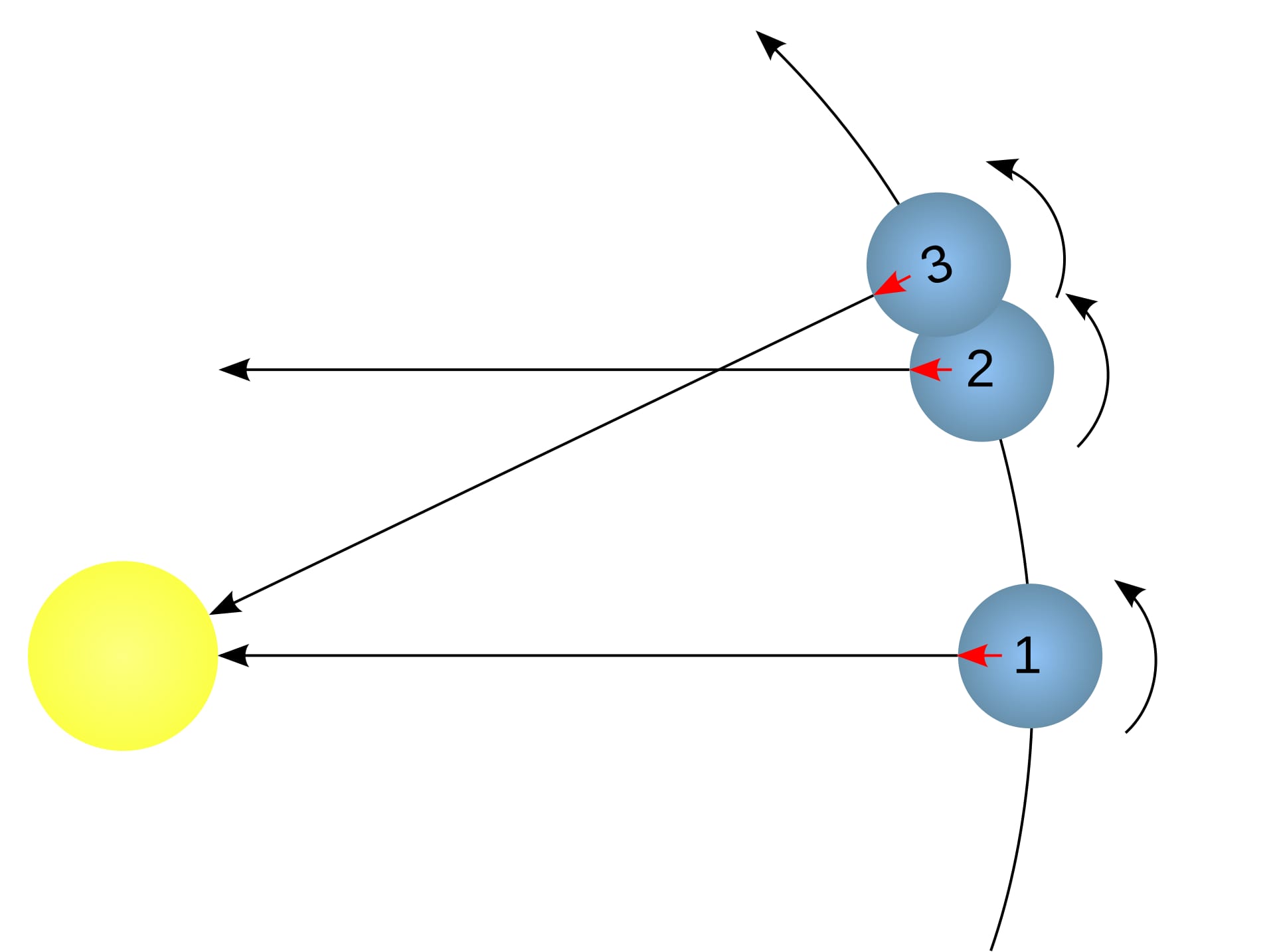
At position 1 the Sun and a distant star are both overhead. At 2, Earth has made one full turn against the stars, a sidereal day, but has moved along its orbit, so the Sun is not yet overhead. It gets there at 3, about four minutes later: a solar day. Diagram: Gdr and Chris828, CC BY-SA 3.0, via Wikimedia Commons.
The four-minute gap has a visible result. Each star rises about four minutes earlier every night, so over a year the night sky rotates through every season's constellations. In one year Earth turns 366.26 times against the stars but sees only 365.26 sunrises, because the orbit itself uses up one turn.
Sidereal and solar Sidereal means measured against the stars (from the Latin sidus, star). A sidereal day, month or year is one full turn or lap relative to the distant stars. A solar or synodic period is measured against the Sun, and is longer whenever the thing doing the measuring is also moving around the Sun.
The day is getting longer
The day is slowly lengthening, because the Moon's tides act as a brake on Earth's spin (the tides part below explains how). The tidal brake alone would add about 2.3 milliseconds to the length of the day every century. Records of ancient eclipses, which only happened where they did if Earth's rotation was where it was, show a slightly smaller observed rate of about 1.8 milliseconds per century from 720 BCE to 2015. The difference comes from the solid Earth still rebounding from the weight of Ice Age glaciers, which makes it spin a bit faster, like a skater pulling in their arms.10
Milliseconds a century add up over geological time. Layered tidal sediments in South Australia, laid down about 620 million years ago, record about 400 days in a year and a day of about 21.9 hours.11 A 2023 study suggests the slowdown was not steady: for perhaps a billion years in the middle of Earth's history, the day may have stalled at about 19 hours, held there by a tug-of-war between the Moon's tides and a daily tide in the atmosphere driven by the Sun's heat.12
On shorter scales the spin is anything but smooth. Winds, ocean currents and the churning liquid core trade angular momentum with the solid Earth, changing the day by a millisecond or so from season to season and decade to decade. Since 1972, timekeepers have added 27 leap seconds to clock time to keep it within a second of Earth's actual rotation. In recent years Earth has been running slightly fast, raising the prospect of the first ever negative leap second. A 2024 study in Nature found that meltwater from Greenland and Antarctica, spreading toward the equator, has slowed the planet enough to put that off by about three years, to around 2029.13 In 2022 the international body that oversees time standards voted to stop adding leap seconds by 2035.14
Wobbles in the spin
The axis does not stay fixed even relative to the ground. The North Pole, the point where the spin axis comes out of the crust, wanders in a rough circle a few meters across. Two rhythms drive most of it. One is yearly, from the seasonal shifting of air and water mass. The other is the Chandler wobble, a free wobble with a period of about 433 days, found by the American astronomer Seth Carlo Chandler in 1891 from tiny changes in measured latitude.15 The two beat together, so the circle grows and shrinks about every six years.
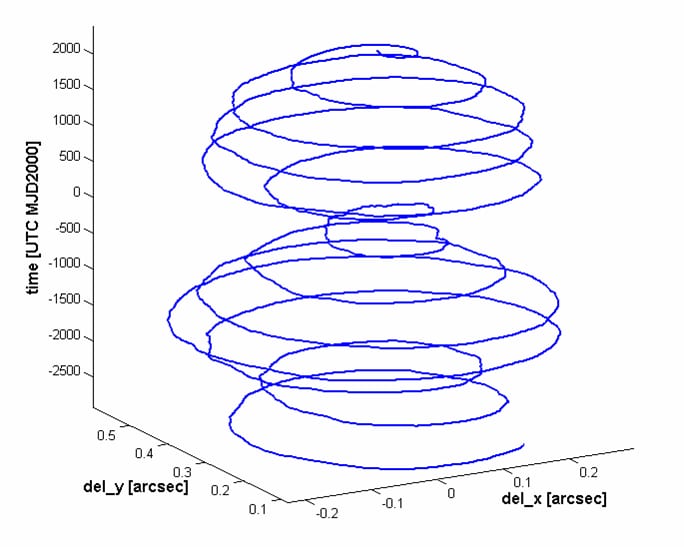
The pole's path, plotted with time running upward: a spiral of loops a few tenths of an arcsecond wide, where 0.1 arcsecond is about 3 meters on the ground. Graph: Shlomi Israel, CC0, via Wikimedia Commons.
A wobble left alone would die out within decades, so something keeps the Chandler wobble going. Studies point mainly to changes in pressure at the bottom of the ocean, with the atmosphere adding the rest.16 Underneath both wobbles, the pole also drifts slowly in one direction as mass moves around the planet. Rebound from the last ice age has long pulled it toward Canada at about 10 centimeters a year. Melting ice and human water use now pull it too: one study found that pumping about 2,150 billion tonnes of groundwater between 1993 and 2010 shifted the pole roughly 80 centimeters.17
The yearly orbit
Part 2 of 7
Earth orbits the Sun at an average distance of 149.6 million kilometers, one astronomical unit, moving at about 29.8 kilometers a second, roughly 107,000 kilometers an hour.1 Light from the Sun takes about 8 minutes 20 seconds to arrive. The orbit is very nearly a circle, but not quite.
An ellipse, barely
The orbit is an ellipse with an eccentricity of 0.0167, which measures how far it is from a circle. Earth comes closest to the Sun, at perihelion, around January 3, at about 147.1 million kilometers, and is farthest, at aphelion, around July 4, at about 152.1 million kilometers.1 Drawn to scale the ellipse would look like a circle to the eye; the Sun just sits slightly off its center.
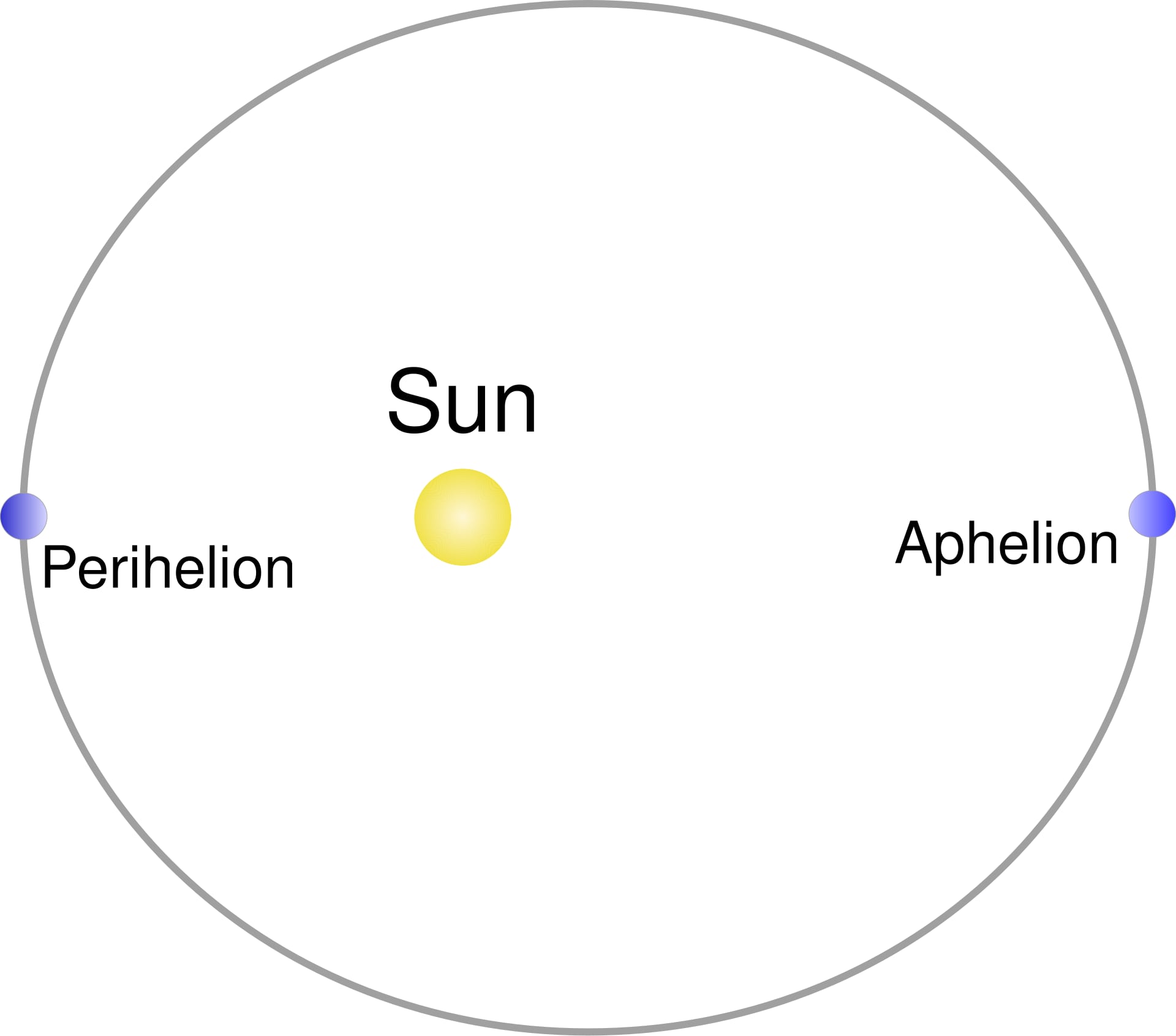
Perihelion, closest to the Sun, and aphelion, farthest. The shape here is exaggerated; Earth's real orbit is much closer to a circle. Diagram: Chris55, CC BY-SA 4.0, via Wikimedia Commons.
Kepler's three laws describe what that shape does to motion. Each planet moves on an ellipse with the Sun at one focus. A line from the Sun to the planet sweeps out equal areas in equal times, so the planet moves fastest at perihelion and slowest at aphelion. And the square of the orbital period is proportional to the cube of the orbit's size, which is why outer planets take so much longer per lap. Earth's January speed is about 30.3 kilometers a second and its July speed about 29.3.1
Why there are seasons
Earth is about 5 million kilometers closer to the Sun in January than in July, and it gets about 7 percent more sunlight then. Yet January is winter in the north. Distance is not what makes seasons. The tilt is.18
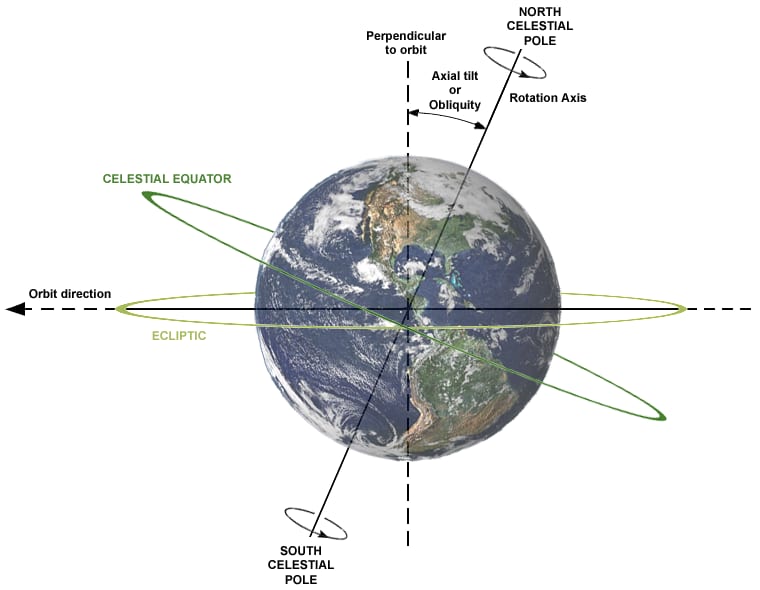
Earth's spin axis is tilted 23.44° from a line perpendicular to its orbit. The axis points the same way in space all year, so the north and south take turns leaning toward the Sun. Diagram: Dna-webmaster, CC BY 3.0, via Wikimedia Commons.
Earth's axis is tilted 23.44° from upright relative to its orbit, and it keeps pointing at the same spot in the sky, close to the star Polaris, all year round. So in June the Northern Hemisphere leans toward the Sun and in December it leans away. Leaning toward the Sun does two things: the Sun climbs higher, so its light strikes the ground more directly and is less spread out, and it stays up longer each day. Both add up to far more heat delivered per square meter. The Southern Hemisphere gets the opposite at the same time, which is why Australia has Christmas in summer.18
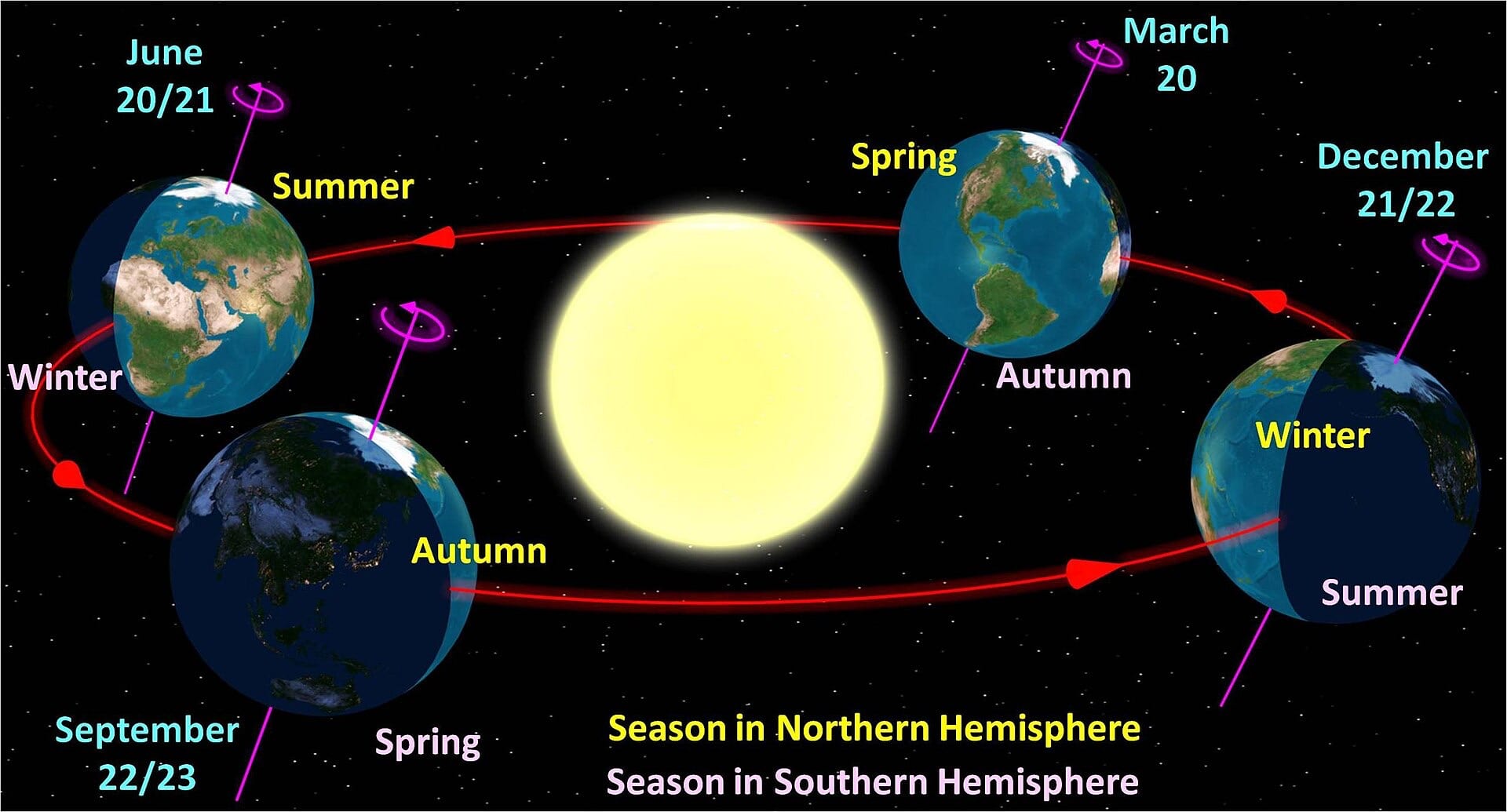
One orbit, seen from above the north. At the June solstice the north is tilted toward the Sun; at the December solstice, away. At the equinoxes in March and September neither hemisphere leans in, and day and night are nearly equal everywhere. Diagram: Tauʻolunga, CC0, via Wikimedia Commons.
The four turning points are the solstices, when the Sun reaches its farthest north (around June 21) or south (around December 21), and the equinoxes, when it crosses the equator (around March 20 and September 22). On the June solstice the Sun stands straight overhead at noon along the Tropic of Cancer, at 23.44° north, and never sets inside the Arctic Circle, at 66.56° north. Those lines are drawn exactly where they are because of the tilt. The solstices were among the first things people marked in stone, from passage tombs that fill with light on the shortest day to Stonehenge's midwinter sunset, a story told in Solar Religion.
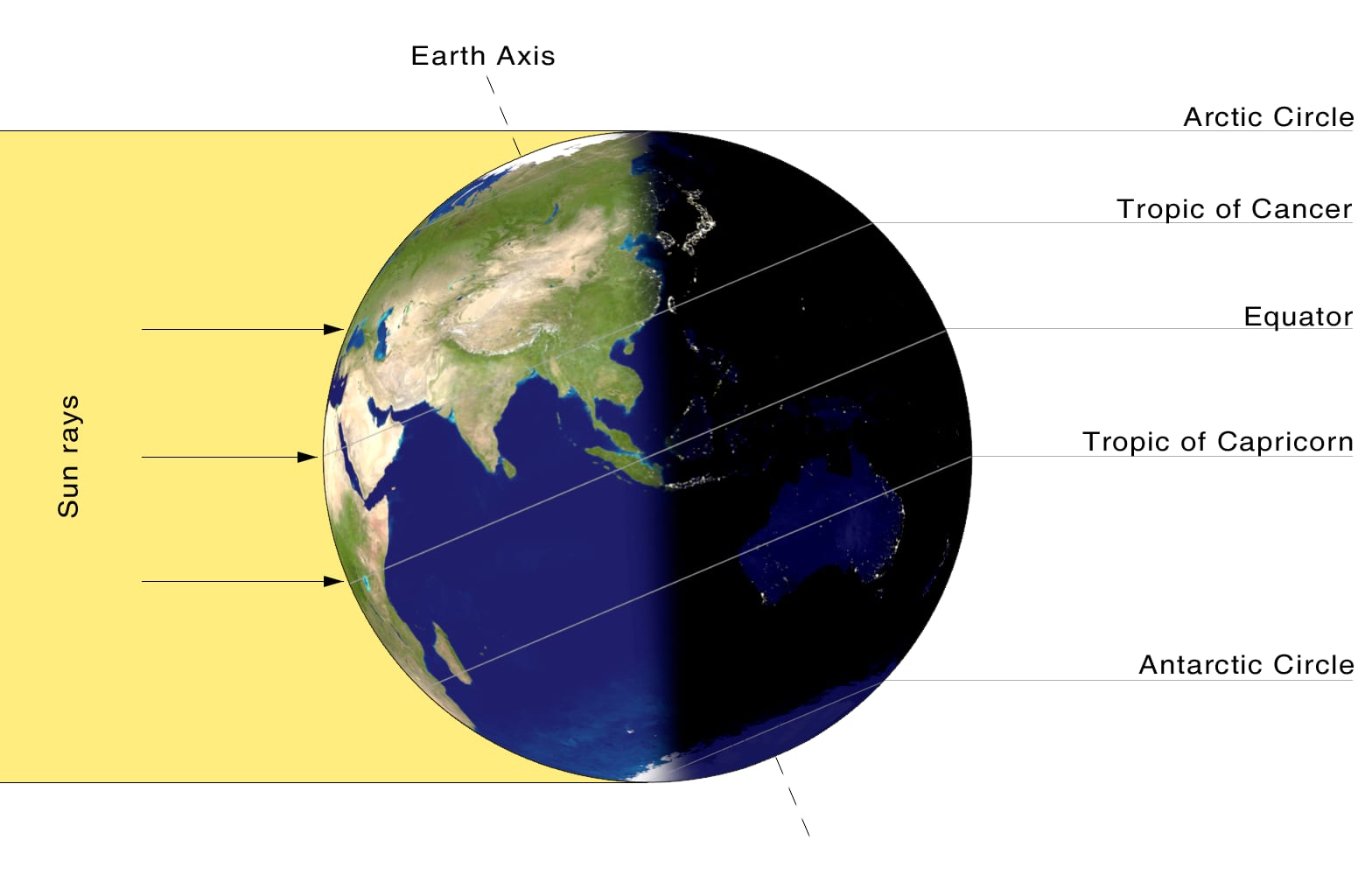
Sunlight at the June solstice. Everything north of the Arctic Circle stays in daylight all day, everything south of the Antarctic Circle stays dark. Illustration: Przemyslaw Idzkiewicz, CC BY-SA 2.0, via Wikimedia Commons.
The ellipse does have one effect on the seasons: it makes them unequal in length. Because Earth moves faster near perihelion in January, the Northern Hemisphere's winter is the shortest season, about 89 days, while its summer, near aphelion, is the longest, about 93.6 days. The north's spring and summer together run about a week longer than its fall and winter.
Two kinds of year
As with the day, there is more than one year. The sidereal year, one lap measured against the stars, is 365.2564 days. The tropical year, from one March equinox to the next, is about 20 minutes shorter, 365.2422 days, because the axis is slowly turning (see precession below) and the equinox creeps backward to meet Earth. The seasons follow the tropical year, so calendars do too.1 The Gregorian calendar of 1582 approximates it with 97 leap days every 400 years, giving an average of 365.2425 days, off by about one day in 3,000 years.
The analemma and the equation of time
A sundial and a clock agree on only four days a year. On the others the sundial can run up to about 16 minutes fast (in early November) or 14 minutes slow (in mid-February). The difference is called the equation of time, and it has two causes.19 One is the ellipse: Earth moves faster near perihelion, so the Sun appears to move faster along its yearly path, and solar days in January are slightly longer than average. The other is the tilt: the Sun's yearly path is slanted relative to the equator, so even at a steady pace its eastward progress, which is what sets the time of noon, speeds up and slows down twice a year.
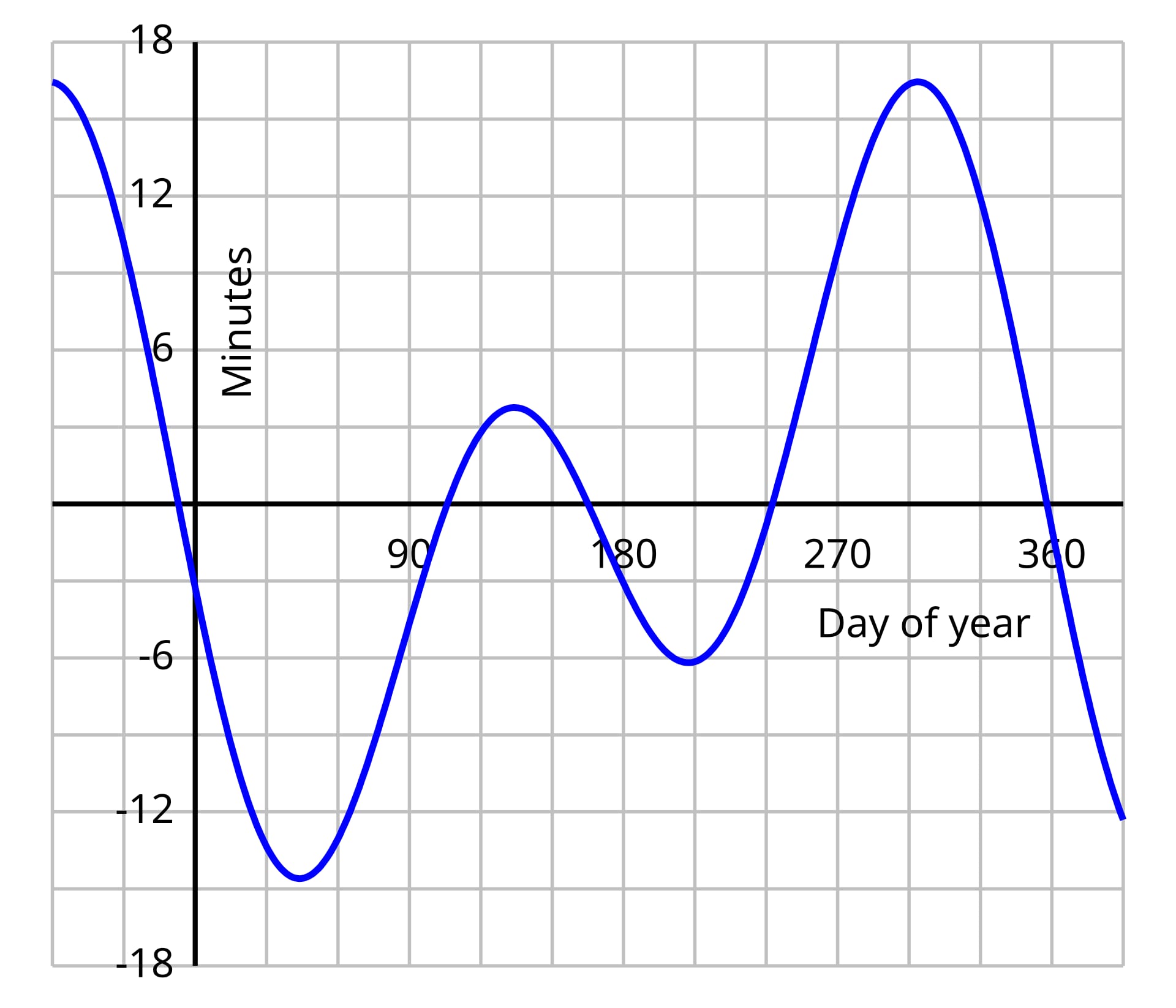
The equation of time over a year: how far sundial time runs ahead of (above zero) or behind (below zero) clock time, in minutes. Graph: Drini and contributors, CC BY-SA 3.0, via Wikimedia Commons.
This is why the earliest sunset of the year, in the mid-northern latitudes, comes in early December rather than on the solstice, and the latest sunrise comes in early January. Photograph the Sun at the same clock time every few days for a year and it traces a lopsided figure eight called the analemma: the up-and-down comes from the tilt, the side-to-side from the equation of time.
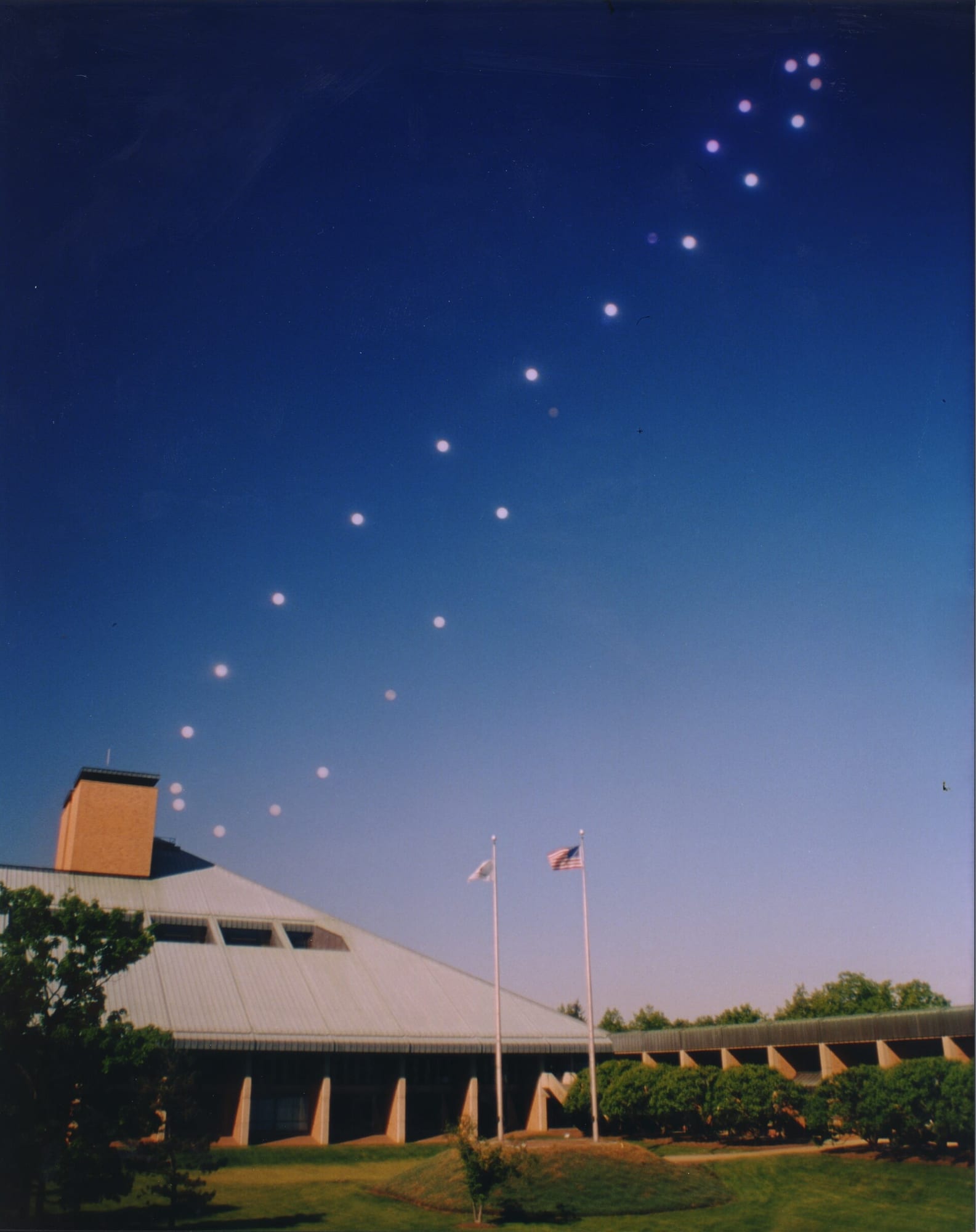
A real analemma: one exposure of the Sun at the same clock time on dozens of days through a year, stacked over a single landscape. Photo: Jack Fishburn, CC BY-SA 3.0, via Wikimedia Commons.
Old globes often printed the analemma as a figure eight floating in the Pacific, as a ready reckoner: find the date along the eight and read off how far north or south the Sun stands and how far a sundial runs from the clock. The shape depends on the planet. Earth's lopsided eight comes from its particular mix of tilt and eccentricity, and the timing of perihelion relative to the solstices. A planet with no tilt and a perfectly circular orbit would have no analemma at all; the Sun would return to the same point at the same time every day. Mars, with a similar tilt but a much more elliptical orbit, has an analemma shaped like a teardrop, because there the ellipse dominates.
The figure is also slowly changing. As perihelion drifts through the calendar over its 21,000-year cycle, the two loops of the eight trade sizes: today the southern loop, around the December solstice, is the larger one, because perihelion falls in January and the Sun's pace is fastest then. In about 10,000 years, with perihelion in July, the northern loop will be the larger.
The slow wobbles
Part 3 of 7
If Earth were a perfect sphere, its axis would keep pointing at the same star forever. It is not. Spinning makes it bulge at the equator, which is about 43 kilometers wider in diameter than the poles.1 The Sun and Moon pull on that bulge, and since the bulge is tilted, their pull tries to stand Earth upright. A spinning body does not respond to a sideways push by tipping over. It responds the way a spinning top does: its axis slowly sweeps around in a circle. That is precession, and the other slow motions of this part follow from it or from the planets tugging on Earth's orbit.
Precession of the axis
Earth's axis traces a cone in space, one full circle every 25,770 years or so, moving about 50.3 arcseconds a year.4 The tilt stays roughly the same while the direction of the tilt turns. Over that circle, the "pole star" changes. Today the axis points within a degree of Polaris, and will come closest around the year 2100. Around 2700 BCE, when the first pyramids were built, the pole star was Thuban in the constellation Draco. Around 14,000 CE it will be Vega, much brighter but farther from the pole.
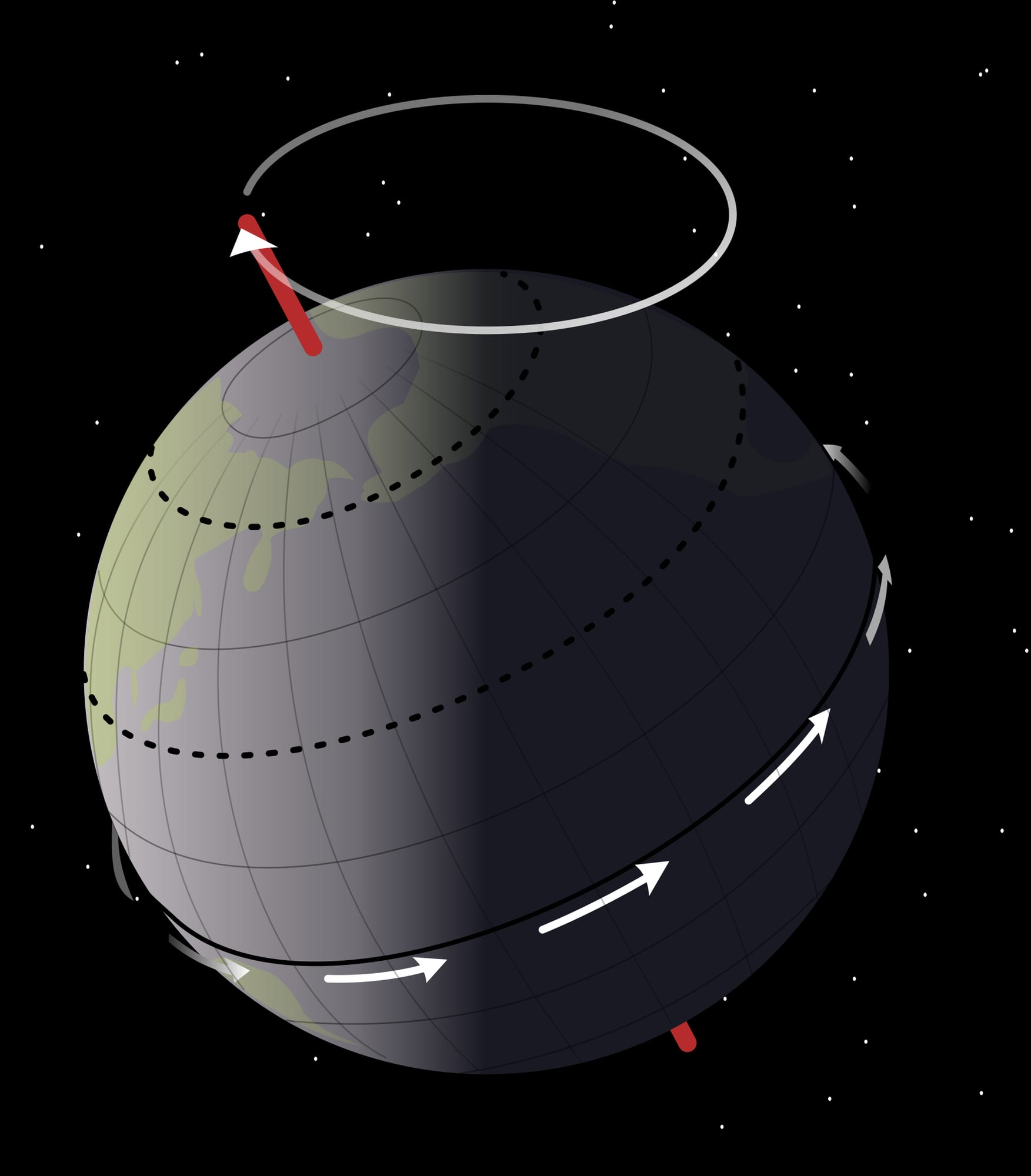
Precession: the axis (red) sweeps out a cone while Earth spins, completing a circle in about 25,800 years. Diagram: NASA and Mysid, public domain, via Wikimedia Commons.
Precession also drags the equinoxes backward along the zodiac, which is what Hipparchus noticed. The Sun at the March equinox sat in front of the stars of Aries two thousand years ago, when the signs of Western astrology were fixed. It now sits in Pisces and is drifting toward Aquarius, the source of the "Age of Aquarius." Astrological signs never moved with the stars, so today they are offset from the constellations they are named for by nearly a whole sign.
Nutation, the nod
On top of the smooth precession circle, the axis nods back and forth slightly. The largest part of the nod has a period of 18.6 years and an amplitude of about 9 arcseconds, tiny but measurable with a telescope. James Bradley found it in two decades of careful observations and published it in 1748.20 The 18.6-year period is not a coincidence: it is the time it takes the Moon's tilted orbit to turn once around (see the Moon's nodes below), which changes how the Moon pulls on the bulge.
The turning orbit
The orbit turns too. The pull of the other planets, mainly Jupiter and Venus, makes the long axis of Earth's ellipse rotate slowly in the same direction Earth goes around, about once every 112,000 years against the stars. Combined with the axial precession going the other way, the timing of perihelion shifts through the seasons in about 21,000 years.3 Perihelion now falls in early January, close to the northern winter solstice. Around 1246 CE the two coincided. In about 10,000 years perihelion will come in July, and northern summers will be closer to the Sun.
Tilt and stretch
Two more properties of the orbit change slowly. The tilt itself rocks between about 22.1° and 24.5° over a cycle of about 41,000 years. It peaked around 10,700 years ago and is now decreasing, slowly, toward a minimum in about 10,000 years.3 A larger tilt makes stronger seasons in both hemispheres: hotter summers and colder winters.
The eccentricity of the orbit, its departure from a circle, also changes as the planets pull on it. Over cycles of about 100,000 and 405,000 years it varies from almost zero to about 0.06. Today it is 0.0167 and decreasing.3 The more elliptical the orbit, the more the season in which perihelion falls gets an extra dose of sunlight.
The tilt would be far less steady without the Moon. In 1993 the French astronomer Jacques Laskar and colleagues showed that without a large moon, Earth's tilt would swing chaotically, perhaps between nearly 0° and 85°, over millions of years, as Mars's does. The Moon speeds up Earth's precession enough to keep it out of resonance with the planets' tugs, which holds the tilt within a narrow band.21 A steady tilt means steady seasons, which may have mattered for the long history of life on land.
Milankovitch cycles
These three slow changes, in tilt, in eccentricity, and in when perihelion falls, are together called the Milankovitch cycles, after the engineer who worked out what they do to sunlight.
Deep Dive: How orbital rhythms pace the ice ages
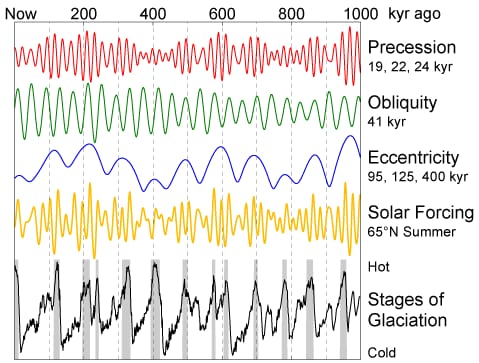
The last million years of the three cycles (precession, obliquity, eccentricity), the summer sunshine at 65° north that they produce together, and the record of glaciations below. Graph: Robert A. Rohde, Global Warming Art, CC BY-SA 3.0, via Wikimedia Commons.
Milutin Milanković was a Serbian civil engineer who spent the First World War as a prisoner in Budapest, where he was allowed to work in the library of the Hungarian Academy of Sciences. He set himself a question that nobody had answered with numbers: how much sunlight does each latitude receive on each day of the year, and how did that change over the past several hundred thousand years? With pencil, paper and the orbital calculations of earlier astronomers, he computed it, and published the full result in 1941 as Canon of Insolation and the Ice-Age Problem.3
His key insight was about which season matters. The total sunlight Earth receives over a year barely changes with these cycles: eccentricity alters it by a fraction of a percent, and tilt and precession only move it around between seasons and latitudes. What decides whether an ice age begins is whether snow on the northern continents survives the summer. Most of Earth's land, and therefore most of the room for ice sheets, is in the Northern Hemisphere. If northern summers are cool, some of the previous winter's snow lasts until the next winter, piles up year after year, and the white surface reflects more sunlight, cooling things further. If northern summers are warm, the snow melts and ice sheets retreat. So Milanković focused on summer sunshine at about 65° north, the latitude of northern Canada and Scandinavia. Low tilt, an orbit that puts the northern summer near aphelion, and high eccentricity to exaggerate that distance all combine to give the coolest northern summers.
For decades the idea had no good test, because nobody could date the ice ages precisely. That changed with deep-sea sediment cores. The shells of tiny marine animals called foraminifera record the ratio of two oxygen isotopes in the seawater they grew in, and that ratio tracks how much water was locked up in ice sheets, since ice preferentially holds the lighter isotope. In 1976 James Hays, John Imbrie and Nicholas Shackleton analyzed two cores from the southern Indian Ocean covering about 450,000 years. Their paper, titled "Variations in the Earth's Orbit: Pacemaker of the Ice Ages," found climate cycles at about 100,000, 42,000 and 23,000 years, the periods Milanković had predicted.22 It is one of the most cited results in climate science.
Not everything fits neatly. Over the last 800,000 years or so, ice ages have come in about 100,000-year cycles, a slow buildup of ice over 80,000 or 90,000 years followed by a fast collapse. But the eccentricity cycle at that period has the weakest direct effect on sunlight of the three. Before about 1.2 million years ago, ice ages came every 41,000 years, following the tilt cycle, and nobody fully agrees why the rhythm changed. This shift is called the Mid-Pleistocene Transition.23 Proposed answers include ice sheets growing too thick to melt in one warm summer, a slow decline in atmospheric carbon dioxide, and the scraping away of soft soil under the ice sheets, which let them rest on hard rock and grow larger. Most researchers now see the orbital cycles as the pacemaker and the climate's own feedbacks, especially carbon dioxide and ice reflectivity, as the amplifier: the orbit sets the timing, and the climate system decides how big the response is.
The cycles also give a sense of scale for today's warming. Left to the orbit, Earth would be in a very slow cooling trend, with the next glaciation tens of thousands of years away, likely more given current carbon dioxide levels. Warming of more than a degree in a century and a half is far faster than anything the orbital cycles produce, which change sunlight over many thousands of years.3
Milanković never saw his theory confirmed in full; he died in 1958, eighteen years before the sediment cores came in. The cycles he calculated now anchor the timescale geologists use to date the last few million years of sediment.
The Moon's path
Part 4 of 7
The Moon is unusually large for its planet, a little over a quarter of Earth's diameter, and its path is one of the most complicated in the solar system to predict. It is pulled hard by both Earth and the Sun, so its orbit is constantly being bent, tilted and turned.
The orbit in numbers
The Moon orbits at an average distance of 384,400 kilometers, about 30 Earth diameters, at a little over a kilometer a second.5 Its orbit is more elliptical than Earth's, with an eccentricity of 0.055, so its distance ranges from about 363,300 kilometers at closest approach, perigee, to about 405,500 kilometers at farthest, apogee, on average.5

Earth and Moon at their average distance, to scale. Most pictures put them far too close. Image: Melikamp, CC BY-SA 3.0, via Wikimedia Commons.
The orbit is also tilted, by about 5.1°, to the plane of Earth's orbit around the Sun, the ecliptic. That small tilt is why there is not an eclipse every month. The two points where the Moon's orbit crosses the ecliptic are called the nodes.
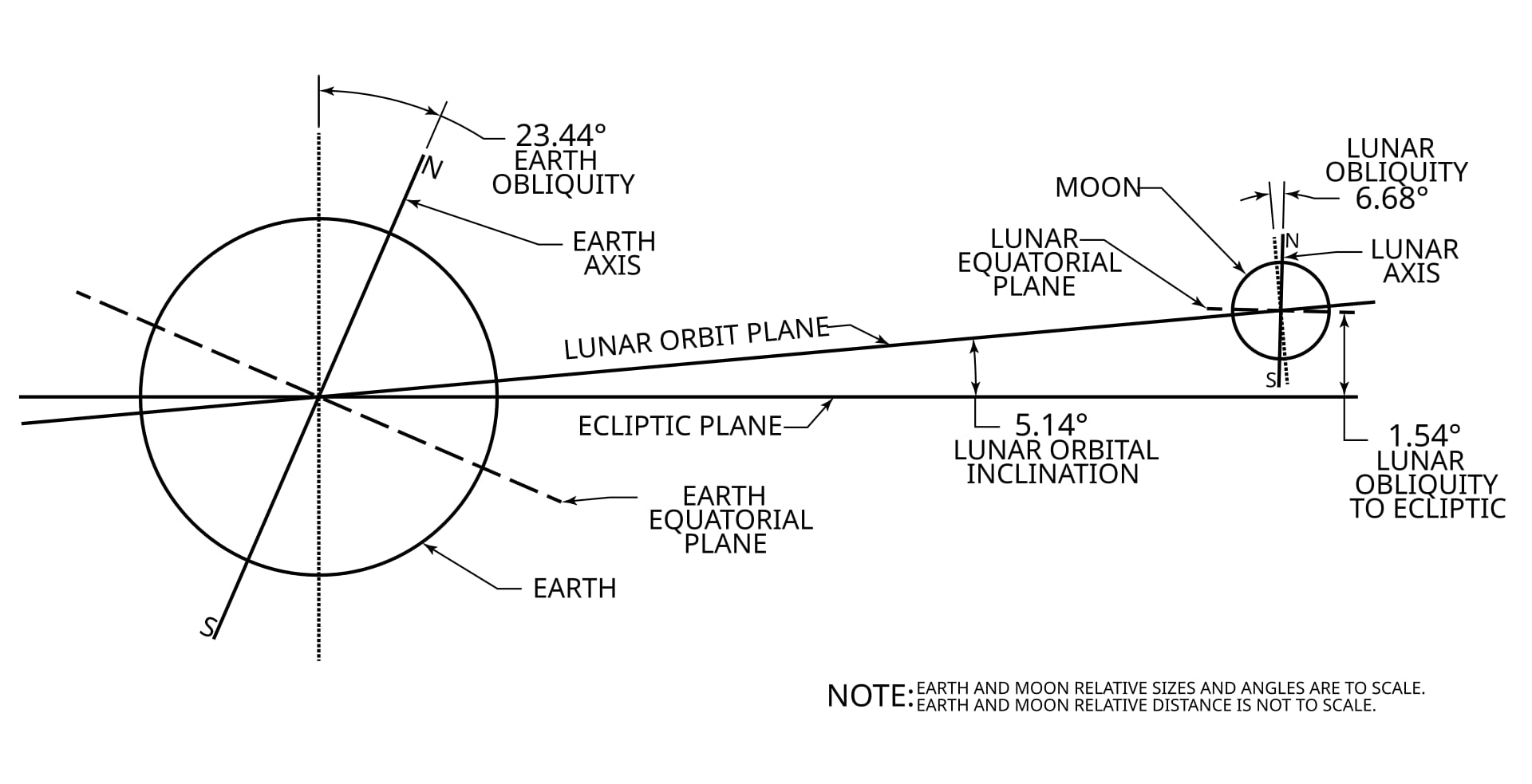
The Moon's orbit is tilted about 5.1° to the ecliptic, and Earth's equator is tilted 23.4° to it, so the Moon can range from 18° to 28.6° north and south of the equator. Diagram: Peter Sobchak, CC0, via Wikimedia Commons.
Five kinds of month
Because every reference point moves, there are several different months, each useful for a different job.5
| Month | Measured against | Length | What it governs |
|---|---|---|---|
| Sidereal | The distant stars | 27.322 days | One full lap of the orbit |
| Synodic | The Sun | 29.531 days | The cycle of phases, new moon to new moon |
| Tropical | The equinox | 27.322 days | The Moon's return to the same declination |
| Draconic | The node | 27.212 days | When eclipses can happen |
| Anomalistic | Perigee | 27.555 days | Closest approaches and supermoons |
The synodic month is longer than the sidereal month for the same reason the solar day is longer than the sidereal day. While the Moon makes one lap, Earth has moved about 27° along its orbit around the Sun, so the Moon needs about two more days to get back into the same position relative to the Sun.
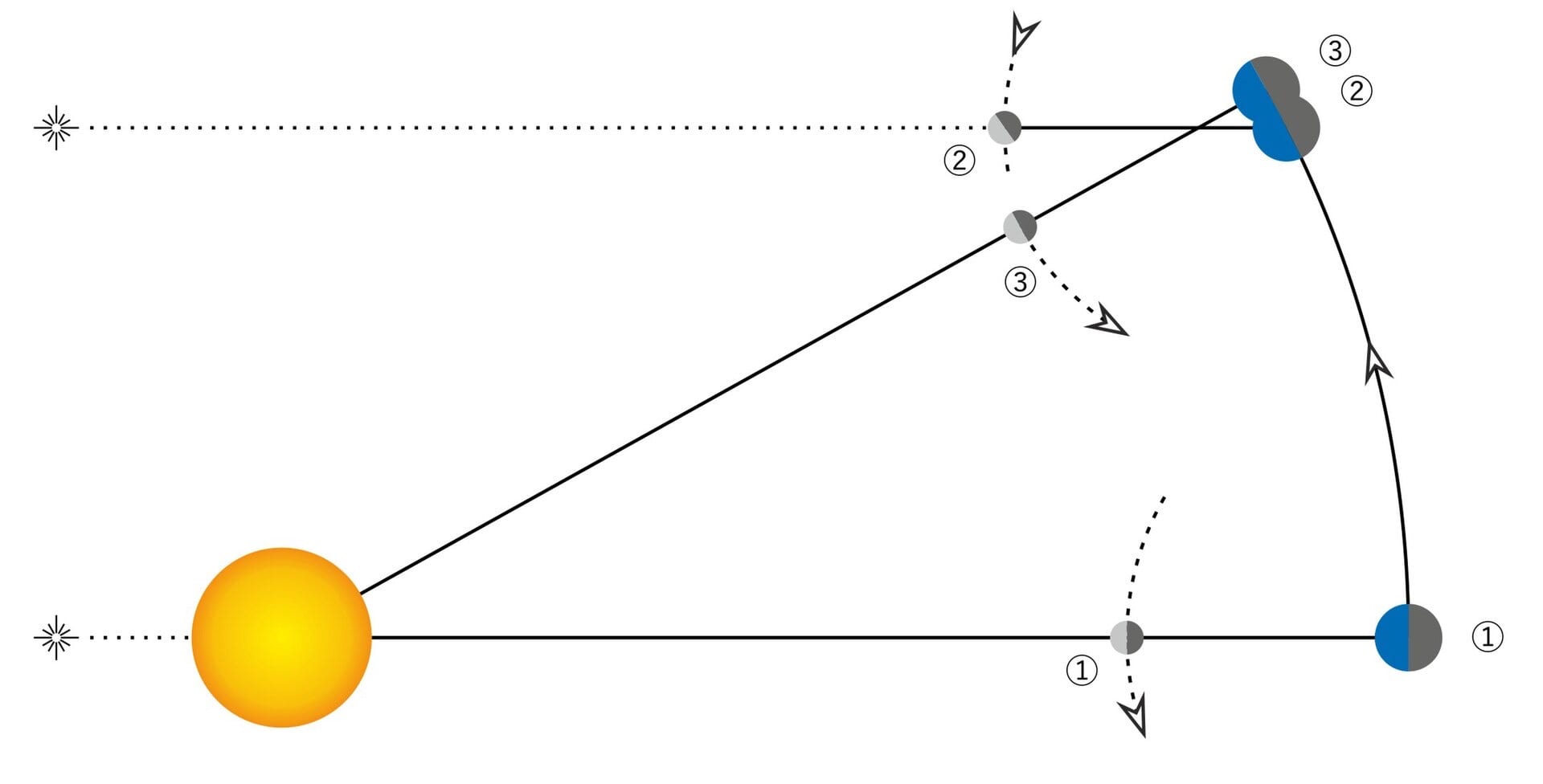
From one new moon (1) the Moon makes a full lap against the stars in 27.3 days (2), but Earth has moved on, and the Moon needs about two more days to line up with the Sun again (3). Diagram: AstroOgier, CC BY 4.0, via Wikimedia Commons.
Phases
The Moon is always half lit by the Sun. Phases are just how much of the lit half faces Earth. At new moon the Moon lies roughly between Earth and Sun and its lit side faces away. At full moon it is on the far side of Earth and its whole lit face is turned toward us. In between come the crescents, quarters and gibbous phases. Waxing means growing toward full, waning means shrinking toward new.
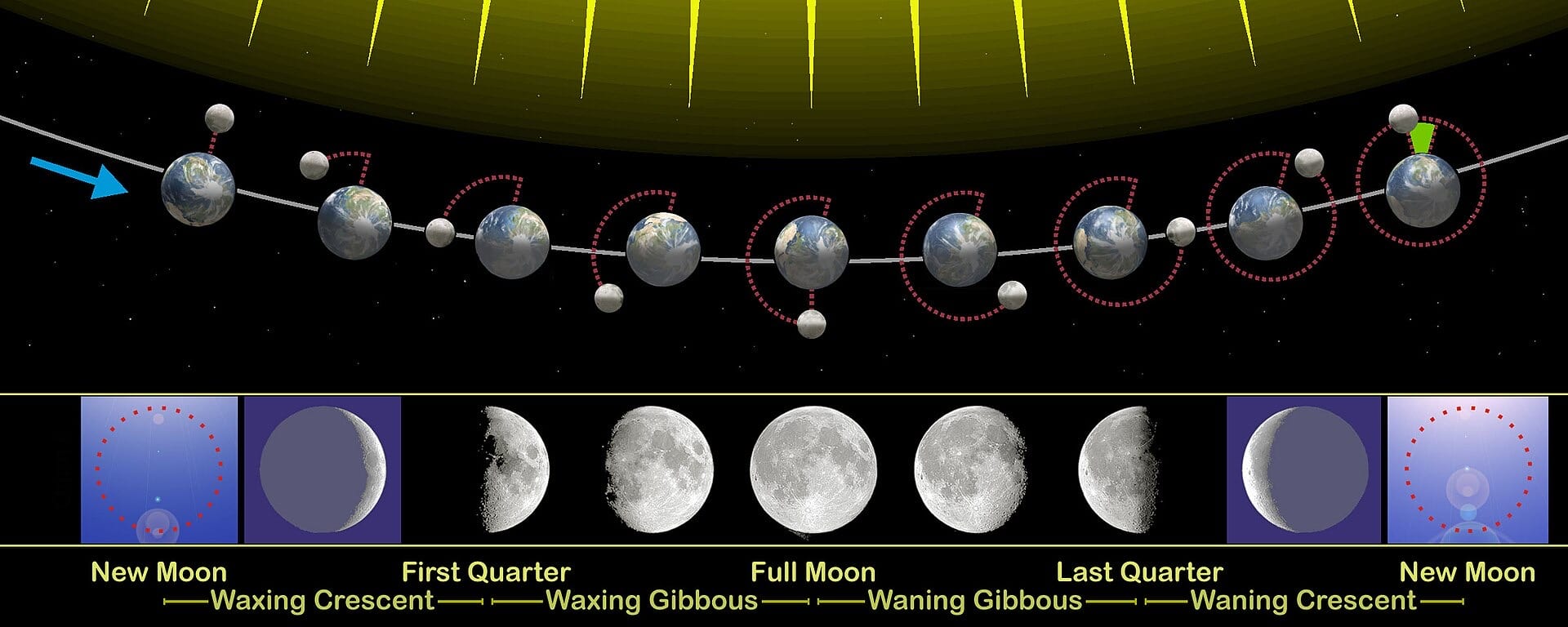
The Moon's orbit seen from above (top) and the phase seen from Earth at each point (bottom). The lit half always faces the Sun, at left. Diagram: Orion 8, CC BY-SA 3.0, via Wikimedia Commons.
The phase also sets the Moon's timetable. A full moon, opposite the Sun, rises at sunset and sets at sunrise. A first quarter rises around noon and sets around midnight. And because the Moon moves about 13° eastward around Earth each day, it rises on average about 50 minutes later each night.
Tidal locking and libration
The Moon always shows Earth the same face. That is not because it does not spin; it spins exactly once per orbit, so the same side stays toward Earth. This is called tidal locking, and it is the end state of the tidal braking described in the next part: Earth's tides on the Moon slowed its spin until spin and orbit matched, long ago.24
The match is not perfect, so the Moon appears to rock. Its spin is steady but its orbital speed is not: it moves faster near perigee and slower near apogee, so the face turns slightly east and west of center over a month. The tilted orbit lets us peek over its north and south poles in turn. Together these librations let observers on Earth see about 59 percent of the surface over time.24
The nodes turn, and the Moon stands still
The tilted orbit does not stay put. The Sun's pull makes it swivel, so the nodes slide backward, westward, along the ecliptic, making a full circle every 18.6 years.5 This is the nodal precession of the Moon, and it has consequences everywhere: it sets the timing of eclipse seasons, drives Earth's nutation, and changes how high and low the Moon can climb in the sky.
When the Moon's 5.1° tilt lines up with Earth's 23.4° tilt, the Moon can range as far as 28.6° north and south of the equator during a month, farther than the Sun ever goes. This is a major lunar standstill. Nine years later the tilts cancel and the range shrinks to about 18.3°, a minor standstill.25 At a major standstill the moonrise swings far north and south along the horizon over a single month, well past where the Sun rises at the solstices, and the Moon rides very high in the sky in winter and very low in summer.
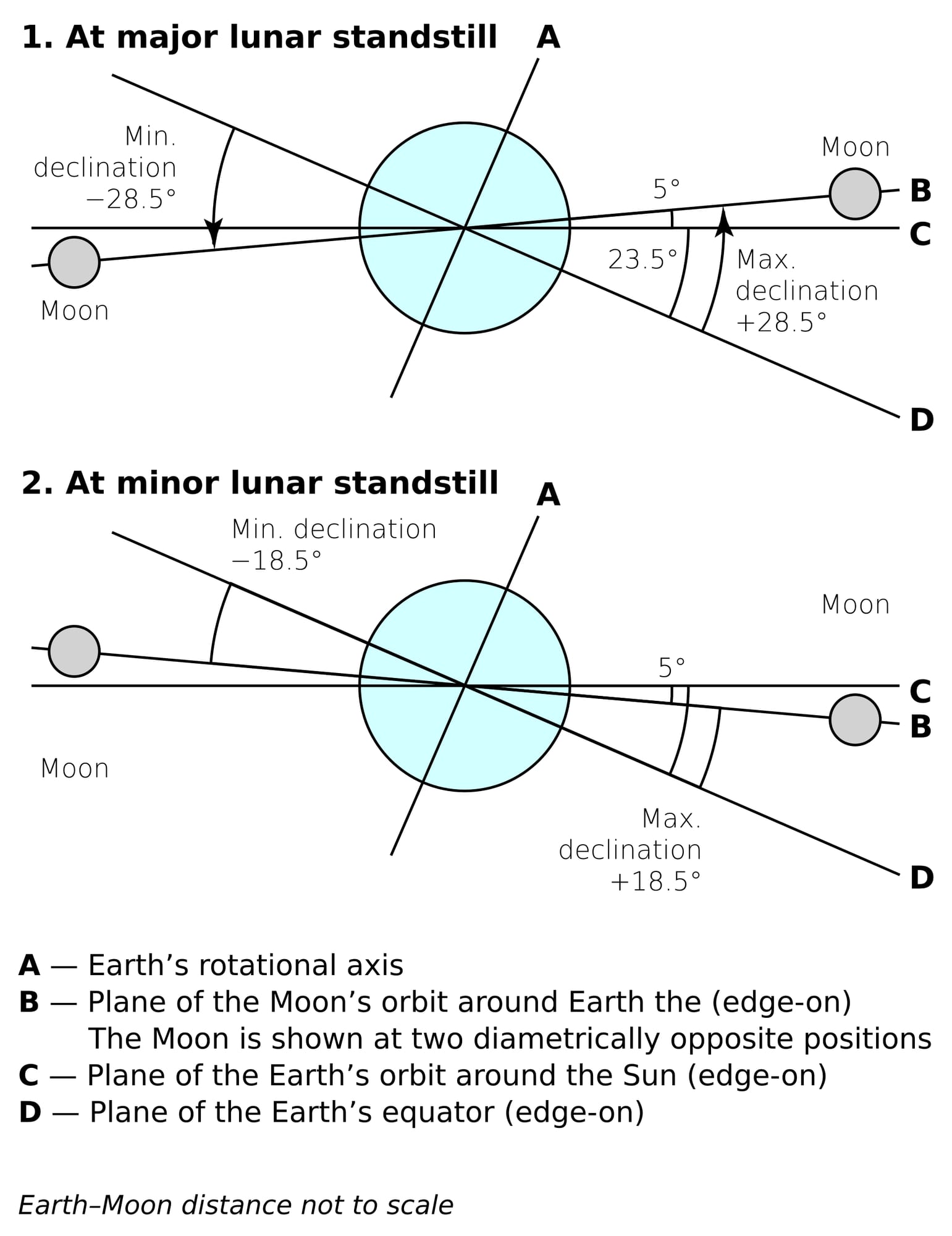
How the two tilts combine. At a major standstill (top) the Moon's 5.1° tilt adds to Earth's 23.4°, letting the Moon reach 28.6° from the equator; at a minor standstill (bottom) they subtract. Diagram: CC0, via Wikimedia Commons.
The latest major standstill ran from about 2024 to 2025, the first since 2006; the next comes around 2043.25 Some ancient builders tracked this cycle. In Ohio, about 2,000 years ago, Hopewell people laid out the Octagon at the Newark Earthworks so that its main axis points to the northernmost moonrise of the major standstill, and several of its walls to the other extremes; the same alignments repeat at High Bank Works, about 60 miles south along the Hopewell route. During the 2024–2025 standstill, teams at Stonehenge and at Chimney Rock in Colorado, where an Ancestral Puebloan great house overlooks a pair of rock spires, watched the extreme moonrises to test alignments proposed there.26 How such claims are tested, and which ones hold up, is the subject of Archaeoastronomy.
The turning ellipse and supermoons
The long axis of the Moon's elliptical orbit turns too, but forward, completing a circle every 8.85 years.5 When perigee happens to fall near full moon, the full moon looks up to about 14 percent bigger and 30 percent brighter than one at apogee: a supermoon. Because the line of perigee turns, supermoons cluster into seasons that drift through the year.
The difference is real but hard to see without a side-by-side comparison, because nobody remembers exactly how big last month's Moon looked. The much more striking effect, the huge Moon hanging just above the horizon, is not astronomy at all. A rising Moon is, if anything, very slightly farther away than one overhead, by up to one Earth radius. The Moon illusion is a trick of perception that has been argued about since antiquity, and a photograph of the horizon Moon shows it no bigger than any other.
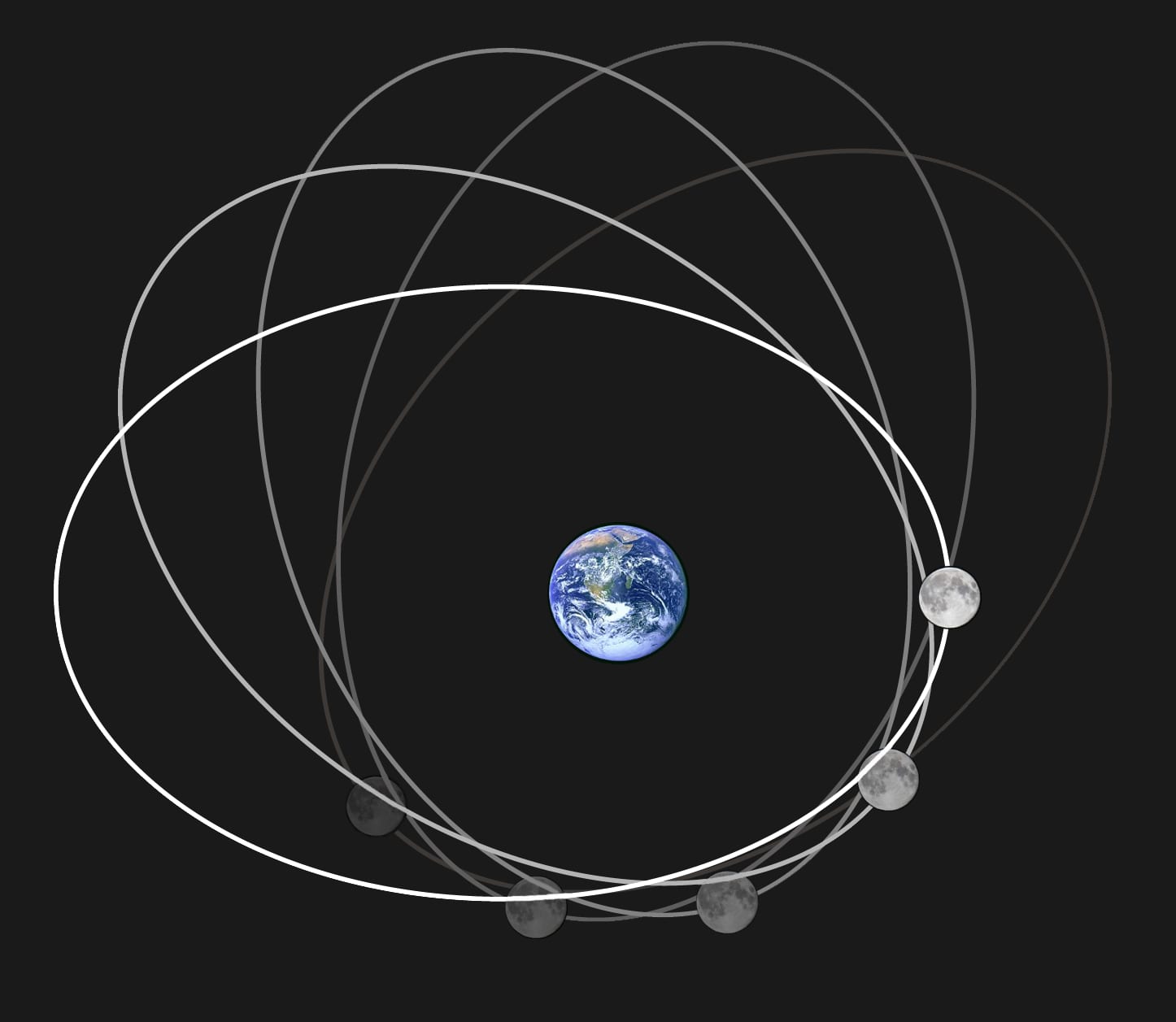
The Moon's elliptical orbit, drawn at several times: its long axis turns forward around Earth once every 8.85 years. Diagram: Rfassbind, public domain, via Wikimedia Commons.
The Moon's path around the Sun
Diagrams often show the Moon looping around Earth as Earth circles the Sun, making a corkscrew or a series of loops. The real path has no loops at all. The Sun pulls on the Moon about twice as hard as Earth does, and Earth moves about 30 times faster around the Sun than the Moon moves around Earth. So, seen from above the solar system, the Moon's path around the Sun is a slightly wavy circle that always curves toward the Sun, weaving just inside and outside Earth's orbit twelve or thirteen times a year. In that sense the Moon is as much a partner planet of the Sun as a satellite of Earth.
Tidal effects
Part 5 of 7
Tides are what gravity does to anything that is not a point. The Moon pulls harder on the side of Earth facing it than on Earth's center, and harder on the center than on the far side. That difference in pull, not the pull itself, stretches Earth along the line to the Moon. Oceans, rock, air and the Moon itself all respond. The effects run from the twice-daily rise and fall of the sea to the slowing of Earth's spin and the slow escape of the Moon.
Why there are two bulges
The puzzle for most people is why there are two high tides a day, not one. The answer is that tides are a stretching, not a lifting. The near side is pulled toward the Moon more than Earth's center is, so the water there bulges toward the Moon. Earth's center is pulled toward the Moon more than the far side is, so the far side is in effect left behind, and the water there bulges away. As Earth spins beneath these two bulges, most coasts pass through two high tides and two low tides each day.27
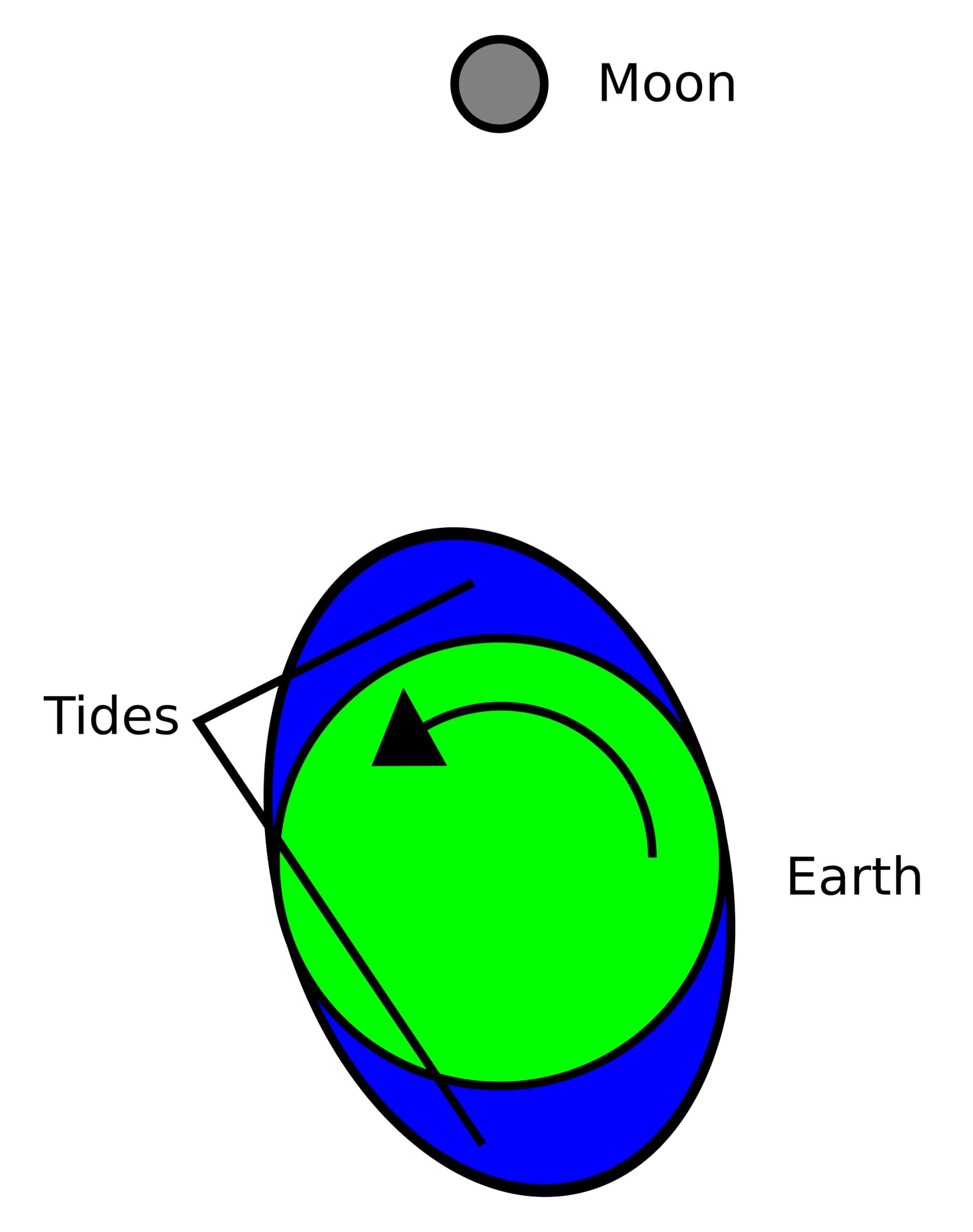
The two tidal bulges. Earth spins faster than the Moon orbits, so friction drags the bulges ahead of the line to the Moon, here exaggerated. That offset is what brakes Earth and pushes the Moon outward. Diagram: AndrewBuck, CC BY-SA 3.0, via Wikimedia Commons.
The cycle runs about 12 hours 25 minutes from high tide to high tide, not 12 hours, because the Moon moves on in its orbit and Earth needs an extra 50 minutes a day to catch it up. That is why high tide comes about 50 minutes later each day, in step with moonrise.27
The Sun's share: spring and neap tides
The Sun raises tides too. It is far more massive than the Moon but also far farther away, and tidal force falls off with the cube of distance rather than the square. The net result is that the Sun's tidal effect is a little under half the Moon's, about 46 percent.27
When Sun, Moon and Earth line up, at new and full moon, the two sets of bulges stack and the tidal range is largest: spring tides, a name with nothing to do with the season. At first and last quarter, when the Sun and Moon pull at right angles, they partly cancel and the range is smallest: neap tides.28 Spring tides come every two weeks. When one coincides with a perigee Moon, the result is an unusually high perigean spring tide, often called a king tide, which floods low-lying streets in places like Miami on clear days.
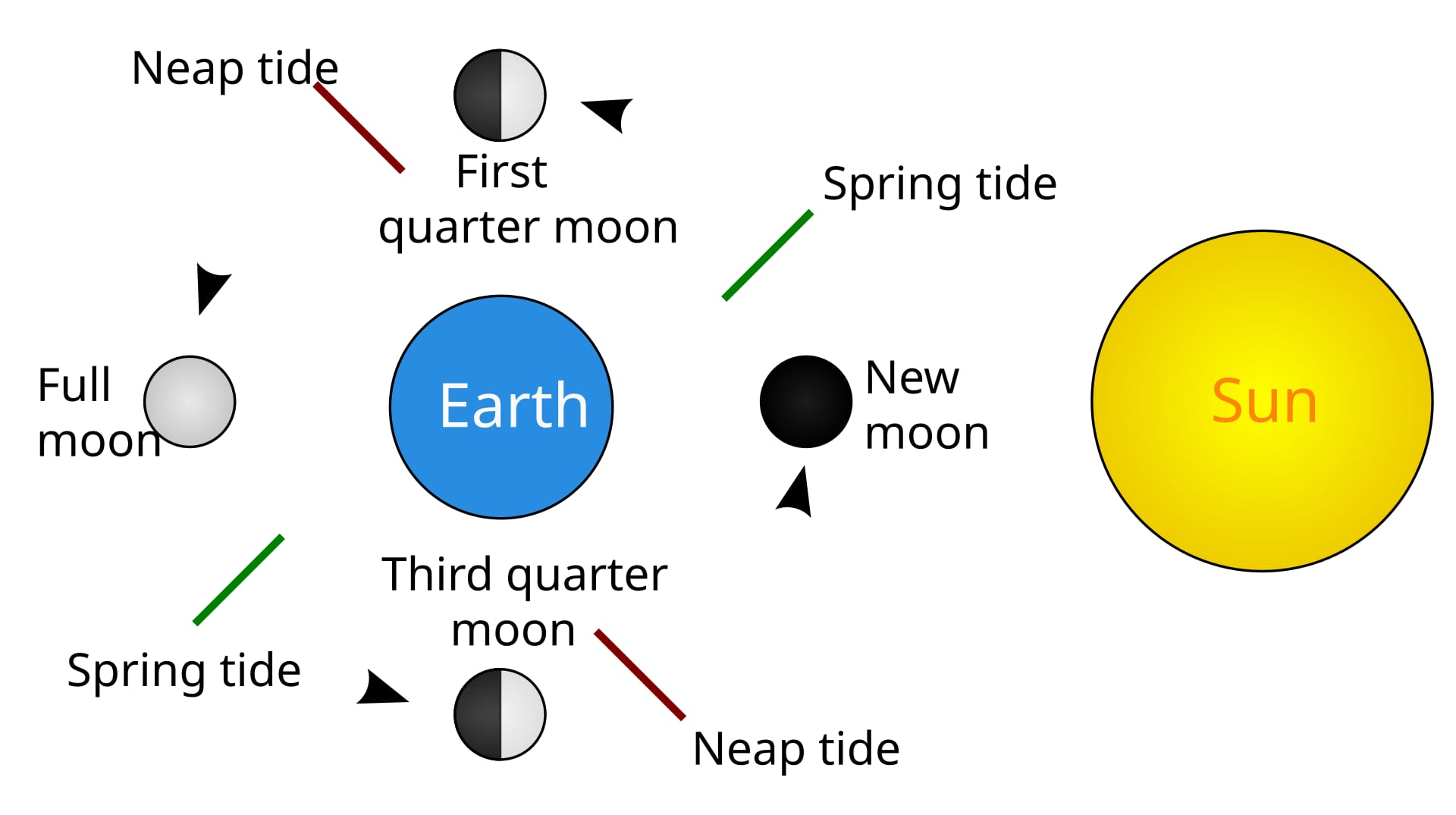
Spring tides at new and full moon, when the Sun and Moon pull in line, and neap tides at the quarters, when they pull at right angles. Diagram: KVDP and Surachit, public domain, via Wikimedia Commons.
The result on a real coast is a pattern of daily tides inside a two-week rhythm, with longer-term swells and dips from perigee, the Moon's declination and the seasons.
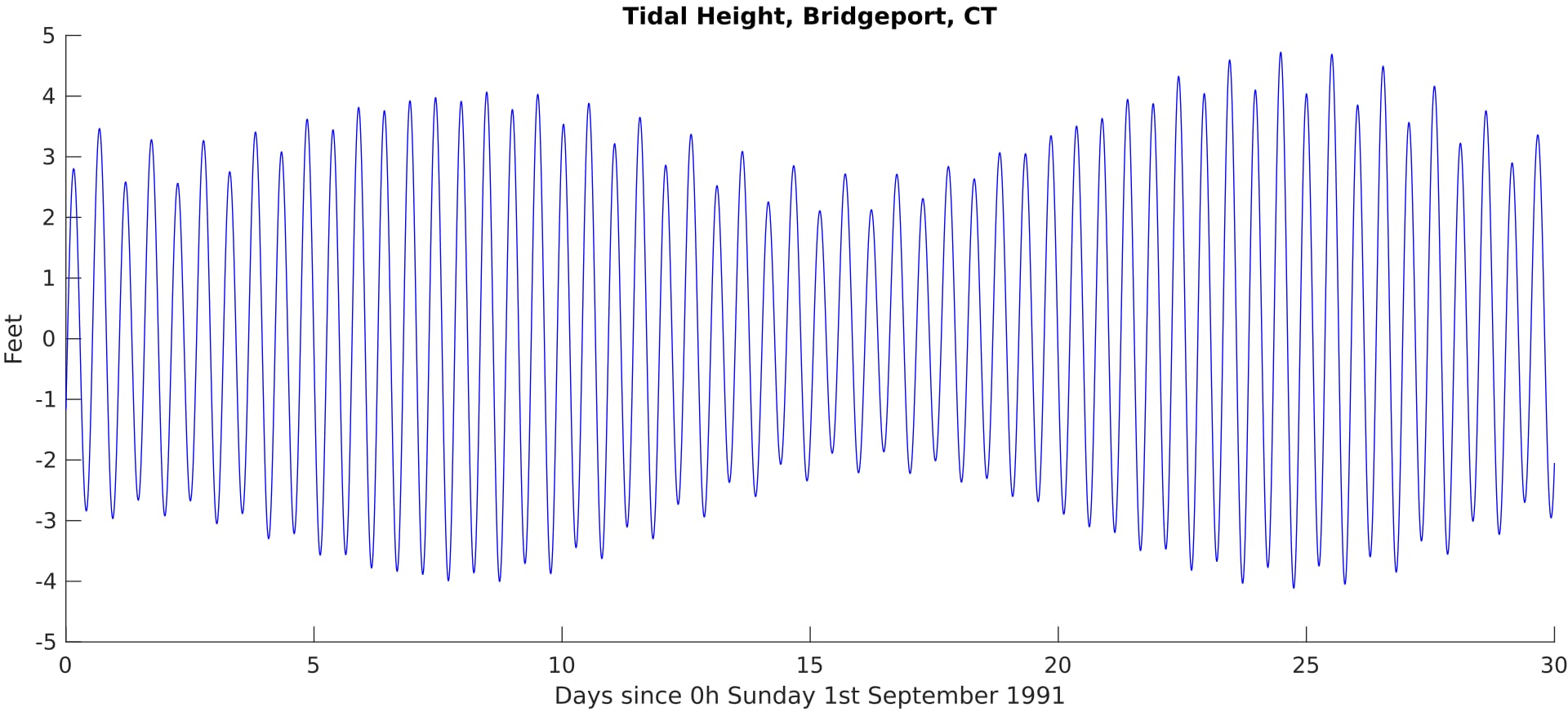
Thirty days of predicted tides at Bridgeport, Connecticut: two tides a day, growing and shrinking over the spring–neap cycle. Graph: Cody Logan, CC0, via Wikimedia Commons.
Real oceans are messier
The two neat bulges are the equilibrium tide, what would happen on a planet covered by deep water. On the real Earth the continents get in the way, and the ocean cannot move fast enough to keep a bulge under the Moon anyway: at the equator the bulge would have to travel at over 1,600 kilometers an hour. Instead, the tides slosh around each ocean basin as huge rotating waves. Each wave turns around a point of almost zero tide, an amphidromic point, with the tidal range growing toward the coasts.27
The shape of the coast does the rest. Some places get one tide a day, some two equal tides, and many get two unequal ones. Funnel-shaped bays whose natural sloshing period is close to the tidal period resonate like a bathtub, and in Canada's Bay of Fundy the range reaches about 16 meters, the largest in the world.29 Elsewhere, in parts of the Mediterranean and Baltic, the range is only a few centimeters.
The ground and air have tides too
The solid Earth stretches too. Twice a day the ground under every city rises and falls by a few tens of centimeters, a motion nobody feels because everything rises together. It shows up clearly in precise GPS measurements and must be corrected for in satellite positioning and the particle accelerator at CERN, whose ring changes length slightly with the Moon. The atmosphere has tides as well, mostly driven by the Sun's daily heating rather than gravity.
Tides may help trigger some earthquakes. Stress from the solid Earth tide is small, but it is applied to faults that may already be close to breaking. A 2016 study of earthquakes worldwide found that very large ones were somewhat more likely to happen when tidal stress was high, around spring tides.30 The effect is statistical: it shifts the odds slightly and cannot be used to predict a particular quake.
Tidal braking and the escaping Moon
The tidal bulges do not line up exactly with the Moon. Earth spins much faster than the Moon orbits, so friction with the seafloor drags the bulges slightly ahead of the line between Earth and Moon. The Moon's pull on the nearer, leading bulge tugs backward on Earth's spin and slows it. In return, that bulge pulls the Moon forward along its orbit, giving it energy, which lifts it into a higher orbit. Earth slows down and the Moon moves outward, and the total spin of the system is conserved.6 The ocean tides dissipate about 3.7 trillion watts of energy, comparable to all the electric power humans generate, most of it in shallow seas.31
Deep Dive: Measuring the Moon's retreat, and reading it in rock
The Moon's retreat is measured with light. Apollo 11, 14 and 15 left arrays of corner-cube retroreflectors on the lunar surface, the same kind of reflector found on a bicycle, but made of precision glass that sends light straight back to wherever it came from. Two Soviet Lunokhod rovers carry smaller ones. Observatories in the United States, France, Italy and elsewhere fire short laser pulses at them and time the round trip. Of the roughly hundred million billion photons in each pulse, only a handful make it back after spreading out over kilometers on the way out and back, but timing those few gives the distance to within millimeters.6
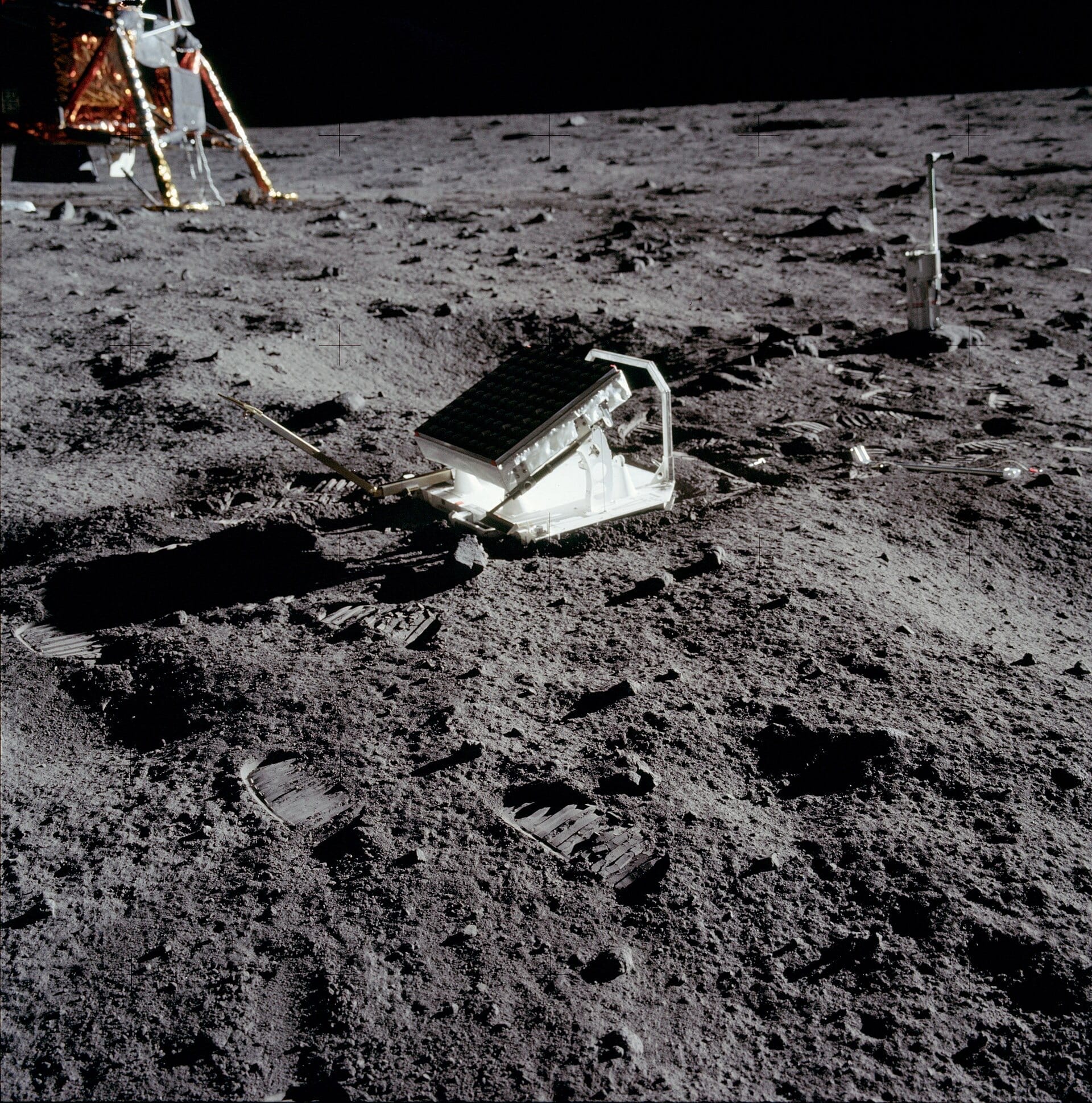
The laser-ranging retroreflector Apollo 11 left at Tranquility Base in July 1969. It still returns laser pulses fired from Earth. Photo: NASA, public domain.
Half a century of these measurements give a clear result: the Moon is moving away at about 3.8 centimeters a year, roughly the rate fingernails grow.6 The same data also show the Moon has a liquid core, confirm Einstein's general relativity to high precision, and pin down Earth's tidal slowdown.
The puzzle comes from running that rate backward. At 3.8 centimeters a year, the Moon would have been touching Earth about 1.5 billion years ago, yet the Moon is about 4.5 billion years old. The answer is that today's rate is unusually high. Tidal friction depends on how the oceans respond, and the present Atlantic happens to be close to resonance with the main lunar tide, so it sloshes hard and dissipates a lot of energy. In past ages, with continents arranged differently, the oceans resonated less and the Moon retreated more slowly.11
The rocks back this up. Some sediments laid down on tidal flats preserve layers from each tide, thickening and thinning with the spring–neap cycle and the seasons. Counting them gives the number of days in a month and in a year at the time. The Elatina Formation of South Australia, about 620 million years old, records about 13 months of about 30.5 days and 400 days in a year, with a day of about 21.9 hours, implying the Moon was then about 96.5 percent of its present distance. Averaged over the time since, the Moon has receded at about 2.2 centimeters a year, little more than half today's rate.11 Older rhythmic layers push the record further. A 2022 study of banded iron formations in Western Australia, about 2.46 billion years old, read the climate cycles caused by precession in them and inferred that the Moon was then about 321,800 kilometers away and the day about 17 hours long.32
The end point is far off. If nothing else intervened, the Moon would keep receding until Earth's day matched its month, both about 47 of today's days long, and Earth would be locked with one face toward the Moon, as Pluto and its moon Charon are now. That would take tens of billions of years, and the Sun will swell into a red giant in about 5 billion, so it will never happen. One nearer consequence is the end of total solar eclipses: as the Moon recedes, it will eventually look too small ever to cover the Sun completely, very roughly 600 million years from now.
Tidal heating and tearing elsewhere
Tides do more drastic things in other parts of the solar system. Jupiter's moon Io is squeezed and relaxed on every orbit by Jupiter's tides, kept slightly eccentric by its neighbors Europa and Ganymede. The flexing heats its interior so much that it is the most volcanic body known, a result predicted in 1979, just days before Voyager 1 photographed its eruptions.33 Tidal heating likely keeps liquid oceans under the ice of Europa and Saturn's Enceladus. And any moon or comet that comes too close to a planet, inside the Roche limit, is pulled apart by tides, the likely fate of the comet Shoemaker-Levy 9, torn into fragments by Jupiter in 1992 before it hit the planet in 1994.
Eclipses
Part 6 of 7
An eclipse is a lineup. A solar eclipse happens when the Moon passes between Earth and the Sun and its shadow falls on Earth. A lunar eclipse happens when Earth passes between the Sun and the Moon and its shadow falls on the Moon.
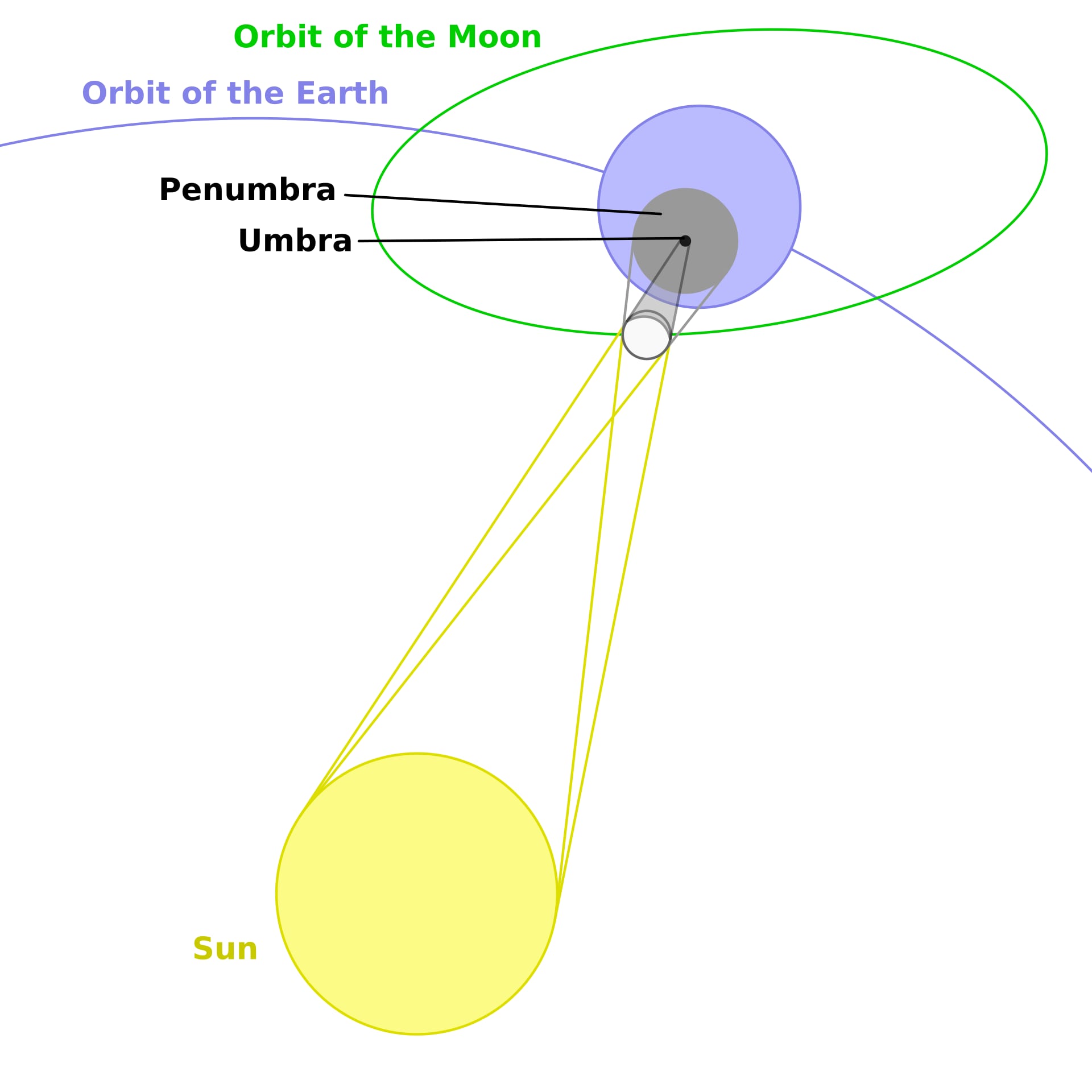
A total solar eclipse: the Moon's dark inner shadow, the umbra, touches Earth along a narrow path; the outer penumbra gives a partial eclipse over a much wider area. Not to scale. Diagram: Sagredo, public domain, via Wikimedia Commons.
Why not every month
If the Moon's orbit lay flat in the ecliptic, there would be a solar eclipse at every new moon and a lunar eclipse at every full moon. Because it is tilted 5.1°, the Moon usually passes a little above or below the Sun at new moon and above or below Earth's shadow at full moon. Eclipses only happen when a new or full moon falls close to one of the nodes, where the Moon's orbit crosses the ecliptic.34
That happens in two eclipse seasons each year, each lasting about 34 to 37 days, when the Sun is near one of the nodes. Because the nodes slide backward, the seasons come about 19 days earlier each year, and a full cycle of the Sun returning to the same node, the eclipse year, is 346.6 days. Every calendar year has at least four eclipses and can have as many as seven, including at least two solar ones.34
A coincidence of sizes
Total solar eclipses depend on a coincidence. The Sun is about 400 times wider than the Moon and, on average, about 390 times farther away, so the two look almost exactly the same size in the sky, about half a degree. Because both distances vary, sometimes the Moon looks bigger and covers the Sun completely, a total eclipse, and sometimes it looks smaller and leaves a bright ring around its edge, an annular eclipse. When the Moon covers the Sun's bright disk, the faint outer atmosphere, the corona, becomes visible, with streamers shaped by the Sun's magnetic field.34
The moments either side of totality have their own names. As the last sliver of Sun disappears, sunlight shines through valleys along the Moon's rugged edge, breaking into a string of bright points called Baily's beads, and the last of them flares as the diamond ring. During an annular eclipse the Sun never vanishes, and the sky stays bright; the bright ring left around the Moon is sometimes called the ring of fire. A few eclipses are hybrid: because Earth's curved surface is closer to the Moon in the middle of the path than at its ends, the same eclipse can be annular at sunrise, total at midday and annular again at sunset.
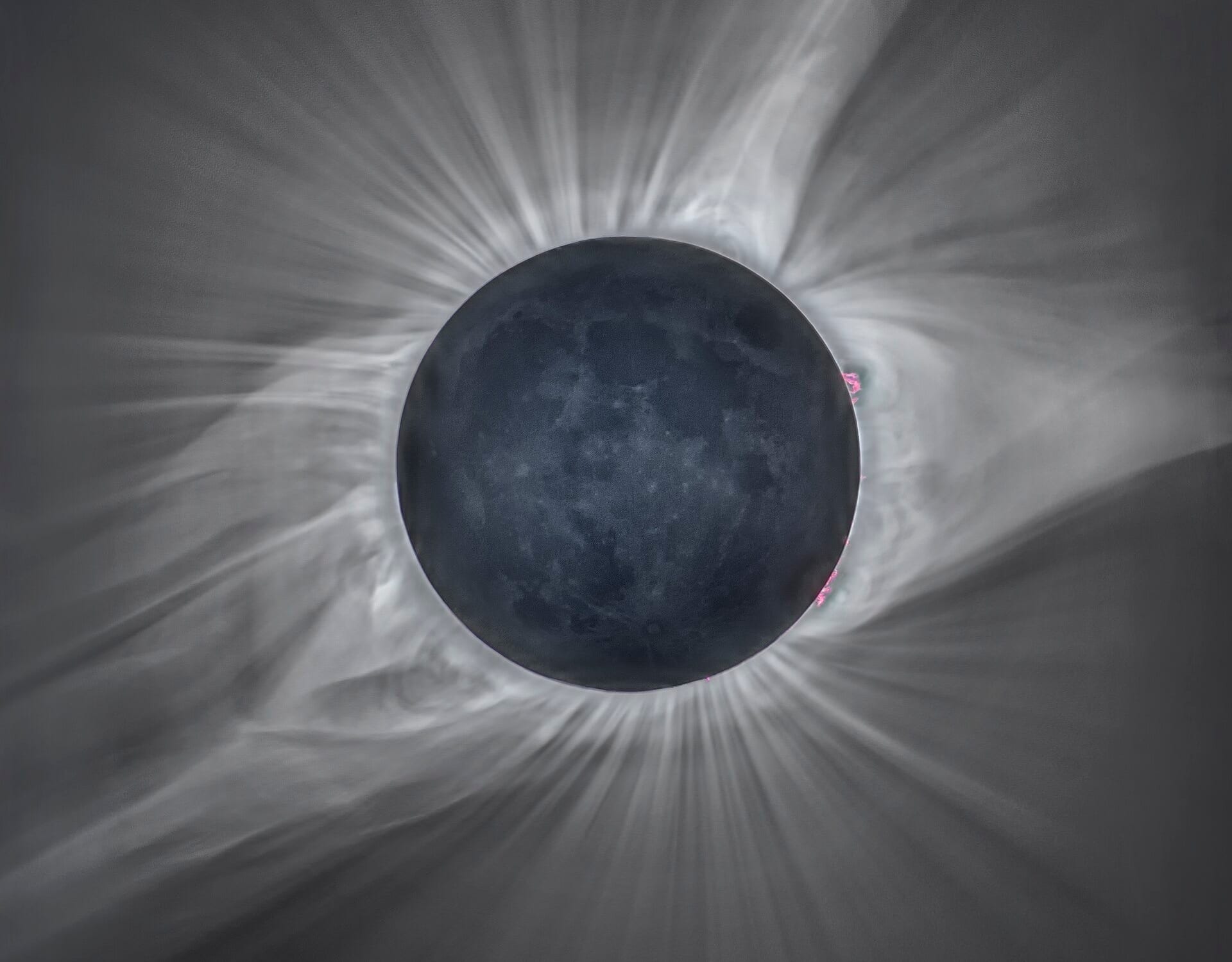
The corona around the Moon during the total solar eclipse of August 21, 2017, over the United States. Photo: Michael S. Adler, CC BY-SA 4.0, via Wikimedia Commons.
The Moon's shadow is small when it reaches Earth: the path of totality is at most about 270 kilometers wide, and totality at any spot lasts at most about 7.5 minutes. That is why a given place sees a total solar eclipse only once every 375 years or so on average, even though one happens somewhere on Earth about every 18 months.34
Lunar eclipses and the red Moon
A lunar eclipse is visible from the entire night side of Earth at once, so many more people see them. During totality the Moon does not disappear. It turns a dusky red, because Earth's atmosphere bends sunlight into the shadow, and on the way it scatters away the blue, the same process that reddens sunsets. In effect, the eclipsed Moon is lit by every sunrise and sunset on Earth at that moment. How dark and how red depends on how clear Earth's atmosphere is; large volcanic eruptions can make the Moon almost vanish.34
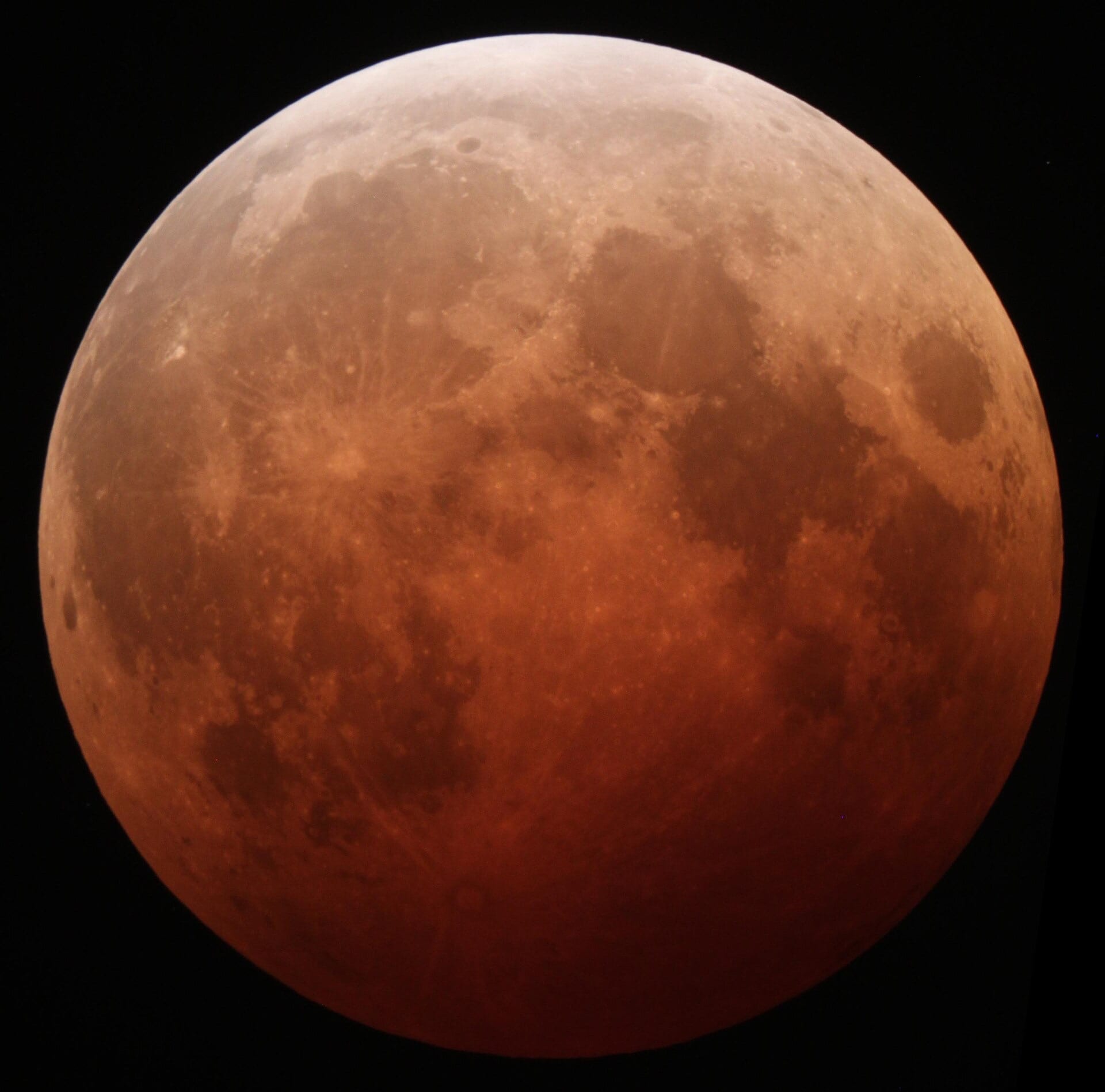
The total lunar eclipse of October 8, 2014, seen from California. The red is sunlight filtered and bent through Earth's atmosphere. Photo: Alfredo Garcia Jr, CC BY-SA 2.0, via Wikimedia Commons.
Lunar eclipses are also slow. The Moon takes about an hour to slide fully into Earth's shadow, totality can last up to about an hour and three quarters, and the whole event from first bite to last can run more than five hours. That leisurely pace is why lunar eclipses were the ones ancient astronomers recorded best. They also gave early proof of Earth's shape: Aristotle pointed out that the edge of Earth's shadow on the Moon is always curved, whatever the time of night, and only a sphere casts a round shadow from every direction.
Because a lunar eclipse needs a full moon and a solar eclipse needs a new moon, the two often come in pairs about two weeks apart, during the same eclipse season, with one at each node crossing.
The Saros: eclipses that repeat
Eclipses repeat. After 18 years, 11 days and 8 hours, the Sun, Moon and nodes come back to almost the same arrangement, and a nearly identical eclipse occurs. This eclipse cycle, the Saros, was known to Babylonian astronomers more than two thousand years ago.35
Deep Dive: Why the Saros works, and the machine that computed it
The Saros works because three different months happen to line up. An eclipse needs a new or full moon (the synodic month), close to a node (the draconic month), and its character, total or annular, long or short, depends on the Moon's distance (the anomalistic month). After 223 synodic months, 6,585.32 days, the Moon has also completed almost exactly 242 draconic months and 239 anomalistic months. All three cycles reset together within a few hours. So after one Saros the Moon is back at the same phase, at the same node and at nearly the same distance, and the eclipse that results is almost a twin of the one before.35
Not quite a twin. The Saros is about 6,585 and one third days long, and the extra third of a day means Earth has turned an extra 120° or so before the eclipse happens. Each eclipse in a series therefore falls about 120° of longitude west of the last. After three Saros cycles, 54 years and 33 days, a period the Greeks called the exeligmos, an eclipse returns to roughly the same longitude. The match among the months is also not perfect. Each eclipse in a series happens a little farther along from the node than the one before, so a Saros series is born as a small partial eclipse near one pole, grows into central eclipses, total or annular, that march across Earth over several centuries, and dies as a partial eclipse near the other pole. A series lasts about 1,200 to 1,500 years and includes roughly 70 to 85 eclipses. Around 40 series are active at any time, overlapping, which is why eclipses seem to come irregularly even though each series is perfectly regular.35
The total eclipse of August 21, 2017, across the United States, belongs to Saros 145. Its next member, 18 years and 11 days later, will cross the United States again on September 2, 2035, shifted westward and south. That was the kind of prediction Babylonian scribes could make, at least for lunar eclipses, from centuries of records written on clay tablets. They knew a lunar eclipse could be expected 223 months after another. The name "Saros" is much younger: Edmond Halley applied it in 1691, borrowing a Babylonian word for a number from a Byzantine dictionary, and it stuck.35
The most remarkable use of the cycle is mechanical. The Antikythera mechanism, a bronze geared device recovered in 1901 from a shipwreck off the Greek island of Antikythera and made in the second or first century BCE, turns out to be an astronomical calculator. X-ray scans published in 2006 and 2008 showed that its back carries a spiral dial with 223 cells, one per month of a Saros cycle, with glyphs marking the months when solar or lunar eclipses were expected and the hour they would happen. A second, smaller dial counted the three Saros cycles of the exeligmos, so the user could correct the time of day. The front showed the Sun and Moon on the zodiac, the Moon's phase, and, through a pin-and-slot gear, the Moon speeding up and slowing down on its elliptical orbit as Kepler would later describe it.36 Nothing as complex survives from the following thousand years.
The Saros is not the only eclipse cycle; the Metonic cycle of 19 years and the Inex of about 29 years link eclipses in other ways, and astronomers use all of them to organize the catalog. But the Saros remains the one people know, because it is the one that makes an eclipse feel like a return.
The next total solar eclipses come on August 2, 2027, across Spain, North Africa and Egypt, where totality near Luxor will last more than six minutes, and on July 22, 2028, across Australia and New Zealand.34
The bigger frame
Part 7 of 7
None of the bodies on this page orbits a fixed point. Each pair circles a shared center of mass, the whole solar system wobbles around a moving center, and that center is carried around the galaxy.
Barycenters: nobody orbits the other's center
Two bodies orbit their common center of mass, the barycenter, not each other's center. Earth is 81 times as massive as the Moon, so the Earth–Moon barycenter sits about 4,670 kilometers from Earth's center, roughly 1,700 kilometers beneath the surface.5 Every month, Earth's center traces a small loop around that point, about 9,300 kilometers across, while the Moon traces its big loop around it on the far side. It is this barycenter, not Earth itself, that follows a smooth ellipse around the Sun.
The Sun wobbles in the same way. Its barycenter with Earth is only about 450 kilometers from its center, well inside it. But Jupiter is massive and far away, and the Sun–Jupiter barycenter sits just outside the Sun's surface. Add Saturn, Uranus and Neptune, and the Sun's center loops around the solar system's barycenter in a complicated rosette, sometimes nearly on top of it, sometimes more than a solar diameter away.37 This same wobble, seen in other stars, is one of the main ways astronomers find planets around them.
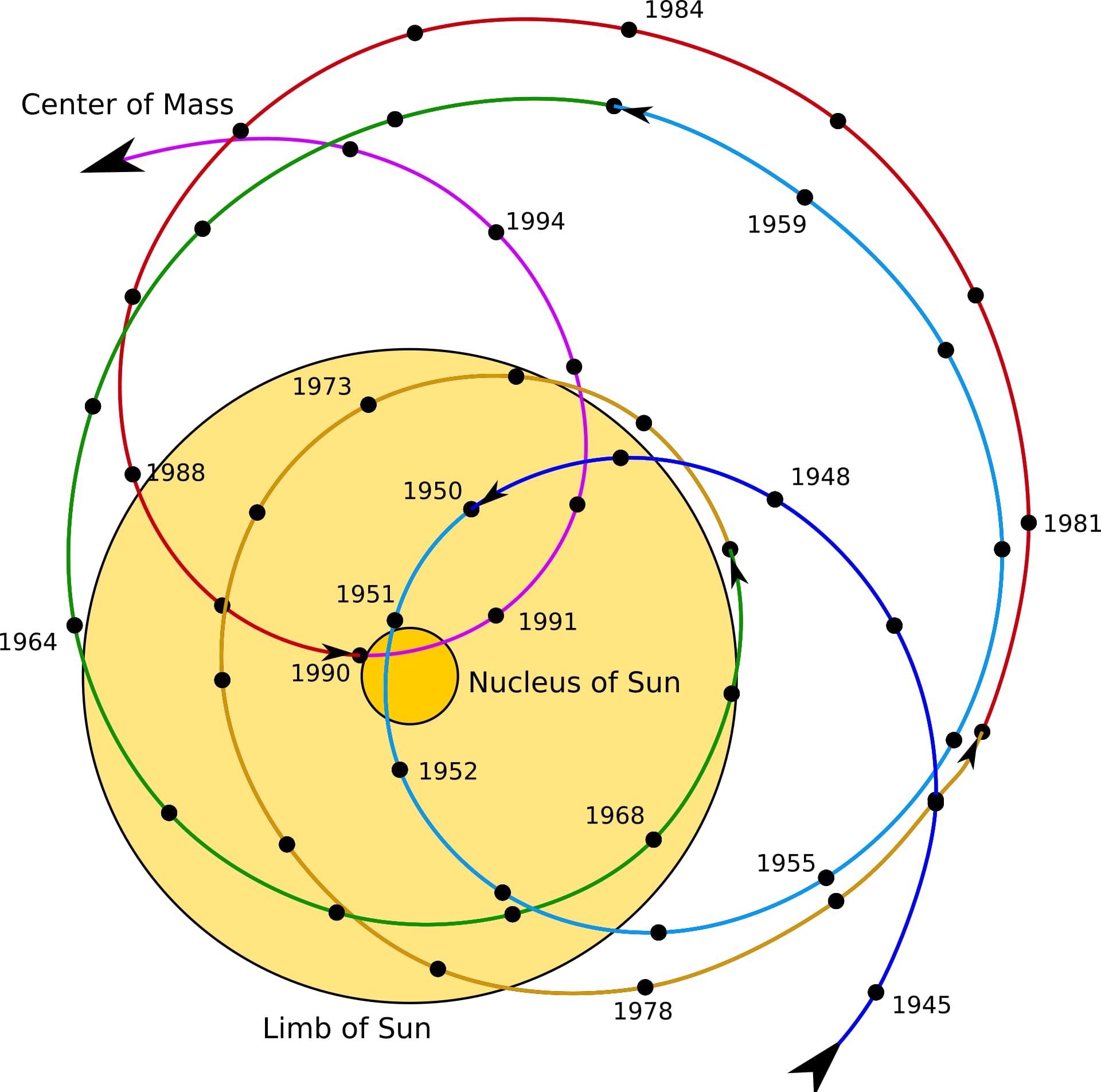
The path of the solar system's center of mass relative to the Sun from 1945 to 1995. The yellow disk is the Sun; the barycenter spends much of its time outside it. Diagram: Carl Smith and contributors, CC BY-SA 3.0, via Wikimedia Commons.
Lagrange points
Where the gravity of two big bodies and the motion of a third balance, there are five points where a small object can keep its position relative to both, the Lagrange points, named for the mathematician Joseph-Louis Lagrange. For the Sun and Earth, L1 lies about 1.5 million kilometers toward the Sun and L2 about 1.5 million kilometers away from it, behind Earth. L1 hosts solar observatories such as SOHO and the DSCOVR satellite, which photographs the full sunlit Earth; L2 hosts the James Webb Space Telescope, which keeps the Sun, Earth and Moon all behind its shield.38 L4 and L5 lie 60° ahead of and behind Earth on its orbit and are stable. Asteroids collect at the L4 and L5 points of Jupiter by the thousands, and at least two small ones have been found at Earth's.
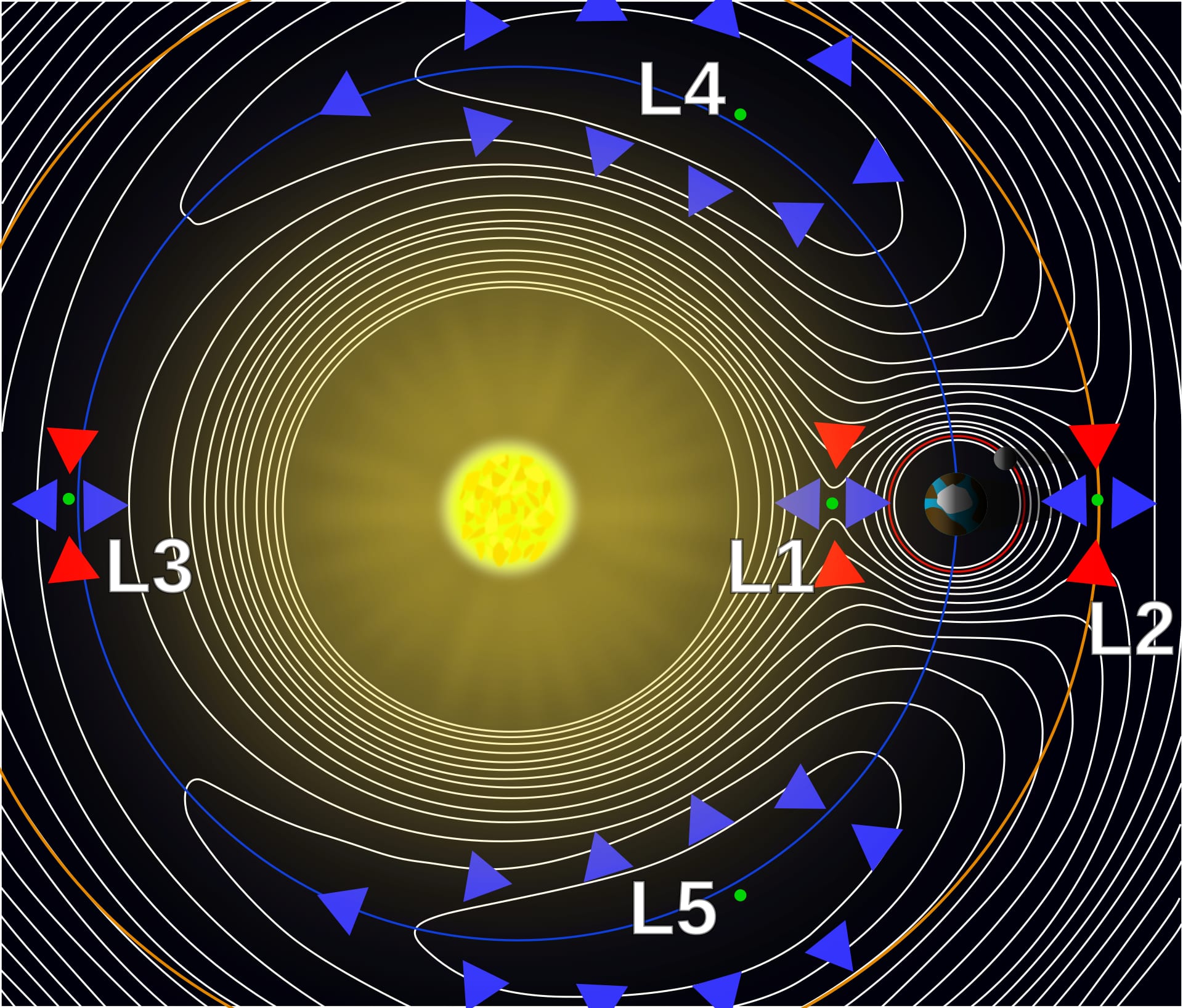
The five Lagrange points of the Sun–Earth system. Arrows show the slopes of the combined gravity: L1, L2 and L3 sit on saddles, L4 and L5 in hollows. Diagram: Xander89, CC BY 3.0, via Wikimedia Commons.
Through the galaxy
The Sun, carrying everything, orbits the center of the Milky Way at a distance of about 8.2 kiloparsecs, about 26,700 light-years.7 Measurements of the apparent motion of the black hole at the galaxy's center against distant quasars give the Sun's orbital speed as roughly 240 kilometers a second, more than 860,000 kilometers an hour.8 At that speed one lap, a galactic year, takes roughly 210 to 250 million years. The last time the solar system was at this point in its orbit, the first dinosaurs were appearing.
The orbit is not a flat circle. The Sun moves about 20 kilometers a second relative to the stars around it, toward a point in the constellation Hercules near the bright star Vega.39 It also bobs up and down through the galaxy's disk, crossing it roughly every 30 to 40 million years and rising perhaps 50 to 90 parsecs above or below it. Today it sits about 20 parsecs, some 65 light-years, north of the midplane and is moving farther north. Some researchers have tried to link the crossings to cycles of extinction or cosmic-ray exposure, but the evidence is weak.
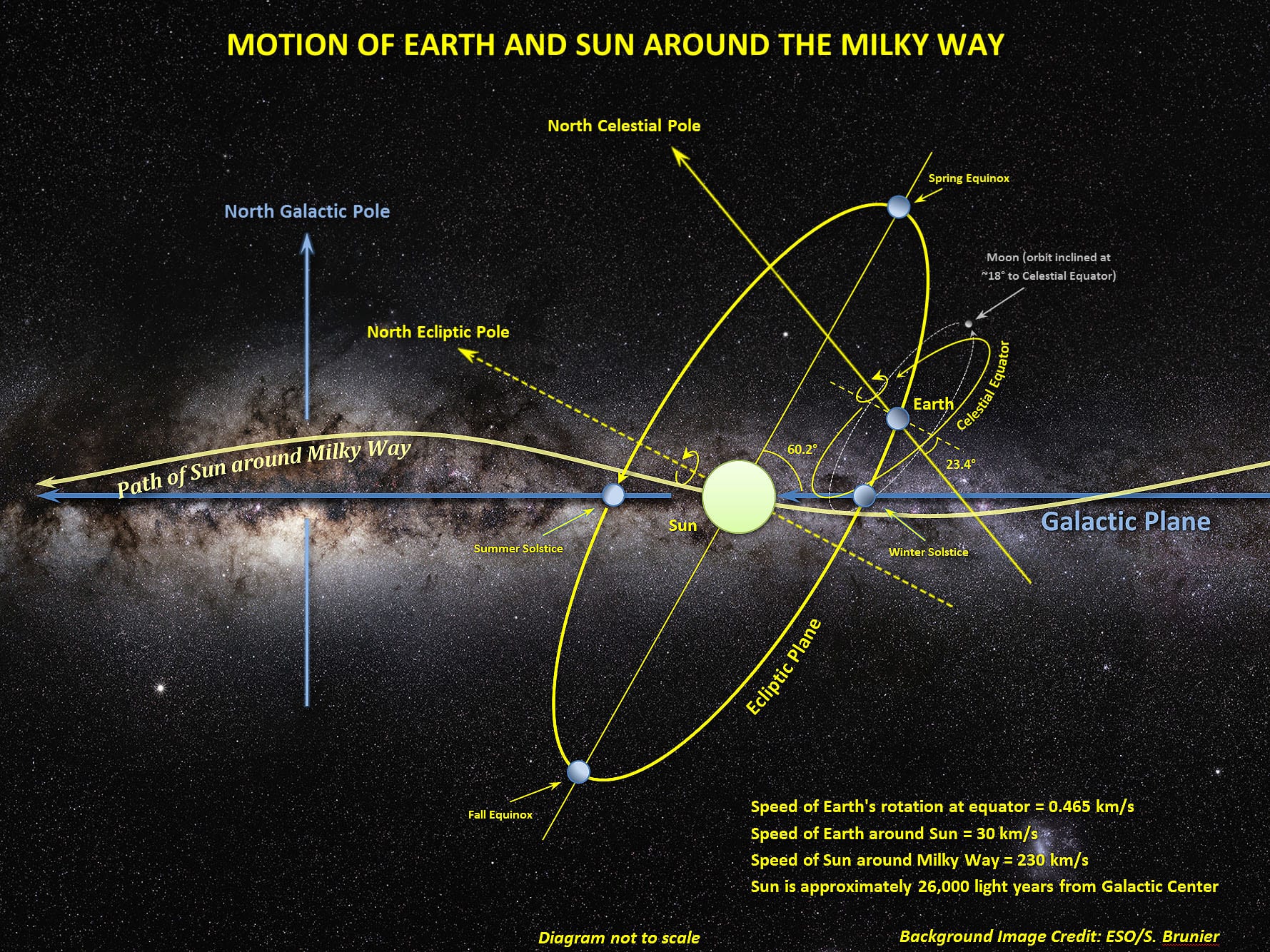
The Sun's path around the Milky Way, and how the solar system is oriented as it goes: the planets' orbital plane, the ecliptic, is tilted about 60° to the galaxy's disk. Illustration: Jim Slater, CC BY-SA 4.0, via Wikimedia Commons.
That tilt corrects a popular picture. A widely shared animation from 2012 showed the planets trailing behind the Sun in a spiral, like a vortex, as it plows through space. The planets do trace spirals relative to the galaxy, but the solar system's plane is tilted about 60° to the direction of travel, not perpendicular to it, so the planets do not trail behind the Sun; they sweep around it at a steep angle as it moves. The net path is a helix only in the sense that any orbit becomes one when the center moves.
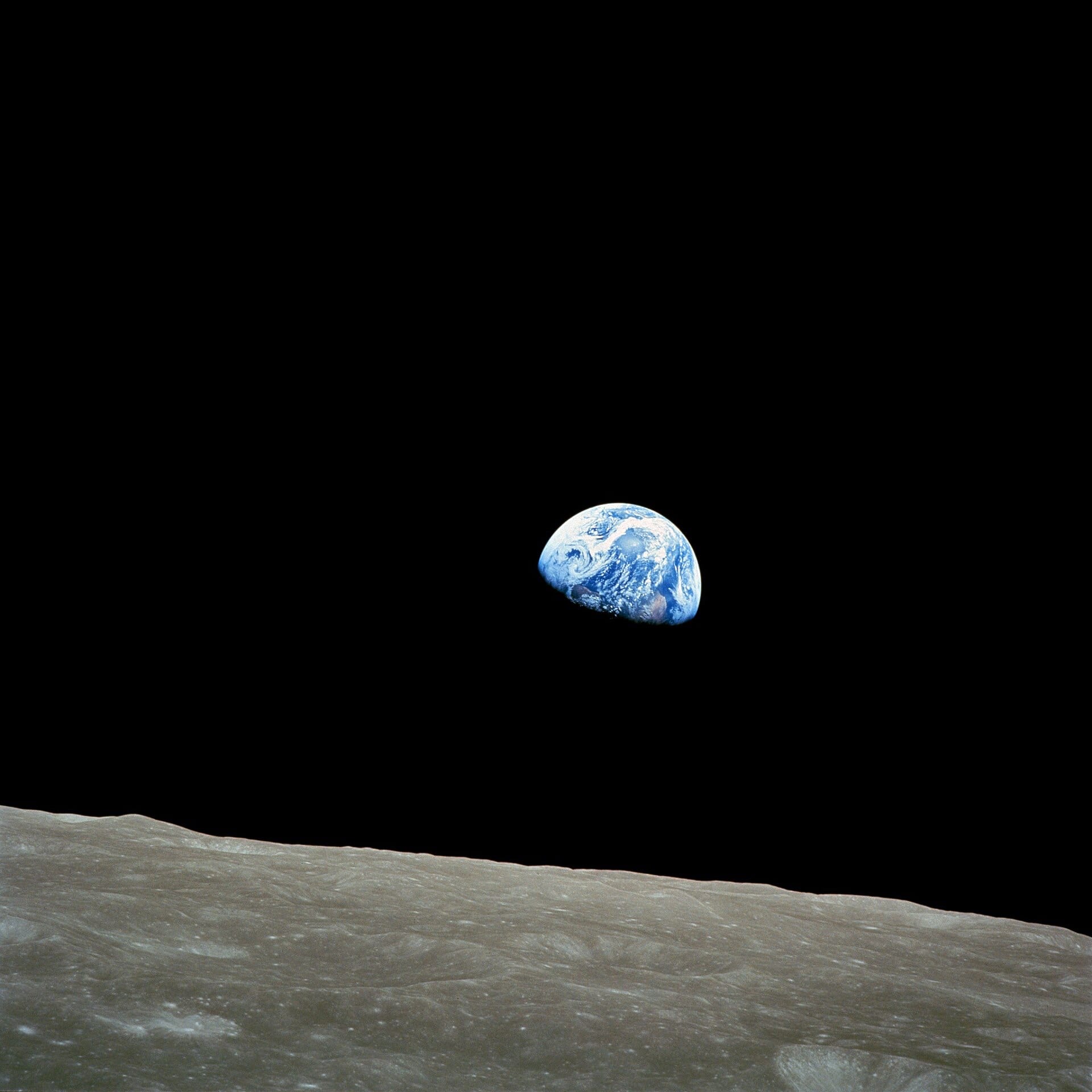
Earthrise, photographed by Bill Anders from lunar orbit on December 24, 1968, during Apollo 8: Earth seen from the Moon, both in motion around the Sun. Photo: NASA, public domain.
Beyond the galaxy the motion keeps compounding. The Milky Way and its neighbor Andromeda are falling toward each other at about 110 kilometers a second and will merge in several billion years. Measured against the cosmic microwave background, the afterglow of the Big Bang, which is as close as physics comes to a universal frame of rest, the solar system is moving at about 370 kilometers a second toward the constellation Crater, next to Leo.40 Even that is only a local current in the larger flows of galaxies.
Footnotes
- NASA Goddard Space Flight Center, "Earth Fact Sheet," NSSDCA, revised 2024: rotation, orbital elements, perihelion and aphelion distances, speeds, equatorial bulge. nssdc.gsfc.nasa.gov ↩
- Speeds of Earth's rotation by latitude follow from 465 m/s × cos(latitude); the Sun's galactic speed is from note 8. ↩
- NASA Science, "Milankovitch (Orbital) Cycles and Their Role in Earth's Climate," 2020: ranges and periods of obliquity, eccentricity and precession, timing of the last obliquity maximum, perihelion trends, effect on current warming. science.nasa.gov ↩
- N. Capitaine, P. T. Wallace and J. Chapront, "Expressions for IAU 2000 precession quantities," Astronomy & Astrophysics 412, 2003, 567–586: general precession of 5,028.8 arcseconds per century. doi:10.1051/0004-6361:20031539 doi.org ↩
- NASA Goddard Space Flight Center, "Moon Fact Sheet," NSSDCA: mean distance, perigee and apogee, eccentricity, inclination, sidereal and synodic months, nodal and apsidal periods, Earth–Moon mass ratio. nssdc.gsfc.nasa.gov ↩
- J. O. Dickey et al., "Lunar Laser Ranging: A Continuing Legacy of the Apollo Program," Science 265(5171), 1994, 482–490: recession of 3.82 cm a year, tidal acceleration, retroreflector arrays. doi:10.1126/science.265.5171.482 doi.org ↩
- GRAVITY Collaboration, "A geometric distance measurement to the Galactic center black hole with 0.3% uncertainty," Astronomy & Astrophysics 625, 2019, L10: R₀ = 8.178 kpc. doi:10.1051/0004-6361/201935656 doi.org ↩
- M. J. Reid and A. Brunthaler, "The Proper Motion of Sagittarius A*. III. The Case for a Supermassive Black Hole," Astrophysical Journal 892, 2020, 39: the Sun's motion around the center from the black hole's apparent motion. doi:10.3847/1538-4357/ab76cd doi.org ↩
- James Evans, The History and Practice of Ancient Astronomy, Oxford University Press, 1998: Babylonian eclipse records, Hipparchus and precession; with Newton's Principia (1687), Book III, on precession and the tides. ↩
- F. R. Stephenson, L. V. Morrison and C. Y. Hohenkerk, "Measurement of the Earth's rotation: 720 BC to AD 2015," Proceedings of the Royal Society A 472, 2016, 20160404: 1.78 ms per century observed against about 2.3 ms tidal. doi:10.1098/rspa.2016.0404 doi.org ↩
- G. E. Williams, "Geological constraints on the Precambrian history of Earth's rotation and the Moon's orbit," Reviews of Geophysics 38(1), 2000, 37–59: Elatina rhythmites, 21.9-hour day, about 400 days a year, mean recession 2.17 cm a year since 620 Ma. doi:10.1029/1999RG900016 doi.org ↩
- R. N. Mitchell and U. Kirscher, "Mid-Proterozoic day length stalled by tidal resonance," Nature Geoscience 16, 2023, 567–569. doi:10.1038/s41561-023-01202-6 doi.org ↩
- D. C. Agnew, "A global timekeeping problem postponed by global warming," Nature 628, 2024, 333–336. doi:10.1038/s41586-024-07170-0 doi.org ↩
- Bureau International des Poids et Mesures, Resolution 4 of the 27th General Conference on Weights and Measures (CGPM), "On the use and future development of UTC," 2022. bipm.org ↩
- S. C. Chandler, "On the variation of latitude," Astronomical Journal 11, 1891, 59–61 and following parts. ↩
- R. S. Gross, "The excitation of the Chandler wobble," Geophysical Research Letters 27(15), 2000, 2329–2332. doi:10.1029/2000GL011450 doi.org ↩
- K.-W. Seo et al., "Drift of Earth's Pole Confirms Groundwater Depletion as a Significant Contributor to Global Sea Level Rise 1993–2010," Geophysical Research Letters 50, 2023, e2023GL103509. doi:10.1029/2023GL103509 doi.org ↩
- NASA Space Place, "What Causes the Seasons?" spaceplace.nasa.gov ↩
- D. W. Hughes, B. D. Yallop and C. Y. Hohenkerk, "The equation of time," Monthly Notices of the Royal Astronomical Society 238, 1989, 1529–1535. doi:10.1093/mnras/238.4.1529 doi.org ↩
- James Bradley, letter to the Earl of Macclesfield on an apparent motion observed in some of the fixed stars, Philosophical Transactions of the Royal Society 45, 1748, 1–43. ↩
- J. Laskar, F. Joutel and P. Robutel, "Stabilization of the Earth's obliquity by the Moon," Nature 361, 1993, 615–617. doi:10.1038/361615a0 doi.org ↩
- J. D. Hays, J. Imbrie and N. J. Shackleton, "Variations in the Earth's Orbit: Pacemaker of the Ice Ages," Science 194(4270), 1976, 1121–1132. doi:10.1126/science.194.4270.1121 doi.org ↩
- L. E. Lisiecki and M. E. Raymo, "A Pliocene-Pleistocene stack of 57 globally distributed benthic δ18O records," Paleoceanography 20, 2005, PA1003. doi:10.1029/2004PA001071 doi.org ↩
- NASA Scientific Visualization Studio, "Moon Phase and Libration, 2026" (visualization 5587): libration, tidal locking, the 59 percent visible. svs.gsfc.nasa.gov ↩
- Griffith Observatory, "Extreme Moon: The Major Lunar Standstill of 2024–2025": declination limits, timing and the 18.6-year cycle. griffithobservatory.org ↩
- Space.com, "'Major lunar standstill' may reveal if Stonehenge is aligned with the moon," 2024. space.com ↩
- NOAA National Ocean Service, "Tides and Water Levels" tutorial: tidal forces, the Sun's share, the 24-hour-50-minute lunar day, amphidromic systems. oceanservice.noaa.gov ↩
- NOAA National Ocean Service, "What is a spring tide?" oceanservice.noaa.gov ↩
- NOAA National Ocean Service, "Where is the highest tide?" oceanservice.noaa.gov ↩
- S. Ide, S. Yabe and Y. Tanaka, "Earthquake potential revealed by tidal influence on earthquake size–frequency statistics," Nature Geoscience 9, 2016, 834–837. doi:10.1038/ngeo2796 doi.org ↩
- G. D. Egbert and R. D. Ray, "Significant dissipation of tidal energy in the deep ocean inferred from satellite altimeter data," Nature 405, 2000, 775–778. doi:10.1038/35015531 doi.org ↩
- M. L. Lantink et al., "Milankovitch cycles in banded iron formations constrain the Earth–Moon system 2.46 billion years ago," Proceedings of the National Academy of Sciences 119(40), 2022, e2117146119. doi:10.1073/pnas.2117146119 doi.org ↩
- S. J. Peale, P. Cassen and R. T. Reynolds, "Melting of Io by Tidal Dissipation," Science 203(4383), 1979, 892–894. doi:10.1126/science.203.4383.892 doi.org ↩
- Fred Espenak, NASA Eclipse Web Site: eclipse seasons, eclipses per year, path widths and durations, lunar eclipse color. eclipse.gsfc.nasa.gov ↩
- Fred Espenak, "Eclipses and the Saros," NASA Eclipse Web Site: 223 synodic, 242 draconic and 239 anomalistic months, series length, the westward shift, Halley's naming. eclipse.gsfc.nasa.gov ↩
- T. Freeth et al., "Decoding the ancient Greek astronomical calculator known as the Antikythera Mechanism," Nature 444, 2006, 587–591, doi:10.1038/nature05357; and T. Freeth et al., "Calendars with Olympiad display and eclipse prediction on the Antikythera Mechanism," Nature 454, 2008, 614–617, doi:10.1038/nature07130. doi.org ↩
- NASA Space Place, "What Is a Barycenter?" spaceplace.nasa.gov ↩
- NASA Science, "What is a Lagrange Point?" science.nasa.gov ↩
- R. Schönrich, J. Binney and W. Dehnen, "Local kinematics and the local standard of rest," Monthly Notices of the Royal Astronomical Society 403, 2010, 1829–1833. doi:10.1111/j.1365-2966.2010.16253.x doi.org ↩
- Planck Collaboration, "Planck 2018 results. I. Overview and the cosmological legacy of Planck," Astronomy & Astrophysics 641, 2020, A1: CMB dipole of 369.8 km/s. doi:10.1051/0004-6361/201833880 doi.org ↩
