Idea
Quantum Reality
Is the world there when no one is looking? A 2012 theorem closed off the answer Einstein hoped for, and physics still has to choose among the strange ones left.

Overview
Quantum mechanics is the most accurate theory science has ever had. It runs the chips in every phone and the lasers in every supermarket scanner. Yet nearly a century after it was written down, physicists still disagree about what it says the world is like.
The disagreement turns on one object: the wave function, the mathematical description of a quantum system that gives the odds of each possible measurement result. There are two broad ways to read it.
- As a thing. The wave function is part of physical reality, the way a magnetic field is. When it spreads out, something real spreads out.
- As knowledge. The wave function is a summary of what someone knows about a system, like a weather forecast. When a measurement "collapses" it, nothing physical happens. Someone just learns something.
Albert Einstein wanted a third option. He believed in a real world with definite properties that exists whether or not anyone looks. He also believed the wave function was an incomplete description of that world, a set of odds standing in for details physics had not yet found.1 That picture, a solid reality underneath with the wave function as partial knowledge about it, is what Quanta Magazine's November 2026 article calls "Einstein's reality."2
In 2012 three physicists, Matthew Pusey, Jonathan Barrett and Terry Rudolph, proved a theorem now known by their initials, PBR. It says that if physical systems have real states at all, and if two systems prepared separately have separate real states, then the wave function cannot be mere knowledge. It has to be part of what is real.3 Einstein's middle path, real world plus wave function as partial knowledge, is closed.
What PBR does not do is say which of the remaining options is right. Physicists can accept that the wave function is real, and live with what follows: a universe that keeps branching, or particles steered by an invisible wave that reaches across space, or collapses that happen on their own. Or they can give up the idea of a reality that exists independently of observation, as Niels Bohr did, and as several newer schools do. As Pusey put it, "if anything is real, the quantum state is real."2
This page follows the argument from the Einstein–Bohr debates of the 1920s and 1930s, through John Bell's theorem and the experiments that confirmed it, to PBR itself and the options it leaves standing.
In context
Three results frame the modern debate, and each closes off a different version of common sense.
- Bell's theorem (1964) says no theory in which properties are fixed in advance and nothing travels faster than light can match quantum predictions. Experiments since the 1970s side with quantum mechanics.4
- The Kochen–Specker theorem (1967) says measurement results cannot all be fixed in advance independently of which other measurements are made alongside them.5
- The PBR theorem (2012) says that if there is an underlying reality, the wave function is part of it.
None of these says reality does not exist. Each narrows what reality could be like. A physicist who wants an objective world now has to accept one that is nonlocal (connected across distance), contextual (its answers depend on the question set), and that contains the wave function itself. The alternative is to drop the objective world altogether.
The debate has practical stakes it lacked in Einstein's day. The same strangeness that troubled him is now a resource. Entanglement drives quantum computing and quantum cryptography, and foundational theorems like Bell's and PBR's are used as tests that a machine is behaving in a genuinely quantum way.2
- 1927 Solvay Einstein and Bohr begin their public argument in Brussels.
- 1935 EPR paper Einstein, Podolsky and Rosen argue quantum mechanics is incomplete.
- 1952 Pilot wave David Bohm builds the realist theory a famous proof said was impossible.
- 1964 Bell's theorem No local theory with preset answers can match quantum predictions.
- 2012 PBR theorem If reality exists, the wave function is part of it.
- 2025 Five qubits A Cambridge team runs the PBR test on an IBM processor.
Several books in the Library come at the same questions from different sides.
Research
Einstein against Bohr
Part 1 of 5
This part covers the first round of the argument, from the Solvay conferences of the late 1920s to the EPR paper of 1935 and the replies to it. Einstein held that quantum mechanics was incomplete, and Bohr answered that it said all physics could say.
Einstein's complaint
Albert Einstein helped start quantum physics when he argued in 1905 that light comes in packets. Yet for the last thirty years of his life he called the finished theory incomplete. He accepted its predictions. His complaint was about reality.
For Einstein, "realism" meant something close to common sense. A physical object has properties whether or not anyone looks at it. A measurement reveals a value that was already there, the way a ruler reveals a length the table already had.1 The physicist Abraham Pais recalled a walk in Princeton when Einstein stopped, turned to him, and asked whether he really believed that the moon exists only when he looks at it.6
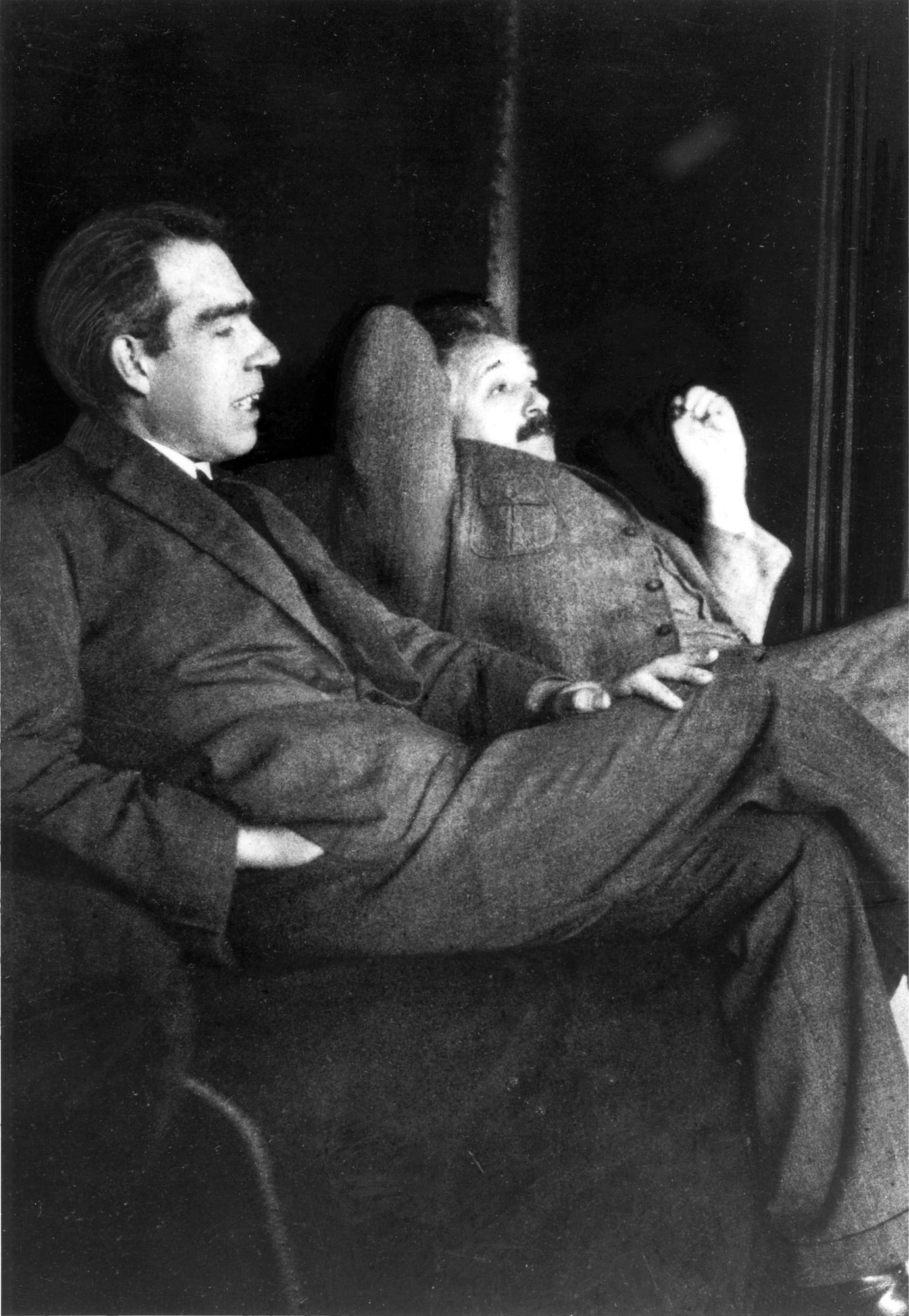
Niels Bohr (left) and Albert Einstein at Paul Ehrenfest's home in Leiden, probably December 1925, a year or two before their public arguments began. Photo: Paul Ehrenfest, public domain, via Wikimedia Commons.
Quantum mechanics, as it stood by 1927, did not fit that picture. Its central object is the wave function (the math that gives the odds of each possible measurement result). It usually gives only probabilities, with no definite value before measurement. Niels Bohr, who led the institute for theoretical physics in Copenhagen, accepted this as the final word. Einstein did not.
The Solvay conferences
The two men argued in person at the Solvay conferences, invitation-only meetings of leading physicists in Brussels. The fifth, in October 1927, is often remembered as the moment Bohr's view won. The proceedings show something messier: three rival approaches and no consensus.7 One of them was Louis de Broglie's "pilot wave" theory, in which real particles ride on a real wave. It drew heavy criticism, and de Broglie soon dropped it.7
At that meeting Einstein raised a short, pointed objection. Picture an electron passing through a small hole and spreading out toward a curved photographic screen. Before it lands, the wave function is spread over the whole screen. When it lands, the wave function suddenly concentrates at one spot. If the wave function fully describes one electron, then one end of the screen instantly "knows" not to register it at the other.1 Einstein preferred to read the wave function as describing a crowd of electrons, like a forecast that covers many days. Then nothing strange travels anywhere.
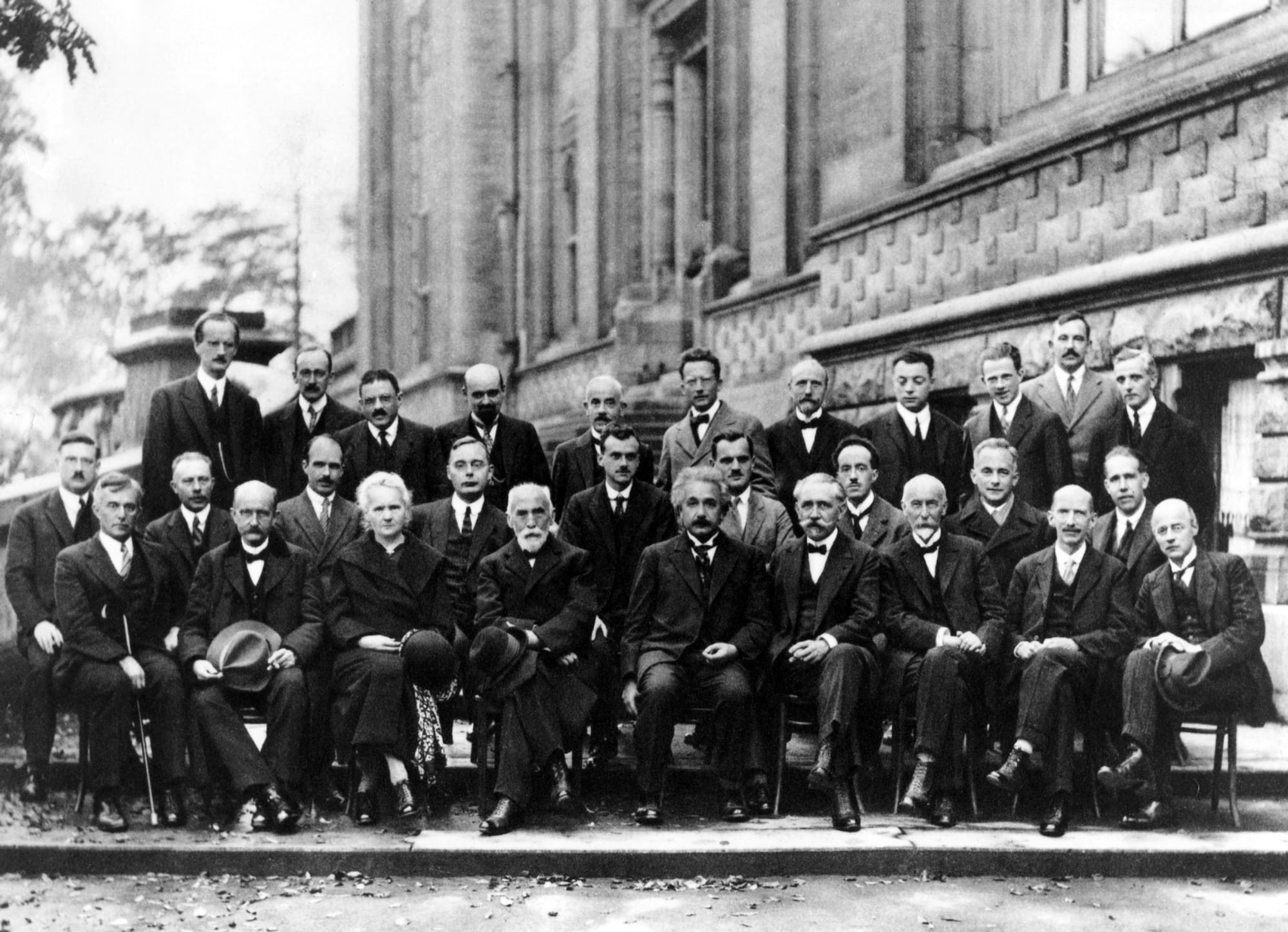
The fifth Solvay conference, Brussels, October 1927. Einstein sits in the front row, center. Bohr is at the right end of the middle row. Photo: Benjamin Couprie, Institut International de Physique Solvay, public domain, via Wikimedia Commons.
At the sixth conference, in 1930, Einstein proposed a sharper puzzle. Imagine a box of light whose clock-driven shutter lets out one photon. Weigh the box before and after. Einstein's relativity says mass and energy are linked, so the change in weight gives the photon's energy. The clock gives the exact time it left. That would seem to beat Heisenberg's uncertainty relation (the rule that certain pairs of quantities, here energy and time, cannot both be pinned down exactly).1 Bohr's answer used Einstein's own general relativity: weighing the box lets it move in gravity, and a clock that moves in gravity changes its rate by just enough to restore the uncertainty.8 Einstein stopped trying to show that the theory was wrong. He set out to show that it was incomplete.1
The 1935 EPR paper
In May 1935 Einstein, Boris Podolsky and Nathan Rosen published "Can Quantum-Mechanical Description of Physical Reality Be Considered Complete?" Their answer was no.9
The argument rests on one rule, which the authors called a criterion of reality. In plain words: if you can predict a quantity with certainty, without disturbing the system in any way, then that quantity is real. It has a value whether or not you check.9
Now take two particles that interact and then fly apart. Quantum mechanics allows a joint state in which their positions are perfectly linked and their momenta (roughly, their motion) are also perfectly linked. Measure A's position, and you can predict B's position with certainty. Measure A's momentum instead, and you can predict B's momentum. You never touched B. By the reality criterion, B must have had a definite position and a definite momentum all along. Quantum mechanics has no state that gives a particle both at once. So, EPR concluded, the quantum description leaves out part of reality.1
An everyday picture helps. Put a left glove and a right glove in two boxes and mail one to Tokyo. Open your box, find a left glove, and you know at once that Tokyo has the right one. Nothing traveled; your knowledge caught up with a fact. This is the world Einstein wanted. The analogy breaks in one place. Gloves pose one question. In the quantum case you choose which question to ask (position or momentum), and B's answer matches whichever you chose.
The paper itself was written by Podolsky, and Einstein disliked his own paper.1
Einstein's own wording of the worry came later. In a letter to Max Born dated 3 March 1947, he wrote that he could not accept a theory that required spukhafte Fernwirkungen, "spooky actions at a distance."10 The phrase is often attached to the 1935 paper. It does not appear there.
Bohr's reply and the Copenhagen view
Bohr answered within months, in the same journal and under the same title.11 He accepted that measuring A does not mechanically disturb B, but denied that this settles anything. Choosing to measure position, he argued, means setting up apparatus that rules out measuring momentum. The choice affects "the very conditions which define the possible types of predictions" about B.11 A property is only meaningful within a specific experimental arrangement. Asking what B's momentum "really was" in a position experiment has no answer.
This is the core of what came to be called the Copenhagen interpretation, though Bohr never used that name and his close colleagues did not fully agree with one another.12 Its common thread is that the wave function is a tool for predicting what observers will find. Bohr's assistant Aage Petersen, writing after Bohr's death, recalled him saying: "There is no quantum world. There is only an abstract quantum physical description. It is wrong to think that the task of physics is to find out how nature is. Physics concerns what we can say about nature."13 Bohr never wrote those words, and the physicist David Mermin argues they should be credited to Petersen.13
Most physicists treated Bohr's reply as the end of the matter, and the study of linked quantum states was largely set aside for thirty years.14
Schrödinger's two replies
Erwin Schrödinger, author of the wave equation, sided with Einstein and published two responses in 1935. The first analyzed the EPR state itself. Two systems that have interacted, he wrote, can no longer be described separately. He named this feature Verschränkung, which he translated as "entanglement," and called it the characteristic trait of quantum mechanics.1514
The second, in German, contained the cat.16 A cat is shut in a steel chamber with a little radioactive material, a Geiger counter and a flask of poison. If an atom decays within the hour, the counter triggers a hammer that breaks the flask. If the wave function is the whole story, then after an hour it describes the cat as living and dead "mixed or smeared out in equal parts." Schrödinger called this a "quite ridiculous case."16 The cat was a reductio (an argument that pushes a view until it becomes absurd). He meant it as a reason to doubt that the wave function describes reality directly. Popular accounts later turned it into a picture of how quantum reality works, the reverse of his intent.
Bell's theorem and the experiments
Part 2 of 5
This part follows how a proof most physicists trusted kept the question closed for about thirty years, how Bohm's pilot wave showed the door was open after all, and how John Bell turned the Einstein–Bohr argument into a question a laboratory could answer. It ends with what the result does and does not rule out.
- 1935 EPR Einstein, Podolsky and Rosen argue that the quantum description leaves out part of reality.
- 1964 Bell's theorem Any local realist theory must keep its statistics inside a limit that quantum mechanics breaks.
- 1972–1998 First tests Freedman and Clauser, then Aspect, then Zeilinger's group find violations, each leaving a loophole open.
- 2015 Loophole-free tests Delft, Vienna and Boulder close the locality and detection loopholes in the same experiment.
A proof that closed the door
Behind the Copenhagen confidence stood a piece of mathematics. In his 1932 textbook Mathematical Foundations of Quantum Mechanics, John von Neumann offered a proof that no "hidden variables" (extra, unseen properties that would fix each measurement result in advance) could be added to quantum mechanics without contradicting it.17 If it held, Einstein's hope was dead before anyone tried. Physicists almost universally accepted it. Max Born, who had introduced the probability reading of the wave function, cited it as settled.17 The one notable early dissent came from a philosopher, Grete Hermann, who in 1935 showed that the proof everyone trusted assumed what it set out to prove.1718
Deep Dive: Grete Hermann and the proof everyone trusted
Grete Hermann was born in Bremen in 1901. She earned a mathematics doctorate at Göttingen under Emmy Noether, then became assistant to the philosopher Leonard Nelson, a follower of Immanuel Kant. She also wrote for an anti-Nazi newspaper, and after 1933 she left Germany for Denmark, Paris and then London.18
Her interest in quantum mechanics came from Kant, who held that every event has a cause. How can a theory say the moment an atom decays has no cause? In 1934 she took the question to Werner Heisenberg in Leipzig. Heisenberg later described the conversations in his memoir and called her "fabulously clever."18 Her 1935 essay on the foundations of quantum mechanics appeared in a small philosophy journal.18 One short section, in small type, carried the title "The circle in von Neumann's proof."19
Take two measurable quantities, R and S. Von Neumann required that the average of the sum, R plus S, always equals the average of R plus the average of S.19 Over many runs, quantum mechanics obeys this. But von Neumann also required it for every hypothetical hidden state, one particle at a time.
Hermann noticed that this demand is harmless when R and S can be measured together, since then the value of the sum is literally the sum of the two values. It is not harmless when they cannot be measured together, as with position and momentum. Then "R plus S" is a third quantity with its own experiment. Nothing forces its individual results to equal the sum of individual results for R and S, which were never both obtained.19 Von Neumann's proof, she wrote, "stands or falls" with this assumption.19 And the only reason to expect it to hold for individual hidden states is that it holds in quantum mechanics as already written. Assuming it means assuming that no finer description exists. That is the circle.
John Bell later gave a simple illustration. For an electron's spin (a tiny built-in magnetism), any single measurement along any direction gives one of two values, plus one or minus one. Spin along a diagonal direction is, mathematically, the sum of the spins along two perpendicular directions divided by the square root of two. If the additivity rule held for individual results, a diagonal measurement could give values like 1.41 or 0. It never does. So no hidden state can obey von Neumann's rule for individual results, and his proof rules out only a kind of hidden-variable theory nobody needed to propose.20
Hermann was not arguing for hidden variables. One of her conclusions was that such an extension of quantum theory is not needed to save the principle of causality. In her Kantian reading, quantum mechanics already supplies causes, though only relative to a particular experimental context.2112 Her goal was to get the logic right.
Almost nobody read her. The journal was obscure, she was a woman and a philosopher writing about physics, and within a few years she was a political refugee.18 Von Neumann's proof kept its authority for three decades. Bell found the same flaw independently in a paper written in 1964 and published in 1966, apparently without knowing her work, and later described von Neumann's assumption as "silly."201918 Her critique became widely known only after the historian Max Jammer described it in 1974.18
The story is often told as a simple morality tale, and that telling is itself under debate. In 2010 the philosopher Jeffrey Bub argued that Bell had misread von Neumann. On Bub's reading, von Neumann never claimed hidden variables were impossible outright. He showed that any hidden-variable theory must work very differently from quantum mechanics, which Bohm's later theory confirms.22 Dennis Dieks extended the defense to cover Hermann in 2017.23 In 2018 Mermin and Rüdiger Schack replied that Hermann and Bell had identified the gap correctly, and that von Neumann had simply overlooked it.19 The technical dispute is live. The historical fact is not: for thirty years, most physicists treated the question of hidden variables as closed, and a sound objection published in 1935 did not reopen it.
The road not taken: Bohm's pilot wave
In 1951 David Bohm, a young Princeton physicist and a protégé of Robert Oppenheimer, published a textbook in the spirit of Bohr. In it he recast EPR with electron spins, the version later experiments would test.1 Soon after, he changed his mind.
In January 1952 Bohm published two papers in Physical Review proposing an interpretation of quantum theory "in terms of 'hidden' variables."24 The idea revived de Broglie's 1927 pilot wave and completed it.17 In Bohm's theory every particle always has a definite position. The wave function is also real: a physical field that guides the particles, the way a current steers a boat. In a double-slit experiment the particle goes through one slit, while the wave goes through both and shapes where the particle can land. If the starting positions are spread out in the way the wave function's odds describe, the theory reproduces every prediction of ordinary quantum mechanics.17 Measurement needs no special rule and no observer.
Two features stand out. It is deterministic: quantum randomness comes only from not knowing the exact starting positions. It is also openly nonlocal: the motion of one particle can depend at once on where distant particles are.17 In PBR's terms, Bohm's theory sits firmly on the side where the wave function is part of reality.
Bohm's timing was poor. In 1949 he had refused to testify before the House Un-American Activities Committee about colleagues. He was indicted for contempt of Congress, later acquitted, and Princeton still declined to renew his contract in 1951. He moved to the University of São Paulo in Brazil, and the U.S. took his passport.25 His theory arrived from exile.
The response was mostly cold. Wolfgang Pauli called it a cheap solution. Léon Rosenfeld, a close ally of Bohr, called it a harmful "new obscurantism" and worked to discourage its publication.26 A 2023 study of Bohm's correspondence by the philosopher Andrea Oldofredi concludes that many critics had not fully read or understood the theory, and that political motives played a part in ignoring it.26 A widely repeated line credits Oppenheimer with saying, "If we cannot disprove Bohm, then we must agree to ignore him."27 The quote is secondhand and its source uncertain.
Einstein did not embrace it either. He had long judged that adding particle paths to the existing theory was an improbable route to a complete physics.1
One reader saw it differently. John Bell, a young physicist from Belfast, had been taught that von Neumann had ruled hidden variables out. "But in 1952 I saw the impossible done," he wrote decades later. "It was in papers by David Bohm."1728 He asked why no one had mentioned the pilot wave to him, even to say what was wrong with it.17 He also asked a sharper question. Bohm's theory was nonlocal. Was that an accident of Bohm's design, or would every theory that reproduced quantum predictions have to be nonlocal?22 His answer, published in 1964, became Bell's theorem, and it turned the EPR debate from philosophy into something a laboratory could test.
Bohmian mechanics remains a minority view, but a working one. Its defenders like its clear account of what exists. Its critics point to the nonlocality and the difficulty of making it fit with relativity.17 Which picture is right is still debated. The narrower historical point is settled: in 1952 Bohm built the kind of realist theory the standard account had called impossible.
Bell's 1964 theorem
For almost 30 years, the argument between Einstein and Bohr looked like philosophy. Einstein thought quantum mechanics was incomplete: particles must carry definite properties that the theory leaves out. Bohr thought asking about those properties made no sense. Neither side seemed to predict anything the other could not. In 1964 John Stewart Bell, a Northern Irish physicist at CERN, showed that the question could be settled in a laboratory.29
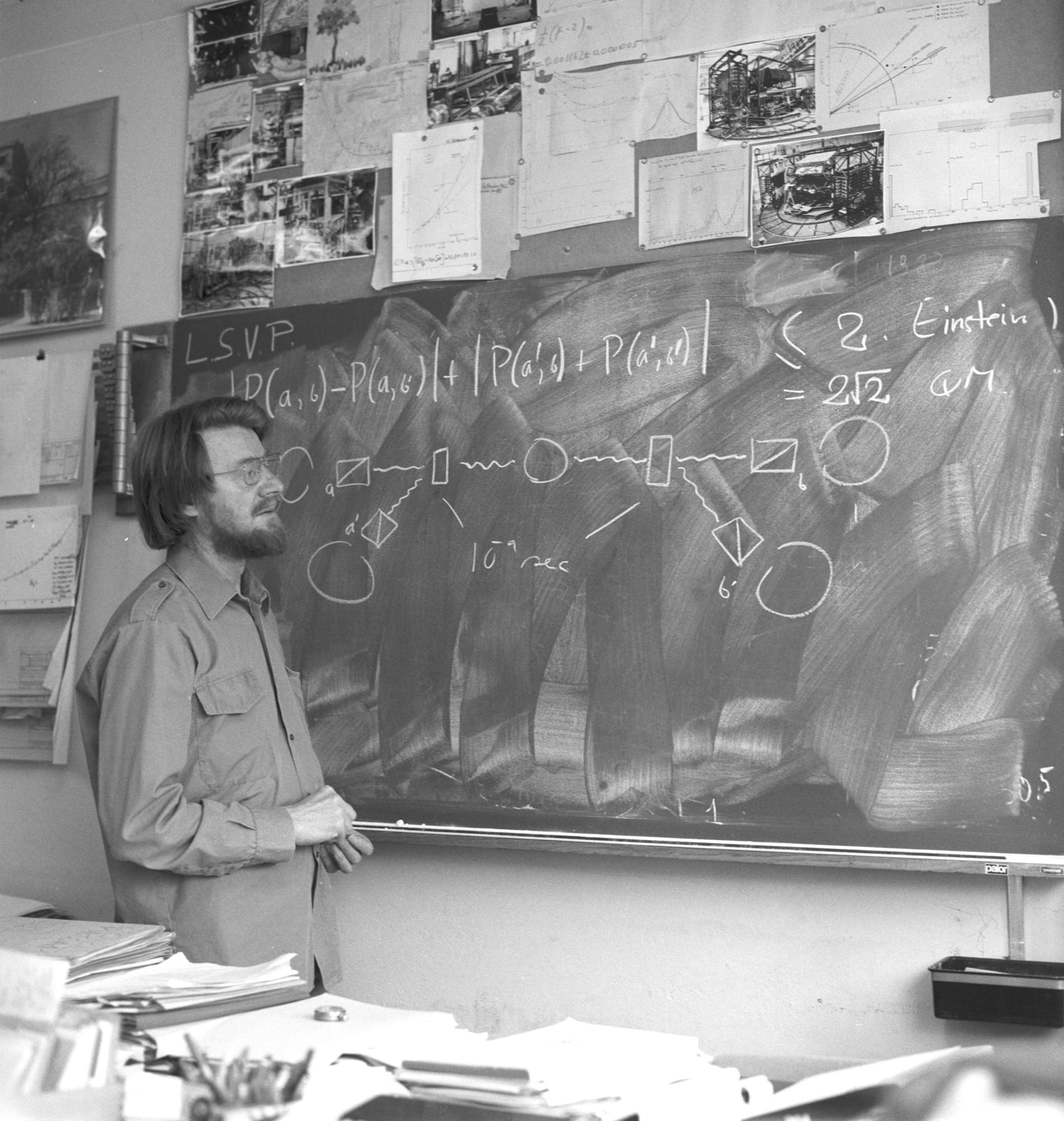
John Bell at CERN in June 1982, in front of a blackboard about his inequalities. Photo: CERN, CC BY 4.0, via Wikimedia Commons.
Bell's paper was six pages long and appeared in a small journal called Physics, which closed soon after.29 It made one claim. Any theory built on two commonsense assumptions must produce statistics that stay inside a fixed limit. Quantum mechanics predicts statistics that break that limit. So at least one of the assumptions has to fail, or quantum mechanics has to be wrong.30
The two assumptions together are called local realism.
- Realism here means that the results of measurements are set ahead of time by properties the particles already carry. Physicists call those properties "hidden variables" because the quantum formalism does not mention them. Think of each particle leaving the source with a sealed instruction card that says how to answer any question it might be asked.
- Locality means that nothing done at one detector can affect what happens at a distant detector faster than light could carry the news.
A third assumption usually goes unspoken: the experimenters' choices of what to measure are not secretly correlated with the particles' instruction cards. This is called measurement independence, or "freedom of choice."30
Bell liked to explain why ordinary correlations are no mystery with the story of his colleague Reinhold Bertlmann, who always wore socks of different colors. If you see that one of his socks is pink, you know at once that the other is not pink. Nothing traveled between the socks. The pattern was fixed when he got dressed that morning.31 Local realism says every correlation between distant particles works like Bertlmann's socks. Bell's insight was that this explanation has a price. If the answers are fixed in advance and the two sides cannot coordinate after the questions are asked, then there is a hard ceiling on how often the two answers can line up in the right pattern. The physicist N. David Mermin later turned this into a puzzle about two boxes with flashing lights, a version still used to teach the idea.32 The cleanest modern form is a cooperative game, and the arithmetic fits on a napkin. That is Bell's game.
Deep Dive: Bell's game, step by step
Two players, Alice and Bob, play as a team against a referee. They can plan together beforehand, but once the game starts they are put in separate rooms and cannot communicate. In each round, the referee hands each player a card that is either red or blue, chosen at random by a coin flip, independently for each of them. Each player must then answer "yes" or "no."33
The rule for winning is short. If at least one player got a red card, they win when their answers match (both "yes" or both "no"). If both got blue cards, they win when their answers differ. There are four equally likely card combinations: red-red, red-blue, blue-red and blue-blue. In three of them the team wants agreement; in one it wants disagreement.
Start with a classical team: players who are ordinary people, or ordinary particles with instruction cards. Since they cannot talk during the game, each player's answer can depend only on the card that player sees. So a strategy is just a list of four pre-set answers: what Alice says to red, what Alice says to blue, what Bob says to red, what Bob says to blue.
An easy strategy is "always say yes." Both players always agree, so the team wins on red-red, red-blue and blue-red, and loses on blue-blue. That is three out of four, or 75 percent.
Can a cleverer plan win all four? Try to write one down. To win red-red, Alice's red answer must equal Bob's red answer. To win red-blue, Alice's red answer must equal Bob's blue answer. To win blue-red, Alice's blue answer must equal Bob's red answer. Chain these together: Alice's blue answer equals Bob's red answer, which equals Alice's red answer, which equals Bob's blue answer. So Alice's blue answer and Bob's blue answer are forced to be the same. But winning blue-blue requires them to differ. The four conditions contradict each other. Any fixed list of answers fails at least one of the four card combinations, so no pre-set strategy beats 75 percent.
Shared randomness does not help. The players could agree to flip a coin before the game and pick one of several plans based on it. Each plan still wins at most three of the four cases, and an average of numbers that are each at most 75 percent is at most 75 percent. This is the whole of Bell's argument in miniature. "Answers fixed in advance" is realism. "Bob's answer cannot depend on Alice's card" is locality. "The referee's coin flips are not rigged to match the plan" is freedom of choice. Grant all three and the ceiling is 75 percent.
Now give Alice and Bob a pair of entangled photons (particles of light whose properties are linked more tightly than any classical pair could be), one photon each. Each player has a polarizing filter, a sheet like the lens of polarized sunglasses that a photon either passes through or is blocked by. Passing means "yes," blocked means "no." The only freedom is the angle at which each player turns the filter, and they choose it based on their card.
The useful fact about this kind of entangled pair is simple to state. If Alice and Bob set their filters at the same angle, their photons always do the same thing. If the filters differ by some angle, the photons agree less often, and the chance of agreeing falls off smoothly as the angle grows. At a 22.5 degree difference they agree about 85 percent of the time. At a 67.5 degree difference they agree only about 15 percent of the time, which means they disagree about 85 percent of the time.30
So the team chooses these settings in advance:
- Alice turns her filter to 0 degrees for a red card and 45 degrees for a blue card.
- Bob turns his filter to 22.5 degrees for a red card and minus 22.5 degrees for a blue card.
Check the four cases. Red-red: 0 and 22.5, a gap of 22.5 degrees, so they agree about 85 percent of the time, as needed. Red-blue: 0 and minus 22.5, again a 22.5 degree gap, agree 85 percent. Blue-red: 45 and 22.5, a 22.5 degree gap, agree 85 percent. Blue-blue: 45 and minus 22.5, a gap of 67.5 degrees, so they disagree 85 percent of the time, which is exactly what this case needs. In every case the team wins about 85.4 percent of the time.33
That number is a ceiling too. In 1980 the mathematician Boris Tsirelson proved that no quantum strategy can do better than about 85.4 percent at this game.34 Nature, as far as anyone has measured, sits right at the quantum line, above the classical one.
This does not allow messages. It is tempting to read the extra 10 percent as Alice's photon "telling" Bob's photon which card she got. But look at Bob's results alone. Whatever angle he picks, his photon passes half the time, at random, no matter what Alice does. He learns nothing about her card until they compare notes later over an ordinary channel. The correlation shows up only in the joint record. So entanglement cannot be used to send a signal faster than light, and the result does not contradict relativity in the way a hidden radio link would.30
The game is the CHSH inequality (named for the four authors introduced below) in disguise. Physicists usually report a number called S. It relates to the win rate by a simple rule: classical teams reach at most S = 2, matching 75 percent, and the quantum maximum is S of about 2.83, matching 85.4 percent.33 When the Delft group in 2015 reported S = 2.42, they were reporting a team that won about 80 percent of its rounds under conditions where no classical team could pass 75.35
The analogy strains in one place. The game makes it look as if quantum players have a better strategy. They don't have a strategy in the ordinary sense. No list of answers sits in either photon waiting to be read. That absence is the point. It is also the opening for different readings. One reading says something nonlocal links the photons. Another says the answers did not exist until measured. A third says the referee's coins were never truly independent. The game shows that some ordinary assumption fails. It does not say which.
From thought experiment to laboratory
Bell's original inequality assumed perfect equipment. In 1969 John Clauser, Michael Horne, Abner Shimony and Richard Holt rewrote it into a form that real detectors could test, now called the CHSH inequality.36 In 1972 Stuart Freedman and Clauser ran the first test at Berkeley. They excited calcium atoms with light so that each atom shot out two photons with linked polarizations, then measured both photons with polarizers. The results broke the inequality and matched quantum mechanics.3738
That experiment left gaps, which physicists call loopholes. A loophole is a way local realism could still explain the data because the experiment did not quite meet the theorem's conditions. Three mattered most.
- Locality loophole. In 1972 the polarizer settings were fixed for long stretches. In principle a slow, ordinary signal could let one side "know" the other side's setting.
- Detection loophole (fair sampling). Detectors caught only a small fraction of the photons. If the photons that got detected were an unrepresentative subset, a local realist model could fake the violation.
- Freedom-of-choice loophole. If whatever chose the settings shared a common cause with the particles, the instruction cards could be tailored to the questions.3038
Alain Aspect, working at Orsay near Paris, went after the first one. In 1982 he and his colleagues Jean Dalibard and Gérard Roger used fast optical switches to change which polarizer each photon would meet while the photons were already in flight.39 The filters were about six meters from the source, so the switching had to happen within a few billionths of a second.38 The violation held. Aspect's switches flipped in a regular, periodic pattern rather than a truly random one, so purists still saw a small gap. In 1998 Anton Zeilinger's group in Innsbruck closed it with stations 400 meters apart and settings chosen by fast random number generators.40
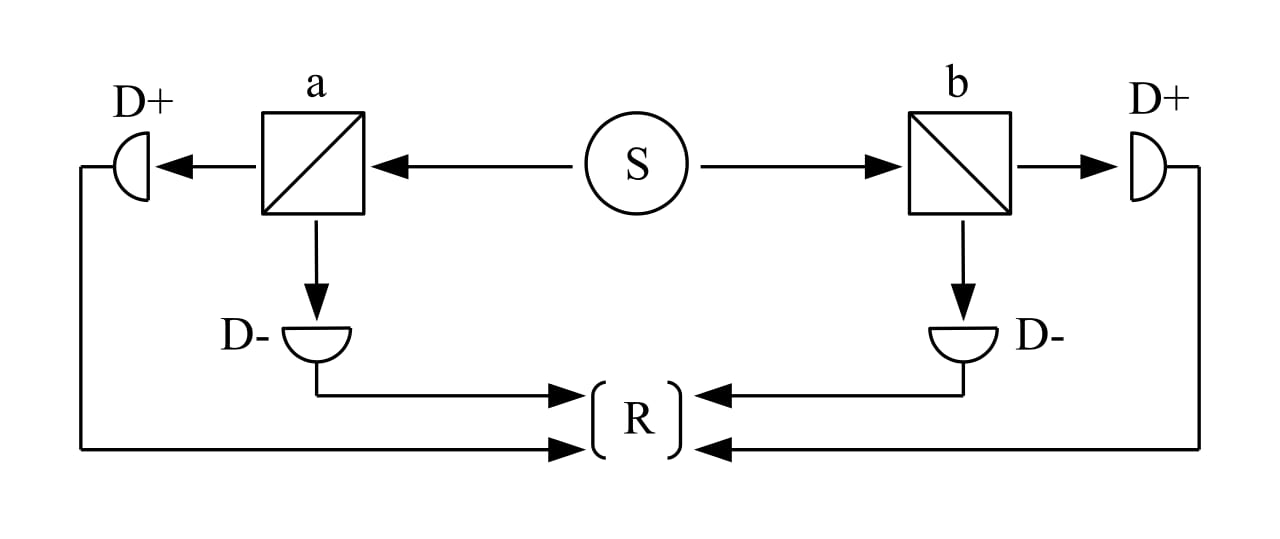
A two-channel Bell test of the kind Aspect ran in 1981–82. A source (S) sends paired photons to two analyzers set at angles a and b. Each photon lands in a "+" or "–" detector, and a coincidence counter (R) compares the two records. Diagram: Neolexx, CC BY 3.0, via Wikimedia Commons.
Closing every loophole at once
For decades, each experiment closed one loophole while leaving another open. Photon experiments were fast but lost too many photons. Experiments with trapped atoms detected nearly everything but were too close together. In 2015 three groups finally closed the locality and detection loopholes in the same experiment.41
- At Delft University of Technology, Ronald Hanson's group, with Bas Hensen as lead author, entangled electrons trapped in two tiny flaws in diamond crystals placed 1.3 kilometers apart on campus. They ran 245 trials and found S = 2.42, above the classical limit of 2.35
- In Vienna, Marissa Giustina and colleagues in Zeilinger's group used entangled photons and highly efficient superconducting detectors. The odds of their result arising under local realism by chance were about 1 in 10³¹.42
- At the US National Institute of Standards and Technology in Boulder, Lynden Shalm and colleagues ran a similar photon experiment and reached the same conclusion.43
The Delft result was statistically modest because the number of trials was small. The two photon experiments were far stronger. Taken together, they are the established result: when both loopholes are closed, local realism still fails.
The third loophole is harder because it can never be fully closed, only pushed back. Any device that picks settings is itself made of physics, and in principle its "random" choices might share a cause with the particles. On 30 November 2016, the BIG Bell Test handed the choice to people. About 100,000 volunteers played an online game that asked them to tap unpredictable sequences of zeros and ones. Their 97 million choices were sent live to 12 laboratories on five continents, where 13 experiments used them to set their measurements. Local realism failed again.44
Other teams looked to the sky. In 2017 a Vienna-based team picked each setting from the color of light arriving from stars in the Milky Way, light that left those stars hundreds of years earlier. Any hidden coordination between the settings and the particles would have had to be arranged at least about 600 years ago.4546 In 2018 the same collaboration, working in the Canary Islands, used light from distant quasars (the bright cores of very distant galaxies). That pushed the date back to at least 7.8 billion years ago, more than half the age of the universe.47
- 1964 Bell's theorem Local realism and quantum mechanics make different predictions
- 1972 Freedman and Clauser First experimental violation, using calcium atoms at Berkeley
- 1982 Aspect at Orsay Settings switched while photons are in flight
- 2015 Loophole-free tests Delft, Vienna and Boulder close locality and detection gaps together
- 2022 Nobel Prize Aspect, Clauser and Zeilinger share the physics prize
On 4 October 2022 the Nobel Prize in Physics went to Aspect, Clauser and Zeilinger "for experiments with entangled photons, establishing the violation of Bell inequalities and pioneering quantum information science."4 By then entanglement had become a working tool for quantum cryptography and quantum computing, and the prize honored both the tests and that turn to technology.48
What Bell's theorem does and does not rule out
The experimental fact is settled: nature violates Bell inequalities, under conditions that close the main loopholes. What that fact means is still debated.
Bell's theorem rules out local realism as a package. It does not rule out realism on its own. A theory can keep definite, pre-existing values if it gives up locality. Bohmian mechanics does exactly that: particles have real positions at all times, guided by a wave that links distant particles instantly.30 Popular summaries sometimes say Bell experiments prove "there are no hidden variables." That is too strong. They rule out local hidden variables.
The menu of choices is roughly this, and none is free.
- Give up locality, as Bohmian mechanics does.
- Give up the idea that measurements have single, definite outcomes, as the many-worlds interpretation does.
- Give up observer-independent facts about outcomes, as Copenhagen-style views, QBism and relational quantum mechanics do in different ways.
- Give up measurement independence. This is superdeterminism: the settings and the particles were correlated all along, so the experimenters' choices were never independent of what they measured.3049
Superdeterminism is the one remaining "loophole" that no experiment can close by design, since any test relies on choosing settings. Most physicists consider it unappealing because it seems to require a vast, finely arranged conspiracy in the universe's starting conditions. A minority, including Sabine Hossenfelder and Tim Palmer, argue that it deserves serious work as a possible route to a deeper theory.49 This is live debate. Later sections take up the interpretations in detail.
Bell's theorem also sets up the PBR theorem. Bell asked whether hidden variables could be local. PBR asks a different question: if there is an underlying reality, can the wave function be mere knowledge about it? Both are "no-go" theorems, results that rule out a whole class of theories in one stroke, and both rely on assumptions that a determined skeptic can question. There is a third such theorem, older than many people realize, which says that properties can't all be pre-set.
The PBR theorem
Part 3 of 5
This part covers the 2012 theorem at the center of this page. It sets out the question PBR answers, how the proof works, what it assumes, how it has been tested, and what it settles.
Thing or knowledge
Every quantum calculation starts with a wave function (the math that gives the odds of each measurement result). For a century, physicists have used it without agreeing on what it is. There are two broad answers. On one, the wave function is a physical thing, as real as an electric field. On the other, it is a record of what someone knows about a physical thing, closer to a weather forecast than to the weather. Philosophers call the first reading ontic (about what exists) and the second epistemic (about knowledge). Einstein leaned toward the second.2
Ontic and epistemic An ontic reading treats the wave function as a physical thing, as real as an electric field. An epistemic reading treats it as a record of what someone knows about a physical thing.
The PBR theorem, named for Matthew Pusey, Jonathan Barrett and Terry Rudolph, is the best-known result on this question. It says that if a physical system has a real state at all, and if systems prepared separately have separate real states, then the wave function has to be part of that real state. The knowledge reading, in the form Einstein would have recognized, does not survive.3
Ontic or epistemic: making the question precise
In 2010 Nicholas Harrigan and Robert Spekkens gave it a sharp form, in a paper first posted in 2007.50 Their "ontological models" framework imagines that every system has a complete physical state, which they call the ontic state (the full list of facts about the system, whether or not anyone can see them). A lab procedure that prepares a given wave function does not fix the ontic state exactly. It produces a spread of possible ontic states, described by a probability distribution. Measurement results then depend only on the ontic state.
Now take two different wave functions and compare their spreads.
- If the spreads never overlap, every ontic state belongs to exactly one wave function. The wave function can be read off the physical state, so it is part of reality. Harrigan and Spekkens called such models ψ-ontic (ψ, the Greek letter psi, is the usual symbol for the wave function).
- If some pair of spreads does overlap, a single physical state is compatible with two different wave functions. Then the wave function cannot be a physical property of the system. It can only describe someone's information about the system. These models are ψ-epistemic.50
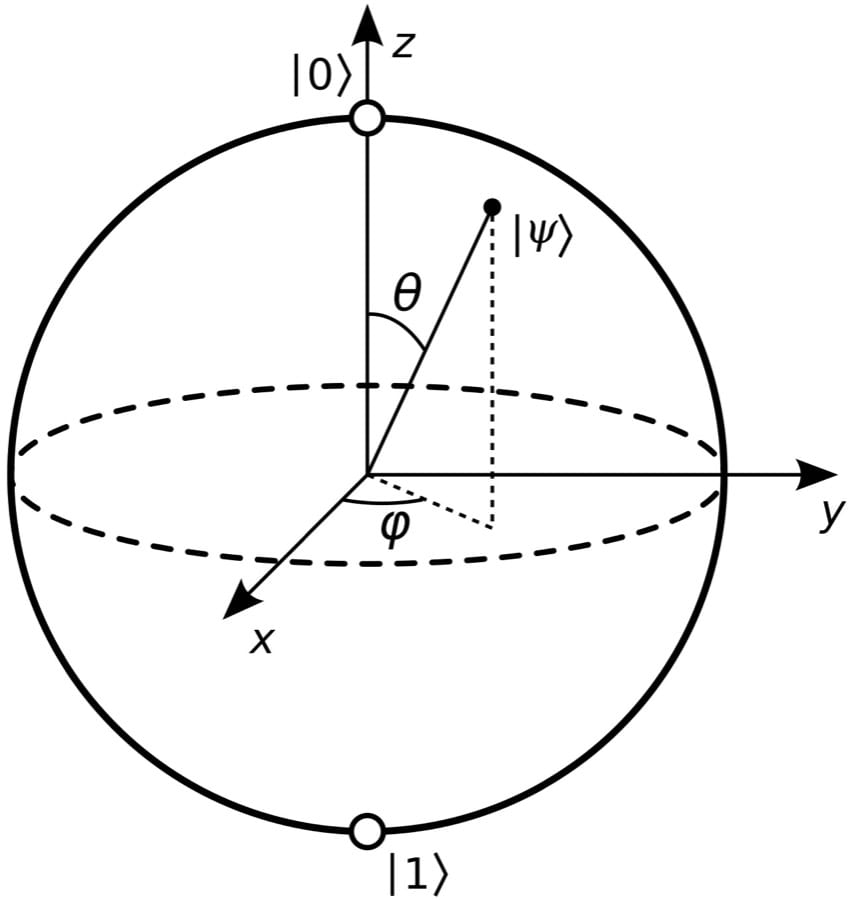
The Bloch sphere, a standard picture of a qubit (the simplest quantum system, with two possible measurement results). Each point on the surface is a different wave function. PBR asks whether two nearby points could share the same underlying physical state. Image: Smite-Meister, CC BY-SA 3.0, via Wikimedia Commons.
Why the knowledge view was attractive
The appeal of the epistemic reading is easiest to see in collapse. Quantum theory says that when you measure a system, its wave function jumps to match the result. Read as a physical event, that jump is strange: something spread out becomes definite everywhere at once. Read as knowledge, it is ordinary. A coin lies under a cup. You give heads and tails even odds. You lift the cup, see heads, and your odds jump to 100%. Nothing happened to the coin. Only your information changed.2
Spekkens pushed this idea hard. In a paper posted in 2004 and published in 2007, he built a toy theory: a made-up world of classical objects with definite properties, plus one rule that limits how much any observer can know about them at once.51 Nothing in the toy theory is quantum. Yet it reproduces a long list of effects usually taken as signs of quantum weirdness, including a ban on copying unknown states, a version of teleportation, and the fact that some pairs of states cannot be perfectly told apart.51 In the toy theory those effects have a plain explanation: the states are states of incomplete knowledge, and different knowledge states can overlap. Spekkens titled the paper "In defense of the epistemic view of quantum states."51
The toy theory is local, so it cannot reproduce the correlations Bell's theorem shows are out of reach for local hidden properties. The hope was narrower: that much of quantum strangeness comes from treating knowledge as a physical object, with only Bell's residue left over as genuinely odd. Jacques Pienaar, now a physicist at the Federal University of Rio de Janeiro, was working on theories of this kind at the time.2
Pusey's failed upgrade
In 2011 Pusey was a graduate student at Imperial College London, working with Rudolph. When he rewrote the toy theory in a notation of his own, it differed from real quantum mechanics by only a few minus signs. His collaborators, sympathetic to Einstein, encouraged him to close that gap and build a full epistemic model of quantum theory.2
"I spent a few days trying to do that, and got fed up," Pusey told Quanta. "So I decided to prove that it was impossible instead."2 He is now at the University of York.52
The result went up on the arXiv preprint server on 14 November 2011 under the title "The quantum state cannot be interpreted statistically."53 Three days later, Nature's news site ran a story by Eugenie Samuel Reich, "Quantum theorem shakes foundations."54 It quoted Antony Valentini, a specialist in pilot-wave theory then at Clemson University: "I don't like to sound hyperbolic, but I think the word 'seismic' is likely to apply to this paper." Reich added, in her own words, that Valentini believed the result might be the most important general theorem on the foundations of quantum mechanics since Bell's theorem.54
The paper appeared in Nature Physics in 2012 under a calmer title, "On the reality of the quantum state."3 Its abstract states the result in one sentence: any model in which the quantum state is mere information about an underlying physical state, and in which independently prepared systems have independent physical states, must contradict the predictions of quantum theory.3
Pienaar remembers his reaction: "That's it. The program's dead."2
How the proof works
- Assume Overlap Suppose two preparations share some real states, with a chance q, bigger than zero, of landing in the shared region.
- Pair up Two systems Prepare two qubits independently, so both land in the shared region with chance q times q.
- Measure Joint measurement An entangled measurement on the pair has four results, each forbidden for one of the four combinations of preparations.
- Clash Contradiction On the shared runs, any result is one quantum theory forbids for some possible combination, yet quantum theory says that never happens.
- So Conclusion So q must be zero: no overlap, and the wave function is written into the real state.
The proof is short, and its logic needs no equations. Quanta tells it with Rudolph's analogy of a dealer, two piles of cards and a player who must name a combination the dealer did not deal. The steps are laid out in the card trick behind PBR.
Deep Dive: The card trick behind PBR
Start with the card version, as Quanta tells it from an analogy of Rudolph's.2 A dealer takes the 26 red cards from one deck and the four aces from another. Call them the red pile and the ace pile. Under the table, he picks a pile at random and draws a card from it. Then he does the same again, independently, for a second card. He lays both cards face down and challenges the player: name one combination of piles these two cards did not come from. There are four combinations: red-red, red-ace, ace-red and ace-ace.
Usually the player wins easily. Say she turns the cards over and sees the two of diamonds and the ace of clubs. The two of diamonds is not an ace, so it came from the red pile. The ace of clubs is black, so it came from the ace pile. The dealer cannot have drawn red-red or ace-ace, and she can safely name either one.2
The trouble comes with the red aces. The ace of hearts and the ace of diamonds are in both piles. If she turns over two red aces, every one of the four combinations is still possible. She has to guess, and a guess fails one time in four. Over many rounds, she is certain to lose sometimes.2
This is the overlap from the Harrigan–Spekkens framework, made physical. The face of a card is its real state. The pile is the state of knowledge, a fact about how the card was prepared that lives in the dealer's head, not in the card. The two knowledge states overlap because some real states (the red aces) belong to both. Compare red and black piles: they share no cards, so the face of any card tells you its pile for certain. There, the pile label is effectively a property of the card itself.2
Now the quantum version. Replace each pile with a way of preparing a qubit (a two-outcome quantum system, such as an ion with two energy levels). In the original paper the two preparations give two particular wave functions that cannot be perfectly told apart by any single measurement.3 Suppose, as the epistemic view requires, that their spreads of real states overlap: that each preparation sometimes produces a real state from a shared region, the quantum counterpart of a red ace. Call the chance of landing in that shared region q, and suppose it is bigger than zero.
Next, prepare two qubits, each one in either of the two ways. This is where the second assumption enters. If the two preparations are independent, their real states are independent too, just as the dealer's two draws were. Then the chance that both qubits land in the shared region is q times q. On those runs, the physical state of the pair is consistent with all four combinations of preparations, exactly as two red aces were.3
Then comes the measurement. PBR described a measurement on the pair as a whole, an entangled measurement (one that asks a question about the two systems jointly, which no pair of separate measurements can ask). It has four possible results. Quantum theory predicts that each result has zero probability for one of the four combinations. Whatever result appears, the player can name a combination that was not dealt, and she is always right.3 Quanta puts the oddity this way: the machine wins without ever turning over the cards, and in fact it has to work without turning them over.2
Put the pieces together. On the runs where both qubits sit in the shared region, the measurement has to give some result. In the ontological-models picture, results depend only on the real state, and that real state could have come from any of the four combinations. So whichever result appears, it is a result that quantum theory forbids for one of those combinations. The model would produce forbidden results on at least q times q of the runs. Quantum theory says that never happens. The only way out is for q to be zero: no overlap at all. The wave function, then, is written into the real state.3
The argument above uses one carefully chosen pair of wave functions. PBR extended it to any two distinct wave functions. When the two are very similar, the trick needs more systems at once, prepared independently, and a bigger joint measurement over all the combinations.3 That is why later tests used more than two qubits.
The analogy has limits, and they matter. Real cards have faces anyone can see. The theorem only assumes a real state exists, not that anyone can see it. Second, the card game makes independence look obvious: the dealer's two draws obviously do not affect each other. In quantum physics it is an assumption, and the most debated one in the proof. Finally, the clean version above needs perfect zeros. Real experiments have noise, so PBR also gave a version that tolerates small errors and turns measured error rates into an upper limit on how much overlap there can be.3 Experiments test that limit, not an exact zero.5556
The two assumptions, and what happens if you drop them
PBR rests on two premises. Each one leaves a door open.
The first premise is that a real state exists. The theorem assumes there is an ontic state, some objective physical condition of the system that fixes the odds of measurement results. Deny that and the theorem has nothing to work on. This is the route of the Copenhagen interpretation and of QBism (a view in which the wave function expresses an agent's personal beliefs about future experiences). Quanta stresses that this route stays open. It is consistent with PBR that the wave function lives in our minds and there is no observer-independent state underneath for it to describe.2 PBR helped push Pienaar toward QBism. "You need two to tango," he told Quanta. "Without two systems, there's no relation. And reality is nothing but relations."2
The second premise is preparation independence: two systems prepared separately, with no contact, have uncorrelated real states. It sounds harmless, but it is a real assumption, separate from locality (the rule that nothing travels faster than light). A few months after PBR, Peter Lewis, David Jennings, Barrett and Rudolph showed it is needed. They built explicit ψ-epistemic models, with overlapping spreads, that match quantum predictions when independence is not assumed. Their abstract states plainly that "additional assumptions are always necessary" to rule such models out.57 So an epistemic theory can survive PBR if it allows hidden correlations between systems that look independent, or if it lets influences run backward in time (retrocausal models, which some researchers explore for this reason).58 Both options give up something most physicists value.
Pusey summed up what is left. PBR guarantees that "if anything is real, the quantum state is real." The theorem does not choose between those options. It removes the middle. "Do you bite the bullet, or do you try and dodge the bullet?" he asked.2 Some physicists want a third door.
Related results
PBR set off a run of related theorems, collectively called ψ-ontology theorems. Each swaps preparation independence for a different assumption.
- Colbeck and Renner (2012). Roger Colbeck and Renato Renner posted their result two weeks after PBR. They assumed instead that experimenters can choose measurement settings freely, independent of everything that happened before, and that quantum theory cannot be improved on for making predictions. From that they derived that the wave function is in one-to-one correspondence with the elements of reality.59
- Hardy (2013). Hardy assumed "ontic indifference": operations that leave a given wave function unchanged can be done without disturbing the real states behind it. With that and two milder assumptions, he showed that the spreads for different wave functions cannot overlap. He also pointed out that Spekkens's toy theory breaks ontic indifference, which is how it manages to have overlap.60
- Maximal ψ-epistemic no-go results. A separate line of work avoids two-system assumptions completely. It asks how much overlap a single-system model could have. A fully epistemic model would explain why similar wave functions are hard to tell apart entirely through overlap, as the red aces do for the two piles. Owen Maroney showed in 2012 that for large systems at most half of that difficulty can come from overlap.61 Matthew Leifer and Maroney showed in 2013 that such "maximally ψ-epistemic" models are ruled out for systems with three or more outcomes.62 Barrett, Eric Cavalcanti, Raymond Lal and Maroney gave a noise-tolerant version in 2014.63 These results do not kill every epistemic model, but they remove most of the explanatory payoff that made the view attractive.
- Leifer's review (2014). Leifer's survey "Is the quantum state real?", in the journal Quanta (unrelated to Quanta Magazine), maps the whole family of theorems, their assumptions and the remaining loopholes.58
Putting it to the test
Each experiment prepares the systems, runs the joint measurement and counts how often a "forbidden" result appears. Noise keeps the count above zero, so each test sets an upper limit on the possible overlap.
- Trapped ions (posted 2012, published 2016). A team in Innsbruck led by Rainer Blatt, with Pusey, Rudolph and Barrett as coauthors, ran the PBR measurement on pairs of trapped calcium ions. Within experimental error the results matched quantum theory, and the paper analyzes which classes of epistemic model the data rule out.55 Quanta dates it to 2012, when the preprint appeared.2
- Single photons (2015). Martin Ringbauer and colleagues at the University of Queensland and elsewhere took the single-system route. They tested the overlap bounds directly on photons with three and four possible outcomes. They found that no knowledge-based model could fully explain why their states could not be told apart. Assuming some underlying reality exists, they wrote, the results strengthen the view that the entire wave function should be real. The alternatives they named were backward-in-time causation or giving up objective reality.64
- IBM processor, five qubits (2025). Songqinghao Yang, Haomu Yuan and Crispin Barnes of the Cavendish Laboratory in Cambridge ran PBR on IBM's 156-qubit Heron2 "Marrakesh" processor. They extended the test from two qubits to five, the card game with five cards, and built a noise-tolerant bound from the chip's measured error rates.56 Most neighboring pairs and five-qubit groups beat the epistemic bound, with pass rates falling as qubits sat farther apart on the chip.56 Barnes told Quanta the goal was to see whether a foundations theorem could become "[an] experimental probe of genuinely quantum behavior," in effect a check on the hardware. Nobody expected quantum mechanics to fail.2
The experiments cannot test PBR's assumptions, which concern a hidden layer no measurement reaches. They show that the conclusion survives the noise of real devices.
What PBR settles, and what it leaves open
What is established: given its two assumptions, PBR is a mathematical proof, and the quantum predictions it depends on have been confirmed in the lab.35556 Any theory that keeps an observer-independent physical state and preparation independence has to treat the wave function as real. That is the position of Bohmian mechanics, many-worlds and the collapse theories. Pienaar's version: "You can think of [the quantum state] as stamped onto the underlying state of the world. You change the quantum state, you change something in reality."2
What is not settled: PBR does not show that the wave function is real. Quanta stresses that reading it that way is a misunderstanding.2 The theorem is a conditional. It leaves the Copenhagen and QBist positions untouched, since they deny that there is a hidden real state for the wave function to be knowledge about. What it removes is the compromise Einstein seemed to want, in which there is an objective world and the wave function is only our incomplete information about it.2
Still in live debate: whether preparation independence deserves the same trust as locality, and whether the ontological-models framework is the right way to define "real state" at all.58 Hardy's idea of states spread over time and Pusey's "woolly" reality are early sketches.2 David Schmid of the Perimeter Institute has said what any new notion of reality would need to win people over: "It needs to have the ring of truth, so that when people see it, they can't unsee it."2
What is left standing
Part 4 of 5
With Bell and PBR in place, this part surveys the views of quantum theory that remain. Each keeps something and gives something up, and physicists remain split among them.
Three camps
Bell's theorem already forced a choice. Any theory that reproduces quantum predictions has to give up something people once took for granted: that influences travel no faster than light, that experimenters choose their settings freely, or that measurements reveal facts that were there all along. PBR narrows the menu again. If there is an objective physical state underneath the math, and two separately prepared systems have independent states, then the wave function (the math that gives the odds of each measurement result) has to be part of that physical state. It cannot be a mere summary of someone's ignorance.58
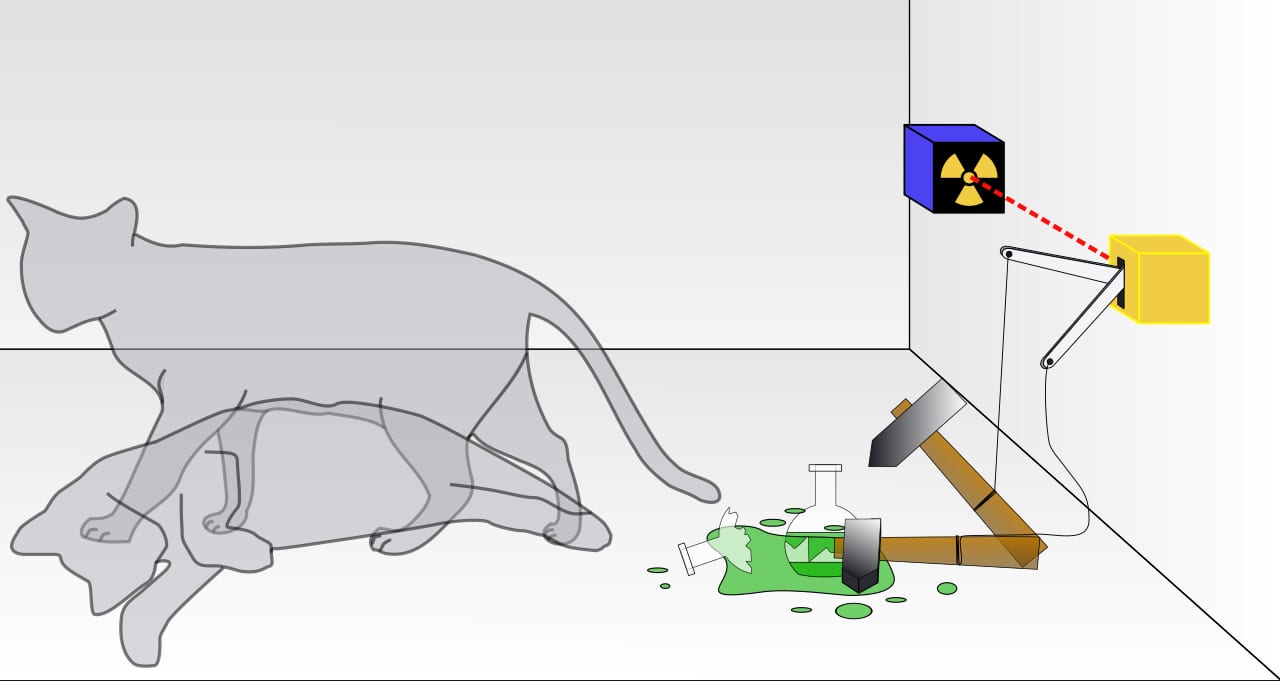
Schrödinger's 1935 cat: a single radioactive atom decides whether poison is released, so standard quantum theory describes the sealed box as a blend of "cat alive" and "cat dead." Every view below is, in part, an answer to what that blend means. Diagram: Dhatfield, CC BY-SA 3.0, via Wikimedia Commons.
So the surviving views sort into a few camps. Some accept a real wave function and live with its strangeness. Some deny that quantum theory describes an observer-free reality at all. A smaller group rejects one of the hidden assumptions that Bell and PBR lean on. What follows is a plain account of each, who defends it, and the objection its critics raise most often. The descriptions are standard; which of them is right is a live debate with no consensus.
| Camp | Views | What it gives up | Common objection |
|---|---|---|---|
| Real wave function | Many-worlds, Bohmian mechanics, objective collapse | A single outcome, locality, or exact quantum equations at large scales | Unclear probabilities, a poor fit with relativity, or ever less room left for collapse |
| Tool for agents | Copenhagen, QBism, relational quantum mechanics | A single observer-independent description of reality | Vague about the quantum-classical line, or explains too little |
| Rejecting a hidden assumption | Superdeterminism, retrocausality | Independence of experimenters' choices, or causes coming before effects | Looks like a conspiracy, or no full theory yet |
Real wave function, strange world
Many-worlds starts from Hugh Everett, who proposed in his 1957 doctoral work that the wave function never collapses. A measurement entangles the device and the person reading it with the thing measured, and every possible outcome carries on, each in its own branch. Bryce DeWitt popularized the idea in the 1970s and gave it the name "many worlds."65 Today its best-known defenders include David Deutsch, Sean Carroll, and Lev Vaidman, who wrote the Stanford Encyclopedia's entry on it.66 Its appeal is economy: the theory is just the quantum equations, taken at face value. The main objection concerns probability. If every outcome happens, it is hard to say what it means for one outcome to be 90% likely, and decades of proposed fixes have not settled the point. Critics also balk at the sheer number of unseen worlds.66
Bohmian mechanics, the pilot-wave theory described above, keeps real particles with definite positions and a real wave function that guides them. Nothing collapses, and randomness reflects ignorance of where the particles started.17 Detlef Dürr, Sheldon Goldstein and Nino Zanghì developed the modern version. Antony Valentini has argued that the early universe may have departed from the usual quantum statistics, which would in principle make the theory testable.67 The price is open nonlocality, and many physicists object that the theory needs a preferred notion of "now," which sits badly with relativity.17
Objective collapse theories change the physics. The wave function is real, and it collapses on its own, at random, with no observer needed. In the 1986 GRW model (Ghirardi, Rimini, Weber), each particle has a tiny chance of collapsing at any moment. For one particle this almost never happens. For a cat made of trillions of trillions of particles, it happens almost instantly, which is why big things look definite.68 Roger Penrose and Lajos Diósi proposed that gravity triggers the collapse: a superposition of a lump of mass in two places strains spacetime, and the strain resolves itself.69
Collapse theories make different predictions from standard quantum theory, so they can be tested. A random collapse should jostle charged particles and make them give off a faint glow of X-rays. In 2020 a team led by Sandro Donadi ran a germanium detector shielded by lead deep under the Gran Sasso mountain in Italy and saw no such glow. That ruled out the simplest, parameter-free version of the Diósi–Penrose model, though variants with an extra adjustable length survive.7071 In 2022 the Majorana Demonstrator, a neutrino experiment in a South Dakota mine, set tighter limits on both GRW-style and gravity-based collapse.72 The standing objection is that each test shrinks the room left for collapse, and the remaining models must be tuned to sit just below what experiments can see.
Quantum theory as a tool for agents
The Copenhagen family of views, tied to Niels Bohr and Werner Heisenberg, never claimed the wave function was a picture of reality. Quantum theory is a way to make predictions about measurements described in ordinary, classical language. There was never one agreed "Copenhagen interpretation," and modern versions (sometimes called neo-Copenhagen) keep the stance while trying to sharpen it.12 PBR does not touch these views, because they reject its starting premise that there is an underlying physical state to talk about. The usual objection is vagueness: the views do not say where the line falls between quantum system and classical measuring device, or why there should be one.
QBism (short for quantum Bayesianism) comes from Christopher Fuchs, Rüdiger Schack, and N. David Mermin. It treats a quantum state as one agent's personal degrees of belief about what will happen when that agent acts on the world. Collapse is just an agent updating beliefs after an experience.73 QBists accept that the world exists; they deny that quantum theory describes it from nowhere. Jacques Pienaar gave up a research program on hidden "incomplete knowledge" states after PBR and moved to QBism. He told Quanta that reality, on this view, "is nothing but relations."2 Critics say QBism explains too little: if the theory only tracks beliefs, it is unclear why those beliefs work so well.
Relational quantum mechanics began with Carlo Rovelli, who proposed in 1996 that a system has properties only relative to another system it interacts with. There is no view from outside. A measurement result is a fact for the device that recorded it, and may not yet be a fact for someone who has not interacted with that device.7475 Rovelli made the case for a general audience in his 2021 book Helgoland, named for the island where Heisenberg worked out matrix mechanics in 1925.76 Critics ask how separate perspectives ever come to agree, and whether "relative facts" are facts at all. Later versions of the view added a postulate meant to secure that agreement.75
Rejecting a hidden assumption
Superdeterminism targets a quiet premise. Bell's theorem and PBR both assume that the settings an experimenter picks are uncorrelated with the hidden states of the particles. Superdeterminism drops that. The particles and the choice of measurement share a common past that correlates them. Sabine Hossenfelder and Tim Palmer argue the idea has been dismissed too quickly; Gerard 't Hooft has built a "cellular automaton" model along these lines.4977 The objection most physicists give is that the required correlations look like a conspiracy and could, in principle, undercut every randomized experiment in science.
Retrocausality is the other route. Huw Price and Ken Wharton argue that causes may run backward in time at the quantum level, so that a future measurement setting can influence a particle's earlier state.78 This escapes Bell without faster-than-light effects. It also offers a way around PBR: the theorem assumes separately prepared systems have uncorrelated hidden states, and in a retrocausal model a joint measurement in the future could correlate them.7879 No full retrocausal theory yet reproduces all of quantum mechanics, and critics doubt one can be built without paradoxes.
What physicists actually think
For the 100th anniversary of quantum mechanics, Nature surveyed more than 15,000 researchers in 2025 and received over 1,100 responses. Copenhagen came first with 36%. Many-worlds took 15%, Bohmian mechanics 7%, and spontaneous collapse and relational quantum mechanics about 4% each. About 17% chose an epistemic view of some kind (one where the wave function describes knowledge or belief), including QBism.8081 Only 24% said they thought their preferred interpretation was correct; most called it adequate or useful. Asked whether the wave function represents something real, 36% said yes, 47% called it a useful tool, and 8% said it describes subjective beliefs.81 Among researchers who work on quantum foundations or philosophy, only 20% chose Copenhagen.81 The survey measures preference, which is a different thing from evidence. It shows clearly that there is no consensus. Earlier polls told the same story.
After PBR
Part 5 of 5
This part follows work since 2016 that asks whether quantum theory can describe observers themselves, and what that means for shared facts. It ends with the popular claim that consciousness collapses the wave function.
The observer problem
PBR leaves a fork. Either the wave function is real, or quantum theory is not a description of observer-independent reality. A separate line of work, older than PBR and sharpened since 2016, asks about the second branch directly. Can quantum theory describe observers themselves, and if it does, do their observations count as facts for everyone?
The question goes back to Eugene Wigner, who in 1961 (two years before his Nobel Prize) imagined a friend inside a sealed lab measuring a quantum system. To the friend, the measurement has a result. To Wigner outside, if quantum theory applies to everything, the friend and the lab are now in a superposition of having seen each result. Wigner used the story to argue that consciousness does something quantum equations leave out.84 Since 2016, physicists have built sharper versions of the story into theorems, and one has been tested with photons. Taken together, they amount to Wigner's friend, upgraded.
Deep Dive: Wigner's friend, upgraded
Start with the original. A friend sits in a sealed lab with an electron whose spin (a tiny magnetic orientation that a measurement finds pointing up or down) is in a superposition of up and down. The friend measures it and sees, say, "up." Wigner waits outside. He knows the lab is perfectly isolated, so by the standard rules of quantum theory he must describe the whole lab, friend included, as a superposition: "electron up and friend saw up" plus "electron down and friend saw down." For the friend, collapse has happened. For Wigner, it has not. Wigner could even do an experiment on the whole lab that would reveal interference between the two branches, the kind of pattern only a superposition makes. This is an extreme, idealized experiment; nobody could isolate a lab and a person this well. It is useful because it asks what quantum theory itself says, if it is taken to apply to everything.84
For decades, this was a puzzle that each interpretation answered in its own way. In 2016, Daniela Frauchiger and Renato Renner of ETH Zurich turned it into a contradiction. Their paper, published in Nature Communications in 2018 with the title "Quantum theory cannot consistently describe the use of itself," uses two labs and four agents.85 Inside one lab, a friend flips a quantum coin that is weighted to land heads one-third of the time, and prepares a particle's spin depending on the result. She sends the particle to a second friend in a second lab, who measures it. Outside each lab stands a "Wigner," and each Wigner performs a large quantum measurement on the whole lab of his friend.86
Every agent reasons using quantum theory and what they know of the others' reasoning. In a chain of steps, each one says something like, "Given what I just saw, I can be certain that agent X will find result Y." When the chain is followed around the loop, it ends in a flat contradiction: in about one run in twelve, the two outside agents get results from which they infer opposite outcomes of the same coin flip.86 Frauchiger and Renner state three assumptions that together produce this. Quantum theory applies to everything, labs and people included. Agents who reason correctly with quantum theory do not contradict each other. A measurement has a single outcome. One of the three must go.85
Each interpretation gives a different answer about which one. Many-worlds drops the single outcome: both coin results happen, in different branches, so the clash dissolves. Collapse theories drop universality: a lab with a person in it would collapse long before any outside Wigner could do his experiment, and Renner himself has said he finds this the most likely way out. Copenhagen-style views and QBism drop consistency between agents' views: a result can be a fact for one observer without being a fact for another.86 Bohmian physicists have argued that their theory survives too, because in it the outside agent's large measurement disturbs the records the inside agent used, which breaks one of the inferences in the chain.87 The theorem settles nothing about which interpretation is right. What it does is show that no interpretation can keep all three assumptions.
The next step tied the question to experiment. In 2018 Časlav Brukner of the University of Vienna combined Wigner's friend with Bell's theorem. He paired two friend-and-Wigner setups, sharing an entangled pair of particles between the two labs, and showed that if quantum theory applies to the friends, then the friends' results cannot all be treated as facts that hold for everyone at once.88 In 2019, a group at Heriot-Watt University in Edinburgh ran a six-photon version of this setup, in which single photons played the part of the friends.89
In 2020, Kok-Wei Bong, Eric Cavalcanti, Howard Wiseman, and colleagues at Griffith University in Australia proved a stronger result, published in Nature Physics. They named a set of assumptions "local friendliness." The first is that every observed event really happened, as a single fact for everyone, and not just relative to the observer who saw it. The second is that an experimenter's free choice cannot be correlated in advance with things it should not be (no superdeterminism). The third is that a choice cannot influence events far away faster than light (locality).90 These assumptions are weaker than the ones behind Bell's theorem. Notably, they do not require that unmeasured properties have definite values. So violating them is a stronger result. The team derived inequalities that any theory obeying local friendliness must satisfy, and showed that quantum theory, if it applies to the friends, breaks them. Then they ran a proof-of-principle test with entangled photons in which the "friend" was the path a photon took. The photons broke the inequalities.90
There is an obvious catch, and the authors say so. A photon's path is not an observer. Whether the experiment says anything about real observers depends on whether something that simple can count as one, and almost no one thinks it does. In 2023 Wiseman, Cavalcanti, and Eleanor Rieffel proposed a version aimed at closing this gap: run the friend as an artificial intelligence with thoughts of its own, on a large, fast quantum computer.91 That machine does not exist. Smaller steps have followed. In 2024, William Zeng and colleagues reported local-friendliness violations on existing quantum computers, with loopholes.92 In September 2026, Joshua Laux and Cavalcanti posted a preprint in which a simple agent-like program, one that stores its results and bets on future outcomes, played the friend on an IBM quantum processor. It too broke a local-friendliness inequality.93 These are crude stand-ins for an observer, and the work is in progress.
The upshot, stated carefully: if quantum theory holds for systems as complex as observers, then at least one of these assumptions fails. Either observed events are not absolute facts shared by all, or something like superdeterminism or faster-than-light influence is real. Which one fails is still open.
What these results say about facts
These theorems connect directly to PBR's fork. PBR says that if there is an objective physical state, the wave function is part of it. The Wigner's friend theorems put pressure on the idea that there are objective, shared facts about what observers saw. Both results are established mathematics. The physical lesson drawn from them is a matter of interpretation. Views that already deny observer-independent facts, such as QBism and relational quantum mechanics, take these results in stride.7573 Many-worlds keeps an objective reality, but at the cost of a single outcome. Collapse theories keep single outcomes, at the cost of quantum theory failing somewhere between a photon and a person, which experiments are now testing.7072
Some researchers want a different notion of reality altogether. Lucien Hardy of the Perimeter Institute told Quanta he questions whether reality needs a single objective state at each moment. He has wondered whether states might spread over more than one moment. He has no finished proposal, and he describes the goal as a broader idea of reality that would still be recognizable.2 This is an open research direction, and nothing more yet.
Where consciousness comes in
Popular accounts often say that in quantum mechanics, a conscious mind makes the wave function collapse. The idea has a real history, but a smaller one than often claimed. Fritz London and Edmond Bauer argued in 1939 that collapse is a gain in the observer's knowledge. Wigner, in 1961, went further and suggested that consciousness acts physically, outside the reach of quantum equations.84 The view is often called the "von Neumann–Wigner interpretation," but the Stanford Encyclopedia notes that the label is a misconception: John von Neumann did not hold that consciousness causes collapse.84
Most physicists reject the idea. It offers no definition of consciousness precise enough to say when a collapse happens. It also makes no prediction that any experiment has confirmed, and none of the main interpretations needs it. In the 2011 Traunkirchen poll, only 6% of participants said the observer plays such a special physical role.83 The Wigner's friend theorems do not support it either. They are about observers as systems that record results, and the experiments so far use photons and simple programs in place of minds.9093 Whether consciousness has anything to do with quantum measurement is speculation. Current physics gives no evidence that it does.
Footnotes
- Arthur Fine, "The Einstein-Podolsky-Rosen Argument in Quantum Theory," Stanford Encyclopedia of Philosophy. plato.stanford.edu ↩
- Charlie Wood, "A Strange Quantum Theorem Has Killed Einstein's Reality," Quanta Magazine, 6 November 2026. quantamagazine.org ↩
- Matthew F. Pusey, Jonathan Barrett and Terry Rudolph, "On the reality of the quantum state," Nature Physics 8, 475–478, 2012. nature.com; preprint arxiv.org ↩
- "The Nobel Prize in Physics 2022," press release, Royal Swedish Academy of Sciences, 4 October 2022. nobelprize.org ↩
- Carsten Held, "The Kochen-Specker Theorem," Stanford Encyclopedia of Philosophy. plato.stanford.edu ↩
- Abraham Pais, "Einstein and the quantum theory," Reviews of Modern Physics 51, 863 (1979), p. 907. doi.org ↩
- Guido Bacciagaluppi and Antony Valentini, "Quantum Theory at the Crossroads: Reconsidering the 1927 Solvay Conference," Cambridge University Press, 2009 (arXiv preprint). arxiv.org ↩
- Jan Hilgevoord and Jos Uffink, "The Uncertainty Principle," Stanford Encyclopedia of Philosophy (discussion of Bohr 1949 and the clock-in-the-box). plato.stanford.edu ↩
- A. Einstein, B. Podolsky and N. Rosen, "Can Quantum-Mechanical Description of Physical Reality Be Considered Complete?," Physical Review 47, 777, 1935. doi.org ↩
- Stephen Boughn, "There Is No Action at a Distance in Quantum Mechanics, Spooky or Otherwise," arXiv, 2018 (citing the Born–Einstein letters, letter of 3 March 1947). arxiv.org ↩
- N. Bohr, "Can Quantum-Mechanical Description of Physical Reality Be Considered Complete?," Physical Review 48, 696, 1935. doi.org ↩
- Jan Faye, "Copenhagen Interpretation of Quantum Mechanics," Stanford Encyclopedia of Philosophy. plato.stanford.edu ↩
- N. David Mermin, "What's wrong with this quantum world?," Physics Today, February 2004 (quoting Aage Petersen, "The philosophy of Niels Bohr," Bulletin of the Atomic Scientists 19, 8–14, 1963). physicstoday.aip.org ↩
- Jeffrey Bub, "Quantum Entanglement and Information," Stanford Encyclopedia of Philosophy. plato.stanford.edu ↩
- E. Schrödinger, "Discussion of Probability Relations between Separated Systems," Mathematical Proceedings of the Cambridge Philosophical Society 31, 555, 1935. doi.org ↩
- E. Schrödinger, "Die gegenwärtige Situation in der Quantenmechanik," Die Naturwissenschaften 23, 807, 1935. doi.org ↩
- Sheldon Goldstein, "Bohmian Mechanics," Stanford Encyclopedia of Philosophy. plato.stanford.edu ↩
- Sidney Perkowitz, "Grete Hermann: the quantum physicist who challenged Werner Heisenberg and John von Neumann," Physics World, 22 April 2025. physicsworld.com ↩
- N. David Mermin and Rüdiger Schack, "Homer nodded: von Neumann's surprising oversight," Foundations of Physics, 2018 (arXiv preprint). arxiv.org ↩
- J. S. Bell, "On the Problem of Hidden Variables in Quantum Mechanics," Reviews of Modern Physics 38, 447, 1966. doi.org ↩
- Thomas Filk, "Thus the Proof Runs in a Circle: Grete Hermann and Her Refutation of No Hidden Variables Arguments," colloquium abstract, University of Würzburg, 28 April 2025. ctdqmat.de ↩
- Jeffrey Bub, "Von Neumann's 'No Hidden Variables' Proof: A Re-Appraisal," Foundations of Physics, 2010 (arXiv preprint). arxiv.org ↩
- Dennis Dieks, "Von Neumann's Impossibility Proof: Mathematics in the Service of Rhetorics," Studies in History and Philosophy of Modern Physics 60, 2017 (arXiv preprint). arxiv.org ↩
- D. Bohm, "A Suggested Interpretation of the Quantum Theory in Terms of 'Hidden' Variables. I," Physical Review 85, 166, 1952. doi.org ↩
- Gregg Lange, "Rally 'Round the Cannon: Bohm's Away," Princeton Alumni Weekly, 5 May 2025. paw.princeton.edu ↩
- Rachel Berkowitz, "Acquitting a physicist accused of 'obscurantism'," Phys.org, 8 November 2023, on Andrea Oldofredi, "Orthodox or dissident? The evolution of Bohm's ontological reflections in the 1950s," European Physical Journal H, 2023. phys.org ↩
- Mike Towler, "De Broglie, Bohm, and the Pilot Wave," Vallico Academy lecture notes (secondhand attribution to Oppenheimer, dated 1953). vallico.net ↩
- J. S. Bell, "On the impossible pilot wave," Foundations of Physics 12, 989, 1982. doi.org ↩
- J. S. Bell, "On the Einstein Podolsky Rosen Paradox," Physics Physique Fizika 1, 195–200, 1964. doi.org ↩
- Wayne Myrvold, Marco Genovese and Abner Shimony, "Bell's Theorem," Stanford Encyclopedia of Philosophy. plato.stanford.edu ↩
- J. S. Bell, "Bertlmann's Socks and the Nature of Reality," Journal de Physique Colloques 42, C2-41, 1981 (CERN preprint). cds.cern.ch ↩
- N. David Mermin, "Is the Moon There When Nobody Looks? Reality and the Quantum Theory," Physics Today 38(4), 38, 1985. physicstoday.aip.org ↩
- Richard Cleve, Peter Høyer, Ben Toner and John Watrous, "Consequences and Limits of Nonlocal Strategies," Proceedings of the 19th IEEE Conference on Computational Complexity, 2004. arxiv.org ↩
- B. S. Cirel'son (Tsirelson), "Quantum generalizations of Bell's inequality," Letters in Mathematical Physics 4, 93–100, 1980. link.springer.com ↩
- B. Hensen et al., "Loophole-free Bell inequality violation using electron spins separated by 1.3 kilometres," Nature 526, 682, 2015. arxiv.org ↩
- John F. Clauser, Michael A. Horne, Abner Shimony and Richard A. Holt, "Proposed Experiment to Test Local Hidden-Variable Theories," Physical Review Letters 23, 880, 1969. doi.org ↩
- Stuart J. Freedman and John F. Clauser, "Experimental Test of Local Hidden-Variable Theories," Physical Review Letters 28, 938, 1972. doi.org ↩
- The Royal Swedish Academy of Sciences, "Popular science background: How entanglement has become a powerful tool," NobelPrize.org, 2022. nobelprize.org ↩
- Alain Aspect, Jean Dalibard and Gérard Roger, "Experimental Test of Bell's Inequalities Using Time-Varying Analyzers," Physical Review Letters 49, 1804, 1982. doi.org ↩
- Gregor Weihs et al., "Violation of Bell's Inequality under Strict Einstein Locality Conditions," Physical Review Letters 81, 5039, 1998. arxiv.org ↩
- Zeeya Merali, "Quantum 'spookiness' passes toughest test yet," Nature News, 2015. nature.com ↩
- Marissa Giustina et al., "Significant-Loophole-Free Test of Bell's Theorem with Entangled Photons," Physical Review Letters 115, 250401, 2015. arxiv.org ↩
- Lynden K. Shalm et al., "Strong Loophole-Free Test of Local Realism," Physical Review Letters 115, 250402, 2015. arxiv.org ↩
- The BIG Bell Test Collaboration, "Challenging local realism with human choices," Nature 557, 212, 2018. nature.com ↩
- Johannes Handsteiner et al., "Cosmic Bell Test: Measurement Settings from Milky Way Stars," Physical Review Letters 118, 060401, 2017. arxiv.org ↩
- Natalie Wolchover, "Experiment Reaffirms Quantum Weirdness," Quanta Magazine, 2017. quantamagazine.org ↩
- Dominik Rauch et al., "Cosmic Bell Test Using Random Measurement Settings from High-Redshift Quasars," Physical Review Letters 121, 080403, 2018. arxiv.org ↩
- Charlie Wood, "Pioneering Quantum Physicists Win Nobel Prize in Physics," Quanta Magazine, 2022. quantamagazine.org ↩
- Sabine Hossenfelder and Tim Palmer, "Rethinking Superdeterminism," Frontiers in Physics 8, 139, 2020. arxiv.org ↩
- Nicholas Harrigan and Robert W. Spekkens, "Einstein, incompleteness, and the epistemic view of quantum states," Foundations of Physics 40, 125, 2010 (arXiv 2007). arxiv.org ↩
- Robert W. Spekkens, "In defense of the epistemic view of quantum states: a toy theory," Physical Review A 75, 032110, 2007 (arXiv 2004). arxiv.org ↩
- "Matthew Pusey," Department of Mathematics, University of York. york.ac.uk ↩
- Matthew F. Pusey, Jonathan Barrett and Terry Rudolph, "The quantum state cannot be interpreted statistically," arXiv preprint, version 1, 2011. arxiv.org ↩
- Eugenie Samuel Reich, "Quantum theorem shakes foundations," Nature news, 17 November 2011. nature.com ↩
- Daniel Nigg et al., "Can different quantum state vectors correspond to the same physical state? An experimental test," New Journal of Physics 18, 013007, 2016 (arXiv 2012). arxiv.org ↩
- Songqinghao Yang, Haomu Yuan and Crispin H. W. Barnes, "Experimental Demonstration of the PBR Test on a Superconducting Processor," arXiv preprint, 2025. arxiv.org ↩
- Peter G. Lewis, David Jennings, Jonathan Barrett and Terry Rudolph, "Distinct Quantum States Can Be Compatible with a Single State of Reality," Physical Review Letters 109, 150404, 2012. arxiv.org ↩
- Matthew S. Leifer, "Is the quantum state real? An extended review of ψ-ontology theorems," Quanta 3, 67–155, 2014. arxiv.org ↩
- Roger Colbeck and Renato Renner, "Is a system's wave function in one-to-one correspondence with its elements of reality?," Physical Review Letters 108, 150402, 2012. arxiv.org ↩
- Lucien Hardy, "Are quantum states real?," International Journal of Modern Physics B 27, 1345012, 2013. arxiv.org ↩
- Owen J. E. Maroney, "How statistical are quantum states?," arXiv preprint, 2012. arxiv.org ↩
- Matthew S. Leifer and Owen J. E. Maroney, "Maximally epistemic interpretations of the quantum state and contextuality," Physical Review Letters 110, 120401, 2013. arxiv.org ↩
- Jonathan Barrett, Eric G. Cavalcanti, Raymond Lal and Owen J. E. Maroney, "No ψ-epistemic model can fully explain the indistinguishability of quantum states," Physical Review Letters 112, 250403, 2014. arxiv.org ↩
- Martin Ringbauer et al., "Measurements on the reality of the wavefunction," Nature Physics 11, 249, 2015. arxiv.org ↩
- Jeffrey Barrett, "Everett's Relative-State Formulation of Quantum Mechanics," Stanford Encyclopedia of Philosophy. plato.stanford.edu ↩
- Lev Vaidman, "Many-Worlds Interpretation of Quantum Mechanics," Stanford Encyclopedia of Philosophy. plato.stanford.edu ↩
- Antony Valentini, "Hidden Variables, Statistical Mechanics and the Early Universe," arXiv, 2001. arxiv.org ↩
- Giancarlo Ghirardi and Angelo Bassi, "Collapse Theories," Stanford Encyclopedia of Philosophy. plato.stanford.edu ↩
- Roger Penrose, "On Gravity's Role in Quantum State Reduction," General Relativity and Gravitation, 1996. link.springer.com ↩
- Sandro Donadi et al., "Underground test of gravity-related wave function collapse," Nature Physics, 2020. nature.com ↩
- "Physicists place fresh limits on gravity's role in wavefunction collapse," Physics World, 2020. physicsworld.com ↩
- I. J. Arnquist et al. (Majorana Collaboration), "Search for Spontaneous Radiation from Wave Function Collapse in the Majorana Demonstrator," Physical Review Letters, 2022. osti.gov ↩
- Christopher Fuchs, N. David Mermin, Rüdiger Schack, "An Introduction to QBism with an Application to the Locality of Quantum Mechanics," American Journal of Physics, 2014. arxiv.org ↩
- Carlo Rovelli, "Relational Quantum Mechanics," International Journal of Theoretical Physics, 1996. arxiv.org ↩
- Federico Laudisa and Carlo Rovelli, "Relational Quantum Mechanics," Stanford Encyclopedia of Philosophy. plato.stanford.edu ↩
- "A relational take on quantum mechanics" (review of Helgoland), CERN Courier, 2021. cerncourier.com ↩
- Gerard 't Hooft, "The Cellular Automaton Interpretation of Quantum Mechanics," arXiv / Springer, 2014–2016. arxiv.org ↩
- Simon Friederich and Peter W. Evans, "Retrocausality in Quantum Mechanics," Stanford Encyclopedia of Philosophy (see §3.3 on psi-ontology theorems). plato.stanford.edu ↩
- Ken Wharton and Nathan Argaman, "Bell's Theorem and Locally-Mediated Reformulations of Quantum Mechanics," Reviews of Modern Physics, 2020. arxiv.org ↩
- Elizabeth Gibney, "Physicists disagree wildly on what quantum mechanics says about reality, Nature survey shows," Nature, 2025. nature.com ↩
- Elizabeth Gibney, "Physicists Can't Agree on What Quantum Mechanics Says about Reality" (reprint of the Nature survey report), Scientific American, 2025. scientificamerican.com ↩
- Max Tegmark, "The Interpretation of Quantum Mechanics: Many Worlds or Many Words?," Fortschritte der Physik, 1998. arxiv.org ↩
- Maximilian Schlosshauer, Johannes Kofler, Anton Zeilinger, "A Snapshot of Foundational Attitudes Toward Quantum Mechanics," Studies in History and Philosophy of Modern Physics, 2013. arxiv.org ↩
- Wayne Myrvold, "Philosophical Issues in Quantum Theory," Stanford Encyclopedia of Philosophy (§2.3 and §4.3). plato.stanford.edu ↩
- Daniela Frauchiger and Renato Renner, "Quantum theory cannot consistently describe the use of itself," Nature Communications, 2018. nature.com ↩
- Anil Ananthaswamy, "New Quantum Paradox Clarifies Where Our Views of Reality Go Wrong," Quanta Magazine, 2018. quantamagazine.org ↩
- Dustin Lazarovici and Mario Hubert, "How Quantum Mechanics can consistently describe the use of itself," Scientific Reports, 2019. arxiv.org ↩
- Časlav Brukner, "A no-go theorem for observer-independent facts," Entropy, 2018. arxiv.org ↩
- Massimiliano Proietti et al., "Experimental test of local observer-independence," Science Advances, 2019. arxiv.org ↩
- Kok-Wei Bong et al., "A strong no-go theorem on the Wigner's friend paradox," Nature Physics, 2020. nature.com ↩
- Howard Wiseman, Eric Cavalcanti, Eleanor Rieffel, "A 'thoughtful' Local Friendliness no-go theorem," Quantum, 2023. arxiv.org ↩
- William Zeng, Farrokh Labib, Vincent Russo, "Towards violations of Local Friendliness with quantum computers," arXiv, 2024. arxiv.org ↩
- Joshua Laux and Eric Cavalcanti, "Extended Wigner's Friend Scenarios with Agent-like Observers on Quantum Computers," arXiv preprint, 2026. arxiv.org ↩