Idea
Archaeoastronomy
Tombs that fill with light on the shortest day, towers that count the Sun, earthworks laid out to the Moon. How archaeologists tell a real sky alignment from a coincidence.

Overview
Archaeoastronomy is the study of how people in the past understood the sky and built it into their lives: their monuments, calendars, myths, farming and navigation. It sits between archaeology, astronomy and anthropology. Its best-known results are buildings lined up with the sky, such as an Irish passage tomb whose chamber is lit only around the winter solstice, or a row of towers in the Peruvian desert that tracks the Sun across the year. But it also covers star lore that survives in living cultures, ancient astronomical texts, and calendar devices like the Maya codices and the Antikythera mechanism.1
The field has a reputation problem, and it has earned one. Any complicated site has many lines in it, and the sky has many rising and setting points, so some of them will match by accident. In the 1960s and 1970s bold claims about "Stone Age computers" ran far ahead of the evidence, and they still feed a steady supply of pseudoscience. Modern archaeoastronomy grew up as a response. It asks for precise surveys, for corrections for how the sky itself has moved over thousands of years, for statistics that measure the odds of chance, and, above all, for evidence from the culture itself that its people cared about the event the monument seems to mark.12
What survives that test is still remarkable. People on every inhabited continent watched the Sun's turning points, many tracked the Moon's slower 18.6-year cycle, and some fixed directions by the stars more precisely than a modern compass. This page goes through how such claims are tested, then the Sun, the Moon and the stars in turn, then the calendars that were written down or built in bronze, and finally the claims that do not hold up. The sky motions behind all of it are explained in Earth, Moon and Sun in Motion.
In context
Interest in old monuments and the sky is centuries old. In the eighteenth century the antiquarian William Stukeley noted that Stonehenge's main axis faces the midsummer sunrise. The modern subject begins with the English astronomer Norman Lockyer, who surveyed Egyptian temples and British stone circles and, in 1906, tried to date Stonehenge from the slow change in Earth's tilt. His date was off, but the method, using the moving sky as a clock, was sound.3
The field's loud phase came in the 1960s. In 1963 the astronomer Gerald Hawkins announced in Nature that Stonehenge was aligned to the Sun and Moon, and in 1965 his book Stonehenge Decoded called it a computer for predicting eclipses. Archaeologists were scathing. At the same time the Scottish engineer Alexander Thom spent decades surveying hundreds of stone circles in Britain and France, claiming they were laid out with a standard unit, the "megalithic yard," and aimed at the Sun, Moon and stars with great precision.4 Re-analysis later showed that most of Thom's high-precision lunar lines did not survive careful selection of the data, though the broader pattern of orientations did.2
In 1981 a conference at Oxford brought the two camps together. The American astronomer Anthony Aveni described them as "green" archaeoastronomy, the statistical study of European megaliths (named for the color of the published volume), and "brown" archaeoastronomy, which works from the cultural and ethnographic record of the Americas.1 Since then the field has matured into a discipline with its own journals and standards, and several sites have been inscribed by UNESCO for their astronomy, among them Chankillo in Peru in 2021 and the Hopewell earthworks in Ohio in 2023.5
- 1906 Lockyer dates Stonehenge by the sky Using the slow change in Earth's tilt.
- 1965 Stonehenge Decoded Hawkins calls the monument a computer.
- 1981 Green meets brown The first Oxford conference.
- 2007 Chankillo published A 2,300-year-old solar observatory in Peru.
- 2023 Hopewell earthworks listed UNESCO inscribes the lunar Octagon.
Research
The parts below start with method, because every claim later on depends on it. Then come the Sun, the Moon and the stars, the calendars, and the claims that fail.
How to test an alignment
Part 1 of 6
An alignment claim says that a line built into a site, a passage, an avenue, a pair of stones, a wall, points to a place on the horizon where something happens in the sky. Testing it means turning both the line and the sky event into the same numbers, correcting for the ancient sky, and asking whether the match could be chance.
Azimuth and declination
The first number is the line's azimuth, its compass direction measured clockwise from true north. A surveyor measures it with a theodolite or GPS, along with the altitude of the horizon in that direction, since a hill raises the point where something rises or sets.
Declination Declination is how far north or south of the celestial equator something in the sky lies, in degrees, the sky's version of latitude. The Sun's declination runs from +23.4° at the June solstice to −23.4° at the December solstice. Given a site's latitude, the azimuth of a line and the height of the horizon, a formula turns the line into the declination of whatever rises or sets along it.
Converting to declination lets researchers compare sites at different latitudes, and ask the real question: which sky event, if any, has that declination? A line at declination −24° at a Neolithic site matches the midwinter Sun. A line at +29° matches nothing the Sun ever does, but it does match the Moon at its northernmost extreme. Refraction, the bending of light by the atmosphere near the horizon, lifts objects by about half a degree and has to be included.2
The sky has moved
The sky of 3000 BCE was not today's sky. Earth's tilt was about 24.0° rather than 23.44°, so the solstice Sun rose and set noticeably farther north and south than it does now. Precession has carried the stars along the zodiac by about 70° since then, so a passage aimed at a bright star's rising five thousand years ago now points at empty sky, and Polaris was not the pole star.6 These shifts cut both ways. They can make a real ancient alignment look slightly off today. And for stars they become a clock: if a line matches a star's rising in only one era, the line can date the building.
At Newgrange, for example, the winter solstice beam today falls short of the center of the chamber. Calculations for 3200 BCE, with the larger tilt of the time, put the original beam closer to the back of the chamber, as the builders presumably intended.7 How these slow motions work is covered in Earth, Moon and Sun in Motion.
Chance
The hardest problem is chance. The Sun alone offers four solstice points and two equinox directions on any horizon; add the Moon's eight standstill points, the cross-quarter days and the rising and setting of dozens of bright stars, and almost any line hits something within a degree or two. A site with many stones has many lines. If a researcher looks at all of them and reports only the ones that match, the result means nothing.
Careful work handles this in a few ways. Researchers decide in advance which lines matter, such as a tomb's single entrance passage, rather than picking from every possible pair of stones. They study whole groups of similar monuments rather than one site, and look for a consistent preference: hundreds of passage tombs in Iberia, for example, face overwhelmingly toward the eastern quarter where the Sun rises, a pattern no single tomb could show.2 They also put numbers on the odds. At the Newark Octagon in Ohio, two researchers generated more than 10 billion random octagons to test whether its fit to the Moon could be an accident.8
- Before Choose the line Fix in advance which feature counts, such as the entrance passage.
- Survey Measure Record azimuth and horizon altitude precisely.
- Convert Find the declination Correct for refraction and for the sky of the building's era.
- Compare Look across sites Do similar monuments share the orientation?
- Check Ask the culture Does anything else show these people cared about this event?
Green and brown
The last step matters most, and it is where the two traditions differ.
| Aspect | Green archaeoastronomy | Brown archaeoastronomy |
|---|---|---|
| Home ground | Prehistoric Europe | The Americas |
| Evidence | Surveys and statistics of many monuments | Texts, codices, art, and living tradition |
| Strength | Puts hard numbers on chance | Shows what people actually meant |
| Weakness | No voices from the builders | Fewer sites suited to statistics |
For a Neolithic stone circle, nobody can ask the builders anything; the statistics are all there is. In Mesoamerica, the Andes and the Southwest, written codices, Spanish chronicles and living Indigenous knowledge can say directly that the Sun's turning point mattered, and how. The strongest cases have both: a precise alignment, repeated at more than one site, and independent evidence of why it was built.
The Sun
Part 2 of 6
The Sun's yearly swing between the solstices is the most obvious rhythm in the sky, and the most widely marked. Watching where it rises against the horizon each morning, a farmer or a priest could keep a calendar to within a day or two with nothing but a fixed viewing spot and a notched skyline.
Light into the tomb
The best-known solar alignment is at Newgrange, a passage tomb in the Boyne Valley in Ireland, built around 3200 BCE, centuries before Stonehenge's great stones and the pyramids of Giza. A long stone-lined passage leads from the entrance to a cross-shaped chamber inside a great earthen mound. Above the entrance is a separate opening, the roof-box. For several days around the winter solstice, the rising Sun shines through the roof-box, up the passage, which slopes uphill, and onto the chamber floor, for about seventeen minutes. The rest of the year the chamber is dark.7
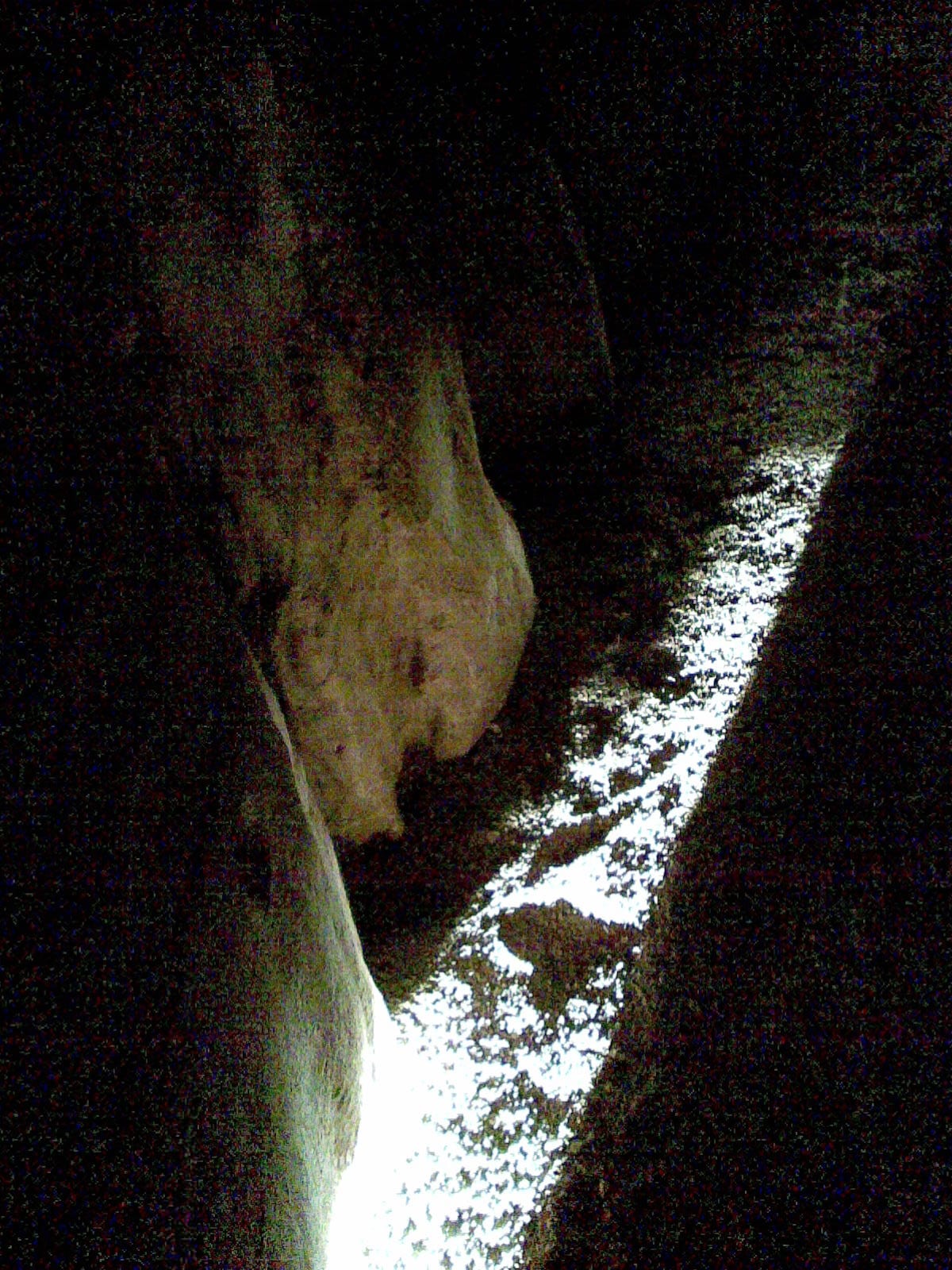
The winter solstice sunrise reaching the chamber of Newgrange, December 2013. Photo: Dentp, CC BY-SA 4.0, via Wikimedia Commons.
The archaeologist Michael O'Kelly, who excavated Newgrange, had heard local stories about the Sun lighting the stones. On December 21, 1967 he waited inside the chamber at dawn and saw it happen, the first person known to have done so in perhaps five thousand years.7 The roof-box shows the alignment was planned. It serves no other purpose, and the builders had to raise the chamber end of the passage so that sunlight entering at the top would reach the floor. Every year the Office of Public Works now holds a lottery for the few places inside on solstice mornings.
Newgrange is not alone. At Maeshowe, a chambered tomb on Orkney built around 2800 BCE, the setting Sun shines down the entrance passage and lights the back wall for a few weeks either side of the winter solstice.9 Both tombs mark midwinter, the turning point when the days stop shortening, and both are tombs. Many researchers read them as linking the return of the light with the dead.
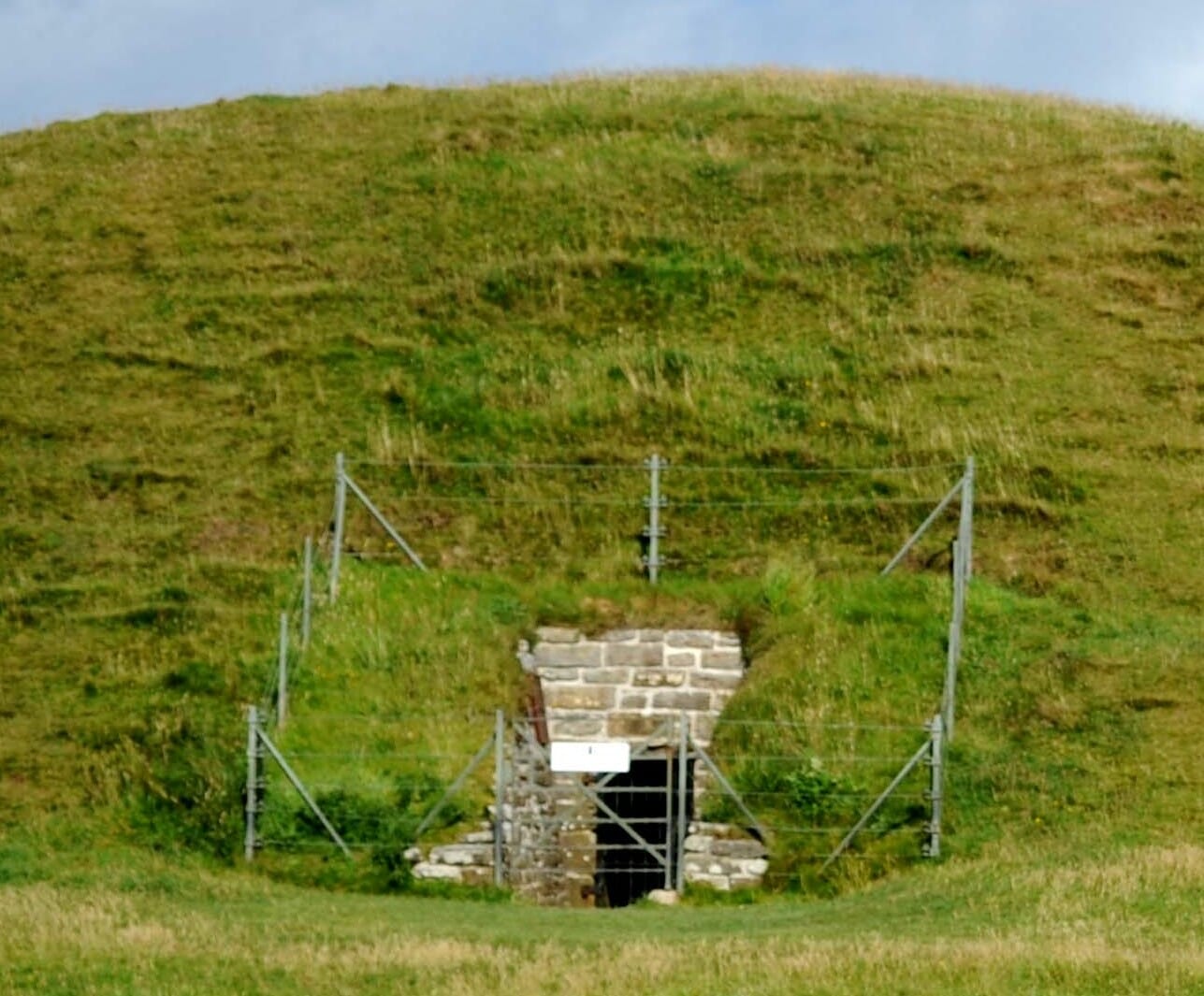
The entrance to Maeshowe on Orkney. Around the winter solstice the setting Sun shines straight down the passage and lights the back wall of the chamber. Photo: Scottish Government, CC BY 2.0, via Wikimedia Commons.
Stonehenge
Stonehenge's main axis runs from the northeast to the southwest. Viewed from the center, it faces the midsummer sunrise over the Heel Stone; viewed the other way, it faces the midwinter sunset. Its great sarsen stones went up around 2500 BCE.10 Modern crowds gather for the June sunrise, but much of the evidence now points to midwinter as the moment that mattered. The ceremonial Avenue approaches from the northeast, so people walking up it would have faced the setting midwinter Sun framed by the tallest trilithon. At Durrington Walls, the large settlement nearby where the builders likely lived, pig teeth show that most animals were slaughtered at about nine months old, which, for spring-born piglets, means midwinter feasts.10
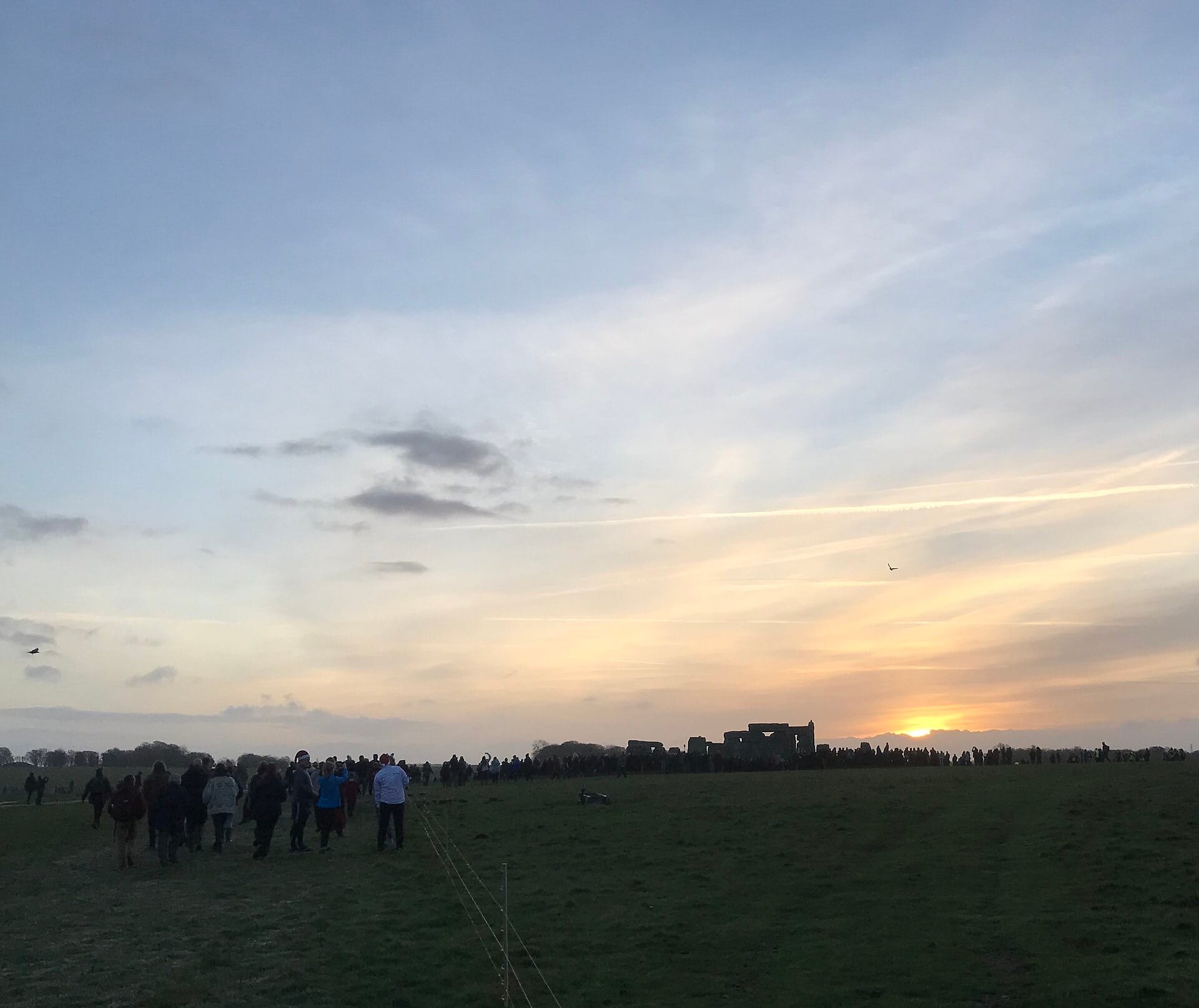
Stonehenge at the winter solstice sunrise, 2018. The axis that faces the midsummer sunrise faces the midwinter sunset in the other direction. Photo: Moonraker, CC BY-SA 3.0, via Wikimedia Commons.
The solstitial axis itself is accepted almost universally. The arguments are about everything else claimed for the site, which the last part of this page returns to. The story of sun-centered religion, from Newgrange and Stonehenge to Egypt and Rome, is the subject of Solar Religion.
Chankillo's horizon calendar
The most complete solar calendar known from the ancient Americas stands in the coastal desert of Peru. At Chankillo, a ceremonial center built around the fourth century BCE, thirteen rectangular towers run along the crest of a low ridge, about 300 meters long, like the teeth of a comb.11
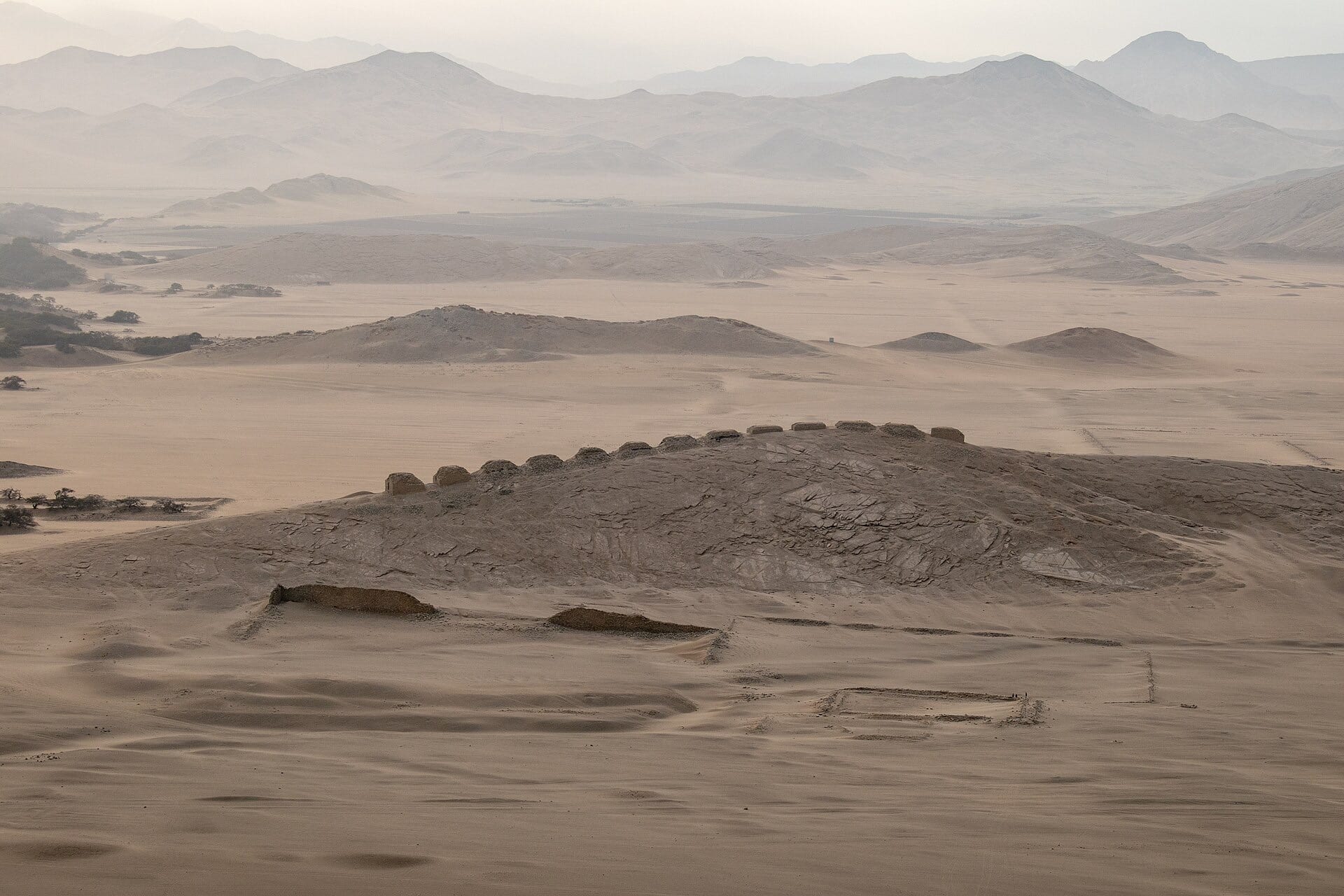
The Thirteen Towers on their ridge at Chankillo, Peru. Photo: Corrispo, CC BY-SA 4.0, via Wikimedia Commons.
In 2007 the archaeologist Iván Ghezzi and the archaeoastronomer Clive Ruggles showed in Science that the row spans almost exactly the arc along which the Sun rises and sets over a year. They identified two observing points, one on each side of the ridge. Seen from the western one, the Sun rises behind the northernmost tower at the June solstice and behind the southernmost at the December solstice, and steps along the gaps between the towers through the year. The eastern point works the same way for sunsets. An observer could tell the date to within a day or two by which gap the Sun appeared in.11 The western observing point has its own building, with a corridor leading to it, and finds there suggest ceremonies were held. Ruggles notes that the word "observatory" can mislead: this was a place where watching the Sun was part of ritual and political life, not a lab. In 2021 UNESCO inscribed Chankillo as a World Heritage Site.511
Sunlight on temples
In Egypt, the great temple of Ramesses II at Abu Simbel, cut into a cliff above the Nile around 1264 BCE, faces east so that twice a year, around February 22 and October 22, the rising Sun shines about 60 meters deep into the rock and lights statues in the inner sanctuary. Three of the four seated figures, including the sun god Ra-Horakhty and the deified king, are lit; the fourth, Ptah, a god linked with the underworld, stays in shadow.12 The whole temple was cut into blocks and moved up the cliff between 1964 and 1968 to save it from the waters of the Aswan High Dam, and the event survived the move.
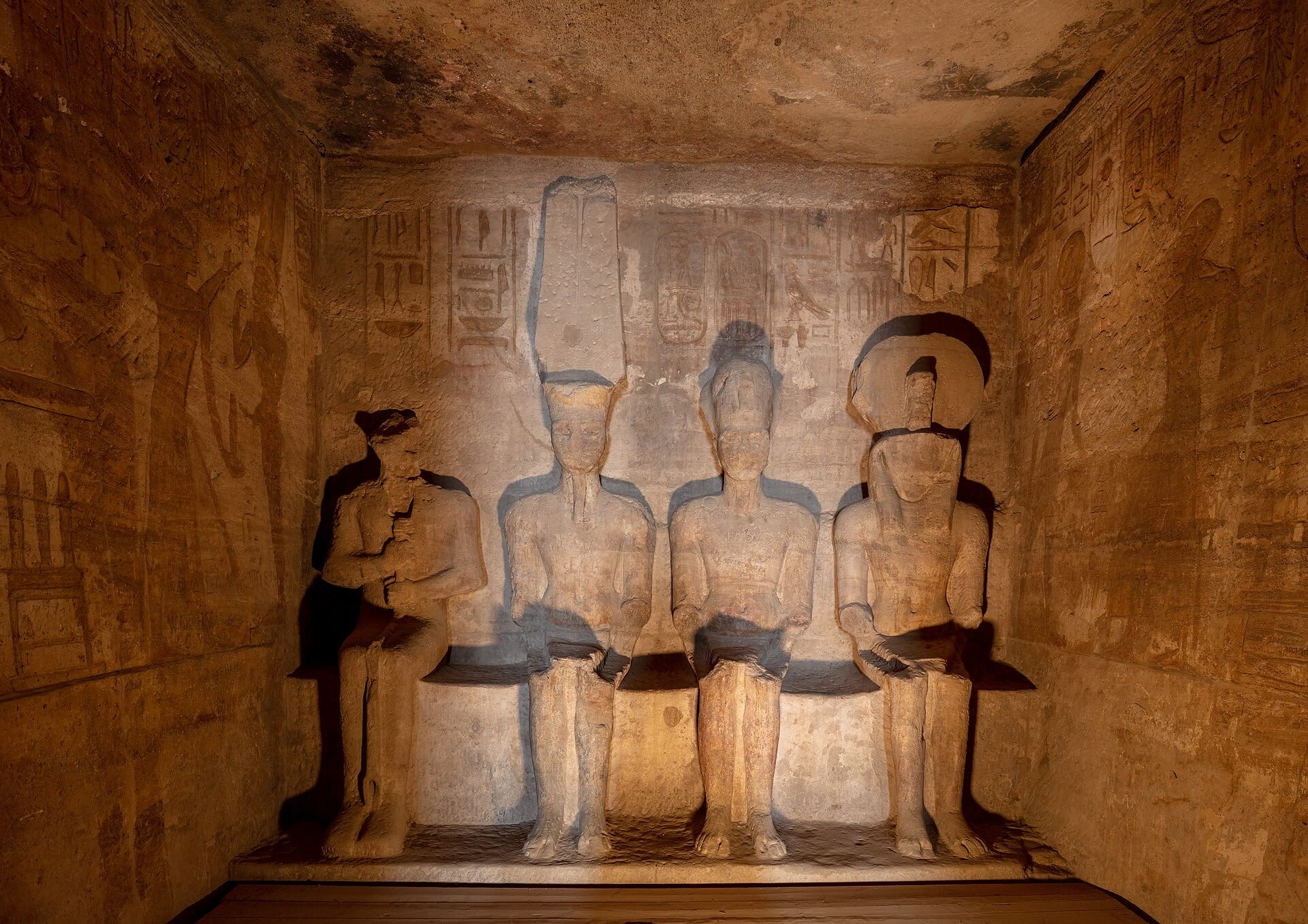
The inner sanctuary of the great temple at Abu Simbel. Twice a year the rising Sun reaches these statues, lighting three and leaving the god Ptah in shadow. Photo: Diego Delso, CC BY-SA 4.0, via Wikimedia Commons.
At Chichén Itzá in Yucatán, the stepped pyramid known as El Castillo, dedicated to the feathered serpent Kukulcán, has a famous light effect. In the late afternoon around the equinoxes, the corners of the terraces cast a row of triangles of light down the side of the northern staircase, joining the stone serpent head at its base, so that a body of light seems to undulate down to it. Tens of thousands of people come to watch. Researchers are divided on whether the effect was designed or is a happy result of the building's shape; it is visible for days on either side of the equinox, and the Maya are not known to have cared much about equinoxes, while they cared a great deal about other solar dates.13
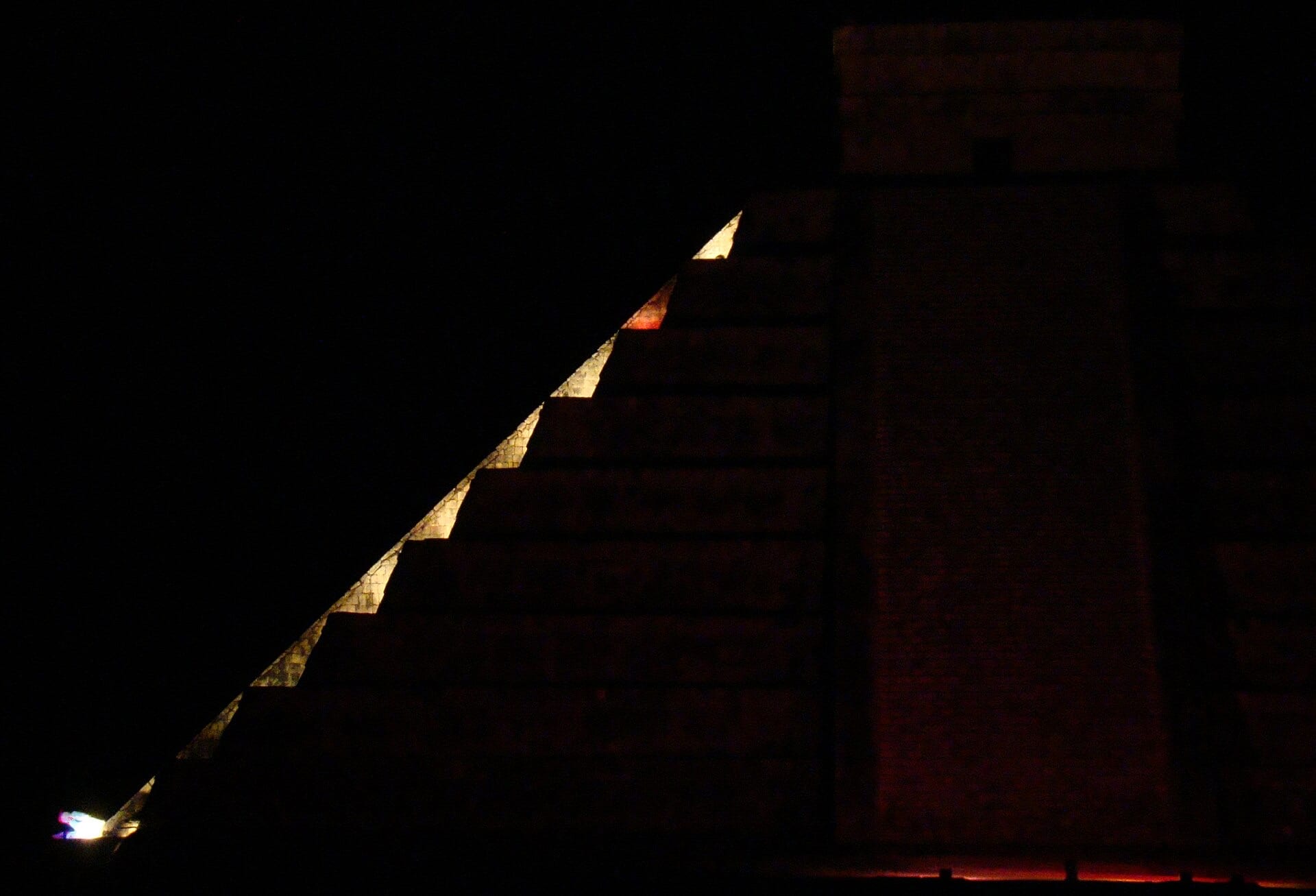
A demonstration, with artificial light, of the serpent of light on El Castillo at Chichén Itzá. Around the equinoxes the afternoon Sun casts these triangles down the northern staircase. Photo: Bjørn Christian Tørrissen, CC BY-SA 3.0, via Wikimedia Commons.
The Sun Dagger
High on Fajada Butte in Chaco Canyon, New Mexico, three stone slabs lean against a cliff in front of a spiral carved into the rock. In 1977 the artist Anna Sofaer, recording rock art there, saw a narrow "dagger" of sunlight fall through a gap between the slabs and cut the spiral at its center near midday close to the summer solstice. At the winter solstice, two daggers frame the spiral's edges, and at the equinoxes a smaller dagger crosses a second spiral.14
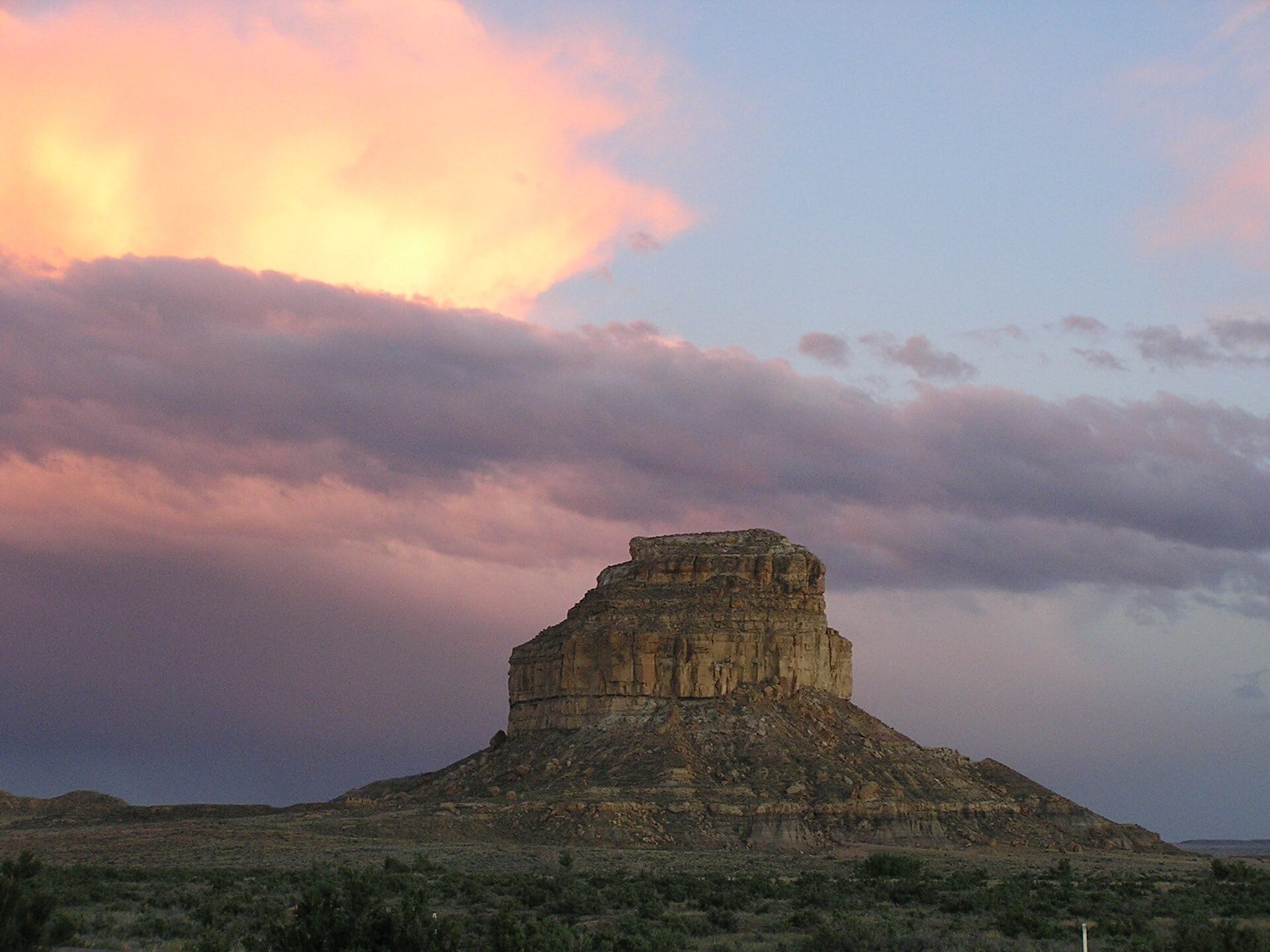
Fajada Butte in Chaco Canyon at sunset. The Sun Dagger spirals are near its top, now closed to visitors. Photo: National Park Service, public domain.
Sofaer and colleagues later argued that the spiral also records the Moon's 18.6-year cycle in its shadows. The site, made by Ancestral Puebloans about a thousand years ago, has been closed to visitors since the slabs shifted in 1989, partly from erosion caused by the foot traffic its fame brought.
The Moon
Part 3 of 6
The Moon is harder to follow than the Sun. Its rising point swings from north to south and back every month, and the size of that swing itself grows and shrinks over 18.6 years. At a major standstill, the Moon rises and sets farther north and south than the Sun ever does; nine years later, at a minor standstill, its range is narrowest. Spotting this needs decades of watching, so a monument aligned to it says something about a society's memory and organization.
Earthworks laid out to the Moon
The strongest lunar case is in Ohio. About 2,000 years ago, Hopewell people built the Newark Earthworks, a complex of geometric enclosures, including a circle joined to an octagon. In 1982 the physicists Ray Hively and Robert Horn showed that the Octagon's main axis points to the northernmost moonrise at the major standstill, and several of its walls point to other standstill extremes. High Bank Works, about 60 miles south, the only other circle-and-octagon pair, repeats the same alignments.8 The case, the statistics and the long fight to get a golf course off the site are told in Newark Earthworks, and the wider Hopewell landscape in Hopewell Route through Ohio.
That repetition is what makes Newark convincing. A single site might fit the Moon by chance; two sites built the same way, both fitting the same unusual lunar events, are much harder to explain away.
Chimney Rock
In the San Juan Mountains of southern Colorado, a Chacoan great house sits on a narrow ridge 300 meters above the valley, next to a pair of natural stone pillars, Chimney Rock and Companion Rock. From the great house, at a major lunar standstill, the Moon rises in the gap between the two spires.
Deep Dive: Chimney Rock and the Moon between the spires
Chimney Rock is one of the most remote outliers of the Chaco world, the network of great houses and roads that centered on Chaco Canyon in northwestern New Mexico between about 850 and 1150 CE. The site has two parts: a lower village of pit houses and stone rooms, and, on a narrow ridge high above it, a great house of about 35 rooms and two kivas, built in the distinctive core-and-veneer masonry of Chaco itself. Reaching the ridge top required a steep climb, the place had no water, and the building had no obvious farming purpose. Archaeologists have long asked why anyone built it there.15
The astronomer J. McKim Malville, of the University of Colorado, proposed an answer in the late 1980s. He worked out that, seen from the great house, the Moon at its northernmost rising, at a major lunar standstill, would come up in the narrow gap between Chimney Rock and Companion Rock. Nothing else in the sky does that; the Sun never rises that far north. The event can only be seen for a year or two in every 18.6, and on only a few nights in each of those years.15
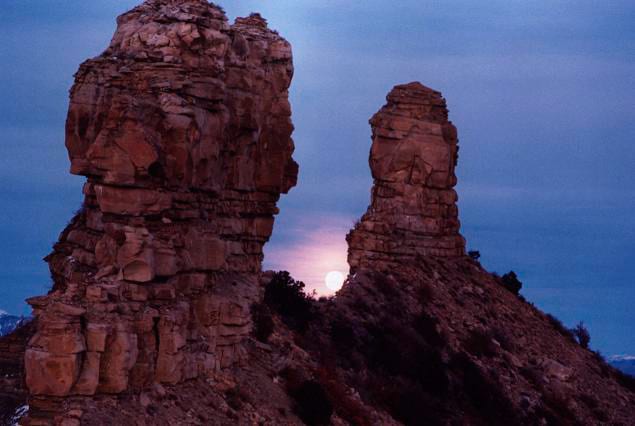
The Moon rising between Chimney Rock and Companion Rock, seen from near the great house. Photo: U.S. Department of Agriculture Forest Service, public domain.
The tree rings gave the idea its force. Roof beams from the great house were cut in 1076 and in 1093 CE, and both years fall at major lunar standstills. Malville and colleagues argued that the great house was built, and then enlarged, to coincide with the Moon rising between the spires, perhaps by people who came up from Chaco to watch it.15 The 1093 date has a parallel at Chaco itself, where construction at several great houses also peaks then.
The claim has been tested and has not fully settled. In 2009 a new excavation took more tree-ring samples to see whether they would confirm a building date timed to the standstill. They added evidence for a major building phase in 1093 and for older timbers, but they could not prove or disprove the lunar hypothesis: wood can be reused, and a cutting date gives when a tree died, not why.16 Skeptics point out that people might have valued the high ridge for defense, signaling or simply its views, and that the standstill fit may be the luck of a dramatic landscape.
Even so, the case has features that critics of weaker claims ask for. The alignment is defined by a single striking natural feature, not by a choice among many lines. It concerns an unusual event that the Sun cannot produce. And the Chaco world elsewhere shows a strong interest in the Moon's cycle: some walls of the great houses at Chaco itself, including Pueblo Bonito's, appear to be aligned to standstill directions, and the Sun Dagger site on Fajada Butte has been read as recording the same cycle.14
The site became a national monument in 2012. During the standstill of 2024 and 2025, rangers and astronomers ran guided moonrise evenings at the great house, giving visitors the same view across the gap that the builders were arguing over nine centuries ago. Whether or not the great house was built for it, the Moon still rises there between the spires on schedule, every 18.6 years.
Callanish and the stone circles of Scotland
On the Isle of Lewis in Scotland's Outer Hebrides, the standing stones of Callanish, set up around 2900 BCE, form a cross-shaped arrangement of rows around a small circle. Local tradition and modern observers describe something that happens only at the major standstill: the Moon, at its southernmost, barely clears a range of hills to the south, skimming low over the landscape before setting, and then appears to reappear briefly among the stones, seen from the northern avenue.17 Whether the builders planned for it is debated. The stones' many lines make chance hard to rule out, and Callanish shows how a site can be both genuinely moving and statistically unproven.
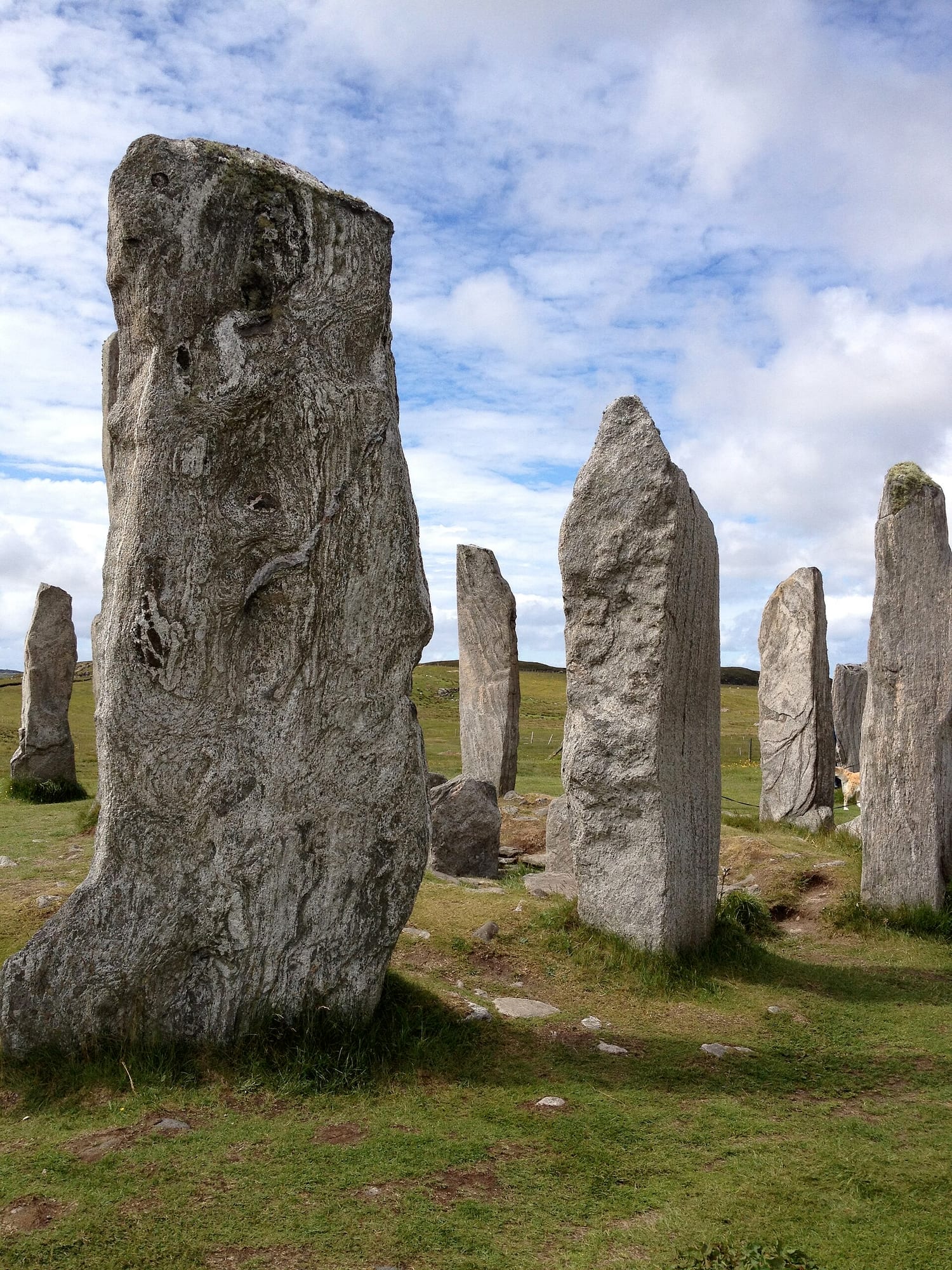
Standing stones at Callanish on the Isle of Lewis. At a major standstill the Moon skims the southern hills and sets among the stones. Photo: Lorna M. Campbell, CC BY-SA 4.0, via Wikimedia Commons.
Stronger evidence comes from a group. The recumbent stone circles of northeast Scotland, built around 2500 BCE, each have a massive stone laid on its side, flanked by two uprights, almost always on the southwest or south side of the circle. Ruggles and the archaeologist Aubrey Burl surveyed dozens of them in the 1980s and found that the recumbent stones consistently frame the part of the horizon where the Moon sets at its southern extremes. Some of the circles also have scattered quartz, a white stone that shines in moonlight.2 One circle proves nothing; dozens with the same preference make a pattern.
The stars
Part 4 of 6
Stars rise and set at the same points every night, which makes them good for fixing directions, but precession moves those points slowly over the centuries. That makes star alignments harder to prove and, when they are real, unusually good at dating a building.
Pointing the pyramids
The pyramids of Giza are aligned to the cardinal directions with startling accuracy. The sides of the Great Pyramid of Khufu, built around 2550 BCE, are off true north by only about 3 to 4 minutes of arc, about a fifteenth of a degree.18 A magnetic compass could not do that, and Egypt had none. The builders must have used the sky.
Deep Dive: How the pyramid builders found north
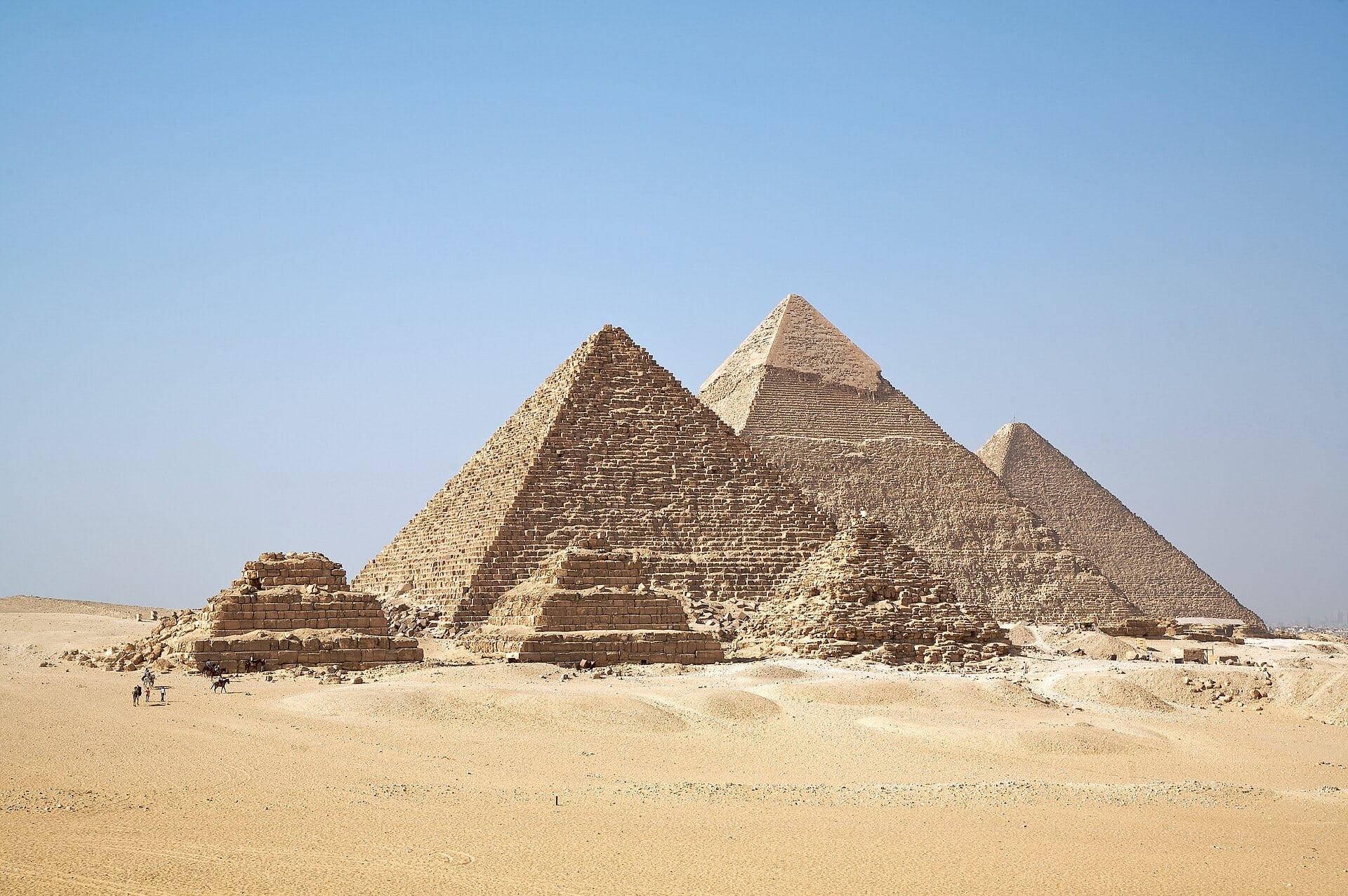
The pyramids of Giza. Khufu's Great Pyramid is aligned to true north to within about a fifteenth of a degree. Photo: Ricardo Liberato, CC BY-SA 2.0, via Wikimedia Commons.
Finding true north without a compass is harder than it sounds. Today the north celestial pole lies within a degree of Polaris, but in the third millennium BCE there was no bright star near the pole at all: precession had carried the pole across a dim part of the sky between the Big Dipper and the Little Dipper. Thuban, in Draco, came closest around 2800 BCE, but it is faint and was still not exactly at the pole. And the pyramids are more precise than any naked-eye sighting on a single star would allow.
Several methods could have done it. One uses the Sun: set up a vertical stick, mark the tip of its shadow at equal times before and after noon, or mark the points where the shadow touches a circle drawn around it in the morning and afternoon, and the line between them runs east to west. Another bisects the rising and setting points of a star on an artificial horizon, such as a circular wall. Both can give good results, and the second needs no pole star at all.18
In 2000 the Egyptologist Kate Spence proposed a more specific method in Nature. Two fairly bright stars, Kochab in the Little Dipper and Mizar in the handle of the Big Dipper, lie on opposite sides of the pole. When one stands directly above the other, a plumb line held up to both points to true north. But because of precession, this works perfectly only in one era. Spence calculated that the line between the two stars passed exactly through the pole around 2467 BCE. Before that date, the method would have led builders slightly to one side of north, and after it, slightly to the other.18
Then she checked the pyramids. The earlier ones of the Fourth Dynasty are aligned slightly east of north, the later ones slightly west, and when their errors are plotted against their approximate dates, they fall close to a straight line, matching the drift the method predicts. If she was right, the alignments act as a clock, and Khufu's pyramid could be dated to within about five years, around 2480 BCE, somewhat later than most chronologies of the time put it.18
The idea drew immediate challenges. The following year the historians of astronomy Dennis Rawlins and Keith Pickering argued in Nature that the stars Spence chose would drift out of vertical too quickly for a builder to use them reliably, and proposed a different pair, Thuban and a fainter star in Draco, which would shift the dates.19 Later work by Juan Antonio Belmonte and others proposed yet another pair in the Big Dipper and argued that the dating did not require changing the accepted chronology. More recently, some researchers have argued that the Sun-shadow or autumn-equinox methods explain the pattern just as well.
What survives the debate is instructive. All parties agree that the pyramids were laid out astronomically, that the accuracy is extraordinary, and that the small but systematic changes from one pyramid to the next track the slow motion of the sky. That is the field at its best: a precise measurement, a testable model tied to a specific era, and rival explanations that can be checked against more sites. Whichever method the builders used, they built the turning of the sky into the most famous monuments on Earth without knowing it was turning.
Sirius and the Egyptian year
The Egyptian calendar was tied to a star. Sirius, the brightest star in the night sky, disappears into the Sun's glare for about 70 days each year, then reappears for the first time in the dawn twilight, its heliacal rising. In ancient Egypt that reappearance came in midsummer, close to the start of the Nile's annual flood, and it was celebrated as the beginning of a new year.20
The civil calendar, however, had exactly 365 days, with no leap year, so it slipped a quarter of a day per year against the seasons and against Sirius. The two came back into step only after about 1,460 years, a span later called the Sothic cycle, after the Greek name for Sirius. A Roman writer, Censorinus, recorded that the two coincided in 139 CE. Working back from that date, and from a few ancient records of Sirius rising on a stated day of the civil calendar, is one of the anchors of Egyptian chronology.20
The Nebra sky disc
The oldest known concrete picture of the sky is a bronze disc about 30 centimeters across, inlaid with gold, found by looters on a hilltop at Nebra in Germany in 1999 and recovered by police in a sting in 2002. It shows a full Moon or Sun, a crescent Moon and 32 small stars, including a tight cluster of seven usually identified as the Pleiades. Two gold arcs were added to the edges later; each spans about 82°, the angle along the horizon between the solstice sunrise and sunset points at Nebra's latitude.21
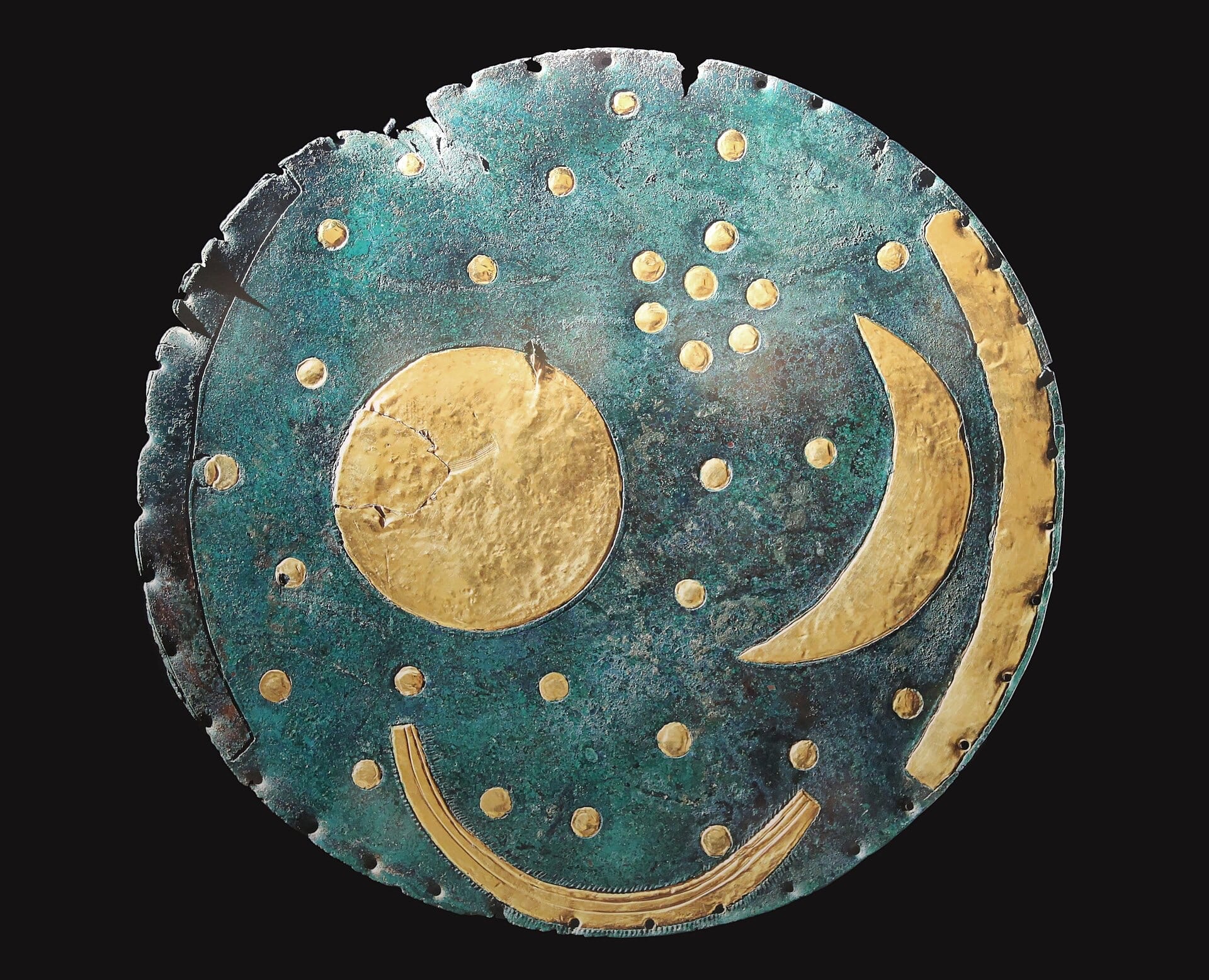
The Nebra sky disc: the Sun or full Moon, a crescent, the cluster of the Pleiades, and a horizon arc on the right edge. Photo: Frank Vincentz, public domain.
The disc is usually dated to around 1600 BCE from the bronze swords and axes said to have been buried with it. The astronomer Ralph Hansen proposed that the crescent next to the Pleiades encodes a rule known from much later Babylonian texts: add a thirteenth month to the lunar calendar in years when a thick crescent Moon stands beside the Pleiades in spring. In 2020 two archaeologists argued that the disc may not belong to the hoard at all and could be Iron Age, centuries younger; the excavating team rejected that reading.21 Whatever its exact age, the disc shows a Bronze Age interest in the solstices and the Pleiades, two of the most common markers of the farming year across the world.
Navigating by the stars
Archaeoastronomy also studies living knowledge. In Polynesia, navigators crossed thousands of kilometers of open ocean using the rising and setting points of stars, held in memory as a "star compass," together with swells, birds and clouds. In 1976 the double-hulled voyaging canoe Hōkūleʻa sailed from Hawaiʻi to Tahiti with no instruments, guided by the Micronesian master navigator Mau Piailug, showing that deliberate long-distance voyaging without instruments was possible. Nainoa Thompson, who learned from Piailug, later developed a modern Hawaiian star compass and has trained a new generation of navigators.22

Hōkūleʻa arriving in Honolulu from Tahiti in 1976, after the first instrument-free voyage between the islands in centuries. Photo: Phil Uhl, CC BY-SA 3.0, via Wikimedia Commons.
The same stars run through calendars. The Māori new year, Matariki, begins with the predawn reappearance of the Pleiades in midwinter, and since 2022 it has been a public holiday in New Zealand, the first national holiday to recognize Māori tradition.23
Calendars on paper and in bronze
Part 5 of 6
Monuments mark events. Writing and machinery go further: they let people predict them. Three traditions show how far careful, patient observation could go without telescopes.
Babylon's astronomical diaries
For about seven centuries, from around 650 BCE to the first century BCE, scribes in Babylon kept nightly records on clay tablets: the positions of the Moon and planets, eclipses, the weather, the price of barley and the level of the Euphrates. From these astronomical diaries they found the cycles behind the motions, including the 223-month eclipse cycle later called the Saros and the 19-year cycle linking the solar year and the lunar month, and developed arithmetic schemes to predict them.24 Greek astronomers inherited much of this. The Antikythera mechanism, a bronze geared calculator from the second or first century BCE, carries the Babylonian eclipse cycle on its back dial, as described in Earth, Moon and Sun in Motion.
The Maya and Venus
The Maya, in Mesoamerica, built an astronomy of their own, with a written number system that included zero and calendars that meshed several cycles at once. The best record of it is the Dresden Codex, one of only four Maya books that survived the Spanish conquest, a folding screen of bark paper probably painted in the thirteenth or fourteenth century. Six of its pages hold a table that tracks Venus.
Deep Dive: The Venus table in the Dresden Codex
To an observer on Earth, Venus is the brightest thing in the sky after the Sun and Moon, and it moves in a cycle that is easy to see and hard to predict. It appears as the evening star in the west after sunset for about eight months, vanishes for a week or two as it passes between Earth and the Sun, reappears as the morning star before dawn for about eight months, and then disappears for a few weeks behind the Sun before the cycle repeats. The full cycle, its synodic period, averages 583.92 days.
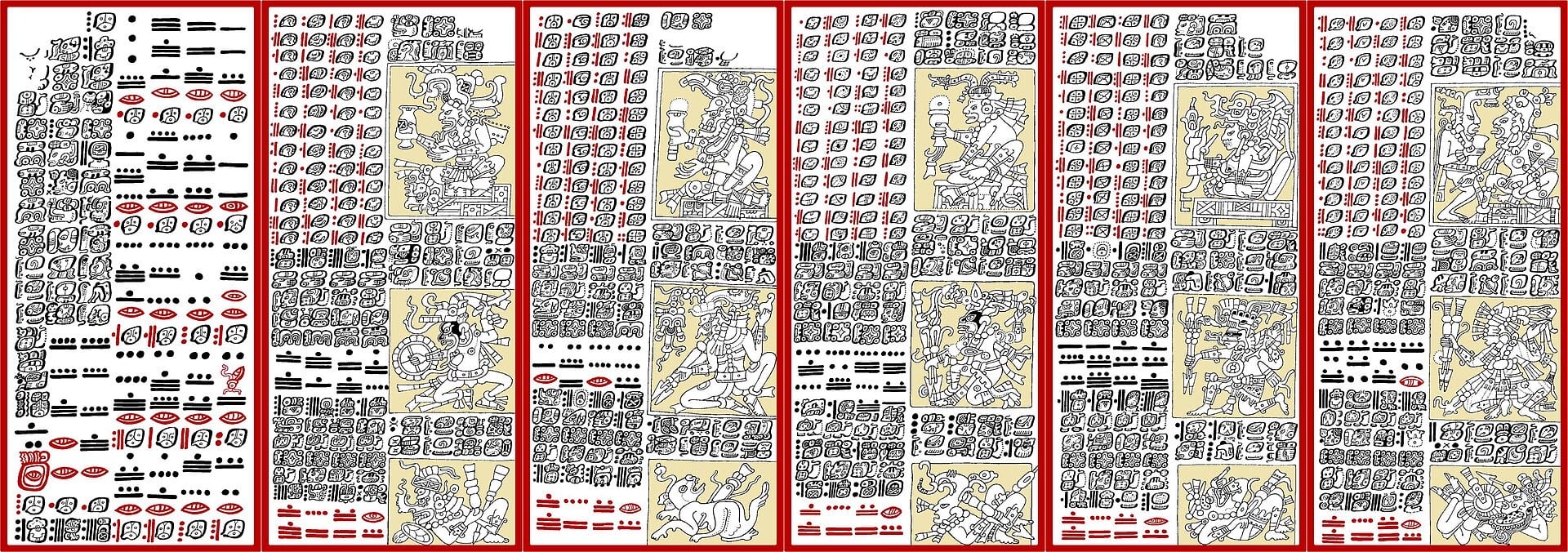
The six Venus pages of the Dresden Codex, redrawn. Each page covers one 584-day cycle of the planet; the table runs through five cycles to return to the same point in the solar year. Drawing: Lacambalam, CC BY-SA 4.0, via Wikimedia Commons.
The Maya scribes rounded the cycle to 584 days and split it into four parts close to the real phases: 236 days as morning star, 90 days hidden, 250 days as evening star and 8 days hidden at inferior conjunction. Five such cycles make 2,920 days, which is exactly eight years of 365 days. So after five Venus cycles, the planet's appearances return to the same point in the solar year. The table in the codex runs through those five cycles on five pages, with an introductory page, listing the dates of each appearance and disappearance in the Maya calendar and naming the gods and omens associated with each.25
The table went further. Five Venus cycles are 2,920 days, and 65 Venus cycles are 37,960 days, which is also 146 rounds of the 260-day ritual calendar and two rounds of the 52-year Calendar Round. So after 104 years, Venus, the solar year and the ritual calendar all line up. The scribes knew 584 days was slightly too long. Over 65 cycles the error adds up to about 5 days, and the table includes correction rules, resetting the starting point after a set number of cycles, that held its predictions to within about two hours of the true heliacal rising over several centuries.25 That was a better fit than European astronomy managed until the Renaissance.
The table was not astronomy for its own sake. The first appearance of Venus as the morning star was considered dangerous: its light was thought to strike particular victims, and the codex pictures the god of Venus spearing them. Rulers timed wars and rituals to Venus's cycle. Inscriptions at several Maya cities record battles fought on dates tied to Venus's appearances, a practice scholars have called "star wars."25 The Maya watched the sky closely because it governed what kings and priests had to do.
The Dresden Codex also contains an eclipse table covering 405 lunar months, about 33 years, flagging the months in which an eclipse was possible. Its windows fall at intervals of six months, occasionally five, the same eclipse seasons that come from the Moon's nodes. Together the tables show that Maya astronomers, working only with the naked eye and long written records, had found and modeled the main cycles of the Moon and Venus as precisely as anyone in the world at the time.
The codex itself has had a hard life. It reached Dresden in 1739, probably by way of Vienna, and was badly damaged by water when the library was bombed in 1945. The pages were later restored, though some paint is lost. The surviving Venus pages remain the clearest written evidence of how Mesoamerican astronomers turned observation into prediction.
Woodhenge at Cahokia
In North America, at Cahokia near today's St. Louis, the largest city north of Mexico around 1100 CE, archaeologists found the postholes of several large circles of wooden posts west of the great platform mound. Viewed from a central post, the posts on the eastern side of one circle mark the sunrise at the solstices and equinoxes, and at the equinox the Sun rises over the front of the mound. The excavator, Warren Wittry, called them "woodhenges." A circle has been rebuilt on the site, and public sunrise gatherings are held there at the solstices and equinoxes.26
Testing the extraordinary
Part 6 of 6
Archaeoastronomy attracts big claims, and the field's credibility depends on testing them as hard as the modest ones.
Stonehenge decoded, and the reply
Gerald Hawkins's 1965 claim that Stonehenge was a computer for predicting eclipses rested on dozens of lines between stones and other features, matched to the Sun and Moon with a computer. The archaeologist Richard Atkinson answered in 1966 with a review titled "Moonshine on Stonehenge." He showed that many of Hawkins's lines used stones from different building phases, centuries apart, or features whose positions were uncertain, and that with so many lines to choose from, many matches were to be expected.27 Later surveys, especially Clive Ruggles's comprehensive study of British and Irish monuments, confirmed the solstitial axis and rejected most of the rest.2 The lesson became the field's first rule: decide which lines matter before looking at the sky.
Lines and wheels
The Nazca lines in the desert of southern Peru, enormous lines and figures drawn by removing the dark surface stones, were long rumored to be an astronomical calendar. In 1968 Hawkins tested the lines against the Sun, Moon and bright stars and found no more matches than chance would give. Later fieldwork by Anthony Aveni and others linked many of the lines to walking, water and the sources of underground streams rather than the sky.28 At the Bighorn Medicine Wheel, a ring of stones with 28 spokes on a mountaintop in Wyoming, the solar physicist John Eddy proposed in 1974 that some cairns marked the summer solstice sunrise and the rising of bright stars. The solstice line is widely accepted; the star lines and the dating that relies on them are debated.29 The wheel remains a sacred site for many Plains nations today.
Göbekli Tepe's Vulture Stone
In 2017 the chemical engineer Martin Sweatman and a colleague argued that a carved pillar at Göbekli Tepe in Turkey, Pillar 43 or the "Vulture Stone," built around 9500 BCE, recorded a comet impact around 10,950 BCE, reading its animals as constellations and dating the scene by precession. The site's excavators replied that the animals belong to an iconography found throughout the site with no astronomical content, and that matching carvings to star patterns depends on arbitrary choices of which animal stands for which group of stars.30 The claim still circulates widely online. The site's actual story is told in Göbekli Tepe.
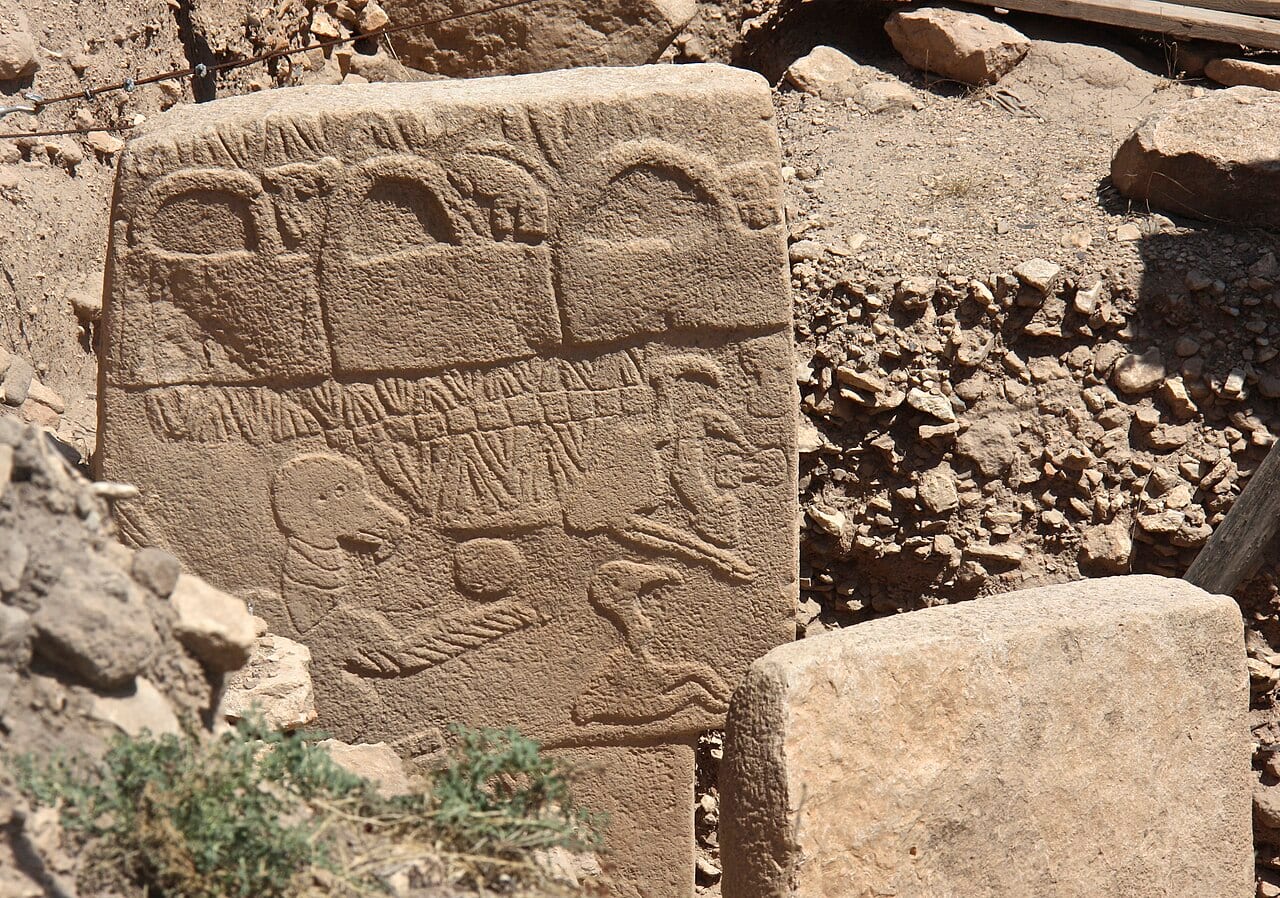
The upper part of Pillar 43, the "Vulture Stone," at Göbekli Tepe. Reading its animals as constellations led to a claimed comet record that the excavators reject. Photo: Sue Fleckney, CC BY-SA 2.0, via Wikimedia Commons.
What a strong case looks like
The cases that hold up share a few features. The line is simple and was clearly intended, like Newgrange's roof-box or Chimney Rock's single gap. The same alignment repeats at more than one site, as at Newark and High Bank or the Scottish recumbent circles. The event is distinctive, such as a standstill moonrise, not one of dozens of possible targets. And there is independent evidence that the people cared about it: midwinter pig bones at Durrington Walls, the Venus pages of the Dresden Codex, or living tradition, as in Polynesian navigation and Matariki.
The weak cases fail the same tests. They pick lines after looking at the sky, rely on a single site, ignore that the sky has changed, or impose a modern astronomer's interests on people who may have cared about very different things. Many alignments that are real still do not mean what enthusiasts claim. A tomb lit at midwinter was not an observatory in a modern sense. It was a place where the Sun's return was met with the dead, and that is more interesting than a computer.
Footnotes
- Clive L. N. Ruggles, ed., Handbook of Archaeoastronomy and Ethnoastronomy, Springer, 2015: scope of the field, history, the Oxford conferences and the "green" and "brown" traditions. doi:10.1007/978-1-4614-6141-8 doi.org ↩
- Clive Ruggles, Astronomy in Prehistoric Britain and Ireland, Yale University Press, 1999: methods, declination, chance, Thom's lines re-examined, recumbent stone circles, Iberian tomb orientations. ↩
- J. Norman Lockyer, Stonehenge and Other British Stone Monuments Astronomically Considered, Macmillan, 1906. ↩
- Gerald S. Hawkins, "Stonehenge Decoded," Nature 200, 1963, 306–308, doi:10.1038/200306a0; Alexander Thom, Megalithic Sites in Britain, Oxford University Press, 1967. doi.org ↩
- UNESCO World Heritage Centre, "Chankillo Archaeoastronomical Complex" (inscribed 2021) and "Hopewell Ceremonial Earthworks" (inscribed 2023). whc.unesco.org ↩
- J. Laskar et al., "A long-term numerical solution for the insolation quantities of the Earth," Astronomy & Astrophysics 428, 2004, 261–285: obliquity over the Holocene. doi:10.1051/0004-6361:20041335 doi.org ↩
- T. P. Ray, "The winter solstice phenomenon at Newgrange, Ireland: accident or design?" Nature 337, 1989, 343–345: the roof-box, the 17-minute illumination, O'Kelly's 1967 observation, and the beam in 3200 BCE. doi:10.1038/337343a0 doi.org ↩
- Ohio History Connection, "The Archaeoastronomy of the Newark Earthworks," with R. Hively and R. Horn, "Geometry and Astronomy in Prehistoric Ohio," Archaeoastronomy 4, 1982, S1–S20. ohiohistory.org ↩
- Historic Environment Scotland, "Maeshowe Chambered Cairn." historicenvironment.scot ↩
- English Heritage, "Stonehenge and the Solstices" and research pages on Durrington Walls feasting. english-heritage.org.uk ↩
- I. Ghezzi and C. Ruggles, "Chankillo: A 2300-Year-Old Solar Observatory in Coastal Peru," Science 315(5816), 2007, 1239–1243. doi:10.1126/science.1136415 doi.org ↩
- UNESCO World Heritage Centre, "Nubian Monuments from Abu Simbel to Philae" (the 1964–1968 relocation). whc.unesco.org ↩
- Anthony F. Aveni, Skywatchers, revised edition, University of Texas Press, 2001: El Castillo's equinox effect and Maya solar interests. ↩
- A. Sofaer, V. Zinser and R. M. Sinclair, "A Unique Solar Marking Construct," Science 206(4416), 1979, 283–291. doi:10.1126/science.206.4416.283 doi.org ↩
- Chimney Rock Interpretive Association, "Lunar Standstill" and site history pages, after J. McKim Malville's work: the moonrise between the spires and the 1076 and 1093 tree-ring dates. chimneyrockco.org ↩
- Chimney Rock Interpretive Association, "Excavation/Stabilization 2009–2010." chimneyrockco.org ↩
- Historic Environment Scotland, "Calanais Standing Stones"; Margaret Curtis and Ron Curtis, Callanish: Stones, Moon and Sacred Landscape, 1994. ↩
- Kate Spence, "Ancient Egyptian chronology and the astronomical orientation of pyramids," Nature 408, 2000, 320–324. doi:10.1038/35042510 doi.org ↩
- D. Rawlins and K. Pickering, "Astronomical orientation of the pyramids," Nature 412, 2001, 699. doi:10.1038/35089138 doi.org ↩
- Marshall Clagett, Ancient Egyptian Science, vol. 2, Calendars, Clocks, and Astronomy, American Philosophical Society, 1995: the heliacal rising of Sirius, the civil calendar and Censorinus. ↩
- Landesmuseum für Vorgeschichte Halle, "The Nebra Sky Disc"; with R. Gebhard and R. Krause, "Critical comments on the find complex of the so-called Nebra Sky Disk," Archäologische Informationen 43, 2020, and the excavators' reply. landesmuseum-vorgeschichte.de ↩
- Polynesian Voyaging Society, "Hawaiian Star Compass" and the history of the 1976 voyage. hokulea.com ↩
- New Zealand Government, "Matariki" public holiday (from 2022). govt.nz ↩
- A. J. Sachs and H. Hunger, Astronomical Diaries and Related Texts from Babylonia, Austrian Academy of Sciences, 1988–2006. ↩
- Harvey M. Bricker and Victoria R. Bricker, Astronomy in the Maya Codices, American Philosophical Society, 2011: the Venus table's structure, corrections and accuracy, the eclipse table; with Aveni, Skywatchers (note 13), on Venus-timed warfare. ↩
- Illinois Department of Natural Resources, Cahokia Mounds State Historic Site, "Woodhenge." cahokiamounds.org ↩
- R. J. C. Atkinson, "Moonshine on Stonehenge," Antiquity 40, 1966, 212–216. doi:10.1017/S0003598X00032488 doi.org ↩
- Anthony F. Aveni, Between the Lines: The Mystery of the Giant Ground Drawings of Ancient Nasca, Peru, University of Texas Press, 2000. ↩
- John A. Eddy, "Astronomical Alignment of the Big Horn Medicine Wheel," Science 184(4141), 1974, 1035–1043. doi:10.1126/science.184.4141.1035 doi.org ↩
- M. B. Sweatman and D. Tsikritsis, "Decoding Göbekli Tepe with Archaeoastronomy," Mediterranean Archaeology and Archaeometry 17(1), 2017, 233–250; and J. Notroff, O. Dietrich et al., "More than a vulture: A response to Sweatman and Tsikritsis," same journal, 17(2), 2017. ↩