Place · Newark, Ohio, USA
Newark Earthworks
The largest geometric earthworks ever built, laid out to the Moon about 2,000 years ago, and a golf course until 2025.
Visited July 2026

On the way
Overview
The Newark Earthworks are the remains of a huge set of earthen walls, circles and squares in Newark and Heath, Licking County, in central Ohio. People of the Hopewell culture built them between about 1 and 400 CE.1 The whole complex once spread across about four and a half square miles, and it is the largest set of connected geometric earthworks known anywhere.23 Less than a tenth of it survives.4
Three pieces are left. The Great Circle, in Heath, is a ring of earth nearly 1,200 feet across with a ditch inside the wall.56 The Octagon Earthworks, in Newark, join an eight-sided enclosure to a round one called the Observatory Circle. Its walls appear to line up with the far points on the horizon where the Moon rises and sets over an 18.6-year cycle.78 A short stretch of wall is all that remains of a third enclosure, Wright Square.4
The builders lived in small, scattered groups who fished, foraged and farmed, and came together to build and use these places.1 Nobody knows what they called themselves; "Hopewell" is a modern label.3 Several Native nations living today, most of them removed from Ohio in the nineteenth century, count the builders among their ancestors.39
For most of the twentieth century the Octagon was a private golf course. After a long court fight, the Ohio History Connection, the state's historical society, bought out the club's lease, and the Octagon opened to everyone on 1 January 2025.10 The earthworks are part of the Hopewell Ceremonial Earthworks, Ohio's first World Heritage Site, inscribed by UNESCO in 2023.111
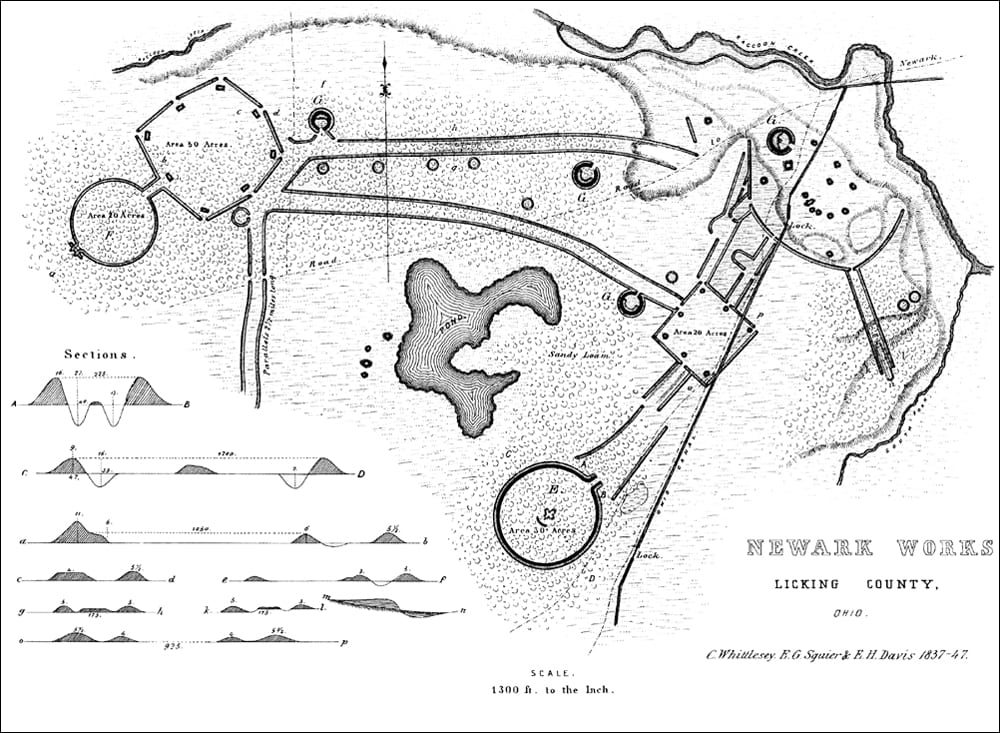
The Newark Works as mapped by Charles Whittlesey, E. G. Squier and E. H. Davis between 1837 and 1847, published by the Smithsonian in 1848. Public domain.
- The Octagon, enclosing 50 acres
- The Observatory Circle, enclosing 20 acres
- Parallel walls heading south, the start of the proposed Great Hopewell Road
- Long parallel walls running east across the complex
- Wright Square, now almost entirely gone
- The Great Circle, with Eagle Mound at its center
- ~2,000 years ago Earthworks built Hopewell people raise the circles, squares and the Octagon between about 1 and 400 CE.
- 1848 Mapped Squier and Davis publish the Newark Works in the Smithsonian's first book.
- 1910 Golf lease A country club leases the Octagon; it stays a golf course for more than a century.
- 1982 The Moon Ray Hively and Robert Horn publish the Octagon's lunar alignments.
- 2023 World Heritage UNESCO inscribes the Hopewell Ceremonial Earthworks; the Octagon opens to all on 1 January 2025.
Older times are squeezed together so the whole span fits.
In context
The Hopewell culture was a shared way of life among many Native groups across the eastern woodlands of North America, at its height from about 1 to 400 CE. Its people built earthen walls and ditches in geometric shapes, raised mounds over the remains of special buildings, and traded across a huge area. Mica, shark teeth, obsidian, copper and sea shells reached southern Ohio through contacts that ran from the Atlantic coast to the Rocky Mountains.12 Archaeologists call this the Hopewell Interaction Sphere.
Ohio's Hopewell works sit along the central tributaries of the Ohio River.1 UNESCO's listing covers eight of them: the Great Circle and the Octagon at Newark, Fort Ancient in Warren County, and five sites in Ross County that make up Hopewell Culture National Historical Park.111 UNESCO singled out their size, their geometric precision, and "an observational knowledge of complex astronomical cycles that would have required generations to codify."1 At Newark the walls of the Great Circle and the Octagon still stand above ground, while at most of the other sites the walls survive mainly below the surface.1
The circles and squares at different sites share exact sizes. The Observatory Circle is 1,054 feet across, the same as two circles at other Hopewell sites, and it encloses the same area as a nearby square.3 Only one other Hopewell site pairs a circle with an octagon: High Bank Works, near Chillicothe, about 60 miles south. Its layout follows the same lunar alignments as Newark's.813
The Hopewell earthworks are far younger than the first signs of people in eastern North America. At Meadowcroft Rockshelter, in southwestern Pennsylvania, people may have camped more than 16,000 years ago. By the time the Newark walls went up, people had lived in this part of the continent for well over ten thousand years.
Newark tracks the Moon through a cycle that takes 18.6 years to repeat.
Three courses in the Library cover this ground.
Research
The research below follows four threads: the Moon in the Octagon's walls, the proposed road south to Chillicothe, the fight to get the golf course off the Octagon, and what Native nations say about the site today. Two nineteenth-century stories run underneath them: the myth that a lost race built the mounds, and a set of forged Hebrew stones.
The Great Circle
The Great Circle is close to a perfect circle, about 1,200 feet across and enclosing about 30 acres.56 Sources disagree on the height of its wall. Figures of 8 feet, 10 to 12 feet, and up to 14 feet are all published, likely because the wall is tallest near the gateway.459 Inside the wall runs a deep ditch, so the bank and the ditch work together like a raised rim and a sunken moat. The only entrance is a gateway on the northeast side, where the wall and ditch turn outward.5
At the center sits Eagle Mound, named by settlers who thought its lobed shape looked like a bird with spread wings. Emerson Greenman dug into it in 1928 and found no burials. The mound had been heaped over the remains of a large rectangular building made of posts, with a screening fence, after the building was taken down. Covering a ceremonial building with a mound is a common Hopewell practice.5
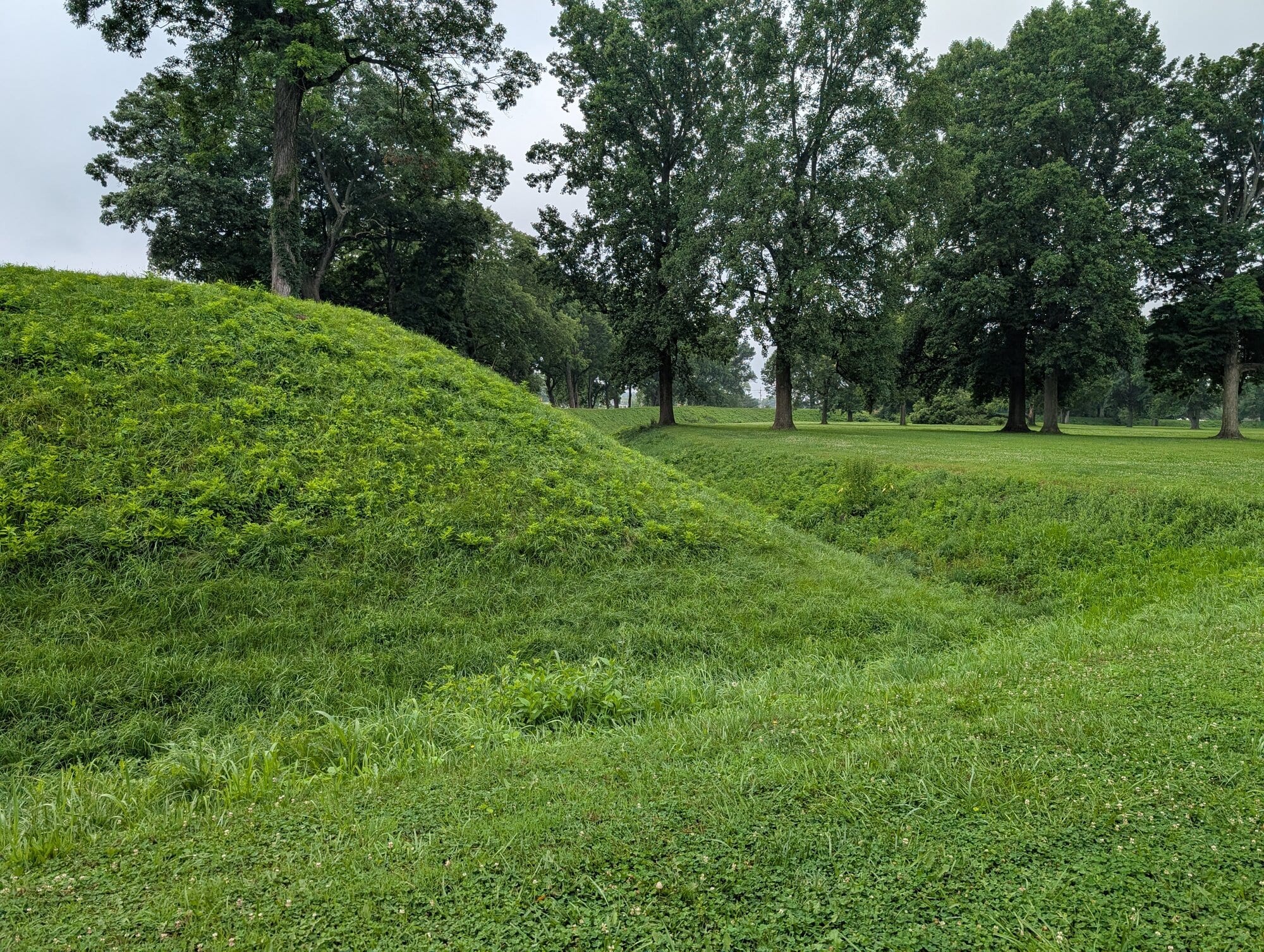
The Great Circle's wall and the ditch inside it, July 2026.
- The earthen wall
- The ditch that runs inside the wall
The circle's modern history is rough. The county agricultural society bought it in 1853 and held the Licking County Fair there until 1933, with horse races run around the inside of the wall. From 1896 to 1924 it also housed Idlewilde Park, an amusement park with an early roller coaster and a Ferris wheel.5 Locals called it the "Old Fort," perhaps echoing the old idea that it was a stronghold of a vanished race.5
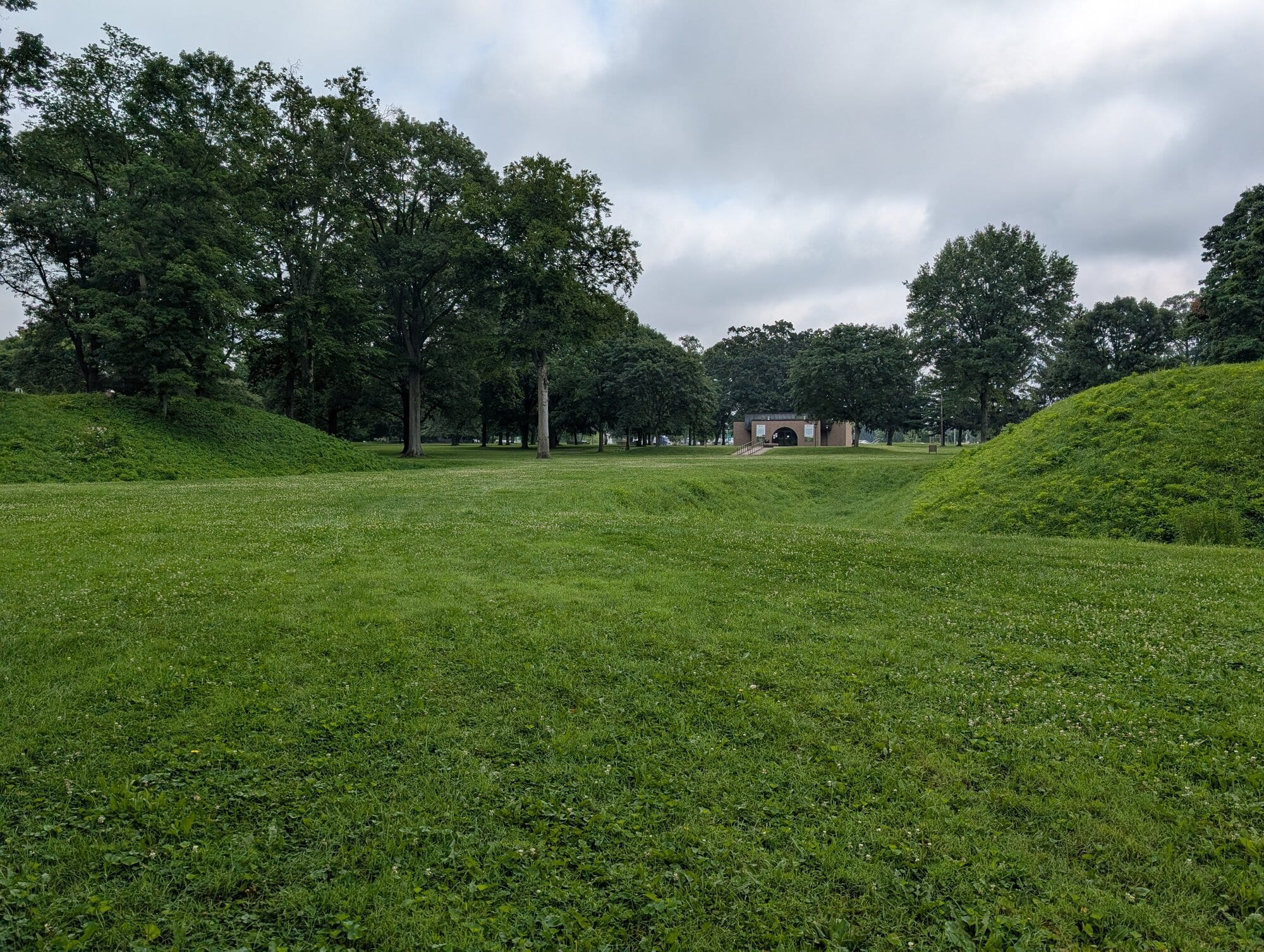
Looking out through the Great Circle's gateway from inside, July 2026. The museum stands just beyond.
- The wall on one side of the gateway
- The wall on the other side
- The museum
The construction dates are less settled than the size. An Ohio History Connection article puts radiocarbon dates for the whole complex between 160 BCE and 310 CE, and samples from opposite sides of the Great Circle's wall suggest it went up within a few generations.15 Excavations through the wall found it was built in stages, with soils of different colors.15
The Moon in the walls
In 1982 two Earlham College professors, Ray Hively and Robert Horn, published "Geometry and Astronomy in Prehistoric Ohio."16 They had come to test, and expected to reject, claims that ancient sites were aligned to the Sun. They reasoned that any complicated site would show some solar lines by chance. At the Octagon they found none. They then asked whether the walls pointed somewhere else, and found the Moon.17
Their claim is that the Octagon encodes the extremes of the 18.6-year lunar cycle. The main axis, running from the Observatory Circle through the Octagon, points to the northernmost moonrise, at the major standstill.78 Four of the Octagon's eight walls line up with other key points: the southernmost moonrise at the major standstill, the northern moonrise at the minor standstill, the northernmost moonset, and the southern moonset at the minor standstill.8 An azimuth is a compass direction along the horizon, and the claim is that the builders fixed these azimuths in earth.
In 2006 Hively and Horn tested the chance explanation. A computer generated more than 10 billion random octagons, pointed them in random directions, and counted how many matched the Moon as well as Newark does. With assumptions as generous to chance as they could make them, they put the odds of an accident at about 1 in 1,000. With assumptions they thought more reasonable, about 1 in 40 million.8 They added that they could not give a definitive answer.8
Later papers widened the claim. In 2013 they argued that four hilltops around Newark are linked to the earthworks by lunar lines and to each other by solstice lines, and that the builders worked out the cycles from the hills before transferring them to the valley floor.1819 In 2023 they argued that all eight sides of the Octagon can be used to watch the standstill cycle, and that the Milky Way met the horizon at the Moon's extreme rise and set points during the Hopewell era.20
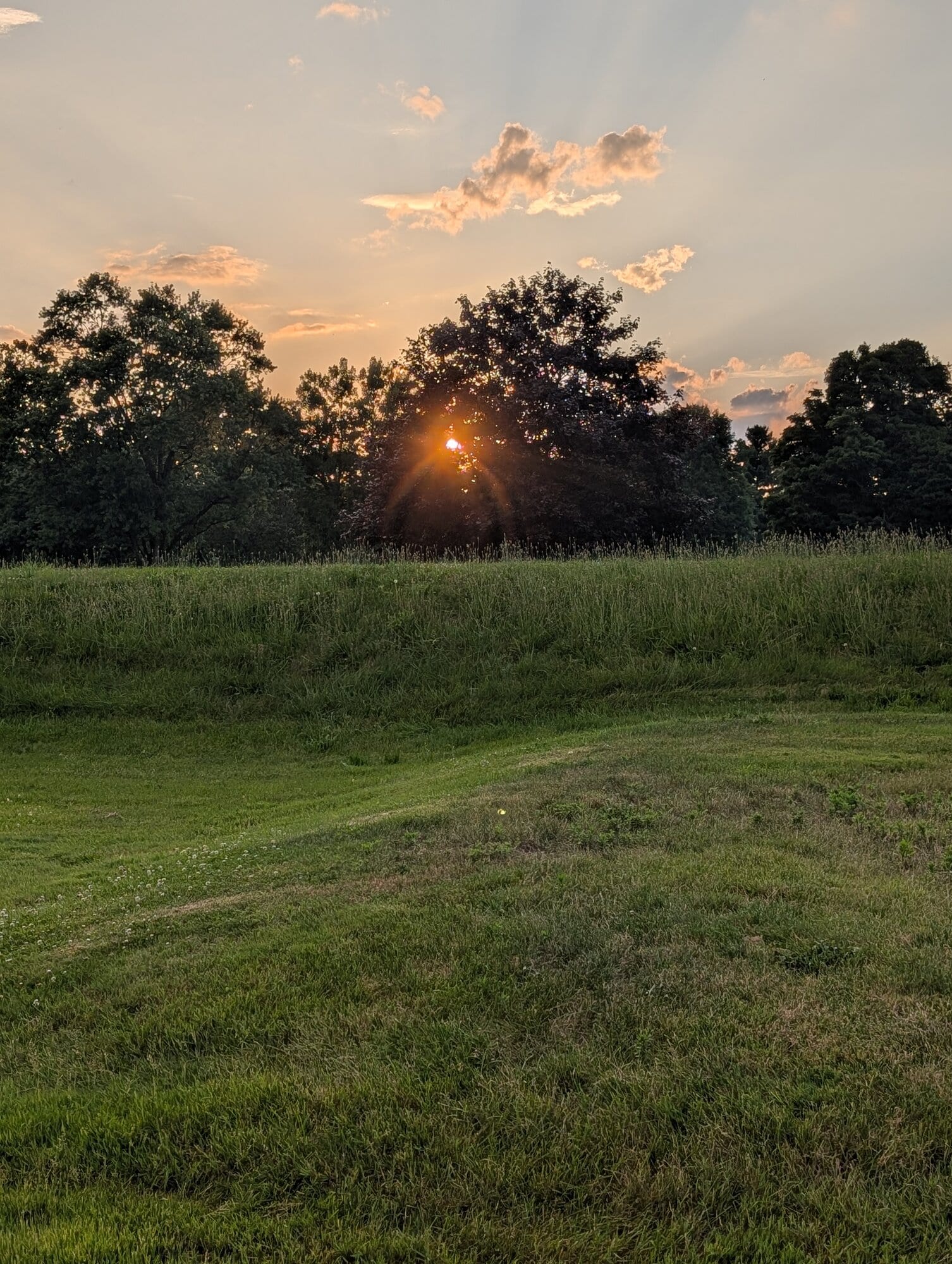
The sun setting behind one of the Octagon's walls, 5 July 2026.
Deep Dive: How strong is the lunar case?
The case is strong for the main points and gets weaker as it grows.
The core claim, that the Octagon's main axis and several walls point to lunar standstill positions, has held up for more than forty years, and Lepper writes that most archaeologists are now convinced the Hopewell aligned their monuments to the Moon and Sun.19 The claim also underpins the UNESCO listing.1 Brad Lepper, the Ohio History Connection's senior archaeologist, found it convincing partly because High Bank Works, the only other circle-and-octagon, repeats the same alignments.19 UNESCO's own text says the earthworks show "alignments with the cycles of the Sun and the far more complex cycles of the Moon."1
There are reasons for caution. Most of the published work, including the statistical tests, comes from Hively and Horn themselves. This page found no independent published re-test of their Monte Carlo study. Their own summary concedes the statistics cannot settle the question.8 The later claims about hilltops, solstices and the Milky Way are newer and more complex, and Lepper expected many archaeologists to meet them with skepticism, which he called appropriate.19 Popular sources often go further than the papers. One conservancy page says the alignments have been proven.13
Numbers can also be made to fit too easily. When a radio astronomer suggested in 2013 that the size difference between the Great Circle and the Observatory Circle matched the Moon's change in apparent size between its nearest and farthest points, Horn pointed out that the Observatory Circle covers about 18.6 acres, and the lunar cycle is 18.6 years. That match is surely a coincidence, a reminder of how easily numbers line up.7
Some claims fail when tested on the ground. On the summer solstice of 1988 Lepper watched the Sun rise from behind Eagle Mound, to test a claim that the Great Circle's gateway faces the solstice sunrise. The Sun came up several degrees to the north.19 Lepper also records the other side of the skepticism: a senior Ohio archaeologist once told Hively and Horn that the Hopewell could not have tracked the Moon "because those people were savages." Lepper calls that ethnocentrism, or outright racism, dressed as caution.19
A fair short version: the main lunar alignments at the Octagon are well supported and widely accepted; the precise statistics and the larger landscape plan remain the work of one research team and are still open to testing.
The Moon can now be watched from the Octagon in public. On 11 October 2025 the Ohio History Connection held a moonrise event during the standstill period. The Moon rose near, though not exactly at, its northernmost point, and trees along the horizon blocked part of the view.21 Lepper and the volunteer interpreter Jeff Gill had watched an earlier standstill moonrise there in the mid-2000s, when the site was still a private club.21
The Great Hopewell Road
From the Octagon, two parallel walls ran southwest. Caleb Atwater described them in 1820 and thought they might run 30 miles or more. Squier and Davis mapped them for about two and a half miles in 1848.2223 In 1862 the brothers James and Charles Salisbury, who lived in Newark, surveyed about six miles of walls about 200 feet apart, ending at Ramp Creek, and wrote that its course "if continued would lead near Circleville & Chillicothe."2324 In 1931 the pilot Warren Weiant Jr. photographed faint parallel lines farther south from the air.24
In 1995 Lepper gave the feature its name, the Great Hopewell Road, and proposed that it ran straight for about 60 miles to the Hopewell centers near Chillicothe, perhaps to High Bank Works, as a road for pilgrims.2325 The idea became famous. Lepper notes that it helped justify the World Heritage listing.24
The evidence south of Ramp Creek is thin.
Reviews have been mixed. Kevin Schwarz, assessing new survey and excavation work in 2016, found the evidence "convincing in some cases" but elusive in others, and called for more data south of Ramp Creek. One test pit there found "flecks of white decaying limestone" in a distinct lens, which some read as a possible road surface.2425 An anonymous reviewer of Lepper's 2024 paper went further and compared the road to "Sasquatch, Nessy, and Alien architects." Lepper agreed there is no definitive physical evidence for a 60-mile road, and disagreed that the idea should be dropped.24
The archaeoastronomer Giulio Magli has looked at the road's direction, about 212 degrees from north. He argued that during the likely period of construction the line matched some simple sky events, possibly by design.2723 A fair grading: the first few miles are certain; a much longer road is a serious hypothesis with real but patchy support; the full route to Chillicothe has not been shown.
Golf course to public park
Local voters approved a tax in 1892 to preserve the Octagon. From 1892 to 1908 the state used it as a militia camp.34 Moundbuilders Country Club leased the land from 1910 and built a golf course over and around the walls. The state historical society, now the Ohio History Connection, was deeded the property in 1933, with the lease attached, and renewed the lease over the years, most recently in 1997, to run until 2078.10283 Under the deed the public could visit only on the club's "reasonable rules." In practice the Octagon opened on a few golf-free days a year.2811
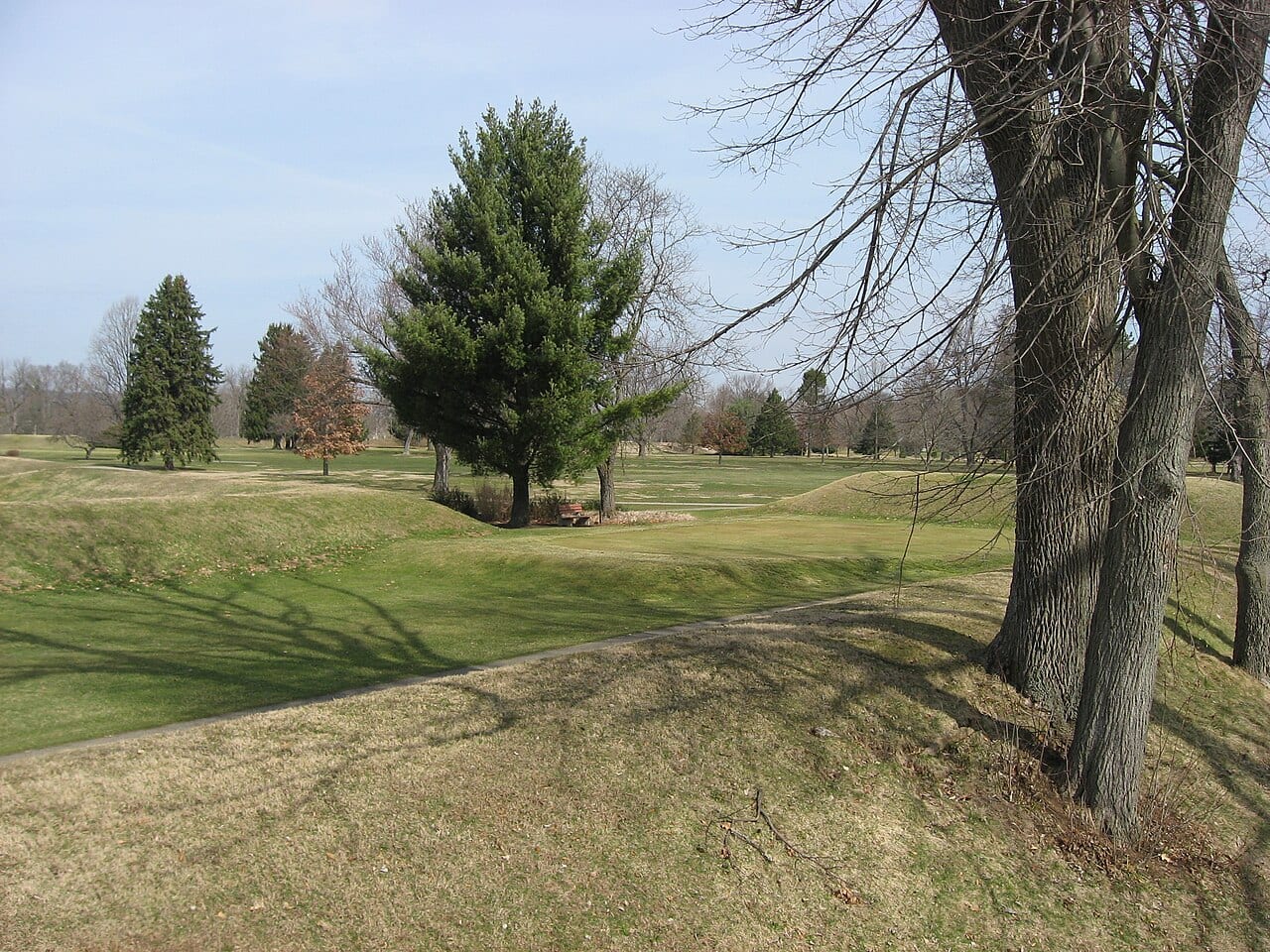
The opening of the Octagon Earthworks in March 2011, while it was still a golf course. Photo: Nyttend, public domain, via Wikimedia Commons.
- A low earthen wall of the Octagon
- Another wall section beyond the fairway
- A golf cart path cutting across the site
- Trees planted for the course
The push for full access began around 1999, when Lepper, Gill and the historian Richard Shiels called the meeting that became Friends of the Mounds.11 The Ohio History Connection began negotiating with the club in 2013. In 2017 it offered $800,000 for the lease, based on an appraisal. The club did not respond, and in 2018 the History Connection sued to take the lease by eminent domain, the power of government to buy private property for public use.1028 The National Park Service had said it would support the World Heritage nomination only if the lease ended and the golf course was removed.28
Deep Dive: The court fight, step by step
A Licking County judge ruled in May 2019 that the History Connection had the authority to take the lease and that the taking was necessary and for a public use. An appeals court agreed.10
On 7 December 2022 the Supreme Court of Ohio upheld those rulings. Writing for the majority, Justice Michael Donnelly called the Octagon's significance "arguably equivalent to Stonehenge or Machu Picchu." In dissent, Justice Sharon Kennedy argued that the public use was only "contingent and prospective," since there was no guarantee of World Heritage status, while the club's use was "actual and present."28
The next fight was over price. The History Connection's experts valued the lease at about $2 million; the club's put it near $22 million. In October 2023 Judge David Branstool ruled that the club could not be paid for the value of the earthworks themselves, because they belong to the public. That excluded all the club's valuation witnesses. The club appealed, the appeals court dismissed the case in January 2024, and the Ohio Supreme Court declined to hear it in April.29
On 1 August 2024 the two sides announced a settlement for a confidential sum, avoiding a jury trial. The club kept playing through the end of 2024 and arranged to move to another course in the county. The History Connection took over the lease on 1 January 2025.1029
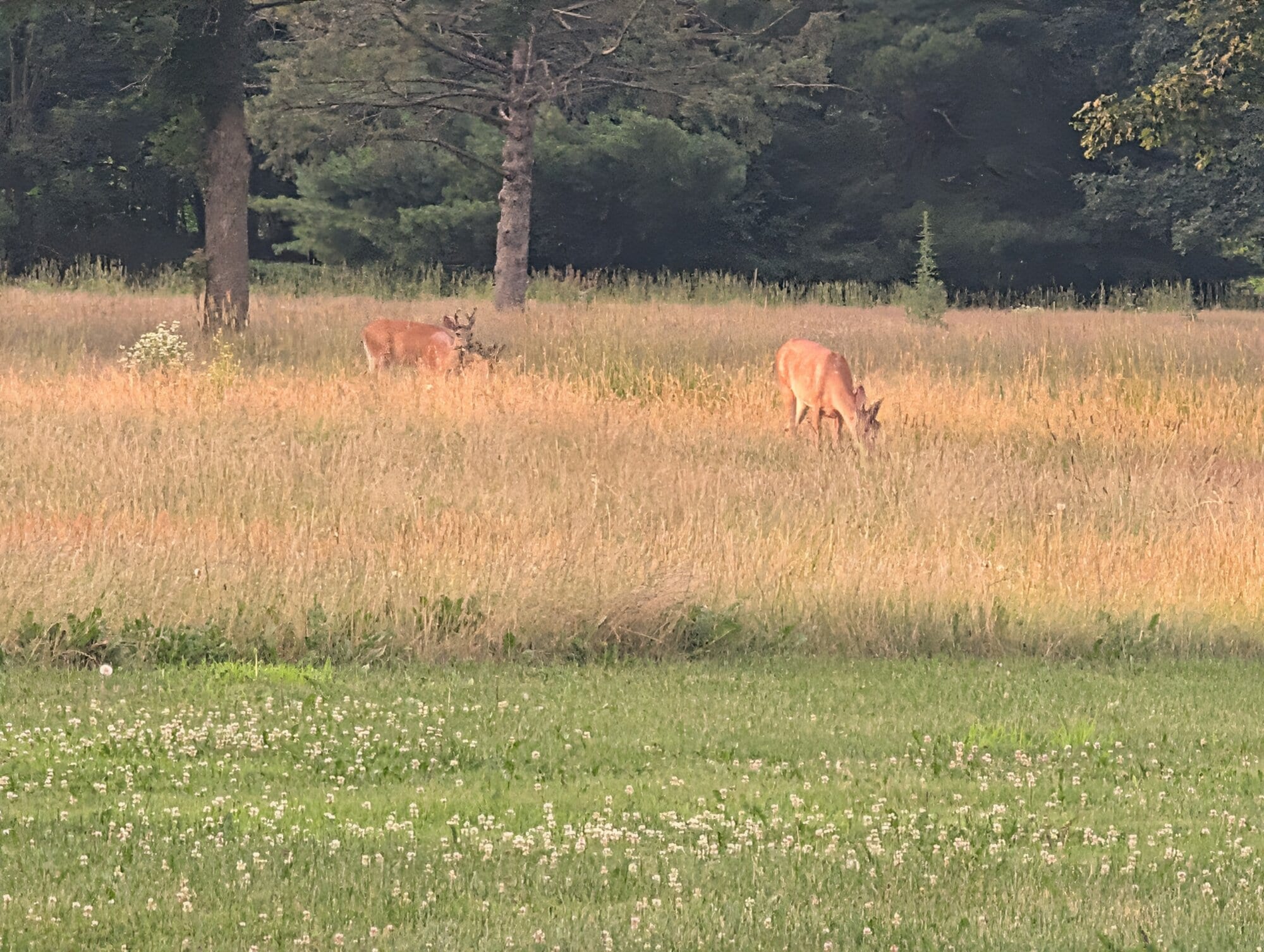
Deer in long grass at the Octagon on an evening in July 2026, the second summer after the golf course closed.
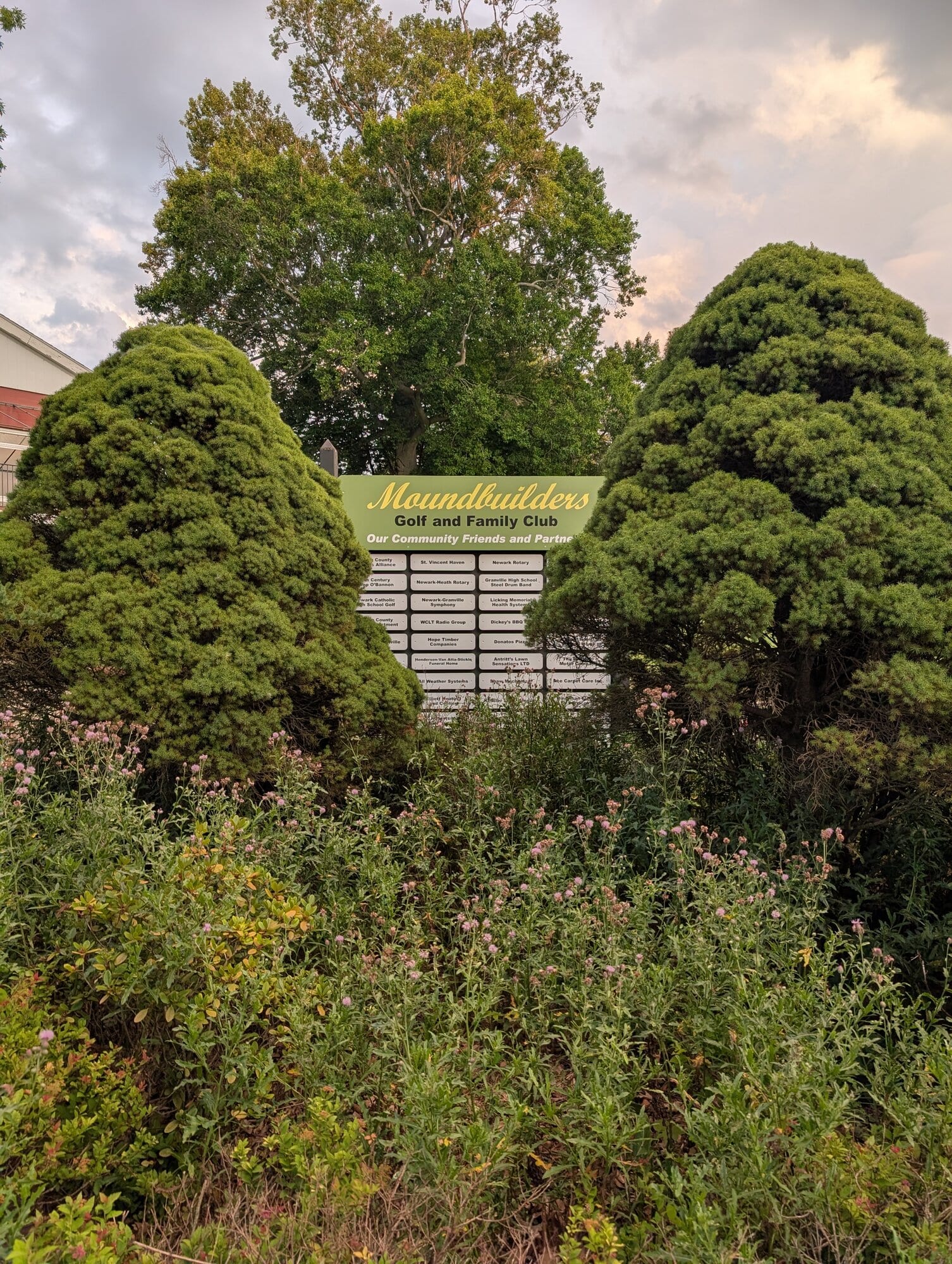
The Moundbuilders Country Club sign by the Octagon, July 2026.
Native nations and the earthworks today
The Hopewell are ancestors of a number of federally recognized tribes with roots in Ohio, among them the Chippewa, Delaware, Kickapoo, Miami, Ottawa, Peoria, Potawatomi, Seneca, Shawnee and Wyandot, according to Alex Wesaw of the Pokagon Band of Potawatomi, director of American Indian relations at the Ohio History Connection.3 Most of these nations were forced out of Ohio in the nineteenth century, after the Indian Removal Act of 1830, Several of their governments are now in Oklahoma, as names such as the Eastern Shawnee Tribe of Oklahoma and the Miami Tribe of Oklahoma show.39
Glenna Wallace, chief of the Eastern Shawnee Tribe of Oklahoma, first saw the Octagon in 2007, on a trip to Ohio State for a lecture on Tecumseh.9 Golfers made it clear she was not welcome. "I was just totally astounded, amazed, disappointed, hurt, all within five minutes," she said.3 She went on to help win the World Heritage listing and gave the acceptance speech for the Hopewell delegation.930 Her phrase for the builders is "uncommon geniuses."911 When the settlement was announced she said she looked forward to standing barefoot at Newark and telling the ancestors, "We did not forget you."29
Other tribal leaders have set terms for the future. Ben Barnes, chief of the Shawnee Tribe, said: "People need to write with us, not about us."3 Diane Hunter, tribal historic preservation officer of the Miami Tribe of Oklahoma, named removing the traces of the golf course as a top priority, along with more research on the site's links to the sky.3 Future research projects at the Octagon will need approval from Native American representatives.3 The Shawnee Tribe has called the History Connection's consultation with tribes "the gold standard."29
Ohio State University's Newark Earthworks Center, active since 2005, works with tribal governments on research about the earthworks. It has hosted visits by the Eastern Shawnee Tribe, the Pokagon Band of Potawatomi and the Wyandotte Nation.31
Mound builders and the Holy Stones
For most of the nineteenth century, many white Americans refused to believe that the ancestors of Native Americans built the mounds. Writers credited Egyptians, Phoenicians, Greeks, Vikings, the Lost Tribes of Israel and others, and imagined a vanished race of "Moundbuilders" wiped out by Indians. That story made removal and violence against Native people seem justified.32 Squier and Davis's great survey of 1848 helped spread it, since they believed the Indians were "mere hunters" incapable of such works.32 It was the Smithsonian's first published book.5
The Smithsonian later ended the debate. Cyrus Thomas's mound survey, which included an 1888 survey of Newark by James Middleton, was published in 1894 and is credited with showing that Native Americans built the mounds.532
Newark produced one of the era's best-known forgeries. In June 1860 David Wyrick, the county surveyor, dug into a small enclosure near the Octagon and found a polished stone, shaped like a plumb bob, inscribed in Hebrew. It became known as the Keystone. In November he found a second stone at a mound about seven miles south: the Decalogue Stone, carved with a short version of the Ten Commandments and a figure labeled Moses, inside a stone box.33 By 1881 at the latest, scholars had dismissed them all as forgeries.33 The letters follow modern printed Hebrew, and the leading Hebrew scholar Frank Moore Cross confirmed in 1991 that the carver had been copying from a modern printed page.33
Lepper and his co-authors argue that the motive was a scientific and political one. In 1860 the question of whether all humans share one origin, from Adam and Eve, was tied up with the fight over slavery. Genuine Hebrew stones in an Ohio mound would have backed the single-origin side, which opposed slavery.33 The stones are on show at the Johnson-Humrickhouse Museum in Coshocton, which now presents them as "a prism through which we can gain a clearer view of Ohio in 1860 CE, not 100 CE."34 In 2014 Lepper found a sample of the wooden platform under which the Decalogue Stone was said to lie. It dated to about 85 to 135 CE, which fits a real Hopewell burial in the mound. The carved stone is a different matter.3433
Footnotes
-
UNESCO World Heritage Centre, "Hopewell Ceremonial Earthworks," list entry 1689, inscribed 2023 (brief synthesis, criteria (i) and (iii), dates 1 to 400 CE; read in full from an archived copy). whc.unesco.org ↩ ↩2 ↩3 ↩4 ↩5 ↩6 ↩7 ↩8 ↩9
-
Court News Ohio, "State Can Acquire Octagon Earthworks From Country Club," 7 December 2022 (the earthworks "cover 4.5 square miles in and around Newark"). courtnewsohio.gov ↩
-
Archaeology magazine, "A New Day for the Ancestors' Mounds," Digs & Discoveries, July/August 2023 (Wallace, Wesaw, Barnes and Hunter quoted; Octagon wall lengths about 570 feet; Observatory Circle 1,054 feet; 1892 tax and militia camp). archaeology.org ↩ ↩2 ↩3 ↩4 ↩5 ↩6 ↩7 ↩8 ↩9 ↩10 ↩11 ↩12
-
Wikipedia, "Newark Earthworks" (secondary source; less than 10 percent preserved, Wright Square, wall heights, National Historic Landmark 1964). en.wikipedia.org ↩ ↩2 ↩3 ↩4
-
Ohio History Connection, Archaeology Blog, "A View Within the Circle," 18 November 2008 (author not named on the page; Great Circle size, Eagle Mound and Greenman 1928, the fair and Idlewilde Park, Squier and Davis as the Smithsonian's first publication, Thomas and Middleton's 1888 survey). ohiohistory.org ↩ ↩2 ↩3 ↩4 ↩5 ↩6 ↩7 ↩8 ↩9
-
The Ohio State University, Department of History, "Newark Earthworks joins World Heritage Sites," 19 September 2023, reprinting Kent Mallett, Newark Advocate (Great Circle nearly 1,200 feet; Octagon 50 acres, walls about 550 feet). history.osu.edu ↩ ↩2
-
Brad Lepper, "The Newark Earthworks and the Moon," Ohio History Connection Archaeology Blog, 5 April 2013 (quotes Hively and Horn 1982; the perigee and apogee idea and Horn's 18.6-acre caution). ohiohistory.org ↩ ↩2 ↩3
-
Brad Lepper, "Octagon Earthworks alignment with Moon likely is no accident," Ohio History Connection blog, 22 December 2013, reposting his Columbus Dispatch column of 13 February 2007 (summarizes Hively and Horn's 2006 Monte Carlo study in the Midcontinental Journal of Archaeology; the paper itself not read). ohiohistory.org ↩ ↩2 ↩3 ↩4 ↩5 ↩6 ↩7
-
Here & Now (WBUR, via NPR station WLRN), "Why a UNESCO site and a golf course share the same place in Ohio," interview with Chief Glenna Wallace, 5 October 2023. wlrn.org ↩ ↩2 ↩3 ↩4 ↩5 ↩6
-
Ohio History Connection, "Octagon Earthworks will open to public Jan. 1, 2025," press release, 1 August 2024 (lease since 1910, deeded 1933, court timeline; read from an archived copy). ohiohistory.org ↩ ↩2 ↩3 ↩4 ↩5
-
Mallett, Newark Advocate, via Ohio State, 2023, as above (inscription in Riyadh; Ohio's first World Heritage Site and the 25th in the United States; nomination January 2022; Shiels and Gill on Friends of the Mounds; golf-free days; Wallace's "uncommon geniuses"). ↩ ↩2 ↩3 ↩4 ↩5
-
National Park Service, Hopewell Culture National Historical Park, "History & Culture" (1 to 400 CE; the trade network and its materials). nps.gov ↩
-
Heartland Earthworks Conservancy, "Aligned to the Heavens" (High Bank Works; advocacy wording that the alignment is "proven"). earthworksconservancy.org ↩ ↩2
-
Judith S. Young, "Moon Teachings for the Masses at the UMass Sunwheel and Around the World: The Major Lunar Standstills of 2006 and 2024-25," Department of Astronomy, University of Massachusetts Amherst, updated December 2010. umass.edu ↩ ↩2 ↩3
-
Construction dates of 160 BCE to 310 CE, the few-generations estimate for the Great Circle wall, and the three building stages come from search-result summaries of an Ohio History Connection article and a National Park Service report; neither was opened. See Sources to check. digitalcommons.unl.edu ↩ ↩2
-
Ray Hively and Robert Horn, "Geometry and Astronomy in Prehistoric Ohio," Archaeoastronomy (supplement to the Journal for the History of Astronomy) 13(4), 1982, S1-S20 (citation only; full text not read). data.isiscb.org ↩
-
Allie Vugrincic, "Eyes on the Sky: Ohio History Connection hosts moon alignment event at Newark earthworks," WOSU, via WYSO, 15 October 2025 (Lepper on how Hively and Horn found no solar alignments). wyso.org ↩
-
Ray Hively and Robert Horn, "A New and Extended Case for Lunar (and Solar) Astronomy at the Newark Earthworks," Midcontinental Journal of Archaeology 38(1), 2013, 83-118 (abstract only, as posted by Brad Lepper on the Ohio History Connection blog, 22 July 2013). ohiohistory.org ↩
-
Brad Lepper, "The Archaeoastronomy of the Newark Earthworks," Ohio History Connection blog, 22 December 2013 (the 1988 solstice test, the "savages" remark, the hilltop alignments). ohiohistory.org ↩ ↩2 ↩3 ↩4 ↩5 ↩6
-
Ray Hively and Robert Horn, "More Topography, Astronomy, and Geometry at the Newark Earthworks," Midcontinental Journal of Archaeology 48(1), 2023, doi 10.5406/23274271.48.1.01 (abstract only). citedrive.com ↩
-
Vugrincic, WOSU, 2025, as above (the 11 October 2025 event; Lepper and Gill's mid-2000s moonrise). ↩ ↩2
-
E. G. Squier and E. H. Davis, Ancient Monuments of the Mississippi Valley, Smithsonian Contributions to Knowledge 1, 1848, plate XXV, "Newark Works" (the plate examined; the text not read). commons.wikimedia.org ↩
-
Wikipedia, "Great Hopewell Road" (secondary source; Atwater 1820, the Salisbury survey, the Van Voorhis Walls, the 212-degree azimuth, LiDAR work by Romain and Burks 2008). en.wikipedia.org ↩ ↩2 ↩3 ↩4 ↩5 ↩6
-
Bradley T. Lepper, "The Great Hopewell Road: A Biased Assessment Thirty Years On," Journal of Ohio Archaeology 10, 2024, 1-37 (read in part: abstract, history of the idea, the concession on "subjective data selection," the reviewer's comment, the Salisbury quotation). ohioarchaeology.org ↩ ↩2 ↩3 ↩4 ↩5 ↩6
-
Kevin R. Schwarz, "The Great Hopewell Road: New Data, Analysis, and Future Research Prospects," Journal of Ohio Archaeology 4, 2016, 12-38 (abstract read; the limestone lens and conclusion quoted through Lepper 2024). ohioarchaeology.org ↩ ↩2
-
John Soderberg, Tod Frolking and Brad Lepper, "Investigating the Great Hopewell Road with Photogrammetry," Current Research in Ohio Archaeology, 2026 (abstract read; trenches dug November 2025). ohioarchaeology.org ↩
-
Giulio Magli, "Possible astronomical references in the planning of the Great Hopewell Road," arXiv preprint 0706.1325, 2007 (abstract only). arxiv.org ↩
-
Court News Ohio, 2022, as above (deed of 1933, 1997 renewal, "reasonable rules," the 2017 appraisals and $800,000 offer, the National Park Service condition, Donnelly and Kennedy opinions). ↩ ↩2 ↩3 ↩4 ↩5
-
Tana Weingartner, "Ohio historical earthwork site will open to public after settlement deal reached," WVXU, via Ideastream Public Media, 1 August 2024 (valuations, the October 2023 ruling, appeals, statements from Wallace and the Shawnee Tribe). ideastream.org ↩ ↩2 ↩3 ↩4
-
National Park Service, Hopewell Culture National Historical Park, "UNESCO World Heritage Inscription Commemoration" (Wallace's acceptance speech is reported from a search summary of this page; the page itself not opened). nps.gov ↩
-
Newark Earthworks Center, The Ohio State University, "About Us." earthworks.osu.edu ↩
-
National Park Service, Hopewell Culture NHP: Administrative History, chapter 1, "Mythology of the Moundbuilders" (read from an archived copy). nps.gov ↩ ↩2 ↩3
-
Jeff Gill, Bradley T. Lepper and Meghan Marley, "The Newark Holy Stones: The History of an Archaeological Comedy," Journal of Ohio Archaeology 8, 2021, 1-17 (read in part: discovery, the Cross 1991 analysis, the monogenesis context). ohioarchaeology.org ↩ ↩2 ↩3 ↩4 ↩5
-
Wikipedia, "Newark Holy Stones" (secondary source; the Johnson-Humrickhouse Museum's reinterpretation and the 2014 radiocarbon date on the platform). en.wikipedia.org ↩ ↩2
