Idea
Rights of Nature
In 2008 Ecuador wrote into its constitution that nature, Pacha Mama, has rights of its own. Courts have used it to stop mines, and an oil field shows its limits.

Overview
The rights of nature is a legal idea with a simple core. A forest, a river or a whole ecosystem can hold rights of its own, the way a person or a company can, and people can go to court on its behalf. Most environmental law treats nature as property or as a resource to be managed, and it protects nature only when harm to it also harms people. The rights of nature reverses that. The river is the one that has been wronged, and the remedy is to restore the river.
Ecuador made the idea part of a national constitution first. Its 2008 constitution gives "Nature, or Pacha Mama, where life is reproduced and occurs" the "right to integral respect for its existence," and the right to keep its life cycles, structure, functions and evolutionary processes going. It adds that "Nature has the right to be restored," and that any person, community or people can ask the authorities to enforce these rights.1 Pacha Mama is the Andean Earth mother, and the constitution names her in the same breath as nature.
Since then the idea has spread to laws, court rulings and local ordinances on every inhabited continent. It has also met hard limits. Ecuador's own courts have used the articles to cancel mining permits in a cloud forest, yet the state kept pumping oil from Yasuní National Park after voters told it to stop.
In context
The idea did not start in Ecuador. In 1972 the American law professor Christopher Stone published "Should Trees Have Standing?", arguing that natural objects could be given legal rights and represented by guardians, as children and companies are.2 He wrote it while Sierra Club v. Morton, a fight over a planned Disney ski resort in California's Mineral King valley, was before the Supreme Court. The Sierra Club lost on standing (the right to bring a case at all), but Justice William O. Douglas cited Stone in his dissent and said the case would be better named Mineral King v. Morton.2
Through the 1990s and 2000s the cultural historian Thomas Berry and the South African lawyer Cormac Cullinan turned this into "Earth jurisprudence" and "wild law": the view that human law should sit inside the larger order of the Earth rather than above it. In 2006 the small coal town of Tamaqua, Pennsylvania, passed the first local law to treat "natural communities and ecosystems" as persons, to stop corporations from spreading sewage sludge on land.3 The lawyers who helped Tamaqua, the Community Environmental Legal Defense Fund (CELDF), were soon in Ecuador.
- 1972 Should Trees Have Standing? Christopher Stone's essay, cited by a Supreme Court dissent.
- 2008 Ecuador's constitution Nature, or Pacha Mama, becomes a holder of rights.
- 2017 A river becomes a person New Zealand's Te Awa Tupua Act for the Whanganui River.
- 2025 The Inter-American Court Recognizes nature as a holder of rights across the Americas.
The Gaia hypothesis is a near cousin. The Gaia Hypothesis says that life and its surroundings act as one system that keeps Earth habitable. Pacha Mama names the same whole from inside a living tradition. The rights of nature asks what follows in law if that whole is treated as someone rather than something.
Research
How Ecuador wrote it
Part 1 of 7
Ecuador's constitution was written in 2007 and 2008 by an elected Constituent Assembly meeting in Montecristi, a town on the Pacific coast. Its first president was the economist Alberto Acosta, who had been President Rafael Correa's minister of energy and mines and whose essay "Nature as a Subject of Rights" helped bring the idea before the assembly.4 CELDF's Thomas Linzey and Mari Margil were invited to help draft the language.45 The assembly approved the rights-of-nature text in 2008, and voters approved the whole constitution on 28 September 2008, by about 64 percent.6
The rights of nature are four short articles, but they sit inside a larger idea the constitution calls sumak kawsay, Kichwa for "good living," in Spanish buen vivir.6 The preamble promises "a new form of public coexistence, in diversity and in harmony with nature." The four articles and the ideas behind them are worth reading closely, because almost every later case turns on their exact words.
Deep Dive: Inside the four articles
Chapter seven of the constitution is headed "Rights of nature," and it runs only four articles. Each does a different job.
Article 71 sets out who holds the right and what the right is. "Nature, or Pacha Mama, where life is reproduced and occurs, has the right to integral respect for its existence and for the maintenance and regeneration of its life cycles, structure, functions and evolutionary processes."1 Two things in that sentence matter in court. The holder is nature as a whole and, as the courts have since read it, each ecosystem within it, so a single forest or river can be the injured party. And the right is about processes as well as things: the cycles, functions and evolution that keep an ecosystem going. A dam that leaves a river standing but stops its seasonal flood can still violate it. The article then gives standing to everyone: "All persons, communities, peoples and nations can call upon public authorities to enforce the rights of nature." No one has to prove that they personally were harmed.
Article 72 gives nature "the right to be restored," and says this is separate from any duty to compensate the people who depend on the damaged place.1 That separation is the heart of the idea. Under ordinary law, a polluter pays the farmer whose crops failed. Under Article 72 the polluter must also repair the river, whether or not anyone lost money. For "severe or permanent environmental impact," including impact from extracting non-renewable resources such as oil and minerals, the state must use the most effective means to restore it.
Article 73 tells the state to take "preventive and restrictive measures" against activities that could drive species extinct, destroy ecosystems or permanently alter natural cycles, and bans introducing organisms or materials that could permanently change the nation's genetic heritage.1 This is the article courts lean on when science is uncertain. In the Los Cedros case, below, the Constitutional Court read it together with the precautionary principle: where an activity might do grave harm and the harm cannot be ruled out, the state must not allow it.
Article 74 turns back toward people. Persons, communities and peoples have the right to benefit from the environment and its wealth so they can live well, and "environmental services shall not be subject to appropriation."1 Clean water, pollination or a stable climate cannot be owned or sold as private goods.
The words around these articles matter as much as the articles. Sumak kawsay comes from Kichwa-speaking peoples of the Andes and Amazon. It names a life lived in balance with community and land, and it was put forward in the assembly as an alternative to development measured only by growth.6 Pacha Mama is an Andean deity of earth and time, honored in offerings that are still made today. Writing her name into a constitution let Indigenous movements, who had pressed for a "plurinational" state since the 1990s, see their own worldview in the text. It also gave the idea a second foundation besides Western ecology: nature has rights here partly because, in this tradition, she is already someone.
The same constitution also holds the tension that has shadowed the rights ever since. Article 407 bans extraction of non-renewable resources in protected areas, and then allows it if the president asks and the National Assembly declares it to be in the national interest. That is the door through which drilling in Yasuní was later approved. Alberto Acosta left the assembly before it finished, after a break with Correa, and became one of the government's sharpest critics on mining and oil.4 The constitution recognized nature's rights and kept the state's oil economy in the same document.
The cases
Part 2 of 7
The first win came quickly and from an unlikely place. In 2011 two foreign residents of Vilcabamba in southern Ecuador, Richard Frederick Wheeler and Eleanor Geer Huddle, sued the provincial government of Loja on behalf of the Vilcabamba River. A road-widening project had been dumping rock and excavated earth into the river, which narrowed it and helped cause floods. On 30 March 2011 the provincial court of Loja ruled for the river and ordered the government to clean up and restore it.7 Compliance was slow and partial, and the case returned to the Constitutional Court as late as 2018,7 but the principle held: a river had won in court.
Not every case went that way. A study by the political scientists Craig Kauffman and Pamela Martin found that high-profile cases pushed by activists against national projects tended to lose in the early years, while small local cases, and the training of judges, slowly built a body of law.8 By 2023 the same authors counted 55 judicial decisions in Ecuador that invoked the rights of nature.8
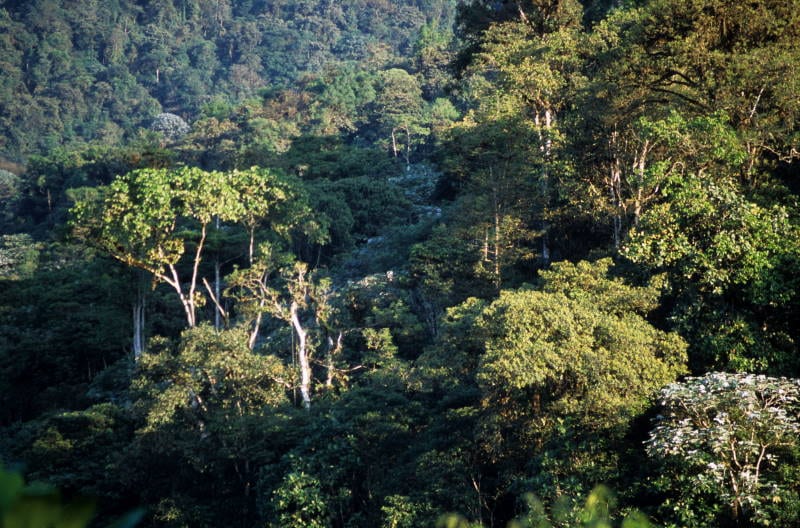
Cloud forest in Los Cedros, the protected forest whose rights the Constitutional Court upheld in 2021. Photo: Diego Tirira, CC BY-SA 2.0, via Wikimedia Commons.
The turning point came in 2021 with the Los Cedros protected forest, a cloud forest in the Andes of Imbabura province, protected since 1995. The government had granted mining concessions inside it to the state mining company ENAMI and its Canadian partner Cornerstone Capital Resources. The Constitutional Court ruled in judgment 1149-19-JP/21, dated 10 November 2021, that the permits violated the rights of nature. The state had not studied how fragile the forest was, and with that uncertainty, mining threatened its right to exist and regenerate. The permits had to be revoked.9 The court also said that the rights of nature are not limited to protected areas: they apply across the whole national territory, with the full force of other constitutional rights.910
Two later cases pushed the idea further. In 2022 the court ruled, in the case of Estrellita, a wooly monkey kept as a pet for 18 years and then seized by the authorities, that individual wild animals are subjects of rights under the rights of nature. Estrellita had died before the ruling, but the court found her rights had been violated and ordered the National Assembly to pass an animal-rights law.11 In July 2024 a judge in Quito ruled that the city had violated the rights of the Machángara River, which runs through the capital, by letting most of its sewage flow into it untreated, and ordered a plan to clean it up. The Kitu Kara Indigenous people brought the case.12
Yasuní: the hardest test
Part 3 of 7
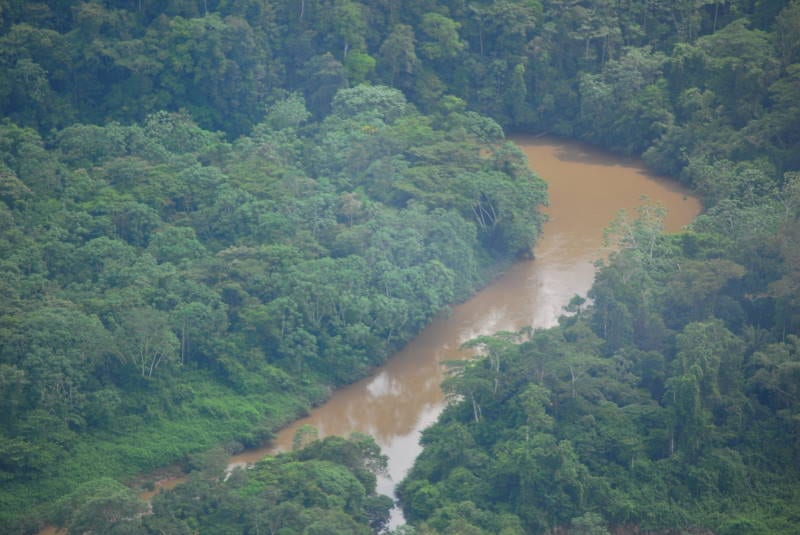
A river through the forest of Yasuní National Park, seen from the air. Photo: Diego Tirira, CC BY-SA 2.0, via Wikimedia Commons.
Yasuní National Park in the Ecuadorian Amazon is one of the most biodiverse places measured on Earth, home to Waorani people and to the Tagaeri and Taromenane, who live in voluntary isolation. It also sits on oil. Its fate shows what the rights of nature can and cannot do when they meet a state that depends on that oil. The long fight over Block 43 has run for nearly twenty years.
Deep Dive: Block 43: from a global offer to a vote ignored
In 2007 President Rafael Correa made the world an offer. Ecuador would leave the oil under the Ishpingo, Tambococha and Tiputini fields, called ITT and later Block 43, in the ground if other countries paid it about half the oil's value: 3.6 billion dollars over roughly thirteen years. The fields held an estimated 846 million barrels of heavy crude.13 The Yasuní-ITT Initiative was a new idea, paying a country not to extract, and it drew wide praise. It drew little money. By 2013 the trust fund had received about 13 million dollars in deposits. In August 2013 Correa ended it, saying "the world has failed us," and the National Assembly used the Article 407 exception to declare drilling in the national interest.1314 Drilling began in 2016.
A group of young activists called Yasunidos tried to force a national vote, gathering signatures in 2014. The electoral authority threw out many of them and the vote did not happen. They kept going, and in 2023 the Constitutional Court finally allowed the question onto the ballot.
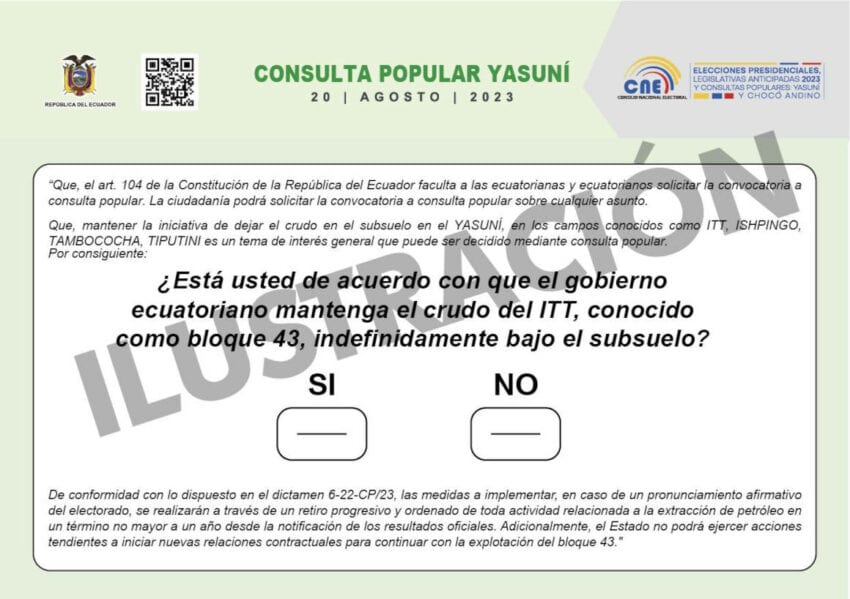
A sample ballot for the 20 August 2023 Yasuní vote: "Do you agree that the Ecuadorian government should keep the crude oil of the ITT, known as Block 43, indefinitely in the subsoil?" Public domain, via Wikimedia Commons.
On 20 August 2023, about 59 percent of Ecuadorian voters said yes.15 On the same day voters in Quito rejected new mining in the Chocó Andino, the forested hills north of the capital, by about 68 percent.15 The ballot's own fine print said the withdrawal from Block 43 would be gradual and done within one year of the official results. That puts the deadline in August 2024.16
The deadline passed. Ecuador was in a fiscal and energy crisis, and Block 43 was one of the state oil company's most productive fields. The government of President Daniel Noboa set out a plan that would close the wells by around 2029. According to Human Rights Watch, Block 43 was still producing over 44,000 barrels a day in 2025, about 9.4 percent of the country's crude.17 In May 2026 the Waorani leader Juan Bay told Mongabay that only 10 of the block's 247 wells had been shut.16 In a separate case, the Inter-American Court of Human Rights ruled in 2025 that Ecuador had violated the rights of the isolated Tagaeri and Taromenane and ordered measures to protect them, including halting oil operations in Block 43; reporting in March 2026 said the state was still not complying.17
Yasuní is where the rights of nature meet their limit. A court can cancel a permit and an official can sign a revocation. Shutting down a working oil field that funds the state is a political act, and so far no ruling, vote or constitutional article has made a government do it on schedule. The case also shows something the rights of nature cannot do alone: the vote that may yet close Block 43 was a direct exercise of democracy, not a lawsuit by the forest. Supporters see the two as working together. The constitution made it thinkable to treat the forest's interest as a public question, and voters answered it.
In November 2025 President Noboa asked voters to call a new constituent assembly to rewrite the 2008 constitution. Environmental and Indigenous groups campaigned against it, warning that the rights of nature could be lost. On 16 November about 61 percent voted no, along with no on the other three questions.18 The ballot did not ask about the rights of nature directly, so the vote is not a direct verdict on them, but the 2008 text, and its four articles, stands.
Beyond Ecuador
Part 4 of 7
Bolivia followed with a Law of the Rights of Mother Earth in 2010, and that year hosted a World People's Conference on Climate Change and the Rights of Mother Earth in Cochabamba, which issued a Universal Declaration of the Rights of Mother Earth.19 New Zealand took a different route, rooted in Māori law rather than a constitution. The Te Urewera Act of 2014 made a former national park a legal entity, and the Te Awa Tupua Act of 2017 made the Whanganui River a legal person, with two guardians, one named by the Crown and one by the river's iwi (tribes), as its human face.1920 The Māori saying behind it is Ko au te awa, ko te awa ko au: "I am the river, and the river is me."
In Colombia, the Constitutional Court in 2016 recognized the Atrato River, poisoned with mercury from illegal gold mining, as a subject of rights with guardians of its own; implementation has lagged.19 In Spain, a citizens' petition with over 600,000 signatures led to a 2022 law giving legal personhood to the Mar Menor, a salt lagoon choked by farm runoff, and in November 2024 Spain's Constitutional Court upheld the law against a challenge from the Vox party.21 It is the first such law in the European Union.
Not every attempt survives. In 2019 voters in Toledo, Ohio, passed a Lake Erie Bill of Rights after algae blooms fed by farm runoff poisoned the city's water. A federal judge struck it down in February 2020 as "unconstitutionally vague" and beyond a city's power, saying it did not define what harmed the lake.22 The ruling points at a real weakness. "Integral respect for its existence" is a stirring phrase, and a court still has to decide what it means for a particular farm, mine or sewer.
Pacha Mama and Gaia
Part 5 of 7
The rights of nature and the Gaia hypothesis grew up separately but answer each other. Gaia is a scientific claim: life, air, water and rock form one self-regulating system. Pacha Mama is a living tradition in which the Earth is a mother and a person. The constitution's phrase "where life is reproduced and occurs" could serve as a summary of either.
The French philosopher Bruno Latour made the link explicit. In his lectures Facing Gaia and in a 2018 paper with the Earth system scientist Timothy Lenton, "Gaia 2.0," he argued that humans now act at the scale of the whole Earth system, and must start regulating that system on purpose rather than by accident.23 The rights of nature are one tool for that. A Gaian reading also sharpens an old critique. If the Earth is one system, rights for one river or one forest are a patchwork, and the harms that matter most, such as a changing climate, cross every border a court can see.
Where it could go
Part 6 of 7
In July 2025 the Inter-American Court of Human Rights published Advisory Opinion OC-32/25 on the climate emergency, asked for by Chile and Colombia. At over 200 pages it is the court's longest, and for the first time it recognized nature and its parts as holders of rights. It also said that states have a duty not to cause irreversible damage to the climate and the environment.24 Advisory opinions guide the courts of every country that accepts the Inter-American system, so the idea that started in four articles in Montecristi now has a regional footing.
At the global level, the parallel push is to make large-scale environmental destruction, "ecocide," an international crime. In September 2024 Vanuatu, Fiji and Samoa formally proposed adding it to the Rome Statute of the International Criminal Court. Amendments need a two-thirds vote of member states and then ratification, so it is far from done.25 Ecocide and the rights of nature come at the problem from opposite ends: one punishes the people who destroy, the other gives the destroyed a voice.
Several ideas follow from what the first two decades showed. They are open questions, not settled trends.
- Guardians, not slogans. The rights that hold up best come with someone named to speak for the place, as on the Whanganui. The Lake Erie law failed partly because no one could say what the lake's rights required. A future model gives every rights-bearing ecosystem guardians, including scientists and the people who live with it, and a budget.
- Measurable rights. Courts need a test. Rights written as concrete conditions, such as a river's minimum flow, a lagoon's oxygen levels or a forest's connected area, can be monitored and enforced. Satellites and sensors now make that cheap enough to do for a whole country.
- Bigger wholes. Most rights so far belong to one river or forest. The Gaian question is whether the atmosphere, the ocean or the climate itself can be a rights holder. The Inter-American opinion, which ties rights to a stable climate, is a step in that direction.
- Votes as well as courts. Yasuní and the Chocó Andino show that people will vote for a place when asked. Rights of nature work best where a public that cares can make a government follow through.
- Rights that bind the state. Ecuador's hardest case is its own oil company. A right that the state can suspend in the "national interest," as Article 407 allows, is weaker than it looks. The next generation of these laws will be tested by whether they hold against the governments that wrote them.
Where it stands
Part 7 of 7
Eighteen years after Montecristi, the rights of nature are real law in Ecuador. They have canceled mining permits, protected rivers and a monkey, and survived an attempt to rewrite the constitution. They have also shown their limits: a vote to shut an oil field still waits to be carried out. Elsewhere the idea has spread from Pennsylvania to New Zealand to Spain, and now to an international court. Whether the Earth, treated as Gaia or as Pacha Mama, can be a party in its own defense is no longer a thought experiment. It is a question courts and voters are answering case by case.
Footnotes
- Constitution of the Republic of Ecuador, 2008, Articles 71-74, English translation at the Political Database of the Americas, Georgetown University (read in part). pdba.georgetown.edu ↩
- Christopher D. Stone, "Should Trees Have Standing? Toward Legal Rights for Natural Objects," Southern California Law Review 45, 1972, 450; Sierra Club v. Morton, 405 U.S. 727 (1972), Douglas dissenting (via secondary summaries; neither read in full). ebsco.com ↩
- Tamaqua Borough, Ordinance No. 612, adopted 19 September 2006, via the Eco Jurisprudence Monitor. ecojurisprudence.org ↩
- Wikipedia, "Rights of nature in Ecuador" (secondary source for Acosta's role and CELDF's invitation). en.wikipedia.org ↩
- "Ecuador: Nature has rights," Green Left, 2008 (Linzey quoted before the final vote). greenleft.org.au ↩
- María Valeria Berros, "The Constitution of the Republic of Ecuador: Pachamama Has Rights," Arcadia 11, Rachel Carson Center for Environment and Society, 2015. environmentandsociety.org ↩
- Natalia Greene, "The first successful case of the Rights of Nature implementation in Ecuador," Global Alliance for the Rights of Nature; and Eco Jurisprudence Monitor, Huddle v. Provincial Government of Loja (later Constitutional Court judgment 012-18-SIS-CC). garn.org ↩
- Craig M. Kauffman and Pamela L. Martin, "Can Rights of Nature Make Development More Sustainable? Why Some Ecuadorian Lawsuits Succeed and Others Fail," World Development 92, 2017, 130-142 (abstract only); and the authors' 2023 count of 55 decisions, via search summaries. cllas.uoregon.edu ↩
- Constitutional Court of Ecuador, Judgment 1149-19-JP/21, Los Cedros Protected Forest, 10 November 2021, summary at ELAW. elaw.org ↩
- "Ecuador's High Court Affirms Constitutional Protections for the Rights of Nature in a Landmark Decision," Inside Climate News, December 2021. insideclimatenews.org ↩
- Constitutional Court of Ecuador, Judgment 253-20-JH/22 (Estrellita), 27 January 2022, English translation hosted by the Harvard Animal Law & Policy Program (summaries read). animal.law.harvard.edu ↩
- "Ecuador court rules that river in capital has rights," JURIST, July 2024. jurist.org ↩
- "Ecuador president pulls plug on innovative Yasuní-ITT Initiative," Amazon Watch, 17 August 2013. amazonwatch.org ↩
- "Ecuador forced to drill for oil in pristine Amazon rainforest: rich countries have failed us," MercoPress, 16 August 2013. en.mercopress.com ↩
- "Ecuadorians reject Amazon oil drilling in historic referendum," Climate Home News, 21 August 2023. climatechangenews.com ↩
- "Ecuador failing to end Yasuní oil drilling: Interview with Waorani leader Juan Bay," Mongabay, May 2026. news.mongabay.com ↩
- Human Rights Watch, "Ecuador: Government Defies Court-Ordered Oil Ban," 16 March 2026. hrw.org ↩
- International IDEA, Democracy Tracker, "Ecuador, November 2025"; and ConstitutionNet, "The People's Verdict: Why did Ecuador's Constitutional Referendum Fail?" idea.int ↩
- Wikipedia, "Rights of nature law" (secondary source for Bolivia's Law 071, Te Urewera and the Atrato ruling T-622/16). en.wikipedia.org ↩
- Eco Jurisprudence Monitor, "Te Awa Tupua (Whanganui River Claims Settlement) Act 2017." ecojurisprudence.org ↩
- Earth Law Center, "In a European First, Landmark Verdict Upholds Constitutionality of Mar Menor's Legal Rights," January 2025, on Spanish Constitutional Court Judgment 142/2024. earthlawcenter.org ↩
- Animal Legal Defense Fund, "Federal Judge Strikes Down 'Lake Erie Bill of Rights'," on Drewes Farms Partnership v. City of Toledo, N.D. Ohio, 27 February 2020. aldf.org ↩
- Timothy M. Lenton and Bruno Latour, "Gaia 2.0," Science 361(6407), 14 September 2018, 1066-1068, doi 10.1126/science.aau0427. gsd.harvard.edu ↩
- Inter-American Court of Human Rights, Advisory Opinion OC-32/25, "Climate Emergency and Human Rights," adopted 29 May 2025, published 3 July 2025; summary at Columbia's Sabin Center blog. blogs.law.columbia.edu ↩
- "Vanuatu, Fiji and Samoa say ecocide should be an international crime," RNZ, 10 September 2024. rnz.co.nz ↩